OneZeroMiner 1.8.5 tests lower memory clocks on CMP and RTX cards
Source report: 2026-11-04 · Editorial analysis published: 2026-11-05
The November 4 update targets core-heavy mining on existing NVIDIA cards. Experimental Linux support has specific driver limits, and the claimed efficiency gain is not a matching cut in watts.
Existing mining cards get another memory-control option
OneZeroMiner 1.8.5 was published on November 4 at 21:49 UTC. Its main change is experimental control of memory clocks on NVIDIA CMP mining cards and several RTX generations. The idea is useful for workloads that rely more on the computing core than on memory speed: an unnecessarily high memory setting can consume power without providing an equivalent gain in useful work.
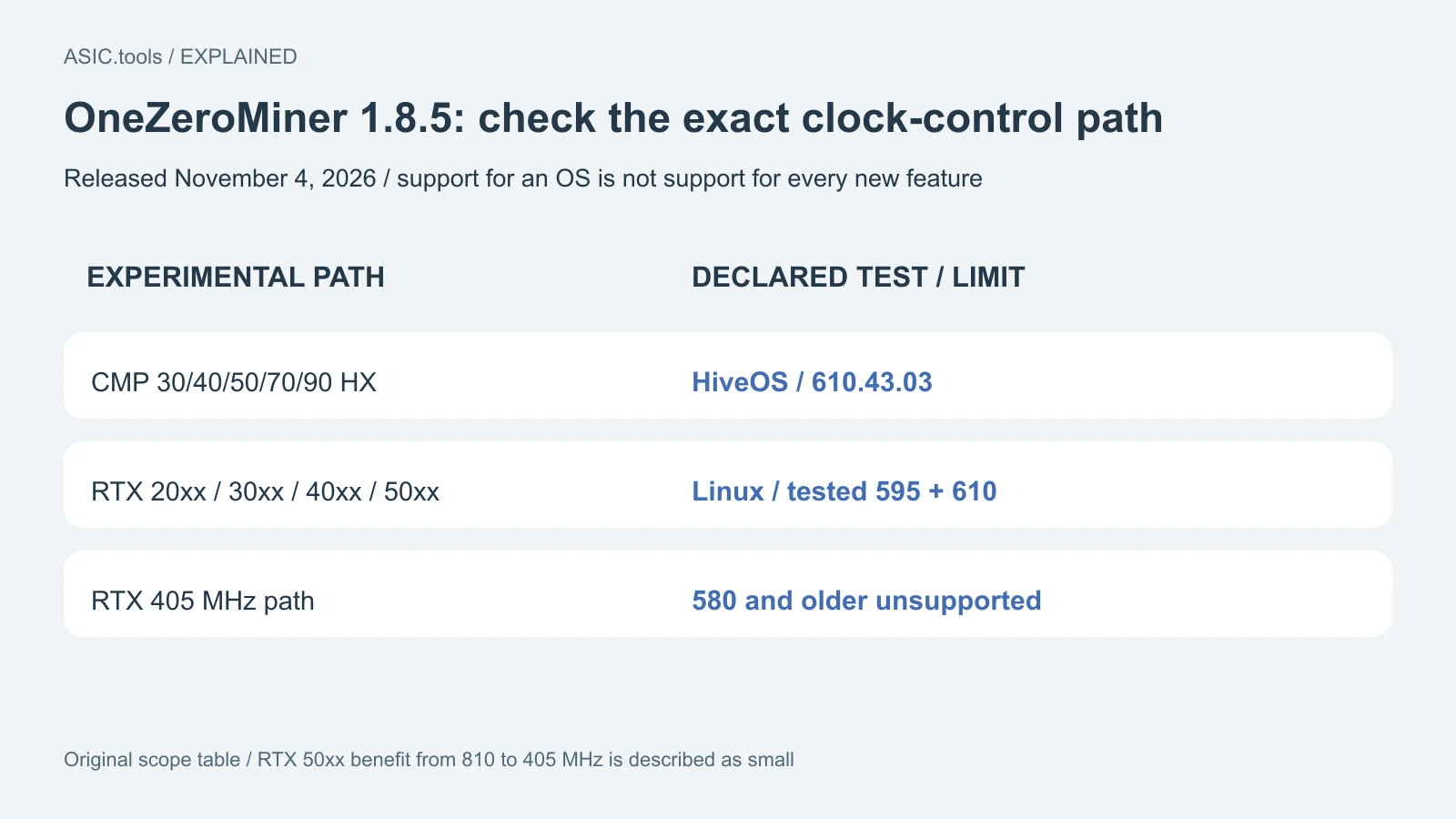
For CMP 30/40/50/70/90 HX, the release lists Linux memory locks at 5000, 810 and 405 MHz through the miner’s built-in mclk option. The author claims a 20–50% efficiency improvement on core-oriented algorithms, but marks the feature experimental and says this CMP path was tested only on HiveOS with driver 610.43.03. That is a reported test scope, not a result established for every operating system or driver.
The separate RTX feature aims to hold memory at 405 MHz while keeping core clocks in their normal range on 20xx, 30xx, 40xx and 50xx cards. The release says it is Linux-only, tested with drivers 595 and 610, and does not support 580 or older for this new feature. The operating system being supported by the miner overall does not make every new clock-control path available there.
Not every card benefits in the same way
The author describes the power reduction from 810 to 405 MHz on RTX cards as small and says it appears to help the 50xx generation little. Other listed generations are expected to see a more noticeable efficiency effect on core-heavy algorithms. Those distinctions matter when choosing what to test: a setting added for several generations is not evidence that each one receives the same benefit.
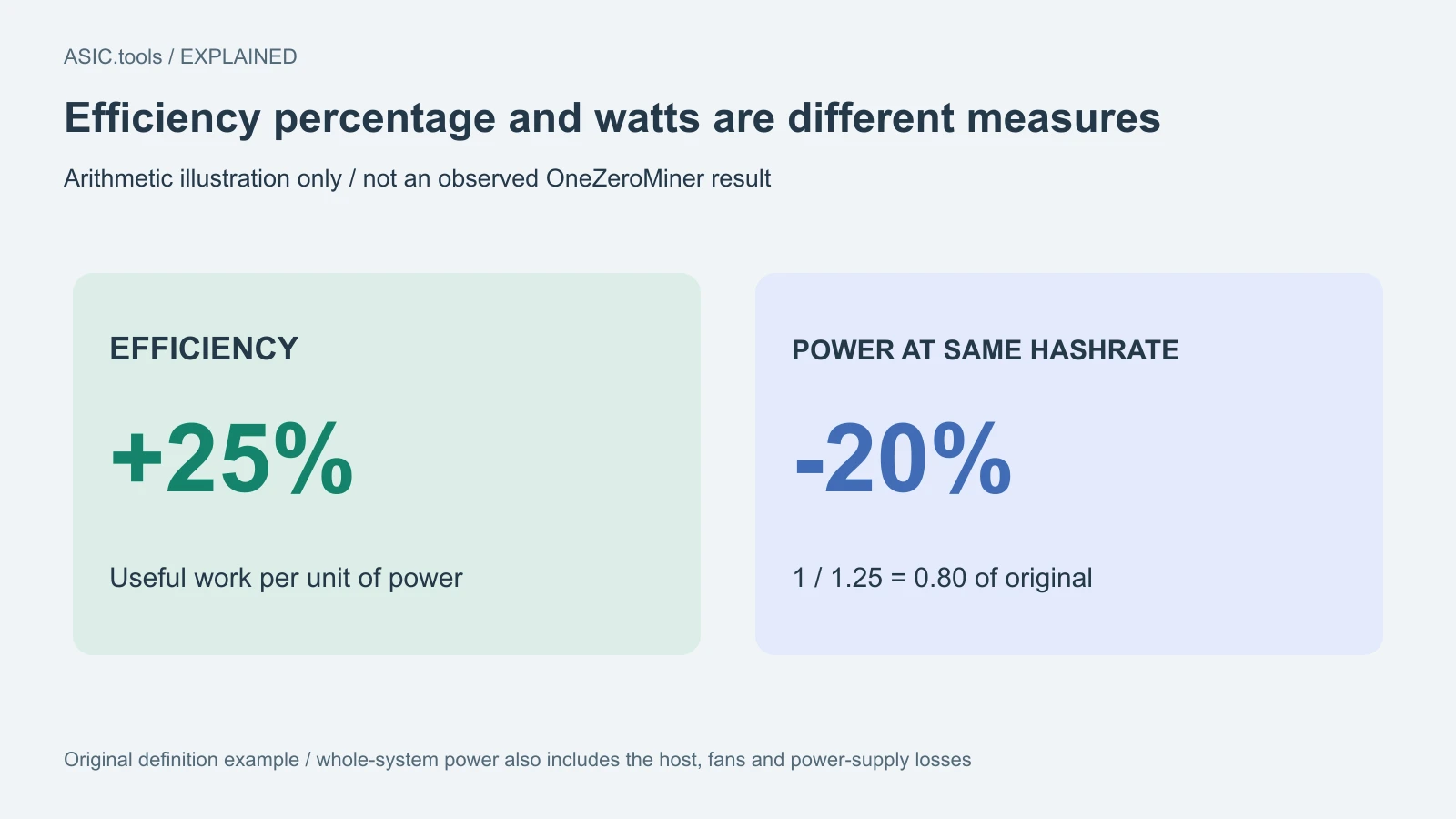
Efficiency means useful computation per unit of power, so its percentage is not identical to a percentage reduction in electricity consumption. As an arithmetic illustration, if hashrate stayed constant and efficiency rose 25%, power would become 1/1.25 of the original, or 20% lower. This is a definition-based example, not a OneZeroMiner measurement or a forecast for a particular card. This conversion assumes unchanged hashrate. If useful output also changes, compare the new output and power together, using the same GPU-sensor or whole-system power basis in both records.
For a home rig, the wall meter also includes the processor, motherboard, fans and power-supply losses. A reduction reported for one GPU therefore need not produce the same percentage change for the whole computer. Compare the same hardware, workload and driver over a meaningful interval, while checking accepted pool work as well as the displayed speed. Lower watts with a larger loss of useful output can be a worse result.
Pearl changes include a telemetry choice
The Pearlhash changes report better performance on V100 and CMP100-210, plus smaller improvements on 20xx, 30xx and 40xx cards. These performance notes are separate from the list of CMP models receiving the experimental memory lock. Similar names should not be used to assume that every feature in the release applies to every card mentioned anywhere in it.
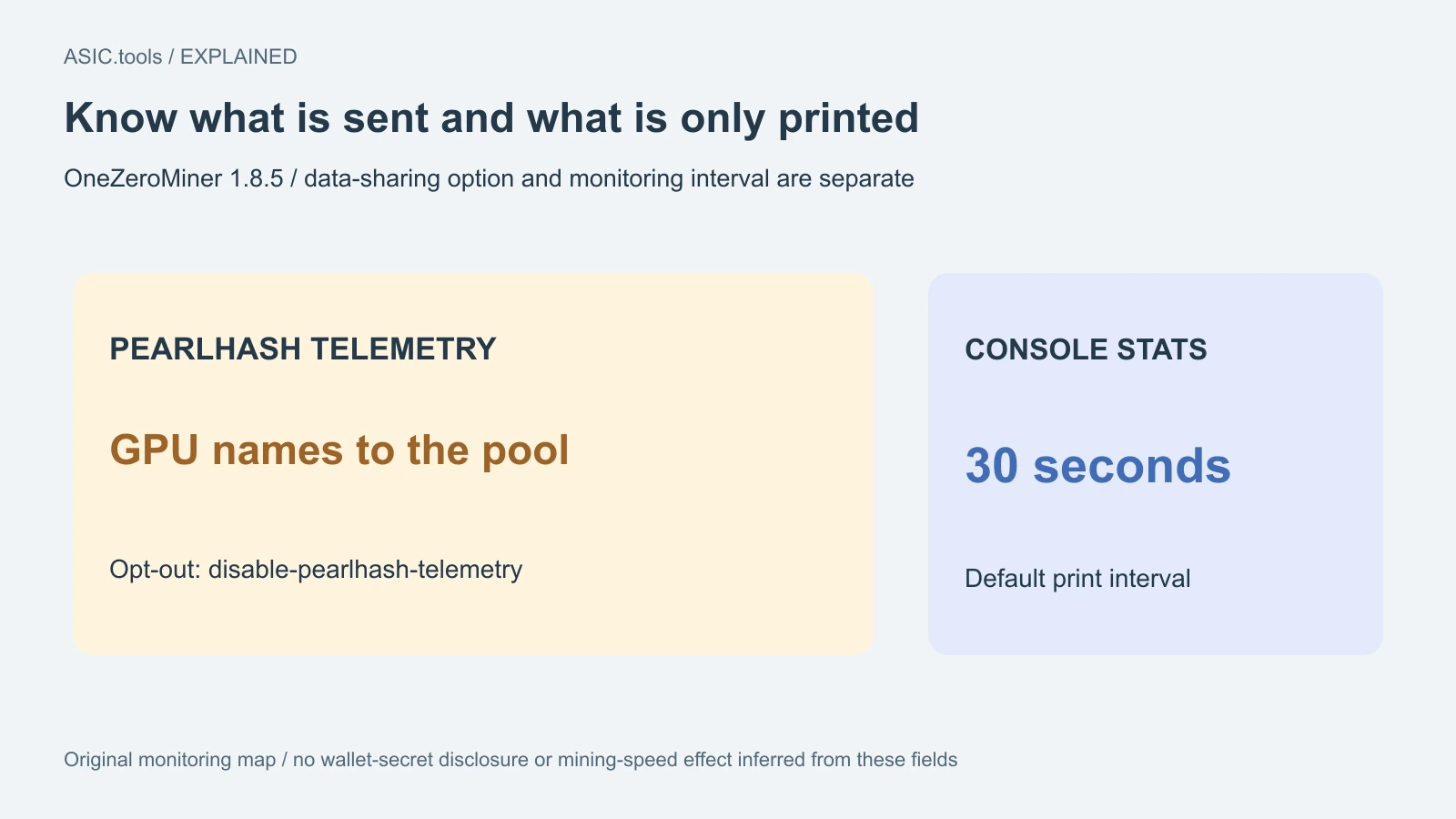
Pearlhash also gains telemetry that can send the names of active GPUs to the pool during authorization. The release provides disable-pearlhash-telemetry as the opt-out option. This is a concrete data-sharing setting worth checking when updating a long-running worker. The stated payload is GPU names; the note does not establish that wallet secrets or unrelated personal data are sent.
Console statistics now add core offset, memory offset, GPU voltage and GPU memory temperature. The new stats-interval option controls how often those statistics appear, with a 30-second default. More frequent output can make a test easier to follow, but changing the printing interval does not itself improve mining speed or change the pool’s accounting interval.
Separate a supported setting from a proven improvement
The release additionally lists native memory-clock locking for 20xx cards on Linux and Windows. This general addition should be read separately from the experimental Linux-only 405 MHz path. Before applying a profile, match the exact feature, card generation and driver, rather than treating the word Windows elsewhere on the page as approval of all the Linux examples.
A practical update comparison keeps the prior configuration and records the new setting, rejected or accepted control requests, temperatures, whole-system power and pool results. If the driver does not hold the requested clock, a successful-looking launch is not enough evidence that the intended condition was achieved. This is especially relevant to cards bought for a second life, where firmware, cooling and board condition can vary.
Official packages and their published SHA-256 values are available on the project’s release page. This report checked the announcement and command reference without running the binaries or changing a rig. Version 1.8.5 offers more control and clearer monitoring for existing hardware; the experiment is to establish what that hardware actually does, not to assume the headline efficiency range applies to its electricity bill.
Source: OneZeroMiner ↗ · Official repository and command reference ↗
Mining calculator ↗