NIP Group plans to buy 4.47 EH/s of running Bitcoin miners: what changes?
Source report: 2026-10-20 · Editorial analysis published: 2026-10-21
An October 20 disclosure describes a share-funded purchase of already operating equipment. The group’s capacity target and monthly Bitcoin forecast need to be read separately from actual production.
From esports to machines already mining Bitcoin
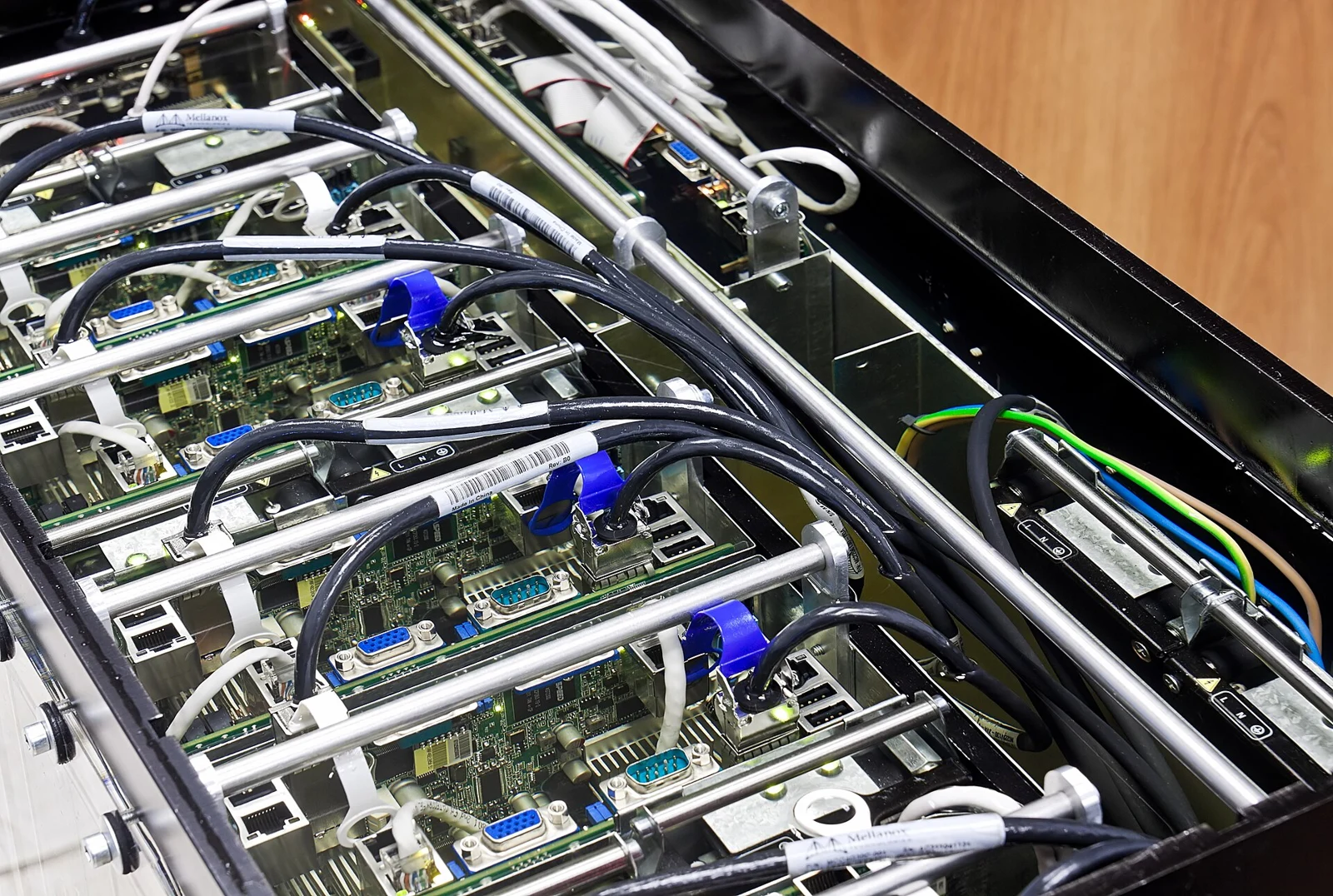
NIP Group, a company with roots in gaming and esports, disclosed another Bitcoin-mining acquisition on October 20. The proposed purchase covers equipment with about 4.47 EH/s of computing capacity that is already installed and operating at hosting facilities. The news is about who will own and receive production from working machines, rather than a newly announced consumer miner that readers can order for a home setup.
The issuer’s release, filed with the US Securities and Exchange Commission, identifies an agreement dated September 24. October 20 is the disclosure date, not the date the parties signed it. Completion is still subject to conditions. This matters because the headline capacity would enter NIP Group’s operations upon closing; an announcement alone does not establish that the transfer has happened or that a full month of output has already reached its accounts.
What 4.47 EH/s actually measures
Hashrate describes how much computing work mining equipment can attempt each second. EH/s means exahashes per second, an extremely large unit used to describe industrial Bitcoin fleets. It is a measure of computing capacity, not coins earned, electricity efficiency or a cash return. Two fleets with the same hashrate can have different bills and downtime, so the big number cannot by itself tell a reader which business is more profitable.
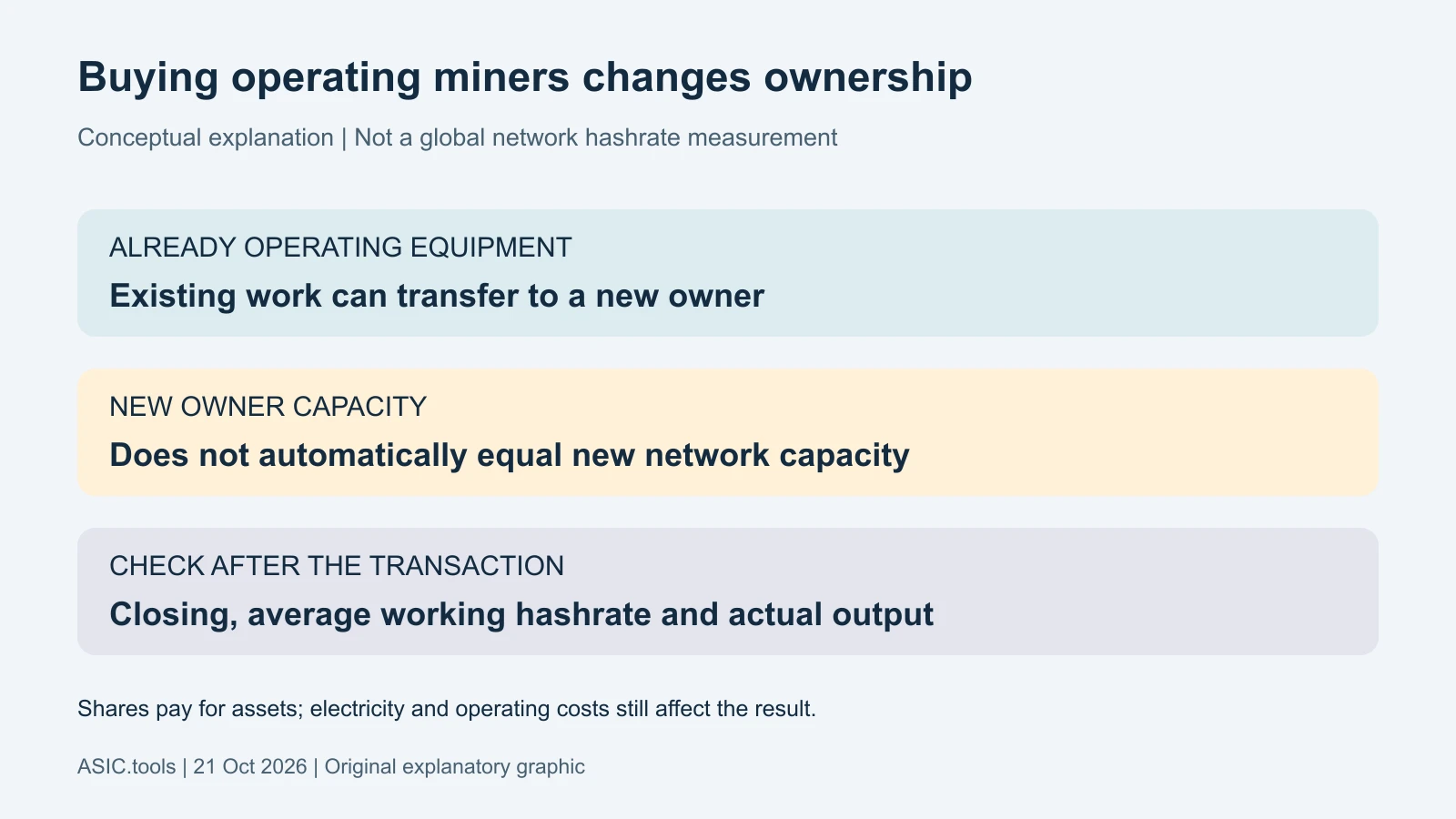
Bitcoin miners compete for rewards by contributing work to the same network. A useful everyday comparison is a fleet of delivery vehicles: buying vehicles that are already on the road changes their owner without necessarily adding vehicles to the road. Here, the company specifically describes operating, hosted hardware. It would therefore be misleading to treat the entire acquisition automatically as 4.47 EH/s newly added to Bitcoin’s worldwide hashrate. Ownership and network expansion are different events.

The larger total includes this purchase
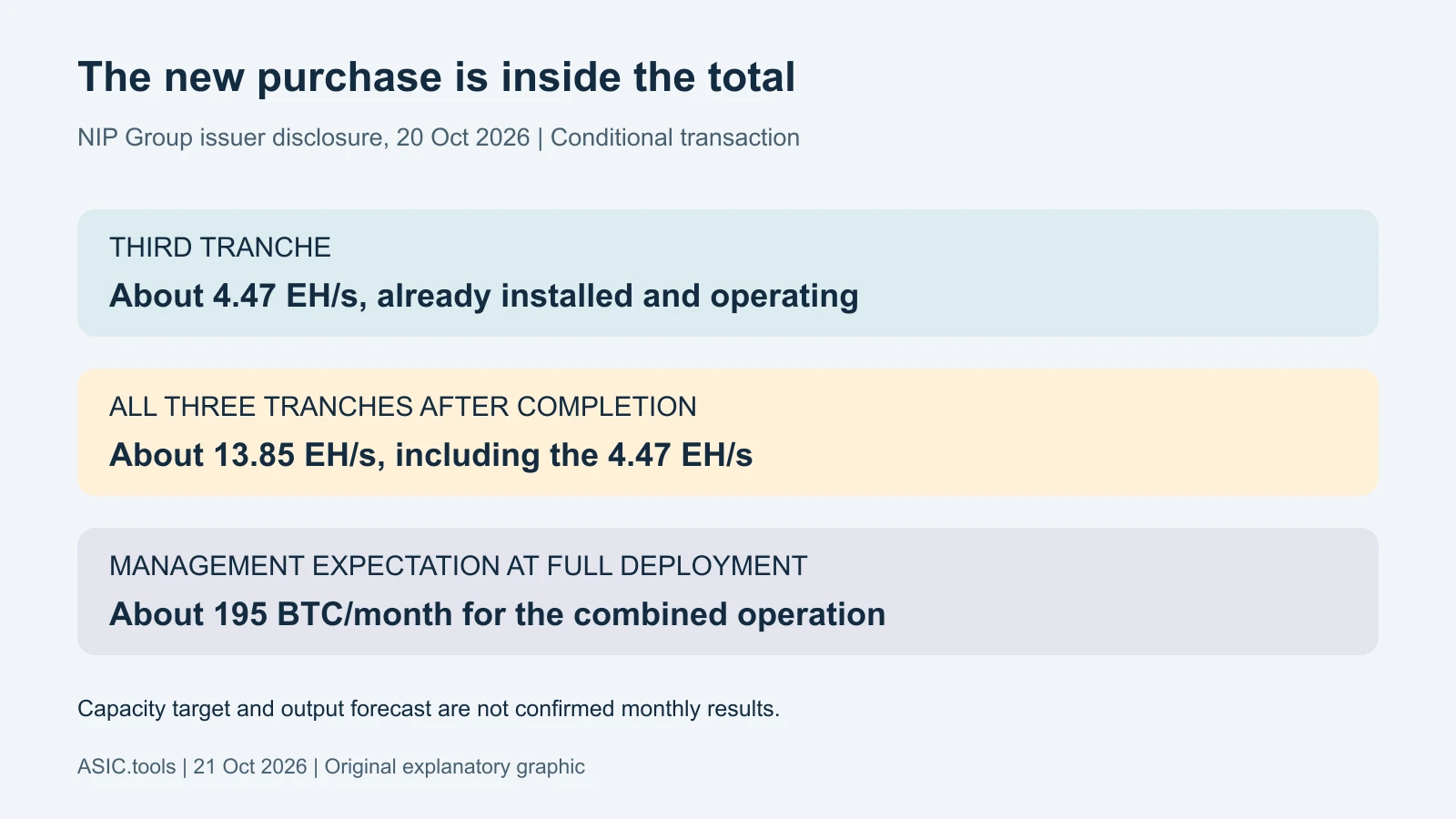
NIP Group says completing the third tranche would bring capacity across all three tranches to about 13.85 EH/s. A tranche is simply one part of a larger series of transactions. The 4.47 EH/s in this disclosure sits inside that expected total; adding it again to 13.85 would count the same machines twice. The release does not turn the combined target into an independently measured current average for a completed reporting month.
The company also forecasts roughly 195 BTC a month at full deployment, subject to network competition, Bitcoin difficulty and operating factors. That is a management expectation for the combined operation, not the third purchase alone and not a result already achieved. Difficulty is Bitcoin’s mechanism for adjusting how hard it is to find a valid block. Changes to it can alter the coins a given fleet earns even when the machines themselves have not become slower.
Paid in shares, with conditions still to satisfy
The agreed consideration is up to 247,091,740 Class A ordinary shares. Consideration means what the buyer provides in exchange for the assets. Shares are ownership interests in the company, not a disclosed cash payment of that same number of dollars. Issuing them also affects the ownership structure. Without the relevant share-count and valuation information, turning this figure into a precise dilution percentage or a cash purchase price would create a misleading shortcut.
The announcement expects closing within ten business days after the closing conditions have been satisfied. That is not an unconditional ten-day countdown from October 20. The company explicitly says completion is not assured. Readers following the transaction should look for confirmation of closing and subsequent operating reports, rather than treating the intended timetable as a completed handover. Installed hardware, a signed contract and a finished acquisition are separate milestones.
Why a production forecast is not profit
Even if a fleet produces the forecast number of coins, those coins are its output before the costs of running the business. Electricity, hosting and maintenance can consume a substantial part of mining revenue. Hosting means equipment is operated at somebody else’s facility under an arrangement that can include power, cooling and technical service. The economic result depends on the actual terms, not merely on the fact that machines are already on racks.
The release does not provide a device-by-device model list, power consumption or an electricity price from which a reader could reproduce an accurate profit calculation. We therefore do not convert the 195 BTC expectation into a profit figure or copy it into the calculator as a hardware specification. A company’s projected fleet output is not a benchmark for an individual ASIC. Nor does a large acquisition prove that a smaller miner should buy the same class of equipment at any price.
The useful signal for an ordinary miner
The deal illustrates another route to building a mining business: buying already operating capacity instead of waiting for delivery and installation of a new fleet. That may shorten integration, as the company expects, but does not remove electricity costs, network competition or the need to verify output. For a home miner comparing the news with their own setup, measured hashrate, actual power draw and the price paid for electricity remain more informative than the purchaser’s size.
For readers tracking competition, the next useful evidence is whether the transaction closes, how much capacity operates on average and how much Bitcoin the group actually produces. For investors, share issuance and the operating costs deserve attention alongside the growth headline. This disclosure provides a conditional expansion plan with an identified payment method. It does not yet provide the final production result, a guaranteed monthly income or new technical specifications for a miner in the catalogue.
A monthly report is useful precisely because it can show how much equipment actually worked through the period. Capacity acquired partway through a month is not equivalent to that capacity operating for the whole month. Comparing the same reporting period and measurement makes the next results more meaningful than simply multiplying a headline target by a coin price.
Source: NIP Group / SEC ↗
Mining calculator ↗