NerdQAxe 1.1.1 updates TLS trust and adds Ethernet to compatible home miners
Source report: 2026-10-31 · Editorial analysis published: 2026-11-05
The October 31 release replaces the system certificate bundle and fixes pool reconnection and Stratum V2 behaviour. Ethernet support depends on the board and fitted accessories.
A small miner needs to trust the right server
NerdQAxe firmware 1.1.1, released on October 31 and still the latest regular release when checked on November 5, brings a security-related change for home ASIC owners using encrypted pool connections. The project replaced the system certificate bundle following the eMudhra compromise described in its release notes. The update also adds wired networking for selected boards and fixes several connection problems.
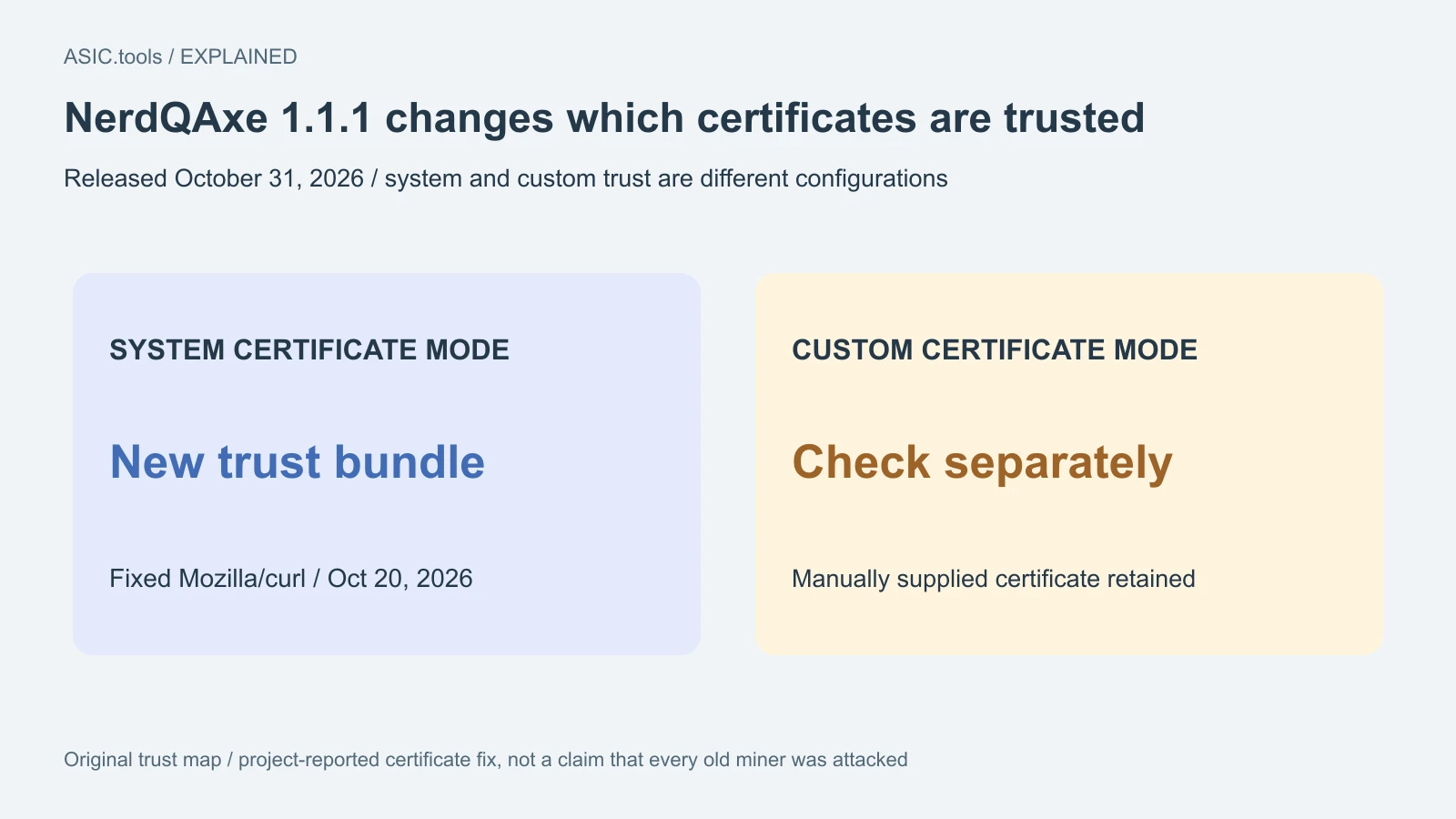
TLS is the protection used to check the server’s identity and encrypt a connection. A certificate store is the list of authorities the device trusts for that check. The project now supplies its own fixed Mozilla/curl bundle dated October 20, 2026, instead of relying on the built-in ESP-IDF lists. This concerns which certificates the firmware accepts; it is not a change to Bitcoin’s mining algorithm.
The contributor’s report for the merged change describes tests on two NerdQAxe++ units and one NerdQX. All three reportedly accepted twelve affected certificate chains before the fix and rejected them afterward, while valid TLS connections continued working. These are the contributor’s reported tests, not independent measurements for this article. They give a concrete reason to examine the update without claiming that every miner had already been attacked.
System trust and a custom certificate are different settings
The new store is used for Stratum TLS with the System certificate setting, the GitHub updater, external API requests and Discord notifications. Stratum is the protocol carrying mining work between the device and a pool. Updating only the website interface is therefore not the issue: the release changes the trust data used by several outgoing services in the device firmware.
A manually supplied TLS certificate remains in use as before. The release explicitly asks owners to check that certificate themselves. Installing a new system bundle does not establish that a separate custom certificate is current or appropriate. When reviewing a worker, first identify which trust mode it uses, rather than assuming that one announcement covers every possible configuration.
The project also published 1.0.37.4-LTS on October 31 with the certificate fix for the long-term-support branch. That provides a separately named update path; it does not mean every new 1.1.1 feature is present in LTS. Match the board and release branch before choosing a file. The announcement does not call for changing a wallet address or turning certificate verification off to make a connection appear successful.
Wired networking has a compatibility list
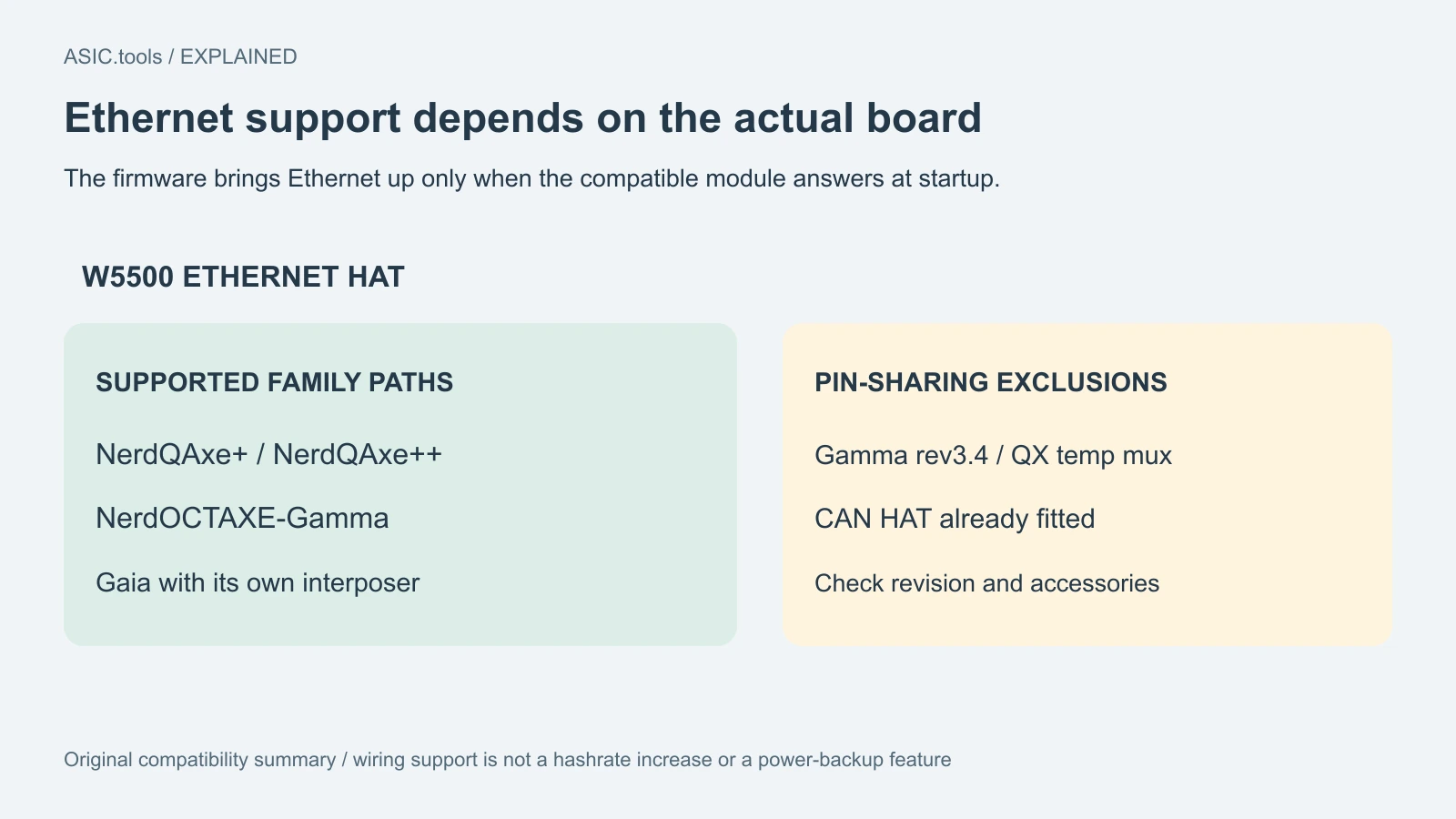
Version 1.1.1 adds W5500 Ethernet HAT support for NerdQAxe+, NerdQAxe++ and NerdOCTAXE-Gamma, and NerdAxeGaia through its own interposer. A HAT is an add-on board; the interposer is the adapter between parts. The firmware checks at startup whether the module answers and brings Ethernet up only when it does, so the same firmware can run with or without that accessory.
There are important pin-sharing exclusions: NerdOCTAXE-Gamma revision 3.4 and NerdQX boards with the temperature multiplexer cannot use this HAT, nor can boards already fitted with the CAN HAT. A firmware download does not create a spare electrical interface where the pins are occupied. Check the exact revision and accessories rather than ordering by the family name alone.
For a miner whose Wi-Fi connection is unreliable, a supported wired path can change how it reaches the pool. It does not increase the ASIC’s rated computing speed, guarantee that the internet provider stays online or supply power during a blackout. Judge the benefit by the actual connection and accepted work, keeping networking reliability separate from the chip’s hashrate.
Connection fixes matter alongside the visible additions
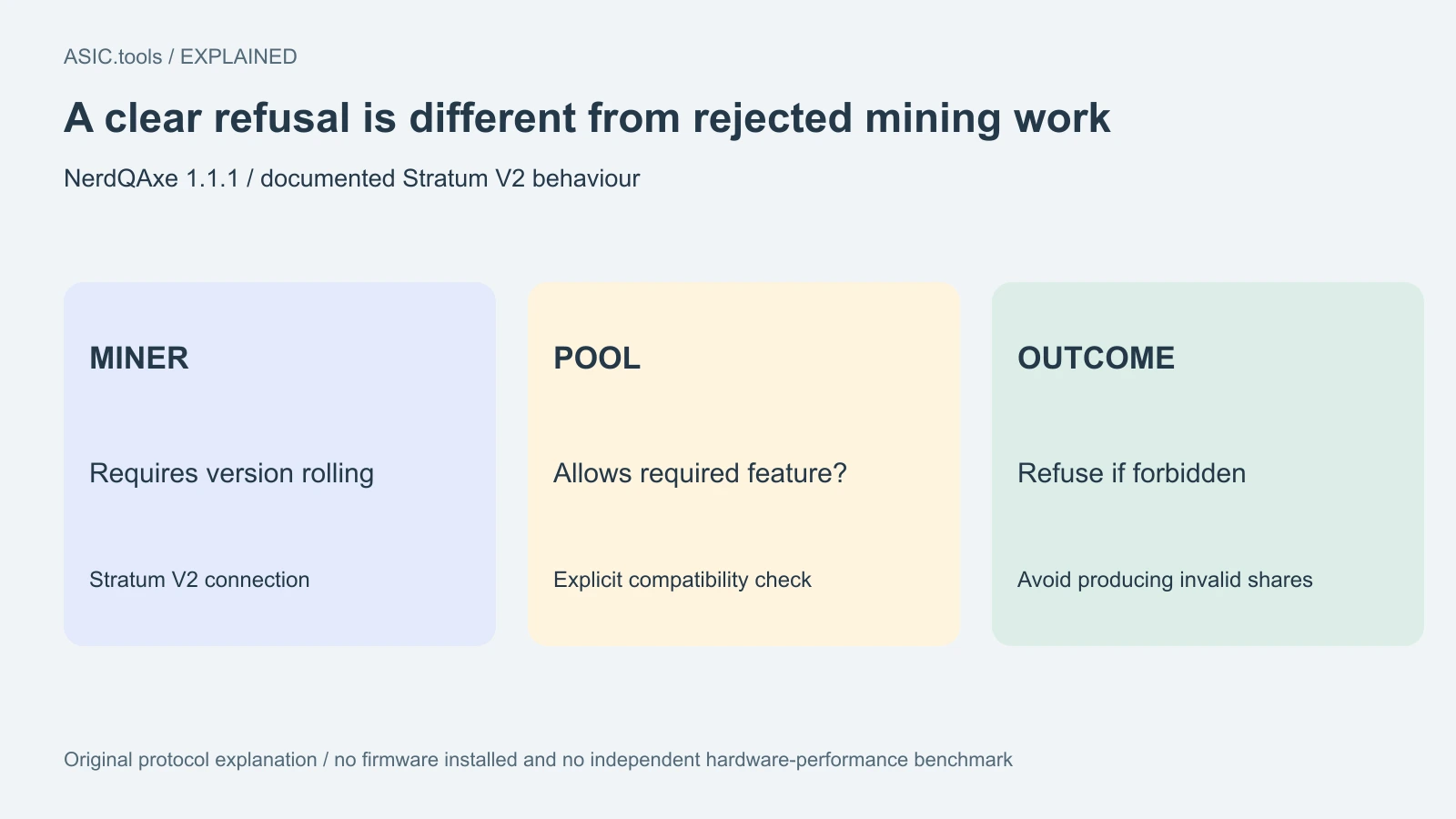
The release fixes a crash after reconnecting to a pool that sent an incomplete subscription response. For Stratum V2, the device now announces that it requires version rolling and refuses a pool that forbids it instead of producing invalid shares. Version rolling is a way of varying block-header work during mining. A refused connection and work that appears to run but is rejected are different operating states.
Other changes include dismissing the found-block screen again after the 1.1.0 display regression, per-chip hardware error rates through the v2 dashboard API and an optional reset of all-time statistics. The release also adds support for the BM1373-based NerdAxeGaia board. Firmware support alone does not establish a shipped product’s paired hashrate, wall power or price, so those specifications are not invented here.
The optional all-time-statistics reset deserves its own note in an update record. A counter after a deliberate reset no longer shares the same starting point as the earlier cumulative total. Clearing that local display history does not create extra accepted work or a new Bitcoin block; record the reset when comparing performance across the update.
The project distinguishes normal releases from diagnostic pre-releases that can capture crash core dumps; those diagnostic builds are not included in this regular release. This report checked the release records and merged change without installing firmware or running binaries. The useful result is clearer trust handling, more precise pool behaviour and an Ethernet option for documented hardware—not a blanket performance claim for every small Bitcoin miner.
Source: NerdQAxe firmware project ↗ · Certificate replacement and contributor test ↗ · Parallel long-term-support release ↗
Mining calculator ↗