LuxOS update adds S21++ support and a signed OTA index
Source report: 2026-09-21 · Editorial analysis published: 2026-09-23
Luxor's September 21 changelog adds new S21++ and S19 XP Hydro board support, Ed25519 verification for OTA indexes and fixes for nonce attribution, curtailment metrics and power targeting.
Analysis and practical implications
This section is our analysis and illustrative calculations, separate from the source report.
A dated firmware changelog
Luxor published a September 21 LuxOS changelog entry covering hardware support, update security, thermal defaults and several operational fixes. The entry is a vendor release note, not an independent performance test by ASIC.tools. It does not promise a particular hashrate, efficiency or revenue improvement for every installation. Operators should identify their miner model, control board, NAND device and hashboard revision before treating a support line as applicable. A model family name alone can hide incompatible boards, and a successful installer launch does not prove that a specific hardware combination has been validated.
New board and installer support
The update adds support for Antminer S21++ machines with A3HB70705 hashboards and S19 XP Hydro units using HHB56611 hashboards. Installer support is also listed for Bitmain AML miners with Winbond W29N01HV NAND and for one-gibibit NAND control boards used in S19 XP equipment. These are precise component identifiers. Before flashing, photograph the control board and hashboard labels, record the stock firmware version and compare the actual NAND marking. Selecting an image intended for a similarly named miner can leave a unit unbootable or unable to initialize its boards.
Thermal limits were aligned with stock
Luxor raised the S21+ default board thresholds to 75 C hot and 80 C panic, from 65 C and 70 C, while the S21++ defaults are listed as 72 C and 77 C. S19 XP Hydro chip limits were changed to 90 C hot and 95 C panic to match stock, and the S21+ Hydro topology was updated to match physical hashboard layout. Higher limits are not a recommendation to reduce coolant flow or ignore inlet conditions. Operators should validate sensors, flow, ambient temperature and shutdown behavior on one unit, because a corrected default can expose cooling weaknesses that an earlier conservative threshold masked.
OTA index signing changes the trust path
The over-the-air update index is now signed and verified with Ed25519. That helps a miner reject an altered index when locating update packages, provided the trusted verification key and implementation are themselves intact. The changelog also says incremental binary-difference updates were removed, so OTA now downloads a full package. Full packages can simplify verification and recovery but use more bandwidth and take longer to transfer. A fleet rollout should still verify the official source, package identity and maintenance window; cryptographic index validation does not protect against choosing firmware for the wrong board.
Nonce attribution and chip health
LuxOS fixed a fault in which duplicate or bad nonces could be attributed to chip 0 rather than the chip that reported them. That could make per-chip statistics and the chip health view flag chip 0 incorrectly. After updating, historical alarms should not be silently reinterpreted as proof that chip 0 was healthy or another chip was faulty; old records were produced by old attribution logic. Start a new observation window, compare board-level accepted hashrate with per-chip counters and preserve pre-update logs. A corrected diagnostic label improves troubleshooting, but pool rejects, cabling, voltage and temperature remain separate causes to investigate.
Document the vendor's recovery instructions before maintenance begins. If an update fails, isolate the affected unit, preserve logs and verify board identity again before reflashing. A fast rollback is safer than repeatedly forcing an image that may not match the installed control board.
Curtailment metrics retain useful temperatures
The metrics fix keeps valid temperature readings from a curtailed board when sensors continue reporting while hashboards are powered down. The notes mention Whatsminer board sensors, Antminer hydro water and board sensors, and other always-on sensors. This distinction matters to automated fleet systems: zero hashing does not necessarily mean sensor data should disappear, and remaining temperature data does not mean the ASIC chips are active. Dashboards should display operating state alongside temperature, power and pool shares. Alert rules written around missing metrics may need review so planned curtailment is not confused with telemetry failure.
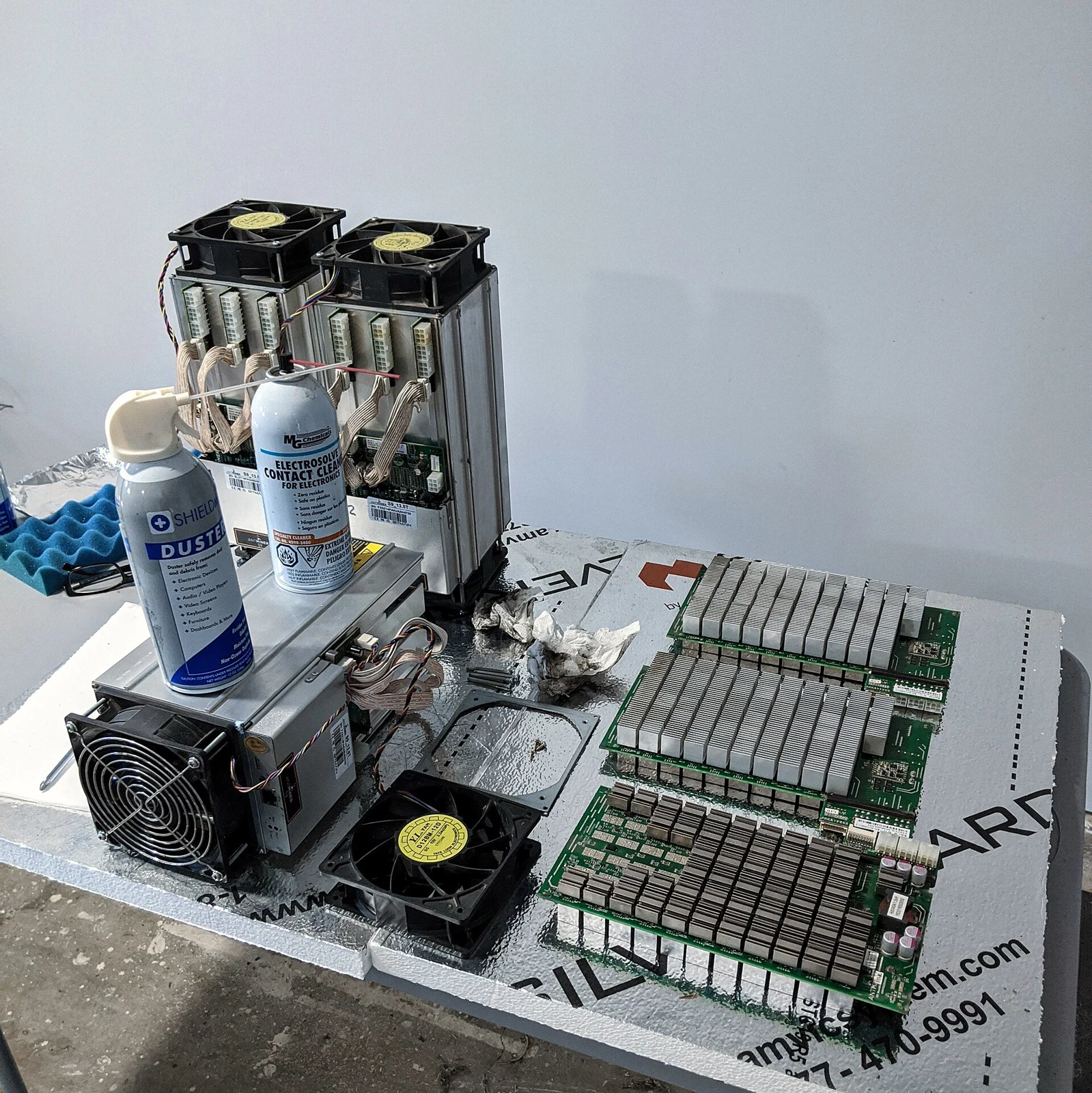
Do not compare two firmware builds only by dashboard hashrate. Use a fixed observation interval after thermal equilibrium and record pool accepted shares, rejected shares, wall-meter energy, temperatures, fan or pump power and any automated recovery. If tuning is adaptive, keep the same power target and let both builds complete their normal learning period. Note changes to sensor naming or API fields before concluding that a metric improved. When a rollback is required, restore both firmware and the saved configuration, then confirm that the miner actually resumed the intended pool. This method separates a real operating change from display rounding, warm-up effects or a different configuration.
Power-target and initialization fixes
Applying a profile no longer restarts tuning when the power target is unchanged. The power ramp fix prevents indefinite bouncing at the minimum frequency step, halves the step after a direction reversal and waits for fresh hashboard data before each step. Luxor also says Whatsminer hashboards now initialize correctly after power-off, corrupt update downloads are discarded, and kernel messages are logged during startup. These changes target control stability and diagnosis rather than guaranteed speed. Compare wall power, accepted shares, ramp duration and restart count before and after deployment using the same profile and thermal conditions.
The update also removes the NOPIC_SHUTDOWN event when no-PIC protection is disabled. Monitoring systems should update event mappings so the absence of that removed code is not treated as a logging failure. Review vendor notes and API behavior together before changing alarms.
A safe rollout checklist
Back up pool, network and performance settings; confirm exact hardware identifiers; and download only through the official Luxor route. Test a single noncritical miner with stable power and local recovery access. After reboot, confirm the running build, all hashboards, chip count, fan or pump behavior, temperatures, wall power and accepted shares. Observe at least one complete tuning cycle and one planned curtailment if the site uses demand response. Then expand in small batches while preserving logs. The September 21 notes document meaningful compatibility and integrity changes, but each farm remains responsible for verifying its own board combination and operating envelope.
For fleet records, store the exact changelog date, installer package, image checksum, board identifiers and time of installation. If a miner behaves differently, those details distinguish a firmware regression from a hardware variation. Keep a recovery path that does not depend on the same OTA service being diagnosed, and do not update every control board at once. A signed index improves authenticity checks, while staged deployment limits the operational impact of a compatible but unexpected change.
Source: Luxor Technologies ↗
Mining calculator ↗