Liquid restores a route from L-BTC to Bitcoin, while direct redemptions stay restricted
Source report: 2026-10-20 · Editorial analysis published: 2026-10-21
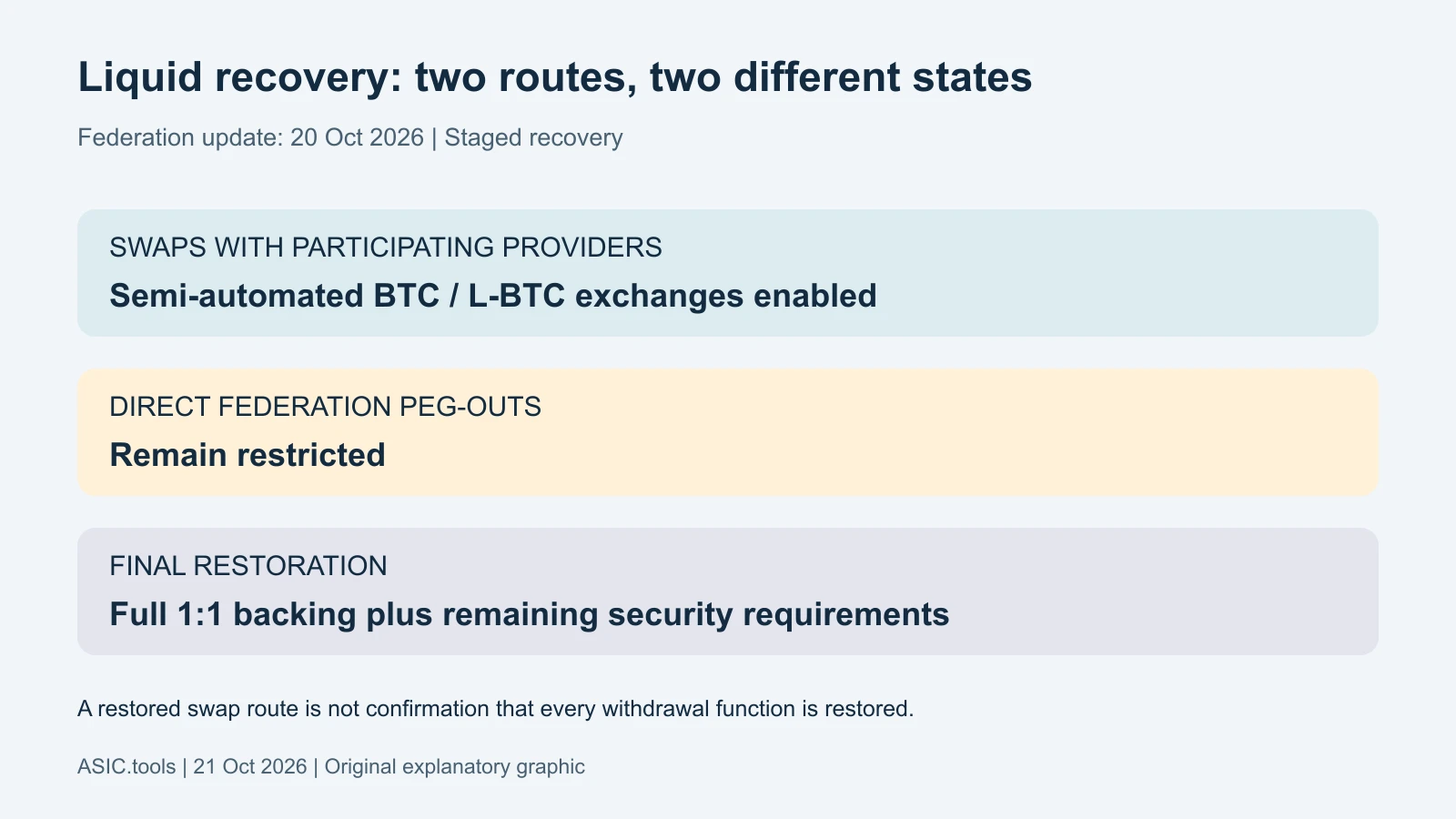
Liquid’s October 20 recovery update enables swaps through participating providers. This is a useful change for holders, but it is not confirmation that the federation’s direct withdrawal system is fully restored.
A way out returns, with an important distinction
Liquid users are getting a practical route to exchange L-BTC for Bitcoin again. In its October 20 update, the Liquid Federation says semi-automated swaps are being enabled with participating providers. For a holder waiting to move value back to Bitcoin, that is a meaningful recovery step after the September security incident. The same statement says direct withdrawals from the federation remain restricted, so the two routes must not be confused.
The new announcement concerns Liquid Network, a Bitcoin sidechain. It is a different product from NGRAVE’s LIQUID wallet application, which appeared in separate phishing news. Here the issue is the network’s reserve management and recovery process, not a request to restore an individual hardware wallet. Someone holding ordinary on-chain BTC should not read this announcement as evidence that their Bitcoin wallet or mining equipment has been compromised.
What L-BTC is, in everyday language
A sidechain is a separate blockchain connected to another network through a mechanism for moving value between them. L-BTC is the Bitcoin-linked asset used on Liquid, designed to have one Bitcoin in the federation’s reserve for each unit. It is not simply another spelling for an ordinary Bitcoin transaction. A wallet can support several networks while still treating their balances and receiving addresses differently.
Think of the distinction as different routes for holding and moving the same intended economic value, each with its own operating rules. A balance shown as L-BTC does not mean the coins are already at a Bitcoin main-chain address. To reach that address, a supported conversion route must actually work. That is why a service announcement about swaps matters to users, even though it does not change Bitcoin’s mining reward or the underlying task performed by a SHA-256 ASIC.
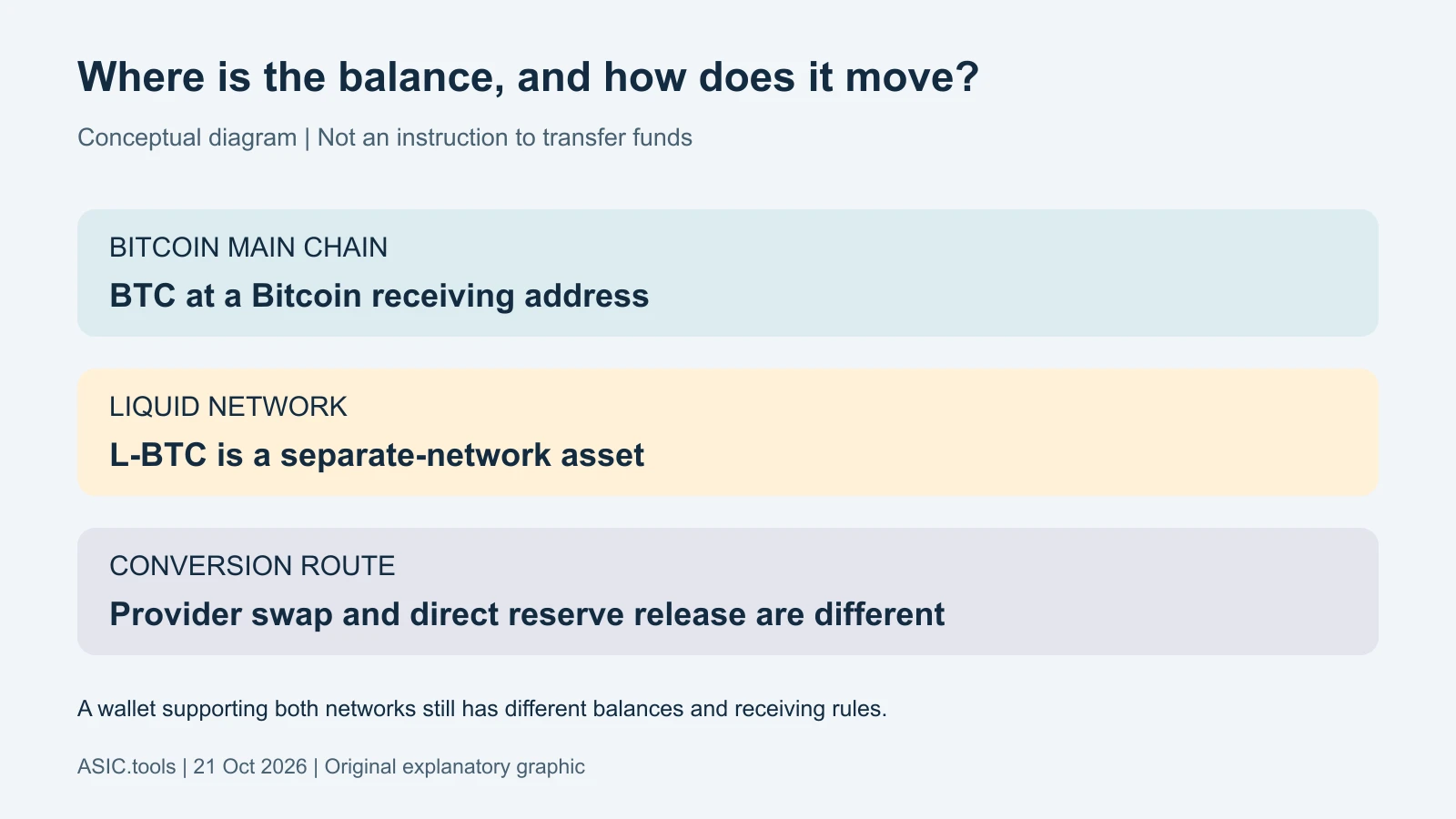
A swap and a federation peg-out are different routes
A swap exchanges assets through a participating service. A federation peg-out is the direct release of Bitcoin from the network’s reserve through its authorised process. Liquid says the new semi-automated swaps provide a practical conversion route while those direct federation operations remain restricted. Restoring one route does not automatically restore every wallet integration, provider or direct redemption function.
The announcement says there is no protocol-imposed volume limit on the swap service. That does not establish unlimited liquidity, zero fees or instant execution at every provider. A provider still has its own availability and transaction conditions. Readers should check the actual route, amount to receive and service terms in the provider’s official interface, rather than inferring the whole customer experience from the network-level phrase about volume limits.
What has been updated, and what remains ahead
According to the federation, updated software managing its Bitcoin reserves has been deployed and a sufficient number of functionary operators have updated for the next recovery stage. Functionaries are the federation operators involved in running the network’s specialised infrastructure. The statement also says safeguards remain in place to prevent premature or unauthorised direct peg-outs. These are the operator’s reported recovery milestones, rather than a claim that our publication independently audited the reserve system.
The stated final phase requires restoring full one-to-one Bitcoin backing and then reactivating federation peg-outs in a controlled way for authorised PAK key holders. A PAK key authorises participation in that peg-out process; it is not a new recovery phrase that ordinary holders must send to support. Remaining security and operational requirements still matter, and the update gives no firm date at which every normal withdrawal feature will return.
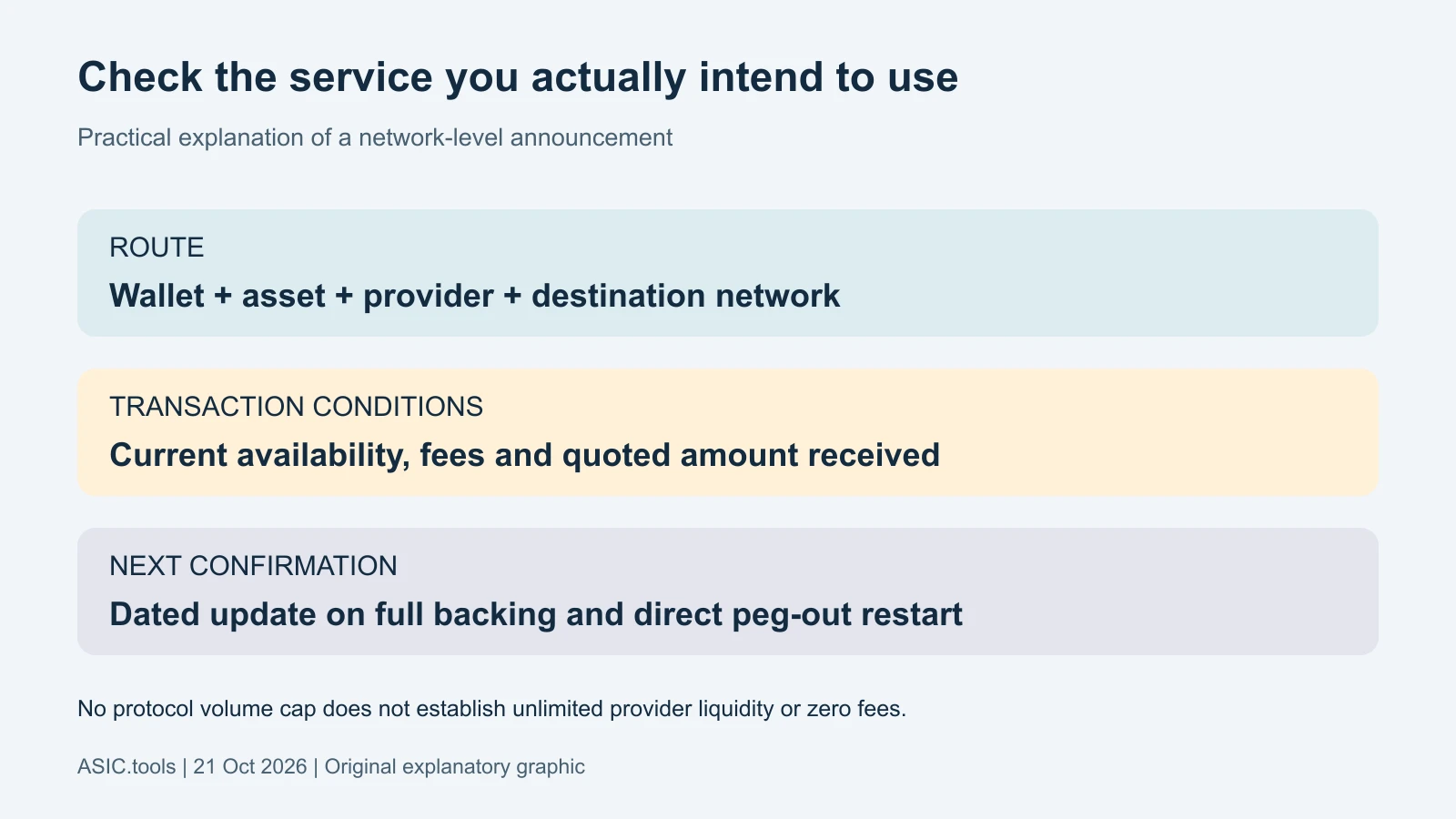
The practical check before moving a balance
For a user, the useful question is specific: can this wallet, with this asset and this provider, complete the intended conversion now? A working transfer inside Liquid is not the same test as a completed conversion into on-chain BTC. Check the network label and destination address, the supported conversion path, fees and quoted received amount before approving a transaction. The announcement itself does not supply a universal fee table or processing-time guarantee.
For anyone receiving mining income through a service that offers multiple payout networks, the same distinction applies. A Bitcoin main-chain payout, an L-BTC balance and a provider’s swap option are different delivery arrangements. Confirm which one your pool or wallet actually uses. This recovery news does not require reconfiguring an ASIC’s mining algorithm, nor does it demonstrate that all pools have reopened every Liquid-related payout route. Service availability should be verified where the payment is made.
What would count as the next confirmation
The next important evidence is a dated federation statement that the remaining reserve and security conditions are complete and direct peg-outs have been reactivated, plus provider-specific confirmation for the route a person needs. The October 20 update describes a staged recovery, not a final all-clear. A reserve explorer can support monitoring, but a page displaying balances and a statement about operational availability answer different questions.
The distinction helps avoid two opposite mistakes: assuming nothing works because one withdrawal mechanism is restricted, or assuming everything works because a swap has returned. The confirmed change is narrower and useful on its own: participating swap providers are restoring a route from L-BTC to BTC, while full direct federation redemption remains a later stage. Follow official dated updates and the provider’s actual conditions rather than a blanket claim that the whole network is either closed or completely restored.
Source: Liquid Federation ↗ · Liquid incident technical assessment ↗
Mining calculator ↗