LG and AIR sign chiller supply agreement for AI projects exceeding 5 GW
Source report: 2026-10-05 · Editorial analysis published: 2026-10-06
LG’s October 5 announcement covers a multiyear North American cooling program. The 5 GW figure describes supported data-centre projects; contract value, equipment quantities and delivery dates are not disclosed.
Analysis and practical implications
This section is our analysis and illustrative calculations, separate from the source report.
Cooling procurement becomes a multiyear relationship
LG Electronics USA announced a long-term supply agreement with AIR Control Concepts on October 5, 2026. LG will provide advanced chillers for AI data-centre projects in the United States and Canada with combined capacity exceeding 5 GW. The companies describe a multiyear program. The announcement does not disclose its value, minimum purchase quantities, a list of sites or a delivery timetable. It is a confirmed supplier relationship, rather than evidence that a five-gigawatt fleet of cooling equipment has already been manufactured or installed.
For miners and operators considering AI workloads, the significance lies in the procurement approach: cooling can be planned as a recurring infrastructure requirement across projects. That is our interpretation of the agreement, not an independently verified order book. The practical outcome at any site will still depend on its design, accepted equipment specifications, purchase orders and installation schedule. A framework relationship can simplify coordination, but it does not replace the documents that identify what will arrive, where it will be installed and when it must work.
The gigawatt figure needs the correct denominator
The disclosed capacity belongs to the data-centre projects that the supply program is intended to support. It should not be read as LG’s chiller revenue, the electrical consumption of the chillers or a measured cooling load delivered today. The release separately says first-half 2026 data-centre cooling orders exceeded $428 million and discusses company growth expectations. Those companywide figures do not establish the value of this AIR agreement. We therefore keep project scale, orders and recognized sales separate throughout the article.
A cooling tender normally needs explicit thermal capacity under specified conditions, while an electrical connection is expressed as power available to a facility. The numbers can be related through the actual facility design, but the relationship is not a universal conversion. Auxiliary loads, redundancy and the workload’s heat rejection path matter. A buyer comparing offers should ask whether a quoted capacity is nominal, usable with a unit unavailable, or guaranteed at a particular outdoor temperature. The headline project portfolio cannot answer those site-specific questions.
The efficiency claim is a simulation with stated conditions
LG describes an air-cooled centrifugal chiller using refrigerant free-cooling and reports approximately 30% lower annual energy use than waterside free-cooling in an internal simulation. Its footnote specifies one 1,750 kW unit at full cooling capacity under Seoul-area climate conditions. The modeled annual values are 1,479,655 kWh and 1,044,824 kWh; LG says actual results depend on installation and operation. This is not a measured saving at an AIR customer site and should not be applied automatically to North American facilities.
The broader lesson is to preserve the reference case when discussing efficiency. A percentage calculated against one cooling system and one weather profile cannot be transferred to a different installation without checking the assumptions. A buyer needs the same load curve, weather data, equipment boundary and availability requirement on both sides of a comparison. Seasonal performance can also differ from a rated point. Our analysis therefore treats the published simulation as a specific manufacturer comparison, rather than a universal promise about a campus’s electricity bill.
A chiller is one part of the liquid cooling chain
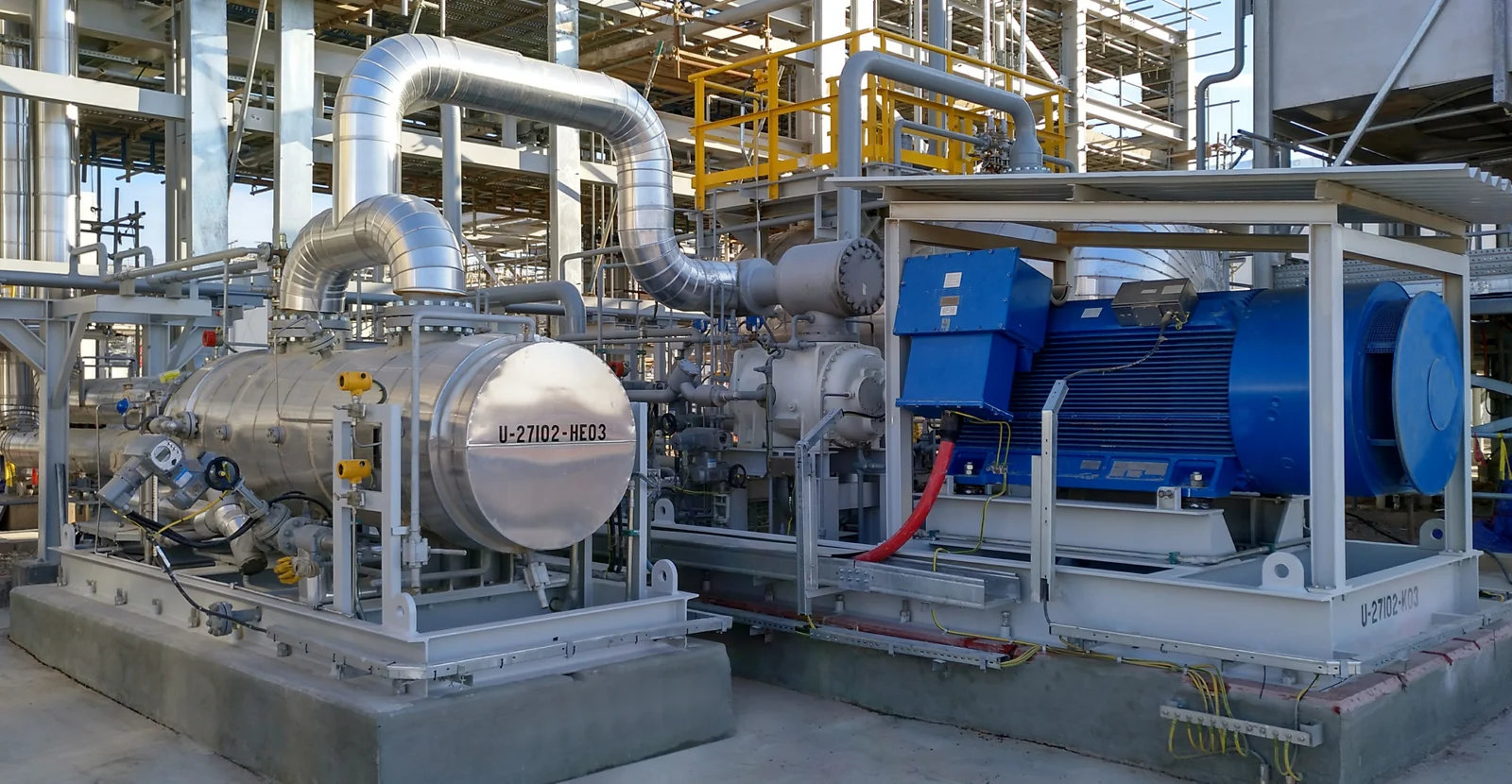
Liquid-cooled computing typically moves heat through several interfaces before releasing it to the surroundings. Equipment inside a rack, a distribution system and the external heat rejection equipment can have different fluid, temperature and pressure requirements. This is general technical context, not a disclosed configuration for the unnamed AIR projects. The October 5 agreement should not be treated as a complete specification of their rack-level cooling, distribution units or backup arrangements. Those elements still require compatible engineering and procurement documents.
The same caution is useful for hydro ASIC installations. A miner’s coolant requirements are not automatically the requirements of a building’s chilled-water circuit. Mixing interfaces without manufacturer-approved separation or treatment can create reliability problems. Operators should reconcile supply temperature, flow, fluid chemistry, filtration and the heat exchanger boundary for the actual equipment. For immersion systems, the primary fluid and secondary loop may be different again. A high-capacity chiller can only provide a useful service when the rest of the system delivers heat to it within its operating envelope.
Redundancy determines usable cooling capacity
A facility promising availability must consider how much cooling remains when a component is maintained or fails. Installing several units does not show that the whole stated capacity is usable under every condition. Pumps, valves, controls, electrical feeds and common pipework can affect the redundancy of the system. These are our design considerations for evaluating a cooling program; they are not a finding about AIR’s customers. The announcement does not publish a site reliability topology or a guaranteed level of service.
For mining, losing cooling can require a rapid reduction of electrical load to keep devices within safe limits. For an AI service, interruption may also affect a customer workload or a contractual service target. Commissioning should test the response to a failed unit and the behavior of control systems during load changes. Operators also need a maintenance plan that works within the redundancy assumptions. A nominal equipment count and a peak output rating are therefore incomplete indicators of how much compute a site can support reliably.
Climate and utilization shape the annual result
Free-cooling uses favorable outdoor conditions to reduce the need for mechanical refrigeration. Its value depends on how often those conditions align with the required coolant temperature and the computing load. A cold-climate mining site, a humid location and a high-density AI campus may present different operating envelopes. The engineering comparison should use the actual location and workload. The Seoul simulation does not establish the annual performance of an unnamed site in the United States or Canada simply because both are part of a North American supply program.
Utilization also matters. A system sized for a large future campus may initially serve only part of the installed compute capacity. The efficiency of an individual unit and the strategy for staging several units can affect this partial-load period. A useful annual model includes startup, changing occupancy, maintenance and the power used by supporting equipment. These are analytical inputs rather than newly disclosed contract terms. They help an operator compare a design that performs well at a full rated point with one that performs well across the expected operating year.
Service and commissioning belong in the purchase decision
Hardware procurement is only one step between a supply agreement and a functioning cooling system. Delivery, installation, controls integration, testing and ongoing service determine whether a facility can use the equipment as intended. A project owner should identify who is responsible for each interface and for correcting a failed acceptance test. Our assessment is that this division of responsibility is particularly important when several contractors contribute to the same system. It is not specified for individual sites in the public announcement.
For an ASIC farm purchasing cooling equipment, the contract should align with the device delivery schedule and the intended operating conditions. Spare parts, local service capability and access for maintenance can matter as much as a headline rating. An acceptance process should establish measured flow, temperatures, controls response and the ability to support the agreed load. A manufacturer relationship may provide a route to procurement, but the project-level evidence is the completed and documented system. We do not infer those milestones from the scale of the announced partnership.
The evidence to watch is equipment delivered and accepted
Follow-up disclosures that would clarify the agreement include purchase volumes, named projects, delivery windows, installed equipment and verified operating results. Those details would allow readers to connect the portfolio scale with real site progress. Until they appear, the 5 GW headline remains a statement about projects supported by a multiyear program, while the economic value and delivery profile of the agreement are undisclosed. Our coverage does not assign the program a speculative contract price or an assumed share of LG’s future revenue.
The practical takeaway for mining infrastructure is to compare cooling on delivered service, operating conditions and lifecycle cost. A large supplier agreement is relevant to the broader competition for infrastructure, yet it is not a substitute for an equipment-specific design. Readers can use the announcement to track the supplier relationship while keeping capacity, simulation results and installed performance in distinct categories. That approach makes the news useful without turning a company forecast into a measured saving or a planned project portfolio into operating compute capacity.
Source: LG Electronics USA ↗
Mining calculator ↗