Bitdeer’s miners got more efficient while the fleet used more electricity
Source report: 2026-11-10 · Editorial analysis published: 2026-11-12
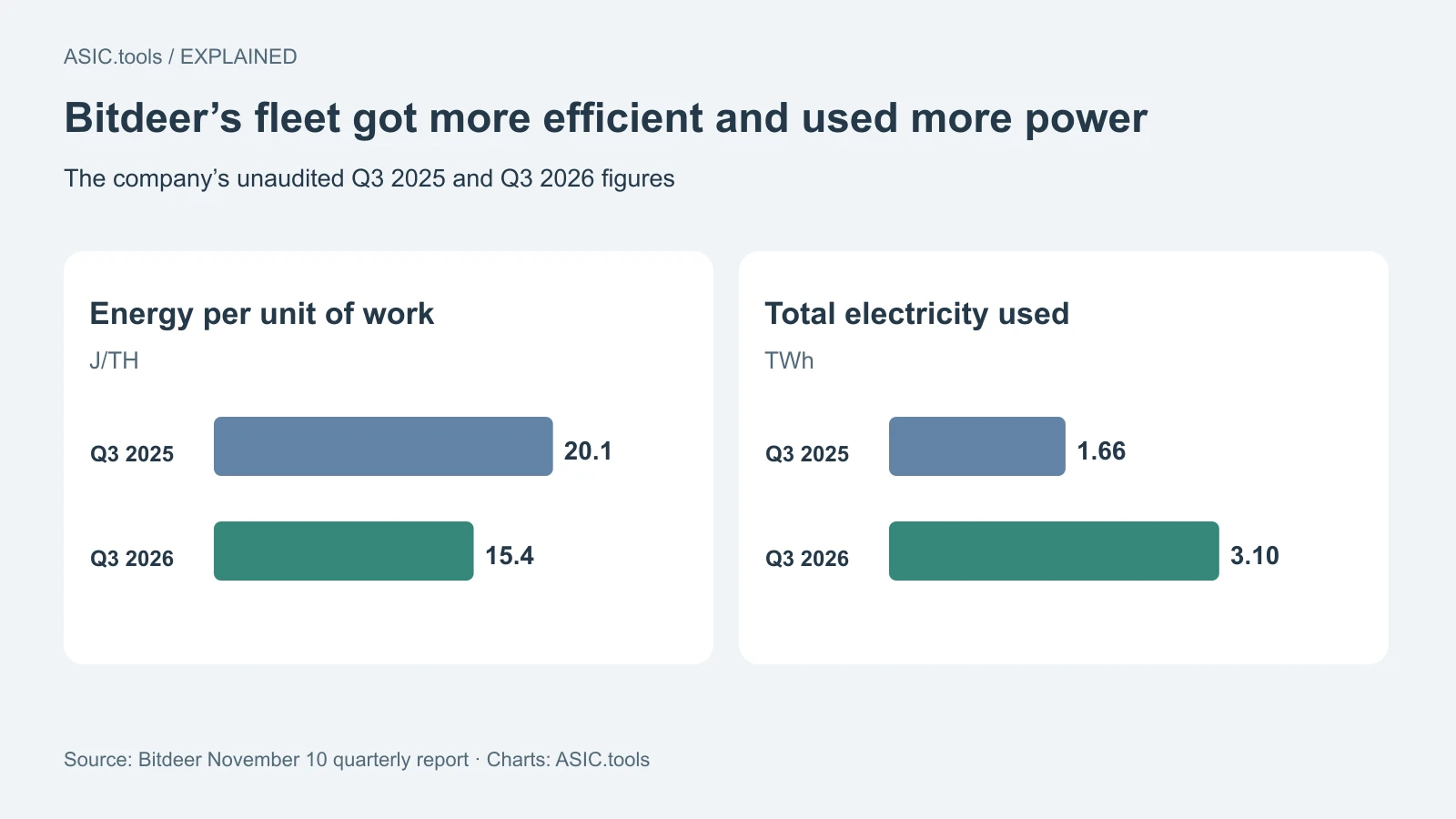
Bitdeer reported 15.4 J/TH in the third quarter, down from 20.1 a year earlier. Its larger operation used 3.10 TWh as the average electricity price also rose.
Better machines, a bigger power bill
In its November 10 report, Bitdeer said its average mining efficiency improved from 20.1 to 15.4 joules per terahash between the third quarters of 2025 and 2026. That is about 23% less energy per unit of computing work. Yet its reported electricity use rose from 1.66 to 3.10 terawatt-hours. A bigger operation can use more power in total while doing each calculation more efficiently.
Average self-mining hashrate rose from 29.1 to 79.6 exahashes per second. Hashrate is the speed of the mining calculations; an exahash is a million terahashes. That figure is an average over the quarter for self-mining. The report separately lists work run with third-party sites and an overall Bitcoin production figure of 3,855 BTC, against 1,109 BTC a year earlier.
The report also gives 82.3 EH/s for self-mining in its operating summary. The 79.6 EH/s in the discussion is the quarterly average. Treating a period-end reading as if it applied throughout the quarter would overstate the work done.
The electricity rate also changed
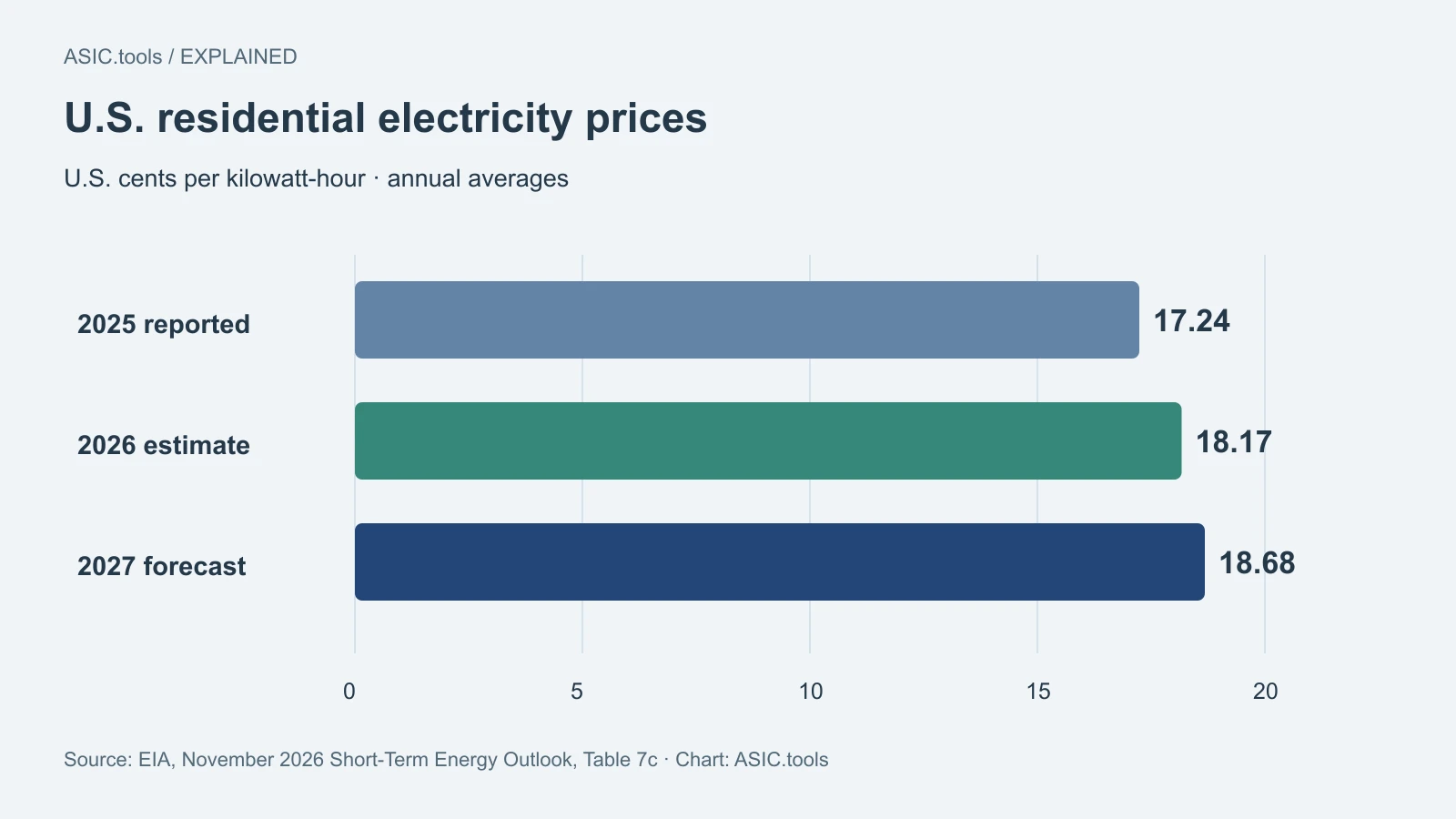
Bitdeer reported an average of $47 per megawatt-hour, up from $43. That is 4.7 versus 4.3 U.S. cents per kilowatt-hour. These are averages reported by the company, not offers from a utility or a hosting company. The price for any individual site can differ, and the total energy and the self-mining electricity cost are different measures in the report.
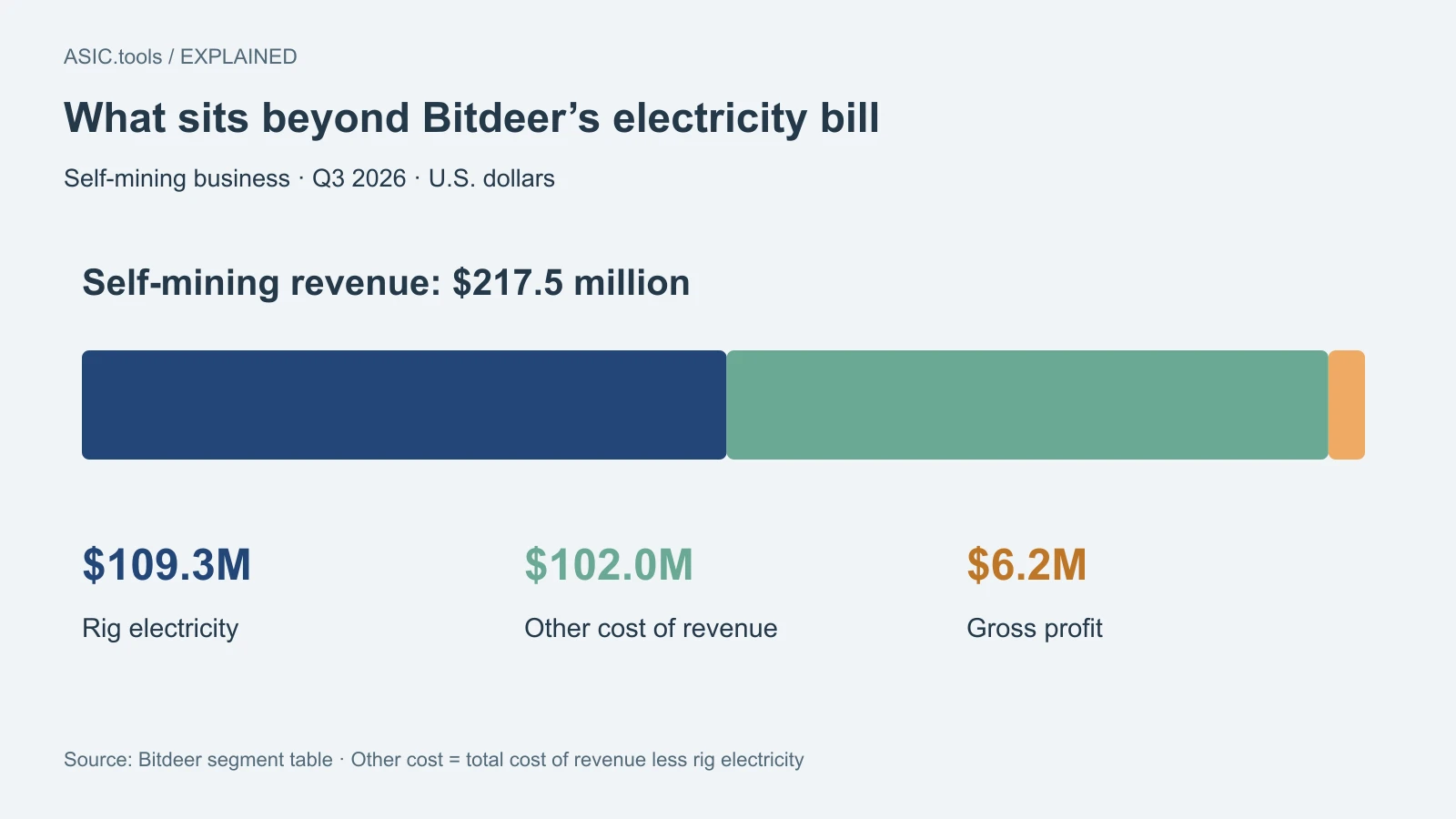
For the self-mining business, Bitdeer reported $217.5 million in revenue and $109.3 million in electricity costs for running the rigs. It reported $211.3 million in total cost of revenue for the same business. The resulting gross profit was $6.2 million. Other costs include depreciation, which spreads equipment cost over its expected service life, and other expenses. Subtracting power alone misses a substantial part of the cost.
That distinction is useful when reading two hosting quotes. A power-only rate does not reveal fees for equipment space, repairs or ventilation. Ask which items scale with consumption and which stay on the bill when the machine is switched off.
Compare two machines at the same speed
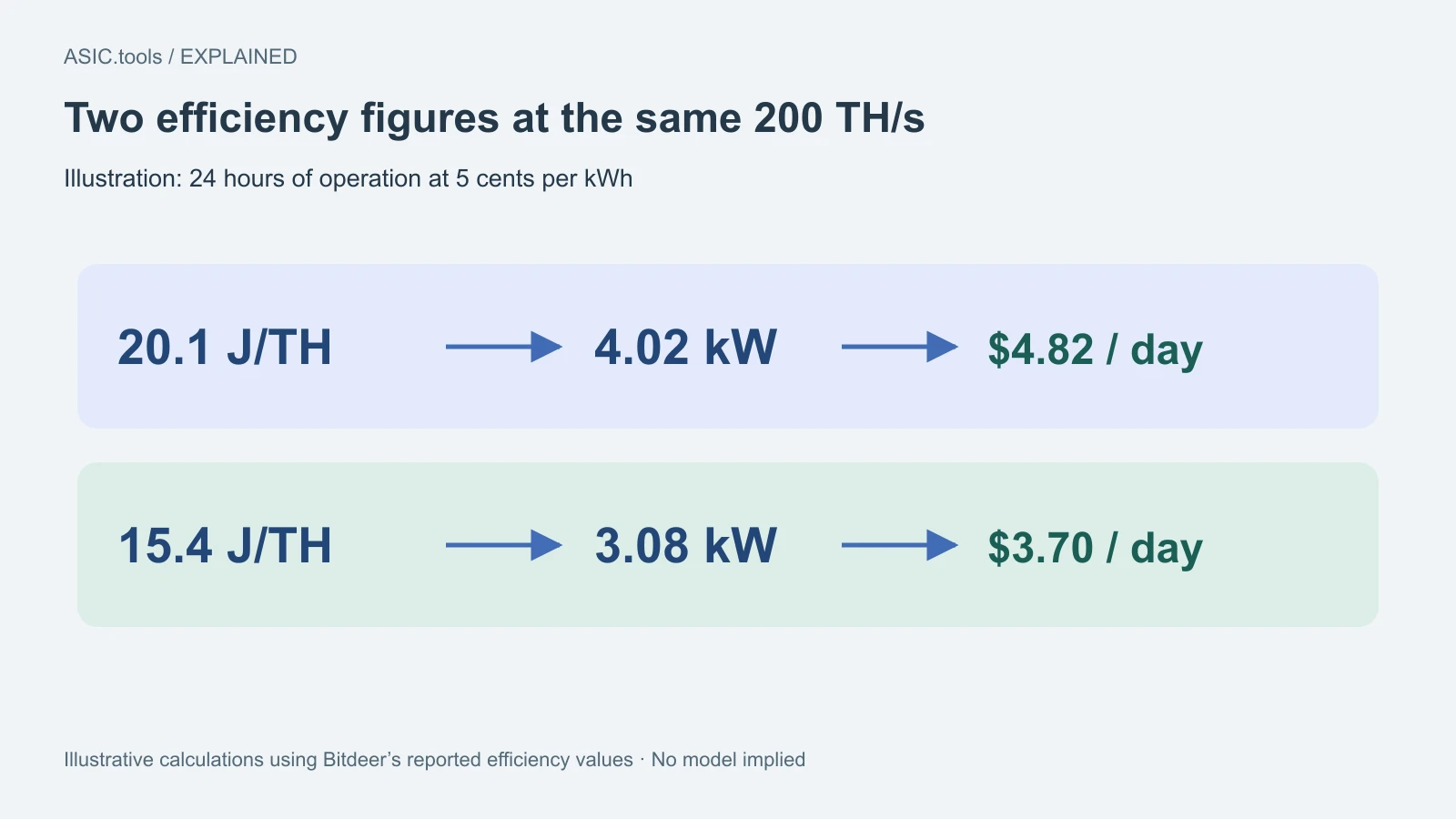
Joules per terahash, or J/TH, shows how much energy a machine needs to make a trillion hashes. Multiply J/TH by the hashrate in TH/s to get watts. At a fixed 200 TH/s, 20.1 J/TH would take 4.02 kW; 15.4 J/TH would take 3.08 kW. These are examples using the reported efficiency values, not two product specifications.
If both ran around the clock at 5 cents per kilowatt-hour, their daily electricity costs would be about $4.82 and $3.70, respectively. The difference comes to $1.13 a day before rounding each total. Measure the whole setup at the outlet where feasible and add separate cooling or hosting charges; they can change the comparison.
Use the same measurement point for both machines. A power reading from the miner and one from the wall can include different losses. Compare accepted pool work over the same hours, too; a setting that looks efficient for a few minutes may lose useful work if the machine repeatedly restarts.
Fleet deployment is different from retail supply
Bitdeer reported $0.3 million from sales of SEALMINER units and accessories, versus $11.4 million a year earlier. The filing also describes spending on manufacturing machines for its own and partner mining operations. A larger fleet does not tell a buyer whether a particular model is in stock or when it will ship.
For a purchase, ask for the actual model and power mode, an estimated delivery date, and an all-in price. Compare how much useful work the unit can deliver at your power rate and how long the lower energy cost could take to cover a higher purchase price. Bitdeer’s quarter is a good example of why electricity price, energy per unit of work and total consumption are three separate numbers.
For a machine that will run in an existing room, also check whether the supply and ventilation can handle the planned load. The example compares power for equal computing work. It does not establish that a given room, circuit or hosting slot can run either hypothetical configuration.
Source: Bitdeer / SEC filing ↗ · Bitdeer — quarterly results ↗
Mining calculator ↗