IREN’s mining fleet falls to 7.9 EH/s as data centres shift to AI
Source report: 2026-11-05 · Editorial analysis published: 2026-11-07
IREN’s November 5 filing separates installed mining capacity from average operating hashrate. It targets a substantial transition by year-end, with small residual mining operations expected through 2027.
A smaller mining operation
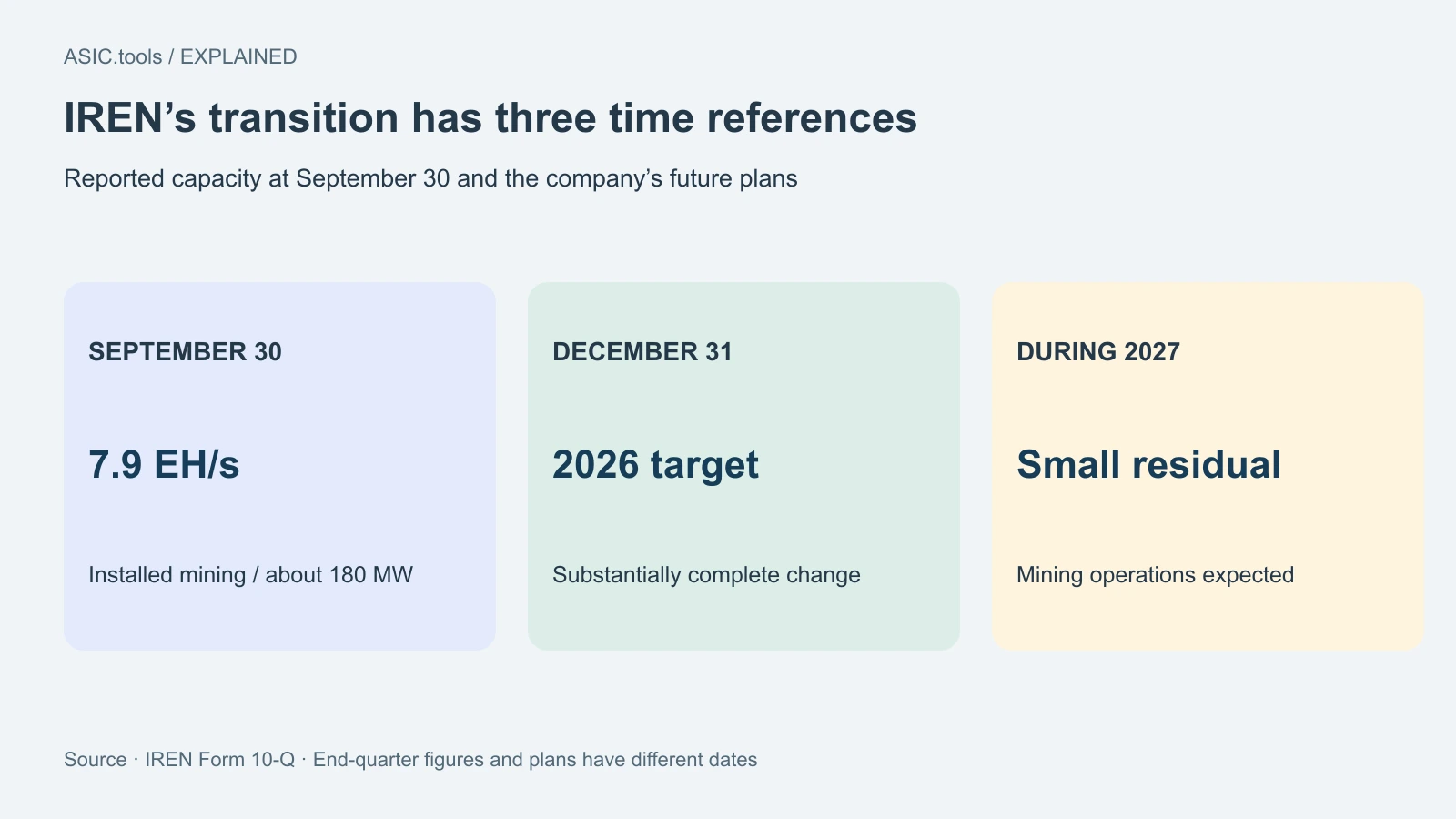
IREN reported about 7.9 exahashes per second of installed Bitcoin mining capacity at September 30, representing roughly 180 megawatts of data-centre capacity. The figures appear in its November 5 quarterly filing. They show the physical scale of the mining operation remaining as the company redirects sites toward artificial-intelligence computing.
The company aims to substantially complete that transition by December 31, 2026, and expects immaterial mining operations to continue through calendar 2027. That is its stated plan. Some sites still mine while capacity moves toward AI Cloud. The report describes a process of retiring mining equipment and repurposing facilities.
For miners watching the business, the distinction matters. Installed hashrate is computing capacity connected to a reported fleet. A quarter's average operating hashrate measures what ran across the period. The remaining equipment at the end of a quarter and the work performed over all three months answer different questions.
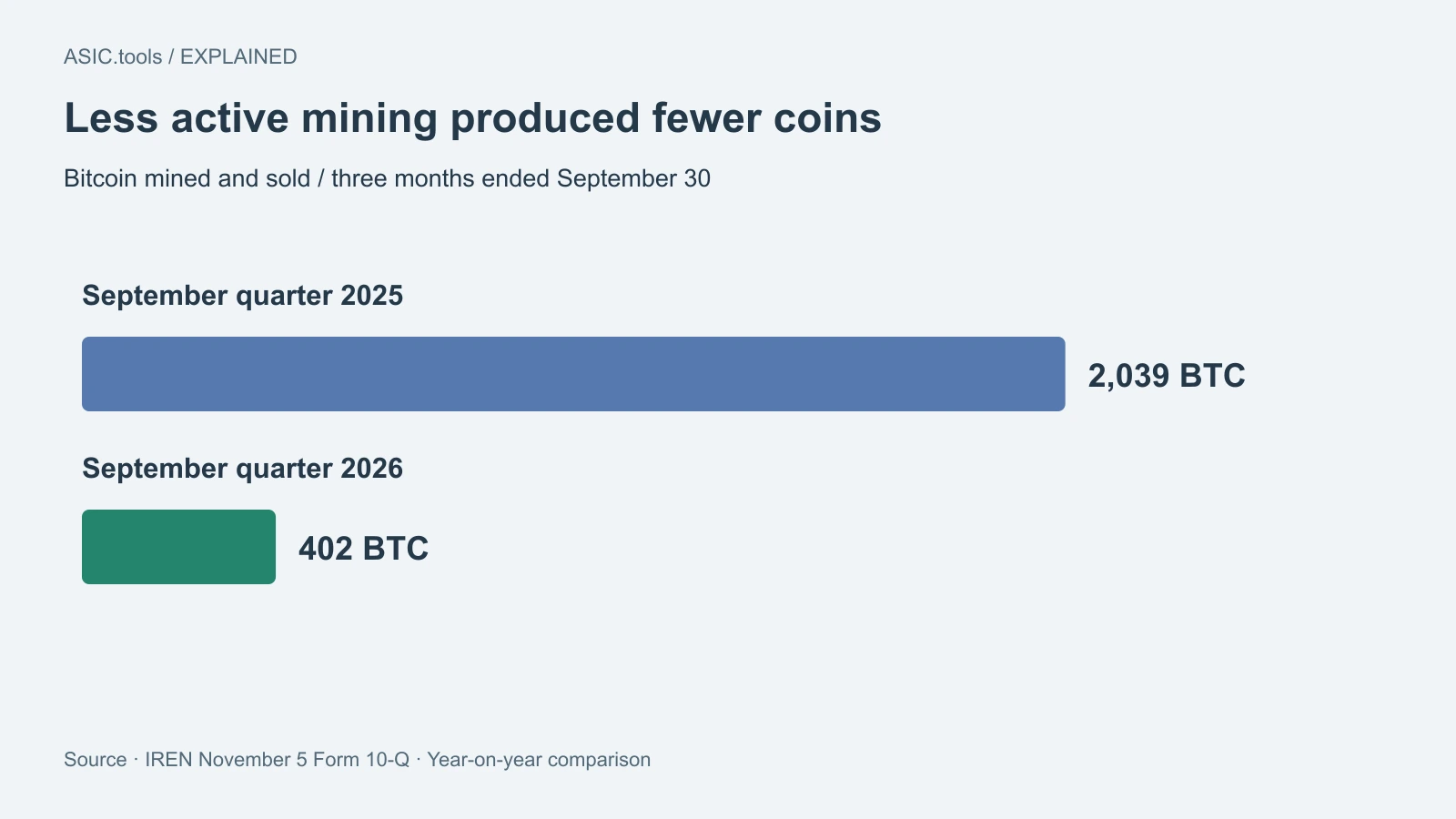
Less operating hashrate meant fewer bitcoin
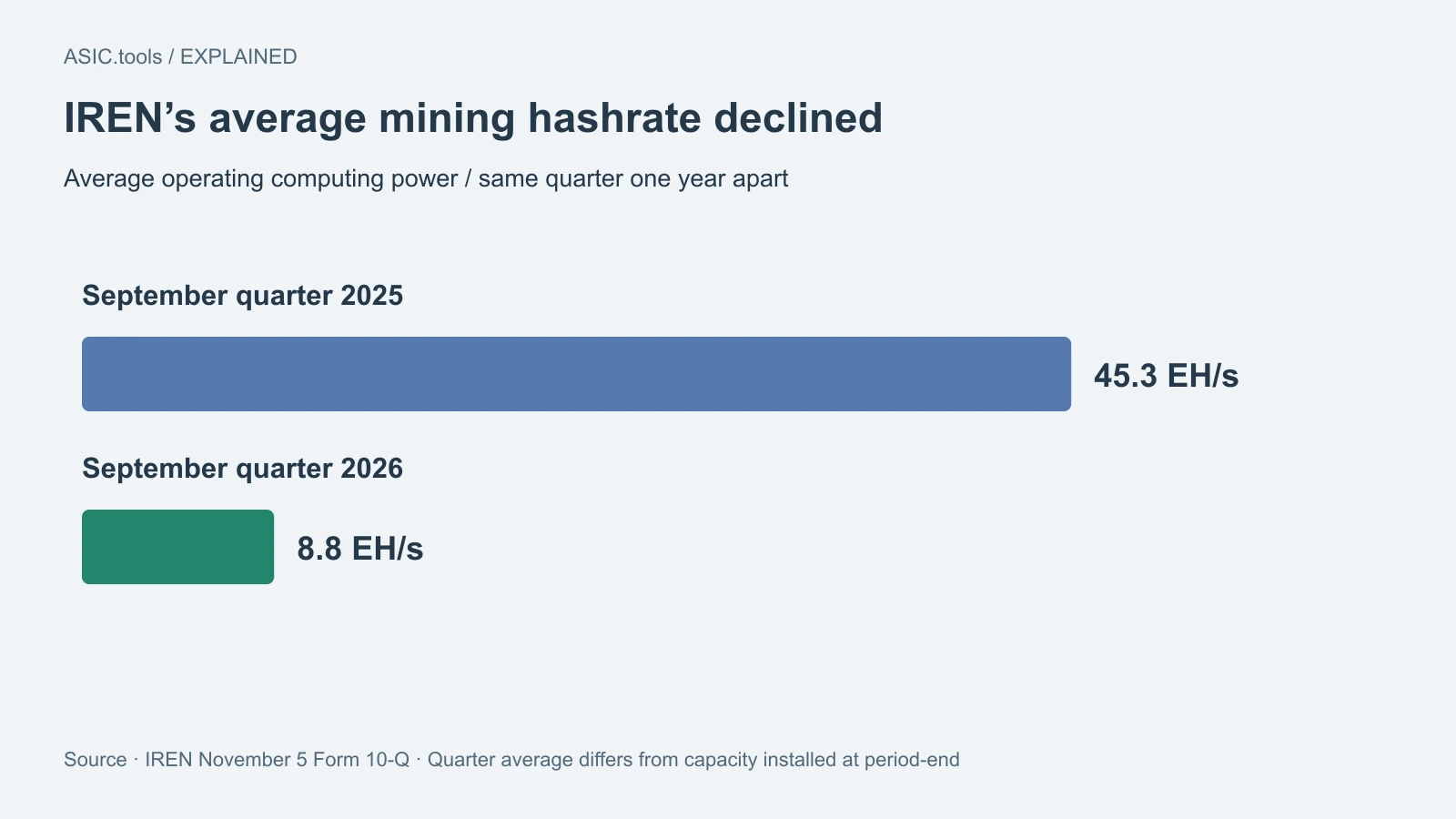
IREN's average operating hashrate was 8.8 EH/s for the three months to September 30, compared with 45.3 EH/s in the same period of 2025. One exahash per second is a quintillion hashing attempts each second. The large decline describes one operator's active fleet as it withdraws equipment.
Production and sale were 402 BTC in the September quarter, against 2,039 BTC a year earlier. Mining revenue fell from $233 million to $28 million over that annual comparison. The filing attributes $116 million of the reduction to fewer bitcoin mined and $89 million to a lower average Bitcoin price. Those two effects account for the reported $205 million revenue decline.
The issuer's earnings release also compares the $28 million with $67 million in the immediately preceding June quarter, a drop of about 58.2%. Keep the comparison period with each number. The 45.3 EH/s and 2,039 BTC figures refer to the year-earlier September quarter. The $67 million figure refers to June 2026.
The filing puts mining cost of revenue, excluding depreciation and amortisation, at $18 million against $80 million a year earlier. It attributes the decrease primarily to $61 million less in electricity costs as operating hashrate declined and mining hardware was decommissioned. Lower total electricity expenditure describes what that smaller operation spent. To compare an electricity tariff, a reader would need the energy quantity and pricing terms for the same interval.
Mining equipment and an AI site have different jobs
An ASIC's chips are designed for a particular mining algorithm. Bitcoin machines repeatedly perform SHA-256 work. AI computing uses a different equipment stack, including GPUs designed to process its workloads. A data-centre owner changing business can retain a site and its power access while replacing the machines that use it.
IREN reported $200 million of AI Cloud revenue for the September quarter, comprising $135 million of services and $65 million of lease revenue. Its total revenue was $228 million when the $28 million of mining revenue was included. These figures show which activity now generates most of the company's sales. They are revenues for the quarter.
Power figures have their own scope. The roughly 180 MW was associated with installed Bitcoin mining capacity at September 30. A power-capacity number describes an available or deployed level of electrical load. Energy consumed over a period is measured in units such as megawatt-hours. The report's capacity figure cannot supply an individual site's electricity bill without measured draw and operating hours.
What the change says about mining competition
A mining fleet that is switched off stops submitting work. For another miner, however, expected output depends on the whole network's competition and its difficulty rules. Other operators can install machines, change operating hours or move equipment. One company's end-of-quarter fleet gives only part of that picture.
The report also says IREN typically sells the bitcoin it mines daily and held none on its balance sheet at September 30. That treasury practice is separate from the amount of computing work still running. A balance of zero coins and a positive mining hashrate can occur together because coins are produced and then sold.
For readers comparing their own records with a public miner, the useful pairing is a fleet's operating work and its production over the same dates. Then add measured energy and the applicable bill. The IREN filing makes the shift visible at three levels, the equipment left at quarter-end, the work averaged over the quarter and the revenue from that period. Keeping those dates and units attached helps read a large company's transition without turning its plan into a prediction for a home miner.
Source: IREN / SEC Form 10-Q ↗ · IREN Q1 FY27 issuer release in SEC ↗ · IREN investor-relations release ↗
Mining calculator ↗