Iberian day-ahead power jumps to €141.71/MWh for November 20
Source report: 2026-11-19 · Editorial analysis published: 2026-11-19
OMIE’s 96-period result is 4.34 times the November 19 average. A constant 3 kW load would use about €10.20 of auction-priced energy over the day, before the rest of the electricity bill.
A dearer delivery day for the Iberian market
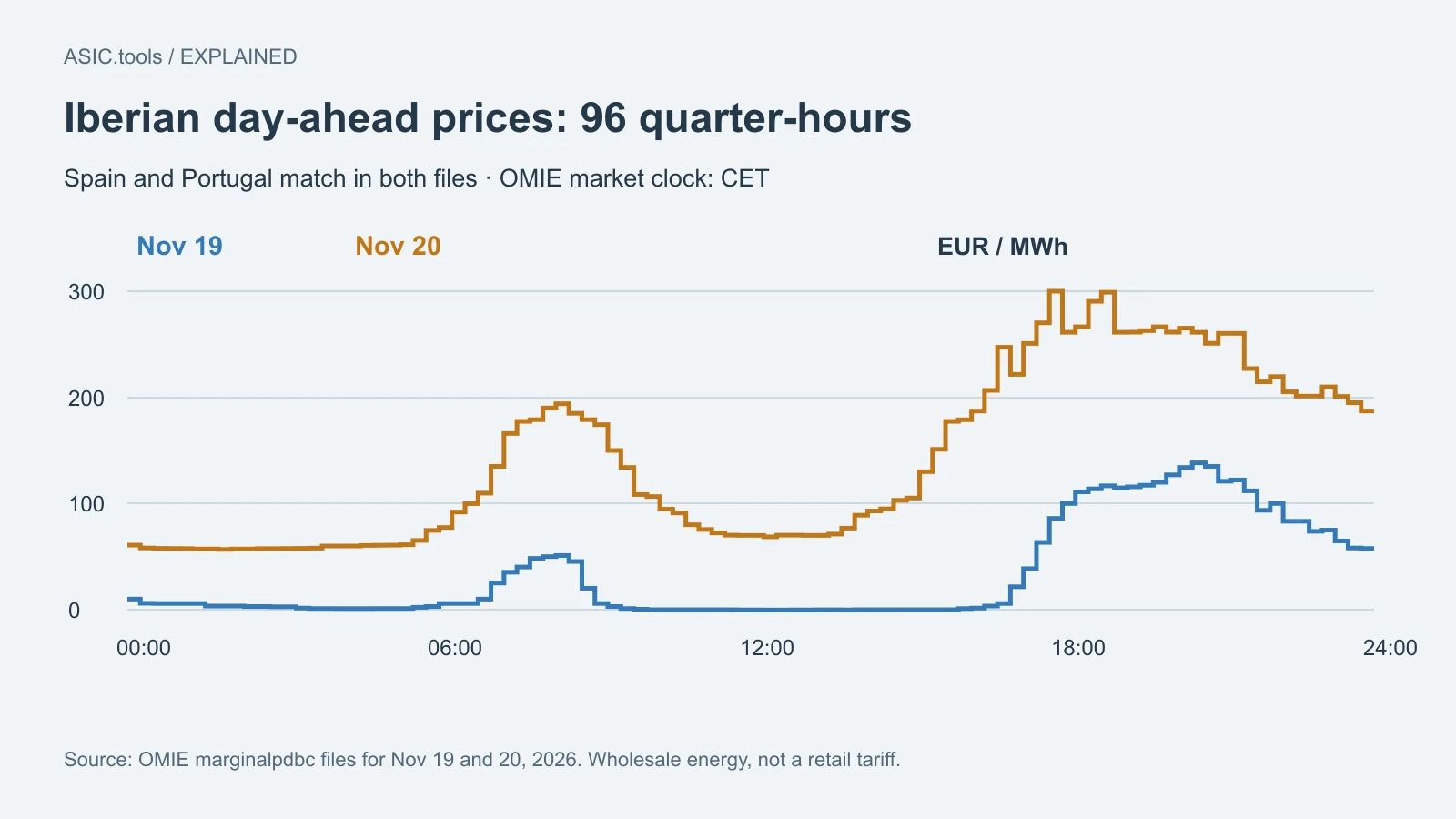
The November 20 day-ahead electricity auction result published by Iberian market operator OMIE puts the average Spanish and Portuguese price at €141.71 per megawatt-hour. That compares with €32.68 for November 19, about 4.34 times as much. For a miner whose electricity contract follows this market, tomorrow’s energy component can therefore be very different from today’s, even if the machine, hashrate and coin price stay unchanged.
This is a completed day-ahead result checked on November 19, not a forecast of an auction that has yet to happen. The downloaded official files contain 96 quarter-hour periods for each delivery day. The Spanish and Portuguese price columns are identical in every period in these two files. The result applies to those markets; it does not set a tariff for a miner elsewhere or change a fixed-price contract overnight.
The average hides the operating window
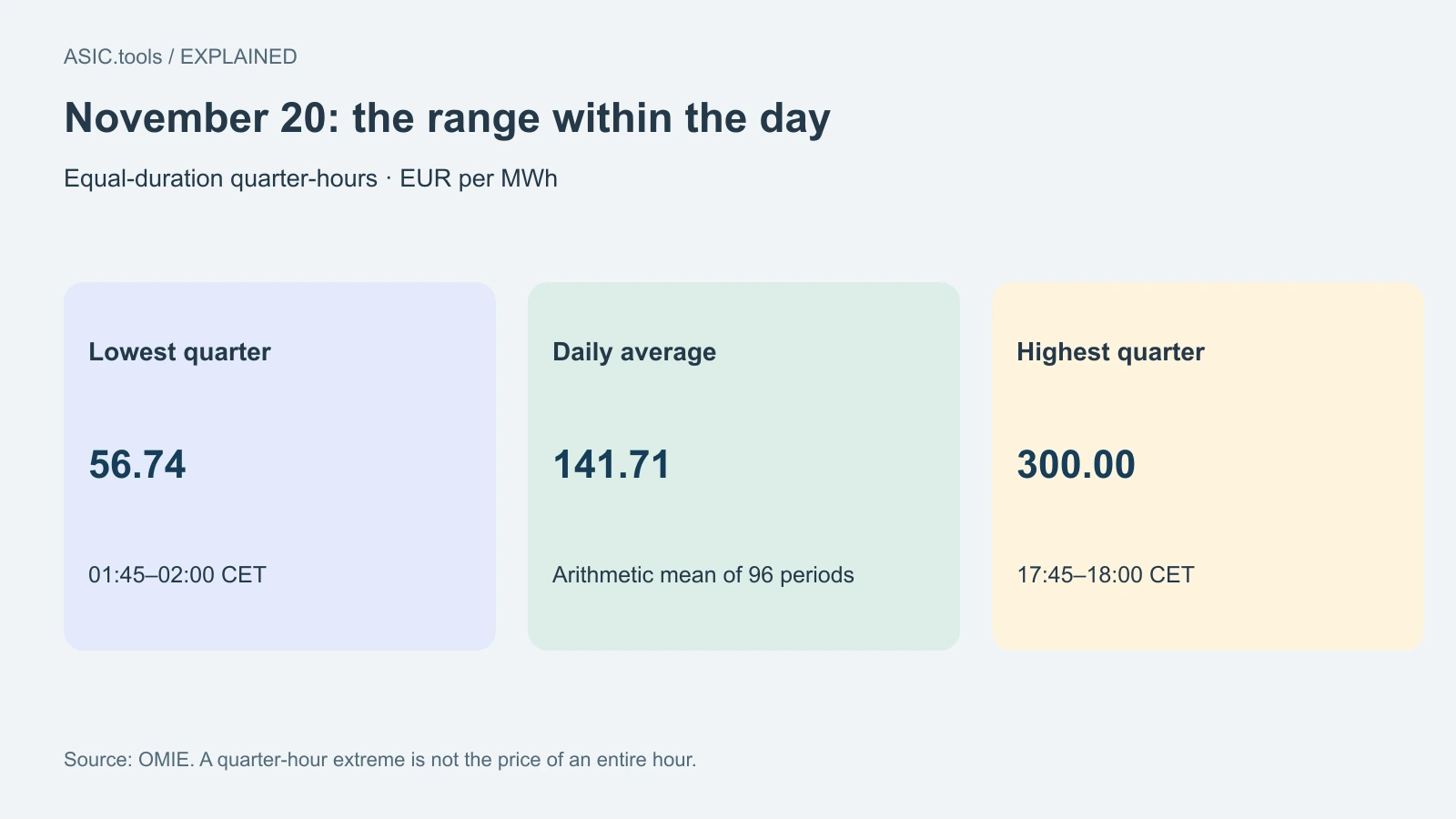
For November 20, the cheapest quarter is €56.74/MWh and the highest is €300/MWh. The low is period 8, from 01:45 to 02:00 on OMIE’s Central European Time (CET) market clock, while the high is period 72, from 17:45 to 18:00 CET. These are individual fifteen-minute intervals. Calling one of them the price for a whole hour would lose the resolution of the actual auction result.
OMIE describes the daily average as the arithmetic mean of the marginal price in each period. All 96 periods on these dates have equal duration, so their simple mean also represents the energy price for a constant load across the full day. It is not an average weighted by every consumer’s actual use. A miner operating only selected intervals has a different mix of prices and should calculate the intervals it really uses.
Wholesale energy is one part of the bill
€141.71/MWh is equivalent to approximately €0.14171/kWh at the auction level. A megawatt-hour contains one thousand kilowatt-hours. The unit conversion makes it easier to compare with an electricity offer, but it does not add network charges, supplier costs, taxes or the other terms of the actual contract. A very low or negative exchange price on another day can coexist with a positive final retail bill for the same reason.
The first check is how the supplier prices the energy component. A fixed-rate offer, an offer indexed to the market and a hosting package can pass costs through differently. Read the applicable interval, additions and settlement rules rather than inserting the auction average directly as the complete tariff. The new result is immediately useful to someone exposed to it; for others it is information about the underlying market, not an automatic change in what the supplier will charge.
What constant three-kilowatt operation would mean
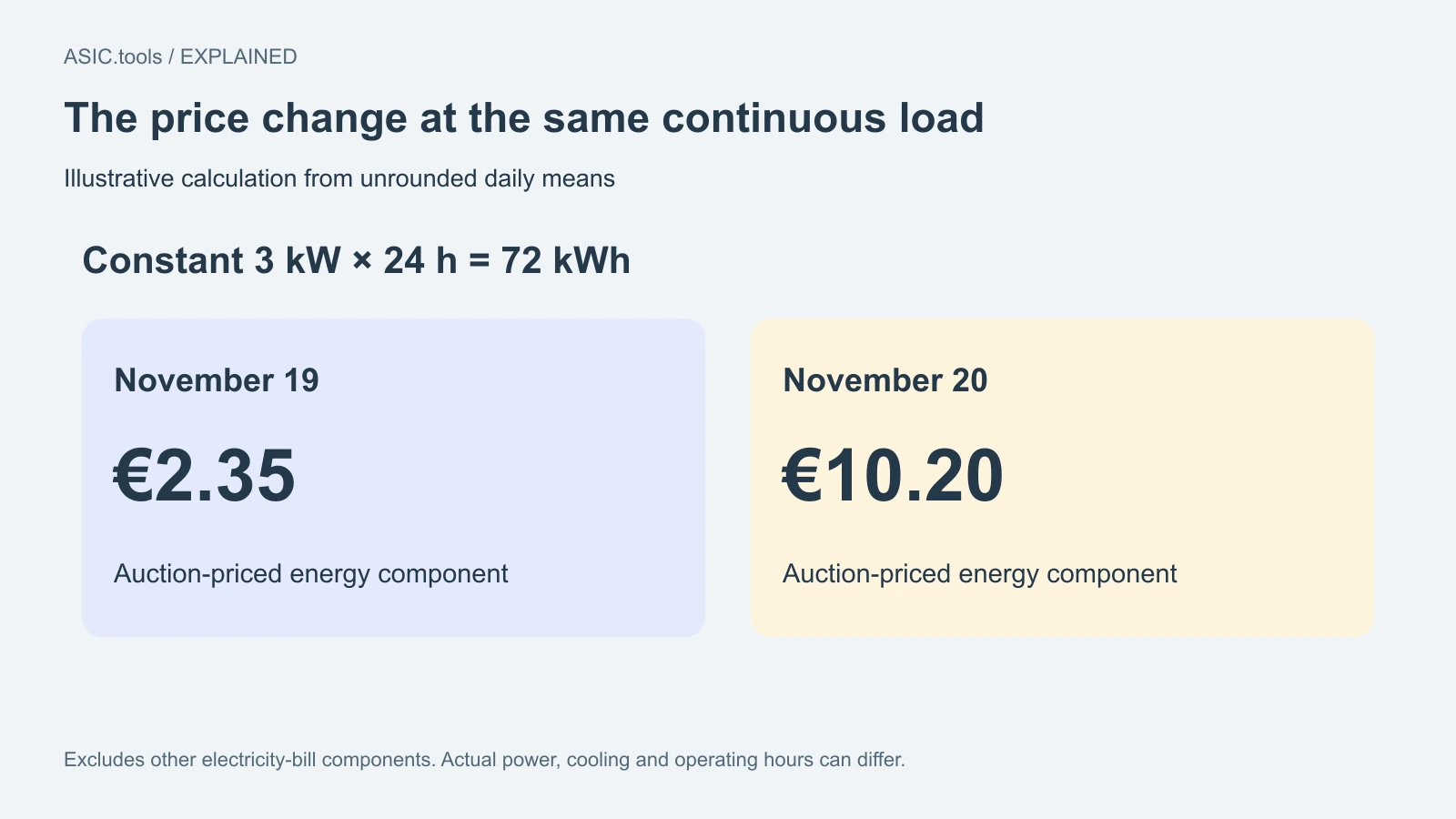
A continuous 3 kW load consumes 72 kWh over 24 hours. Multiplying that energy by the unrounded mean of the November 20 auction gives about €10.20. The same calculation for November 19 gives about €2.35, a difference of approximately €7.85 in the auction-priced energy component. This is an illustrative constant load, not a claim about a particular ASIC or a full electricity invoice.
The example holds power and operating hours constant so the price change is visible. A real setup can draw a different amount at the wall, and cooling or other equipment adds consumption. If a miner stops during expensive intervals, its energy use and the work it delivers both change. A daily calculation for continuous operation should therefore not be reused as the result of a selective schedule without recalculating the actual hours and power.
Compare the actual tariff with the work delivered
For an operating decision, put the contract’s full variable electricity cost beside the expected value of work during the same intervals. Pool fees, other running costs and the machine’s measured efficiency also matter. The OMIE file supplies a price input; it does not establish a particular miner’s revenue. If revenue is entered manually in a calculator, keep the currency and the period consistent with the energy costs being compared.
Before applying a schedule, check that the control actually changes the intended machine’s operating state and that it resumes as planned. Keep a record of the operating intervals and wall consumption, then compare the pool’s accepted work over that period. This turns the published quarter-hour curve into an auditable local decision, rather than assuming that a cheap interval, a configured timer and a successful mining restart are the same thing.
Keep the delivery date attached to the number
The two daily means differ sharply, but the auction files alone do not explain which weather, generation or demand factor caused the difference. No such cause is assigned here. They also do not establish future Bitcoin prices, network difficulty or mining profitability in another country. Their concrete finding is a higher priced November 20 delivery day and a range of prices within it, published before that day begins.
For an Iberian miner with relevant market exposure, the practical next step is to check tomorrow’s intervals against the contract and measured load while there is still time to plan. Preserve the date and units when sharing the figure: €141.71/MWh for November 20 is not today’s retail price per kWh. The useful comparison is between the costs the operator will actually pay and the work it can deliver, with the auction result kept in its proper place.
Source: OMIE ↗ · November 19 comparison file ↗ · Official day-ahead result methodology ↗ · OMIE current daily results ↗
Mining calculator ↗