FutureBit HashFly makes a simulated fruit-fly brain test Bitcoin hashes in a browser
Source report: 2026-09-20 · Editorial analysis published: 2026-09-26
FutureBit presented HashFly, a browser demonstration that maps a fruit-fly connectome simulation to simplified double-SHA-256 checks. It is an experimental visualization, not an organic ASIC replacement, and its claimed 1 W/TH potential has not been measured on working biological hardware.
Analysis and practical implications
This section is our analysis and illustrative calculations, separate from the source report.
What HashFly actually demonstrates
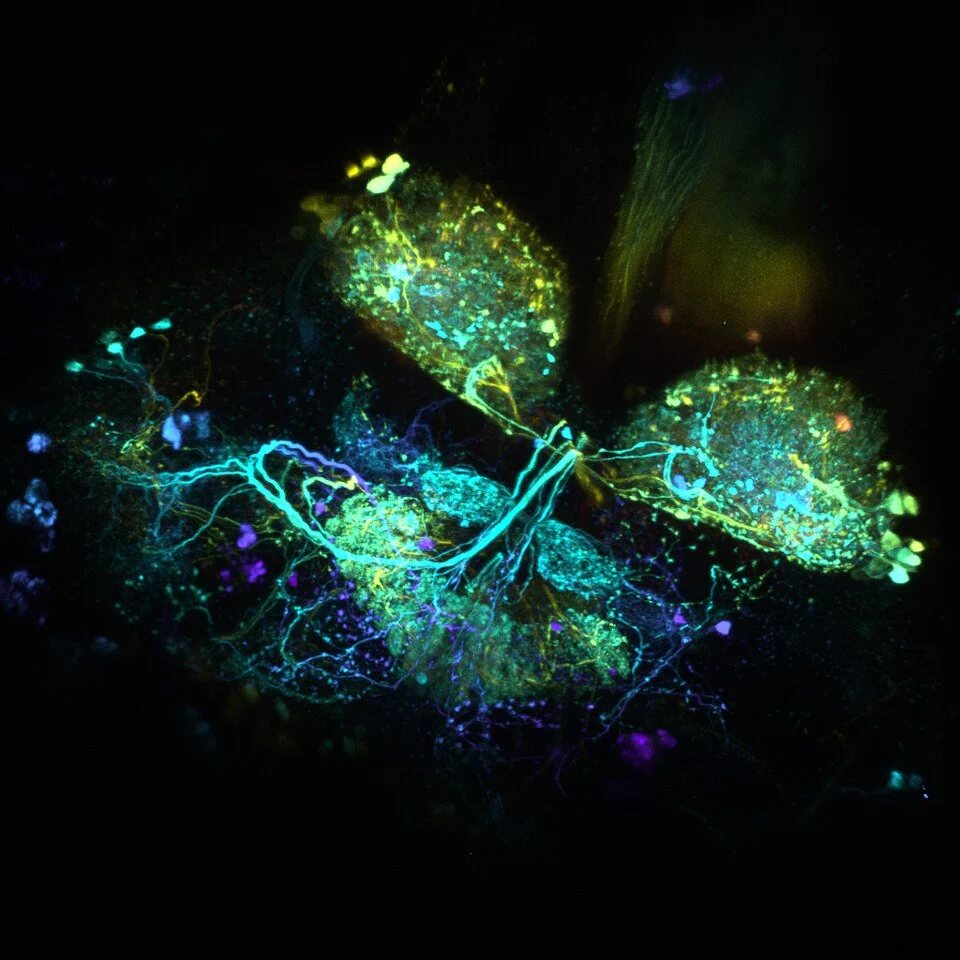
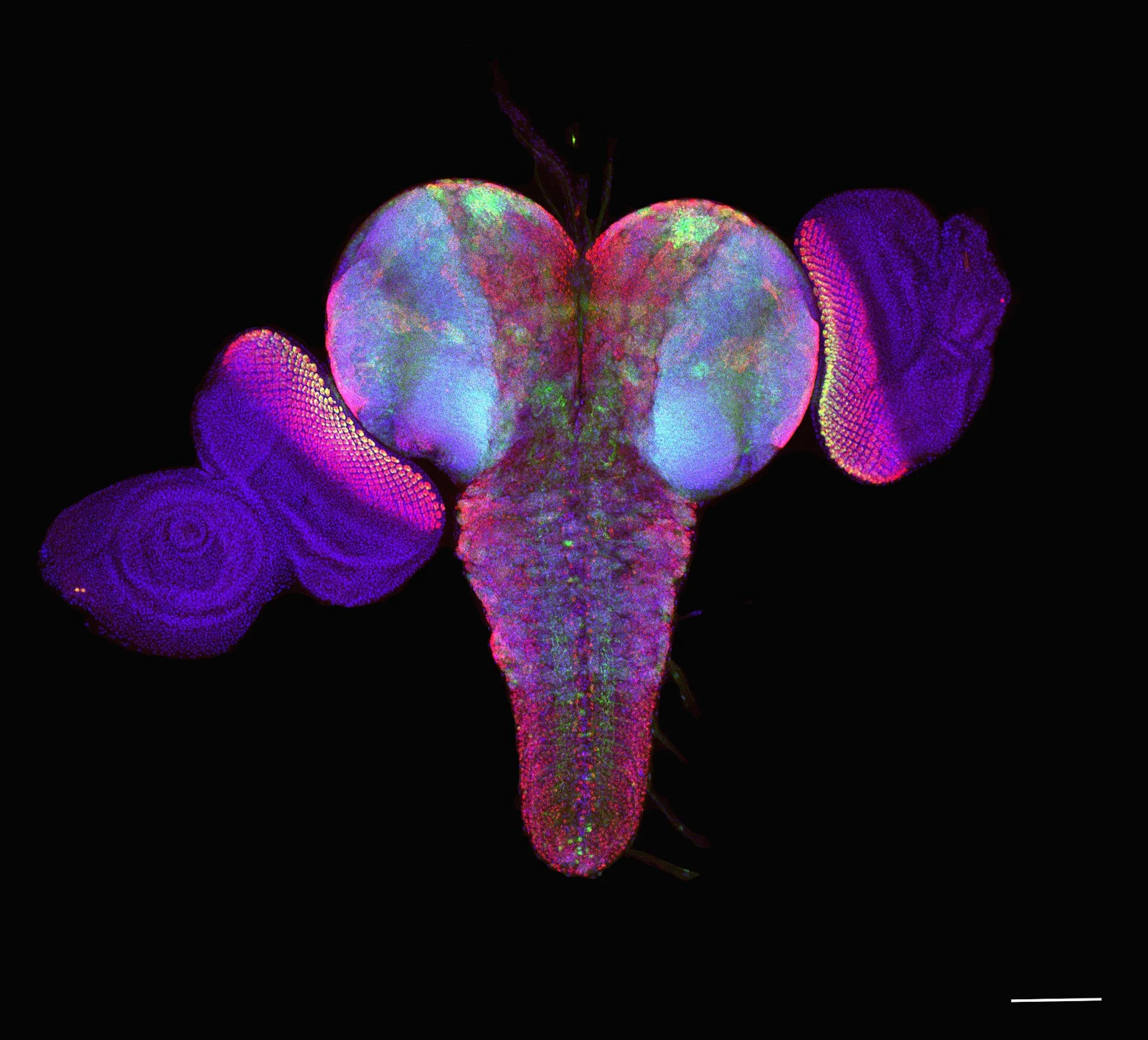
FutureBit introduced HashFly in September as a browser-based proof of concept built around a digital representation of a fruit-fly nervous system. Tom’s Hardware reports that the demo displays about 2,914 neural traces firing, drawn from a much larger MaleCNS v1.0 connectome containing 165,122 reconstructed neurons. The interactive page lets a visitor press a mining button and change a simplified target. This is software animating a published neural map; it is not a living brain, a physical neuromorphic processor or a production Bitcoin miner connected at competitive network difficulty.
How the simplified hash check is mapped
According to the report, simulated photoreceptors that would normally respond to light instead read a block header, while cells identified as PPL101 signal when a double-SHA-256 result meets the selected target. That mapping is interesting as an educational bridge between a neural graph and a deterministic cryptographic test. It does not mean the biological circuit naturally performs SHA-256. The browser code defines inputs, calculations and visual responses, so reviewers need the implementation, dataset version and reproducible benchmarks to separate the connectome’s role from conventional computing executed underneath.
Why the demo does not mine at Bitcoin difficulty
The web interface offers difficulty levels only up to six leading zeros, which Tom’s Hardware notes is vastly easier than the target used by the live Bitcoin network. The reporter observed roughly 80 accepted demo blocks in about an hour and estimated browser performance near 100 kH/s. Those numbers describe the demonstration environment and cannot be compared as revenue-producing hashrate. A valid mining benchmark would need standard headers, repeated nonce ranges, a verified share target, elapsed time, hardware utilization and independent reproduction while controlling browser and host CPU acceleration.
The 1 W/TH claim is hypothetical
FutureBit suggested that a system scaled to real organic neurons could reach about one watt per terahash, described as roughly ten times the efficiency of leading 3 nm silicon ASICs. The company said the estimate uses total power consumed by a fruit fly and assumes all neurons can execute Bitcoin hash functions continuously. That assumption is the central uncertainty: a whole animal’s power budget is not a measured SHA-256 engine, neurons do not natively implement the required Boolean operations, and supporting sensors, memory, control, cooling and interfaces would also consume energy.
Comparison with a real desktop ASIC
Tom’s Hardware contrasts the browser result with FutureBit’s Apollo III, a compact commercial miner that the company advertises at up to 18 TH/s. Even without treating either figure as a laboratory certification, the gap between about 100 kH/s and terahashes per second spans many orders of magnitude. HashFly therefore belongs in research and visualization, not a procurement table. Operators should not calculate payback, electricity savings or pool income from the 1 W/TH projection, because there is no physical product, purchase price, sustained hashrate, error rate or wall-power measurement.
What a serious experiment would measure
A follow-up should publish source code, the exact connectome transformation, the portion of SHA-256 executed by neural simulation and the portion performed by ordinary processors. Tests should report hashes per second, joules per hash, latency, error rate, memory, host-system power and scaling behavior. A control implementation on the same hardware would show whether the neural mapping contributes useful computation or only visualizes results. For biological hardware, repeatability, lifetime, nutrient supply, temperature, interface electronics and ethics would add costs that a fruit-fly metabolic estimate does not capture.
FutureBit says it plans to scale the simulation
The company says it is working toward simulating all neurons in the dataset with the SHA-256 function and intends to publish findings. That is a testable next step, but a larger simulation may require more conventional compute and therefore consume more electricity even if it becomes visually richer. Useful evidence would include a public repository, versioned datasets, benchmark scripts and results from independent machines. ASIC.tools will distinguish a full-connectome software experiment from a biological device and from an ASIC capable of submitting valid pool shares at current difficulty.
Practical conclusion for miners
HashFly is valuable as a conversation about unconventional computing and as a playful way to explain targets and double SHA-256. It does not presently change ASIC selection, farm design or mining economics. Operators should continue to compare machines using verified wall power, sustained pool-side hashrate, rejection rate, firmware and warranty. Researchers can evaluate HashFly by asking which component performs each calculation and how power is measured. Until working hardware produces reproducible hashes under a standard test, efficiency language should remain explicitly hypothetical rather than treated as a product specification.
Source: Tom's Hardware / FutureBit ↗
Mining calculator ↗