Fortitude’s 15 MW Aurora mine joins SPP demand response: why hosting uptime needs context
Source report: 2026-10-29 · Editorial analysis published: 2026-10-31
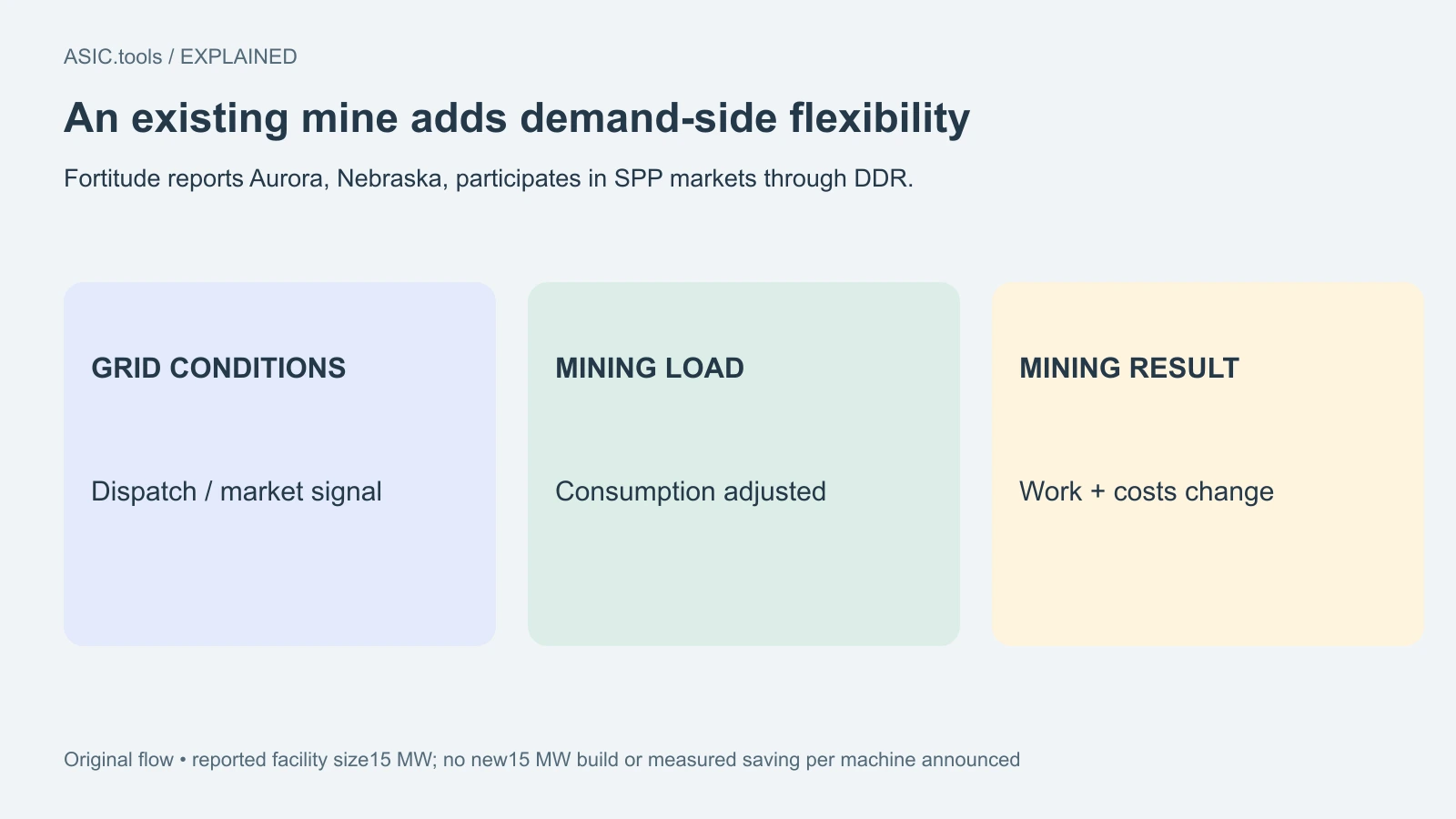
The October 29 announcement says Aurora can adjust electricity use under SPP dispatch and market signals. This is participation by an existing facility, not a new 15 MW build or proof of a specific saving for each hosted miner.
An existing mine gains a power-market role
Fortitude announced on October 29 that its 15 megawatt Aurora facility in Nebraska is participating in Southwest Power Pool’s wholesale markets through Dispatchable Demand Response, or DDR. In plain language, a registered electricity load can reduce its draw when instructed. The announcement concerns how an existing mining site uses power; it is not a claim that another 15 MW of mining capacity has just been built.
Aurora receives service from Southern Public Power District through a wholesale supply agreement with Nebraska Public Power District. Fortitude says the facility is designed to change consumption in response to grid conditions and market signals. Its stated goal is more flexible operation and better power-cost management. The release does not provide measured savings, a dispatch history or a guaranteed benefit per mining machine.
Reducing demand is different from generating electricity
SPP defines DDR as measurable load reduction and describes a DDR resource as a controllable load able to reduce withdrawal from the transmission grid at SPP’s direction. A miner can provide that kind of flexibility by doing less computational work during selected periods. The site is not thereby generating new electricity or storing energy in its ASICs; the immediate effect is lower demand while the reduction lasts.
For the grid, the ability to reduce a large load can help at demanding times. For the miner, the trade-off is work not performed during the interruption. Whether that improves the overall result depends on the applicable electricity agreement, market arrangements and forgone mining receipts. “Always on” is therefore not the only possible operating objective, but an interruption also does not become profitable merely because it is called demand response.
Fifteen megawatts does not describe a daily saving
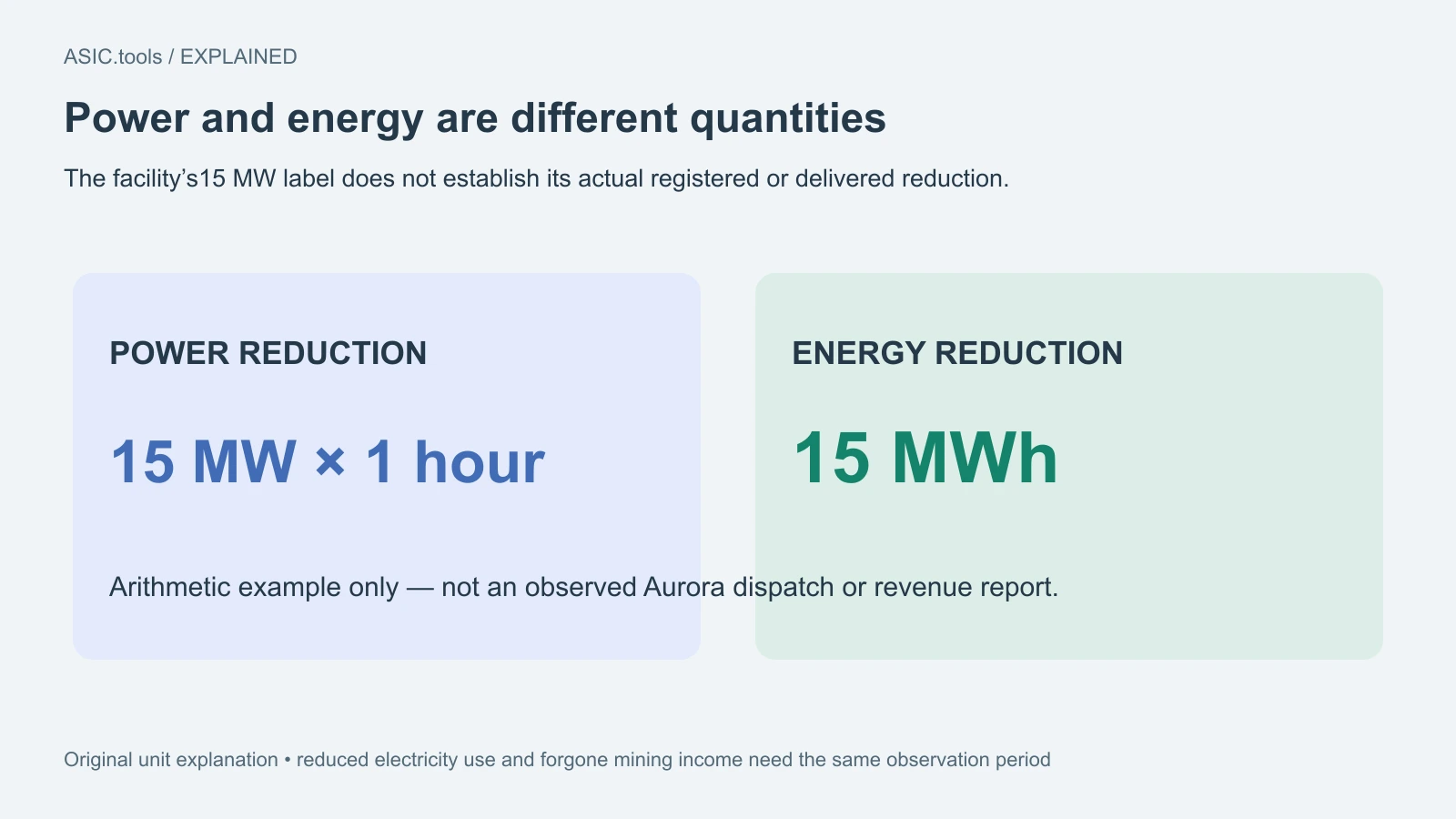
A megawatt measures power, while a megawatt-hour measures energy over time. To illustrate the distinction, a full 15 MW reduction lasting one hour would correspond to 15 MWh less consumption. This is an arithmetic example, not an observed Aurora dispatch, a verified registered reduction quantity or a report of revenue. The announcement’s facility size alone does not tell us how much load was actually reduced.
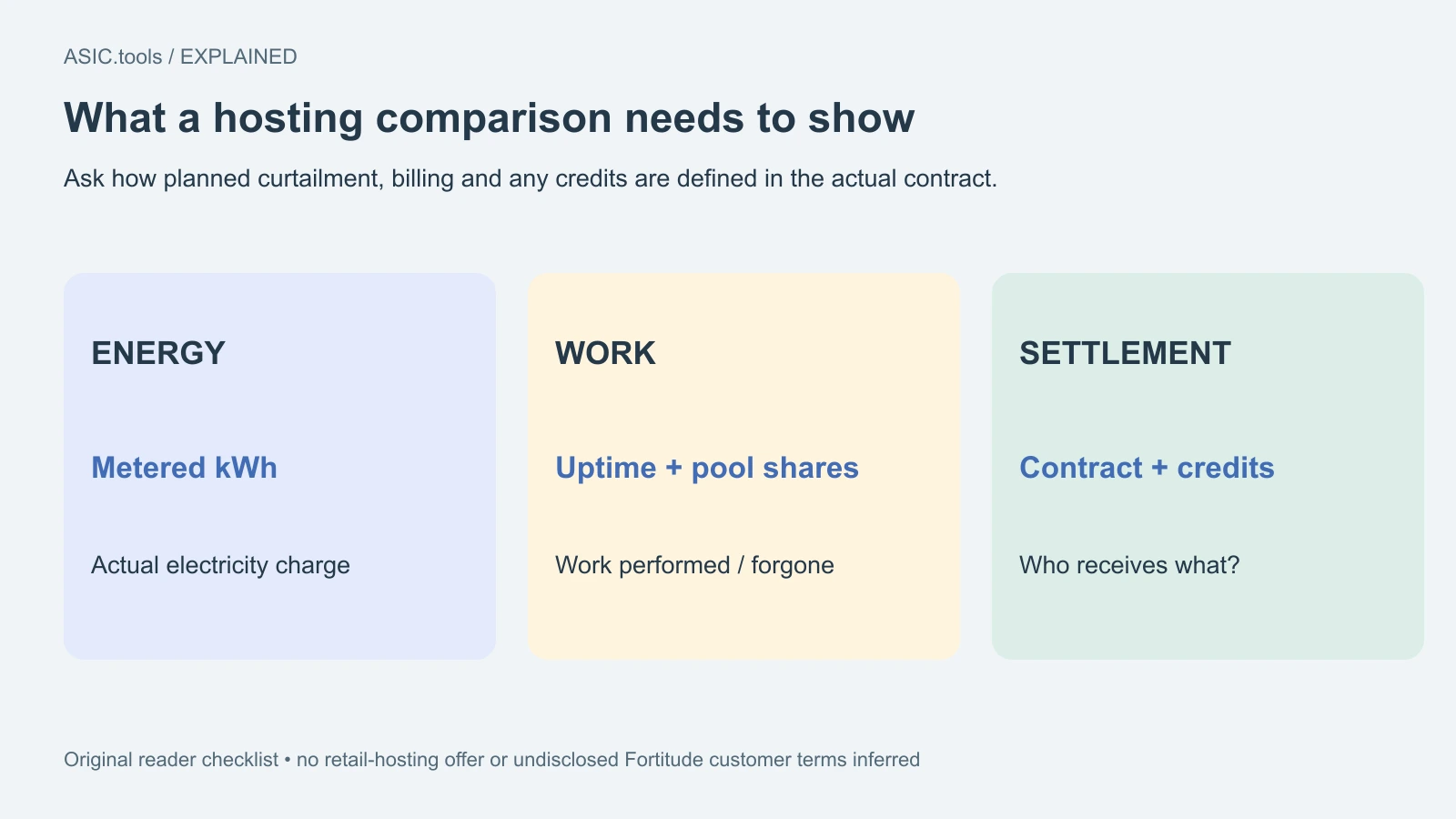
The same distinction applies to a hosting report. A meter can show energy use, a machine log can show uptime, and a pool can show accepted work and payouts. Those records explain different parts of the result. Lower kWh can accompany fewer accepted shares; a lower energy bill cannot be presented as a net gain without comparing the work and income that were also lost.
Hosting customers need the contract behind the uptime figure
For a reader comparing mining hosts, Aurora’s announcement raises a useful contract question: when power use is curtailed, who receives any associated benefit and who bears the lost mining time? A host may have a flexible power arrangement while the customer pays under a separate service contract. The announcement does not state that Aurora offers retail hosting or disclose terms for outside machine owners.
Before choosing a host, ask how the agreement records planned curtailment, how electricity is billed during it and whether service guarantees exclude it. Check whether any credits are passed through and how they appear on statements. Those are questions to resolve from the actual contract, not claims about Fortitude’s undisclosed customer terms. A headline uptime percentage is much easier to interpret when these rules are visible.
The home-mining lesson is about timing, not automatic market access
A household can understand the principle without assuming it has access to SPP’s programme. If a home miner uses a time-based tariff, the owner can compare running through expensive hours with a shorter schedule, using the actual bill and pool result. A household timer, however, is not by itself a registered DDR resource, and no general payment for switching off a home ASIC is established by this company announcement.
Fortitude’s news illustrates why the power agreement is part of mining infrastructure alongside the device and cooling. For a small operator, the practical next step is to keep energy, downtime and net pool receipts in one dated comparison. That makes it possible to assess whether flexibility improves the result for that particular setup, while keeping the company’s reported participation separate from benefits that have not been quantified.
Accepted shares are a pool’s records of contributed work, not a separate block reward for every share. When reviewing a pause, compare records for the same interval rather than a pool’s delayed average with an instantaneous power reading. That helps distinguish intentional load reduction from a connection or device fault without assuming that every drop in reported hashrate has the same cause.
Heat reuse adds another practical question. If a miner supplies useful space heating, stopping it during expensive hours can also remove needed heat. Any replacement heating cost belongs in that household comparison. Likewise, do not count the same electricity saving twice as both a lower energy bill and a separate credit unless the actual settlement shows two distinct benefits.
Source: Fortitude Mining / SPP ↗ · Fortitude official dated announcement index ↗ · SPP demand-response glossary ↗
Mining calculator ↗