ForgeMiner 1.9.2 fixes GPU voltage controls and brings failed cards back to mining
Source report: 2026-11-06 · Editorial analysis published: 2026-11-07
The November 6 release adds visible voltage confirmation on Linux, broader card recovery and memory-clock fixes. Its CMP 90HX test shows why less power and peak hashrate deserve a joint check.
A requested setting is easier to verify
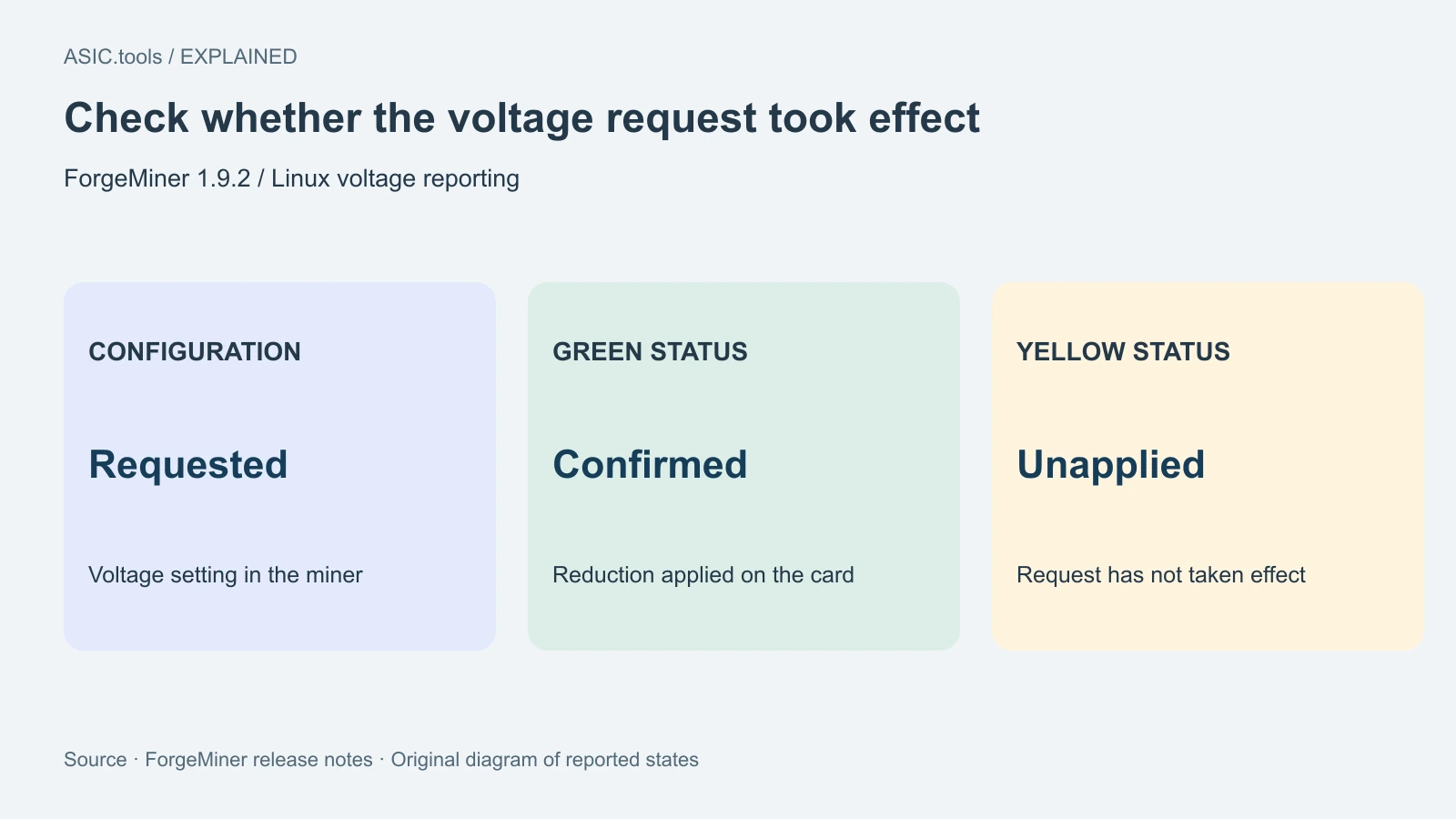
ForgeMiner 1.9.2, released on November 6, fixes voltage controls on many NVIDIA cards and expands recovery after a card fails during mining. For a GPU rig, both changes address lost work that can be hard to spot. A command may appear in a configuration while the card keeps its previous voltage, or a failed card may sit idle while the others carry on.
The developer says some RTX 20, 30, 40 and 50 cards had rejected the requested voltage offset with an ambiguous-record error. The new version takes the control information from the card. On Linux, a Volt column and the API field voltage_mv show the current core voltage. Green indicates that the requested reduction was confirmed on the device. Yellow indicates a request that was not applied.
That visible confirmation gives an operator a way to check a change before comparing electricity use. Voltage is the electrical pressure driving the chip. Reducing it at a fixed clock can lower consumption, while the useful outcome still depends on the card completing valid work. The release describes the software changes and its developer tests. A rig's own pool log and meter provide the results for that installation.
Memory settings have a large hardware dependency
The Linux memory-clock fix covers RTX 20 through 50 cards and the CMP 90HX and 50HX, with NVIDIA driver 595 or newer for these controls. It also restores the previous memory setting when exiting. Following a crash, restoration happens at the next start before mining resumes, according to the release. This matters when another rig manager has already set that clock.
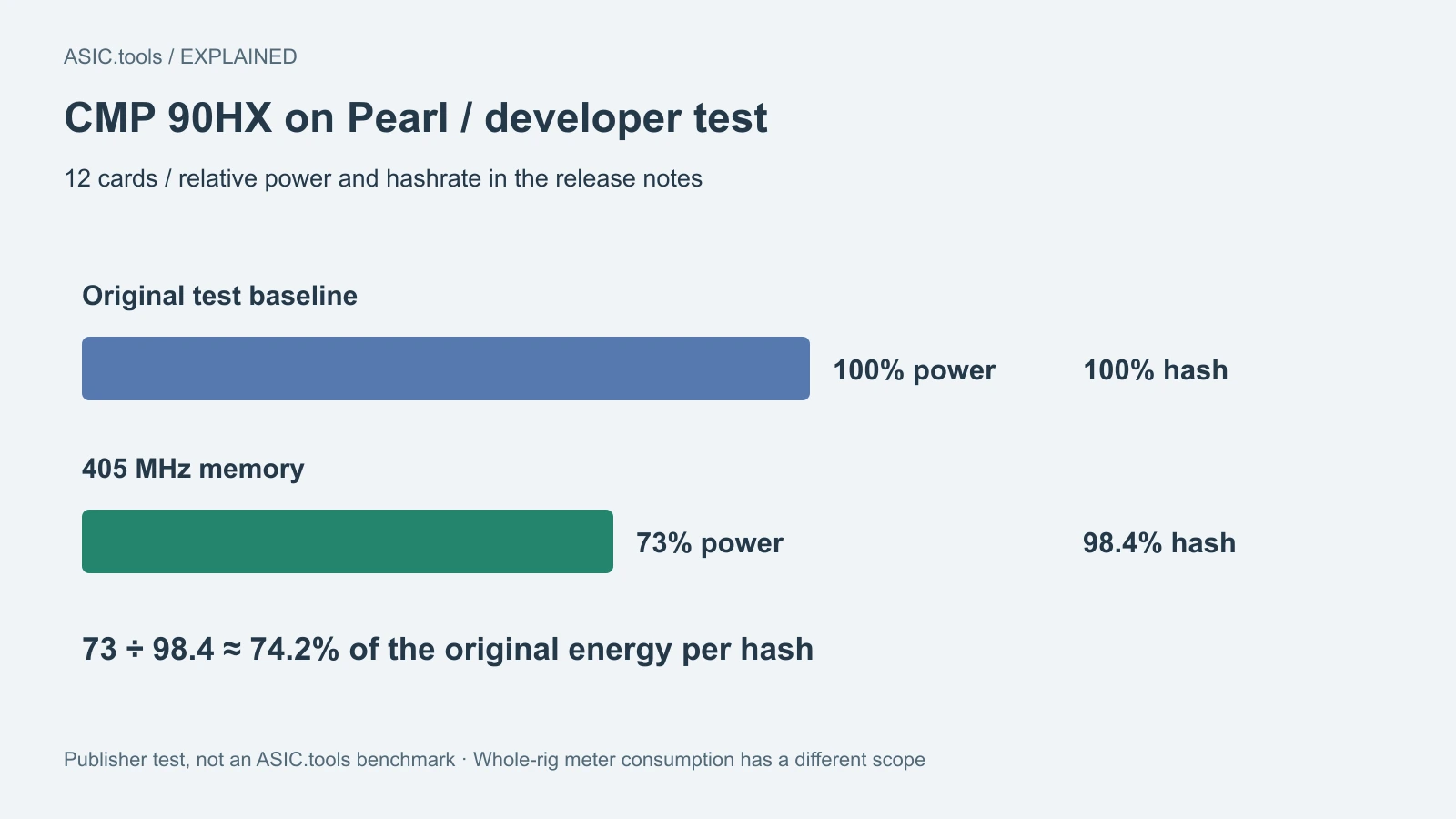
The most striking test in the notes is for Pearl on twelve CMP 90HX cards. At 405 MHz memory, the developer reports roughly 27% less power with 1.6% less hashrate. On RTX 30, 40 and 50 cards, the reported difference is much smaller, up to 1.6 W less per card with up to 0.9% less hashrate. Pearl on RTX 20 and CMP 50HX needs faster memory, and the notes report a sharp loss of performance at 810 MHz or below.
The practical comparison is energy spent per useful hash. Taking the CMP example as relative figures, 73% of the original power divided by 98.4% of the original hashrate is about 74.2% of the original energy per hash. That is an illustrative calculation from the developer's test, roughly a 25.8% improvement in that ratio. The meter for the complete rig also includes the CPU, fans and power-supply losses.
Failed cards get another chance
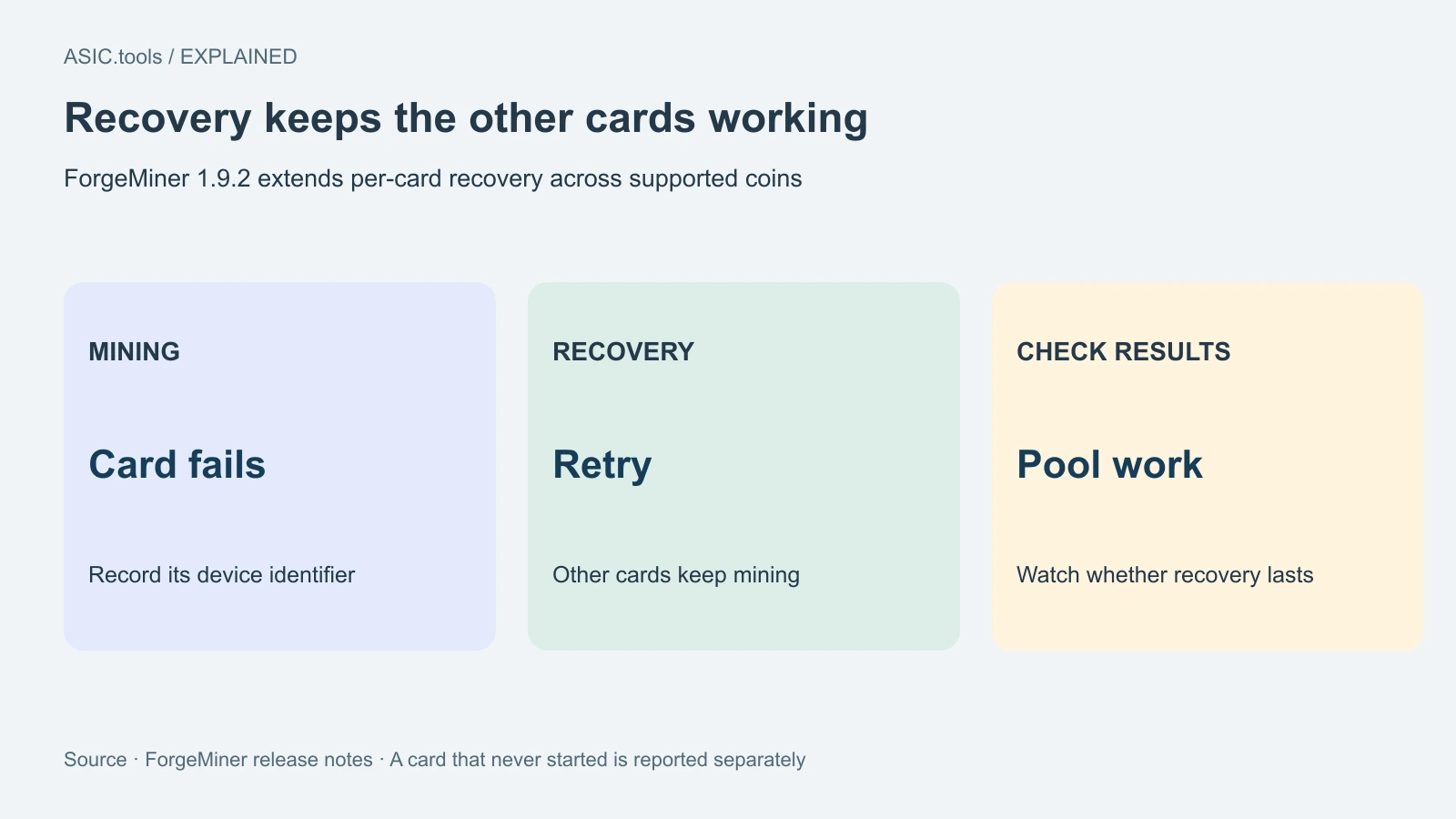
Recovery now covers a card that fails during mining on every supported coin. Version 1.9.1 had provided it only for Quantus. The program retries that card with progressively longer waits while the other cards keep working. A card that never started remains reported as idle. Operators can use the device list to tell those two states apart.
On Windows, the launcher can restart the miner if a card cannot be recovered inside the existing process. The release also addresses RX 7000 cards hanging in chipset-connected slots without PCIe atomics, a communication capability used by some GPU workloads. The affected algorithms named in the fix include Conflux, Xelis and KawPow. These changes concern recovering useful operation after a fault.
A restart entry gives you a time to compare with the pool's accepted work. If the same card repeatedly disappears, keep its identifier and the relevant log entries together. A total hashrate figure can conceal one weak device in a larger rig. The per-card record shows whether recovery lasts and how much work was actually restored.
Check the change over a useful interval
The release also reports faster Quantus and KawPow mining at the same overclock. Those are publisher benchmark claims. For a local comparison, keep the coin, pool and intended clock settings consistent, then inspect accepted work, rejected shares and operating time alongside power. A brief speed peak and a full period of credited mining answer different questions.
The official release includes versioned downloads and SHA-256 checksums for the Windows, Linux and HiveOS packages. A checksum is a fingerprint that can confirm whether a downloaded file matches the listed archive. Keeping the version number and prior configuration with the results makes a later comparison reproducible. This report reviews the release documentation. The software was not installed or benchmarked for the article.
Small-memory rigs get an installation fix
The release also changes how the CMP unlock driver module is built. Previously, compiling on every CPU thread could exhaust memory on a 4 GB rig while it was mining. The new build limits parallel work to the available memory and can create a temporary swap file if needed, removing it afterwards.
The developer reports checking this on a 4 GB rig with twelve CMP 90HX cards mining. Installation logs and later mining logs cover different stages of that change. A completed driver build shows that the installation step finished. The per-card status and accepted work show how the resulting system runs.
Source: ForgeMiner release notes ↗ · Publisher release metadata ↗
Mining calculator ↗