LuxOS deployment through Commander
Source report: 2026-08-19 · Editorial analysis published: 2026-09-10
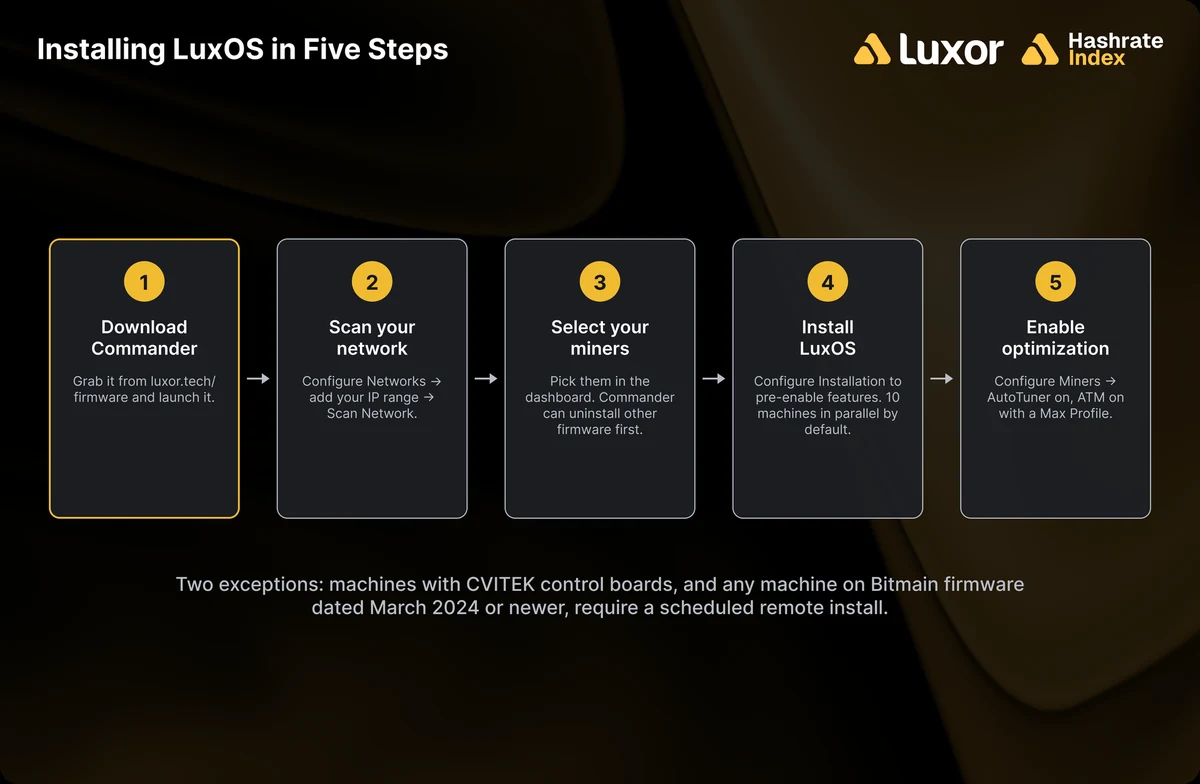
The new guide describes network deployment on supported miners. Control-board compatibility must be checked before selecting a firmware image.
Analysis and practical implications
This section is our analysis and illustrative calculations, separate from the source report.
A firmware rollout starts with an inventory
Installing firmware across a fleet is primarily an exercise in controlling differences. Machines with similar names can use different control boards, power supplies or firmware generations. Before scheduling a deployment, record the exact model and board type for each group and match it with the supplier's current compatibility information.
The inventory should also include the current firmware version, operating profile, network address and pool configuration. These details make it possible to identify which devices changed and to restore the earlier state if the new configuration behaves unexpectedly. A list of network addresses alone is not a reliable rollback plan.
Create a baseline before changing software
Run a representative machine under stable conditions and record measured wall power, temperatures, accepted pool work and any hardware errors. Preserve the settings that produced those measurements. Comparing a new firmware image against an undocumented previous state invites misleading conclusions.
Use a period long enough to avoid judging the result from a momentary display value. A local hashrate estimate, a pool's average and an electricity meter can use different reporting windows. Align those windows when comparing them. An apparent efficiency improvement may disappear when rejected work or additional cooling consumption is included.
Roll out in stages with an actual return path
A practical sequence is one test machine, then a small representative group, then the remaining compatible devices. Define the observation period and failure criteria before expanding. The test group should represent the different hardware revisions and environmental conditions present in the fleet, rather than only the best-performing machines.
Keep the approved original image and recovery instructions available through a trusted source. Verify how the device can be reached if the normal web interface is unavailable. A network deployment tool can simplify installation, but it does not remove the need for device-specific recovery knowledge and access to the physical site.
Measure the result at the business boundary
After deployment, compare accepted work and energy use under the same operating target. If the goal was lower power, do not evaluate success only by peak hashrate. If the goal was additional output, record the extra power and cooling burden as well. A configuration change should be tied to the objective that justified it.
Finally, update the inventory with the installed version and any exceptions. Document devices that were intentionally left unchanged, machines that required recovery and settings that differ from the standard profile. That operational record turns a one-time installation into a maintainable fleet configuration and makes future troubleshooting much faster.
Source: Hashrate Index / Luxor ↗
Mining calculator ↗