SRBMiner 3.8.6 targets GPU efficiency on pearlhash and quantus
Source report: 2026-11-08 · Editorial analysis published: 2026-11-10
The November 8 release names specific NVIDIA generations and AMD support changes. Check accepted work and wall power rather than assuming a universal profit increase.
A targeted update for graphics cards
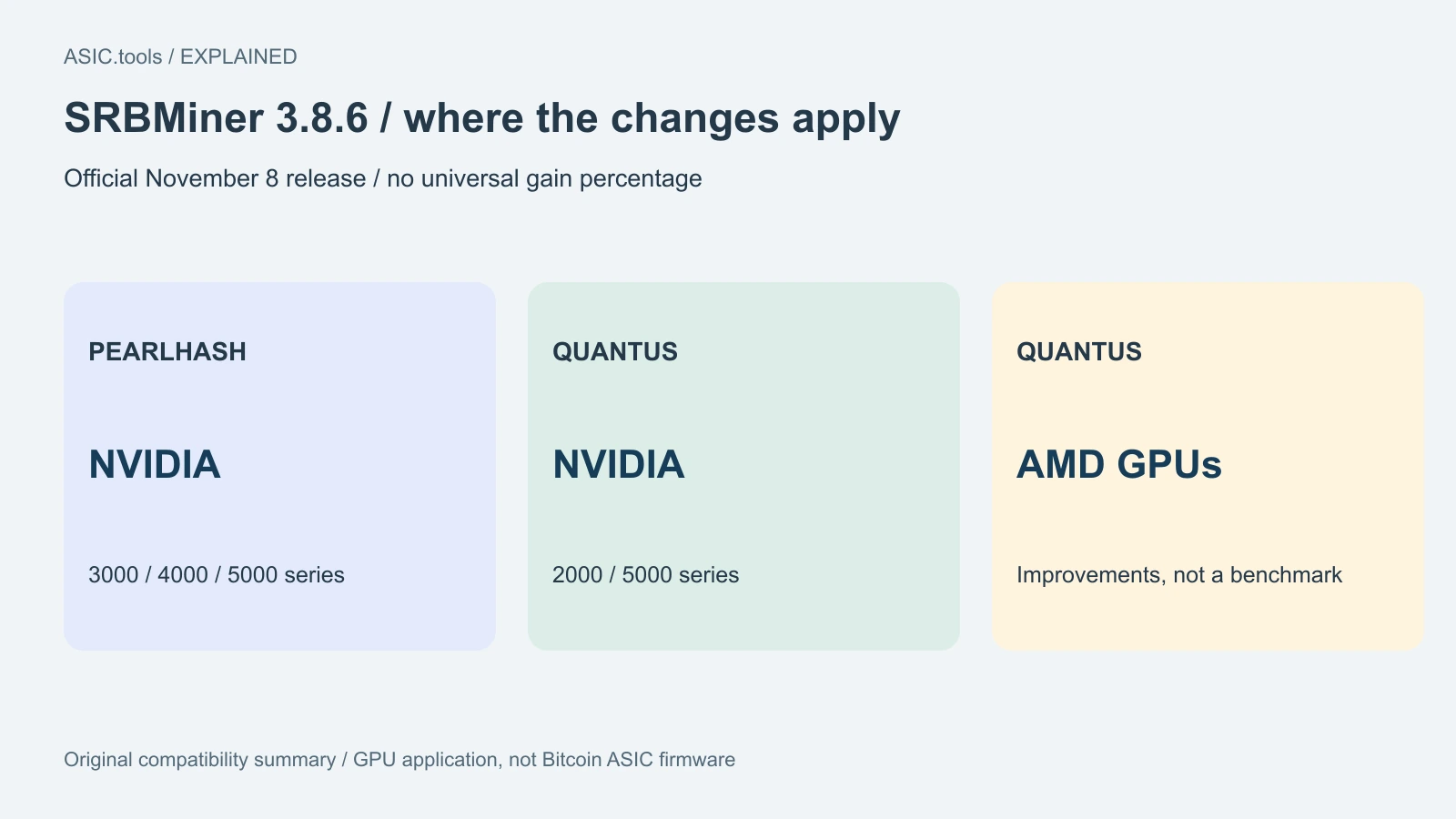
SRBMiner-MULTI 3.8.6, published on November 8 at 21:13 UTC, brings another efficiency-focused update for GPU mining. The developer names better pearlhash efficiency on NVIDIA 3000, 4000 and 5000 series cards, alongside quantus improvements for NVIDIA 2000 and 5000 series and AMD GPUs. The release is marked as a regular release, rather than a prerelease, on the official GitHub page.
For owners of those cards, the practical question is whether the new program can do useful mining work with less electricity, or more work within the same budget. The changelog does not publish a common percentage gain or a universal before-and-after benchmark. Its wording also differs: pearlhash explicitly gets an efficiency claim, while quantus gets improvements without a quantified promise of reduced wall consumption.
Match the card and the algorithm
An algorithm is the set of calculations used for mining a particular network. The same graphics card can behave differently when the algorithm changes. A pearlhash improvement for NVIDIA 3000, 4000 and 5000 cards does not by itself establish the same gain on every other NVIDIA series. Likewise, the named quantus changes for NVIDIA 2000 and 5000 do not become a blanket update claim for all generations.
AMD improvements are also listed for quantus, but without a detailed per-card results table in this release note. Start with the algorithm and exact hardware already used by your rig, then check the relevant software settings. This is a mining application for compatible computers and GPUs. It is not a firmware image to flash into a Bitcoin SHA-256 ASIC, and it does not change an ASIC’s supported algorithm.
Keep the tuner changes in order
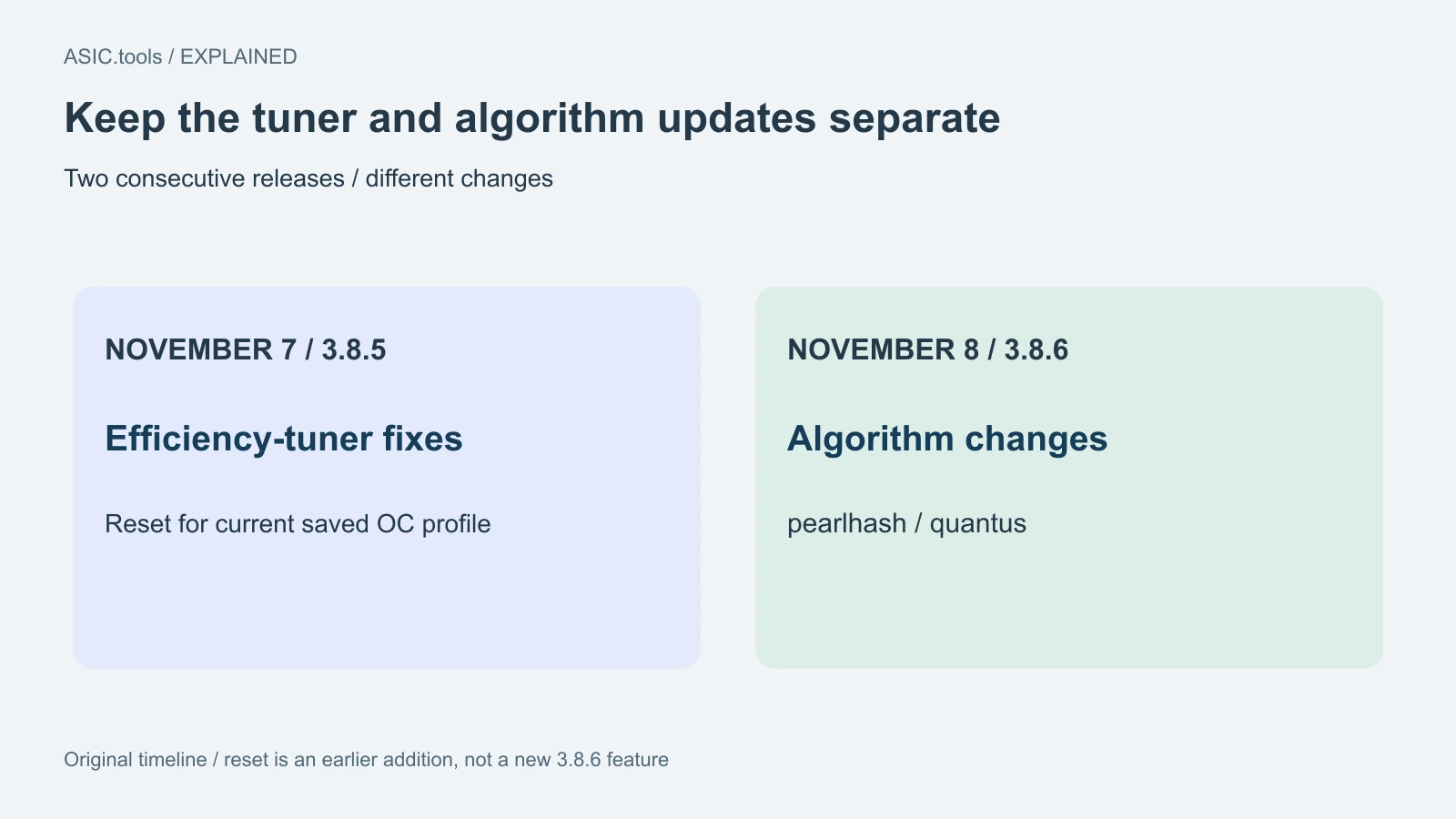
The preceding 3.8.5 release on November 7 fixed the efficiency fine-tuner and added --gpu-power-tuner-reset, which deletes the saved profile for the current overclock configuration. That addition belongs to 3.8.5; the new 3.8.6 note is about the named algorithm improvements. Keeping the two releases separate helps an operator understand whether a result came from a new mining path, an earlier tuner fix or a changed saved profile. The documented reset is NVIDIA-only and does not itself enable tuning.
A saved tuning result is tied to the conditions under which it was obtained. Record the old settings before changing them, and use the documented reset only when you mean to discard that current profile. Do not erase a working setup merely to make a version number look current. A controlled test with a copy of the old configuration makes it easier to return to a known result if the new settings behave poorly.
What to measure after changing versions
A useful comparison records accepted work at the pool, energy at the wall, temperature and stability over comparable periods. Pool shares are small pieces of proof that a miner is doing work; accepted shares count, while stale or rejected work can make a fast local display misleading. Short tests can also be noisy, so compare similar durations and allow the system to settle before treating a result as representative.
Keep algorithm, pool, card clocks and power settings consistent for the initial version comparison. If you then tune power or clocks, record that as another change. This separates a software improvement from a different operating point. A result that works on one card is useful evidence for that card, rather than proof that every machine in a mixed rig will gain the same amount.
Saved watts need a price tag
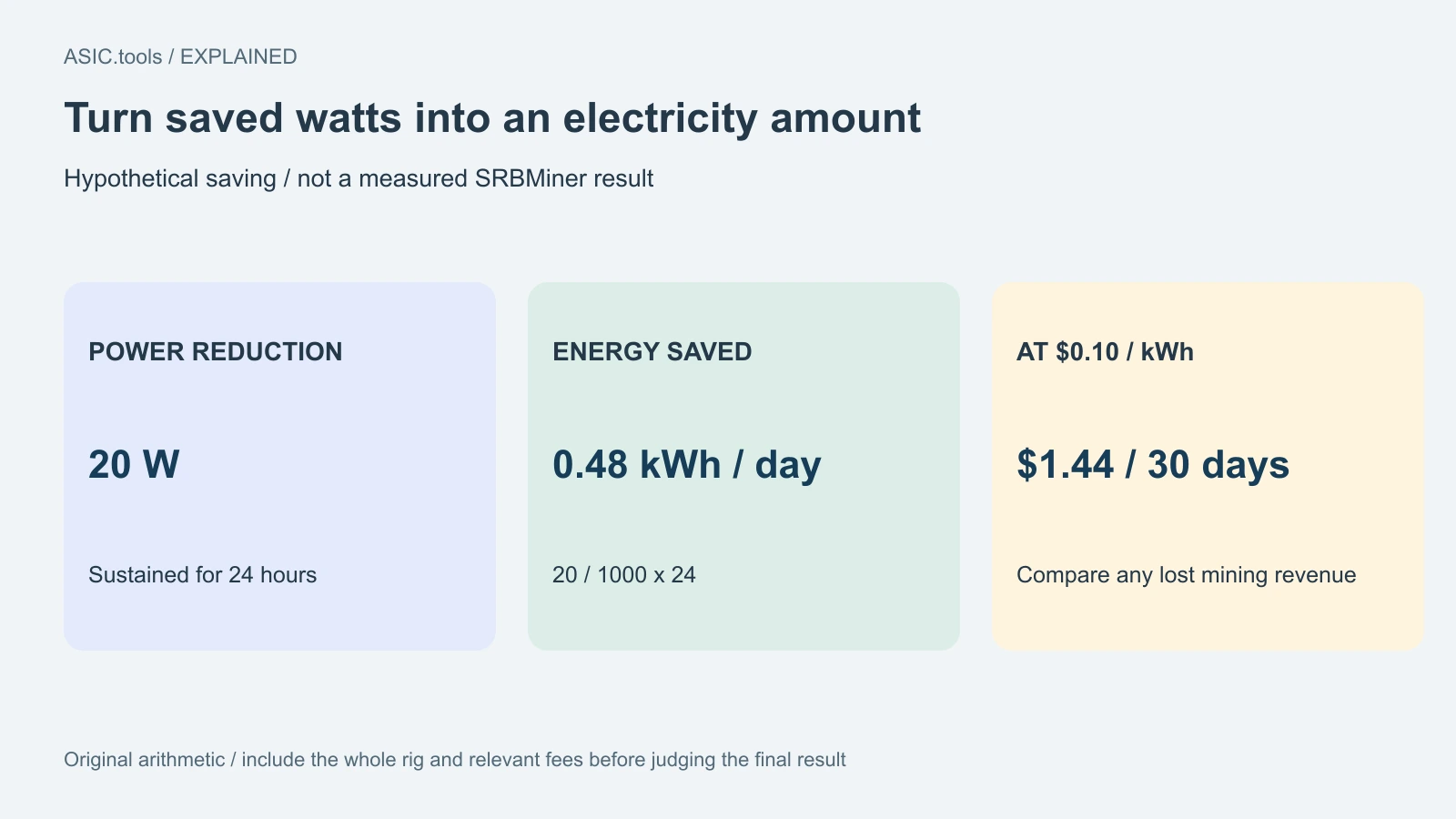
For scale, a hypothetical 20 W reduction sustained for 24 hours saves 0.48 kWh a day. At an illustrative electricity price of $0.10 per kWh, that is $0.048 a day, or $1.44 over 30 days. This is arithmetic for a chosen example, not a measured benefit of SRBMiner 3.8.6 or a quoted electricity tariff. It shows why a visible improvement on a chart may produce only a modest cash difference.
If the lower power setting also reduces accepted hashrate, compare the lost revenue with the saved electricity. The official algorithm list currently shows a 2% developer fee for pearlhash and quantus; that is distinct from any pool fee. A gross revenue estimate should account for the fee treatment it actually uses. Count the complete rig’s consumption, including the computer and other equipment outside the GPU’s own reported power.
Downloads and the decision to switch
The official release provides Windows and Linux packages and a custom HiveOS archive. Its HiveOS instructions require manual algorithm, pool and wallet configuration. Selecting a custom miner therefore does not supply the correct payout destination automatically. Preserve and check your intended settings rather than copying a random example with somebody else’s wallet address.
Use the developer’s release page as the download starting point; GitHub’s asset metadata also provides SHA-256 digests for comparing the downloaded files with the listed assets. A checksum matches bytes to a reference, not a profitability test. For a working rig, the reason to keep 3.8.6 should be a better measured result on its actual workload. The release offers a specific opportunity to test, with no basis for replacing that measurement with a promised percentage gain.
Source: SRBMiner developer / GitHub ↗ · SRBMiner 3.8.5 previous release ↗ · Official parameters ↗ · Official algorithm support and developer fees ↗
Mining calculator ↗