
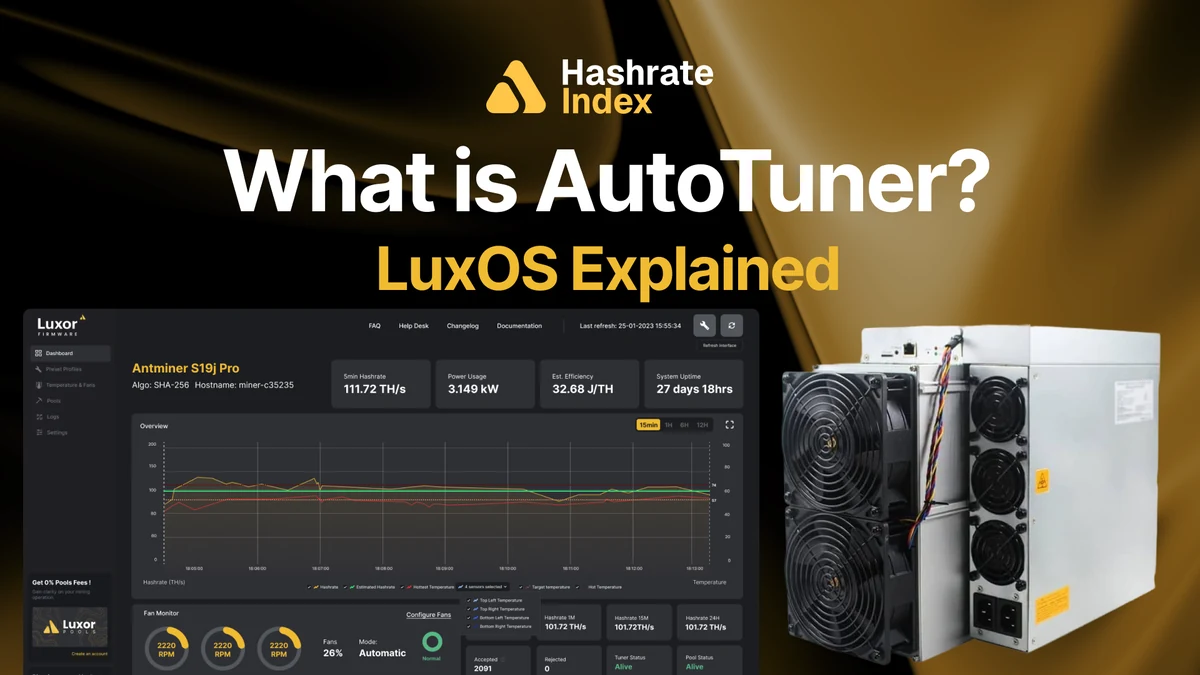
AutoTuner adjusts voltage to the workload
Source report: 2026-06-23 · Editorial analysis published: 2026-09-10
The feature searches for stable operating settings at a target hashrate. Results depend on the individual machine and environmental conditions.
Analysis and practical implications
This section is our analysis and illustrative calculations, separate from the source report.
Automatic tuning needs a defined target
A tuning system can search for an operating point, but the operator still needs to choose the objective. Maintaining a hashrate target, minimizing energy per unit of work and maximizing total production are different tasks. The preferred setting depends on the site's power, cooling and commercial constraints.
State the target before evaluating the result. If a tuning process lowers power by also lowering output, compare the resulting contribution rather than declaring success from the power number alone. A useful result connects energy consumption, accepted work and stable operating time.
The individual machine matters
Devices with the same model name can behave differently because of component variation, operating history or repair work. A setting that is stable on one machine may not be the best setting for another. Automatic adjustment can respond to some differences, but it does not remove the need to observe the actual device.
Keep a record of machines that repeatedly diverge from the expected behavior. Those exceptions may need maintenance rather than more aggressive tuning. The operating objective is a fleet that remains understandable, not a collection of unexplained individual settings.
Use a matched before-and-after test
Record a baseline with the same measurement boundary used for the tuned result. Include wall power, accepted pool work, error behavior and operating conditions. Avoid comparing a short favorable interval after tuning with a long mixed interval before it.
If auxiliary cooling changes, include the associated energy in the installation comparison. A lower device temperature can be valuable, but the business result depends on the total energy and useful work. Separate the supplier's claim from the measurements made at your site.
Turn the result into a maintained configuration
After a successful test, document the version, target and relevant limits. Define how the system behaves when conditions change and how an operator restores an approved state. A setting that is efficient today may require review after maintenance or a significant change in ambient conditions.
Automatic tuning is most useful when it reduces repetitive adjustment while preserving visibility. The operator should still be able to explain what the controller is trying to achieve, how success is measured and which conditions require human attention.
Source: Hashrate Index / Luxor ↗
Mining calculator ↗