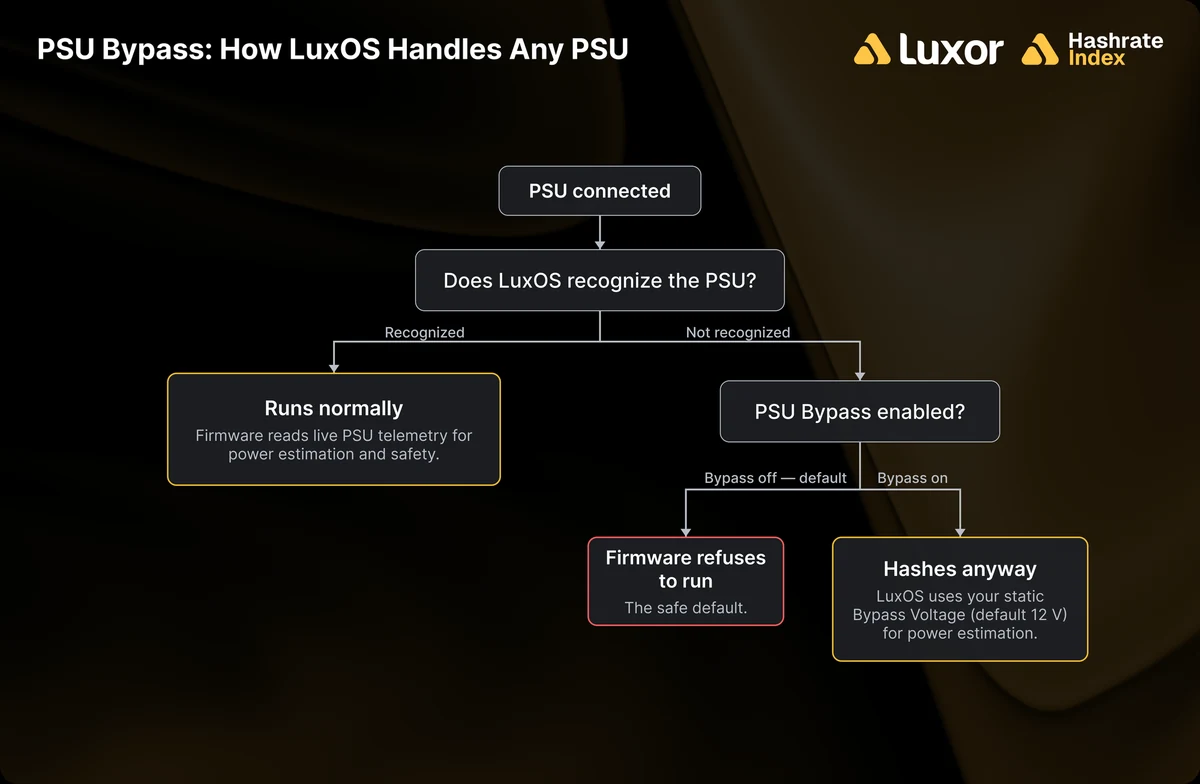
LuxOS explains its PSU Bypass option
Source report: 2026-07-31 · Editorial analysis published: 2026-09-10
The feature relaxes PSU identification requirements. Electrical compatibility and equipment limits still apply; it is not universal power-supply compatibility.
Analysis and practical implications
This section is our analysis and illustrative calculations, separate from the source report.
Identification and electrical compatibility are separate
A power supply may be electrically suitable for a device yet fail a firmware identification check. The reverse is also possible: recognizing a component does not prove that every proposed operating setting is appropriate for the installation. A bypass feature addresses a software check; it does not rewrite the electrical limits of the equipment.
That distinction should guide any discussion of alternative or repaired power supplies. The relevant information includes voltage, current capacity, connectors, control compatibility and the conditions under which the combination has been approved. A convenient software option is not a substitute for that information.
Understand why a check exists before bypassing it
Identification can help firmware select expected behavior or reject an unsupported configuration. If a device does not recognize its power supply, the cause might be a communication problem, an incompatible component or a change introduced during repair. Diagnosing the cause is more informative than immediately suppressing the check.
Maintain a record of the original configuration and the repair history. That helps technicians distinguish an intentional replacement from an unexpected component. It also makes later support discussions more precise: the supplier can evaluate a defined combination rather than a machine described only by its external model name.
Evaluate the entire power path
The power supply is one part of the electrical installation. Cables, connectors, distribution equipment and the available input circuit also impose limits. Changing one component does not increase the capacity of the others. A safe operating plan must remain within the documented limits of the complete path.
For a repaired machine, a controlled acceptance test should record stable operation, measured consumption and relevant temperatures. Do not use an aggressive performance profile as the first proof that a replacement works. The immediate objective is a supported, stable configuration that can be documented and maintained.
Treat flexibility as a maintenance capability
The useful promise of a flexible firmware feature is that it may support a documented repair or a specialized configuration. That can have practical value when original components are unavailable. The value depends on clear compatibility evidence and a responsible operating procedure.
Keep the feature's software behavior separate from claims about universal compatibility. If the supplier has not documented the proposed hardware combination, record that uncertainty rather than presenting the bypass as approval. For fleet management, an exceptional configuration should remain identifiable so that future updates and maintenance do not silently apply inappropriate assumptions.
Source: Hashrate Index / Luxor ↗
Mining calculator ↗