Controlling a fleet by watts
Source report: 2026-07-14 · Editorial analysis published: 2026-09-10
Power Targeting adjusts operating parameters toward a chosen wattage within configured limits, helping align miners with site power budgets.

Analysis and practical implications
This section is our analysis and illustrative calculations, separate from the source report.
A power target expresses the site constraint directly
A site often has a defined electrical limit: the capacity of a connection, a distribution circuit or an operating agreement. Controlling miners by a wattage target can make that limit easier to manage than choosing a frequency and hoping the resulting consumption fits.
The target still needs a measurement boundary. Device-reported power, wall power and the load at the site connection are not necessarily identical. A fleet controller should leave room for auxiliary equipment and measurement uncertainty rather than allocating the entire connection rating to the sum of miner targets.
Distribute a budget across different machines
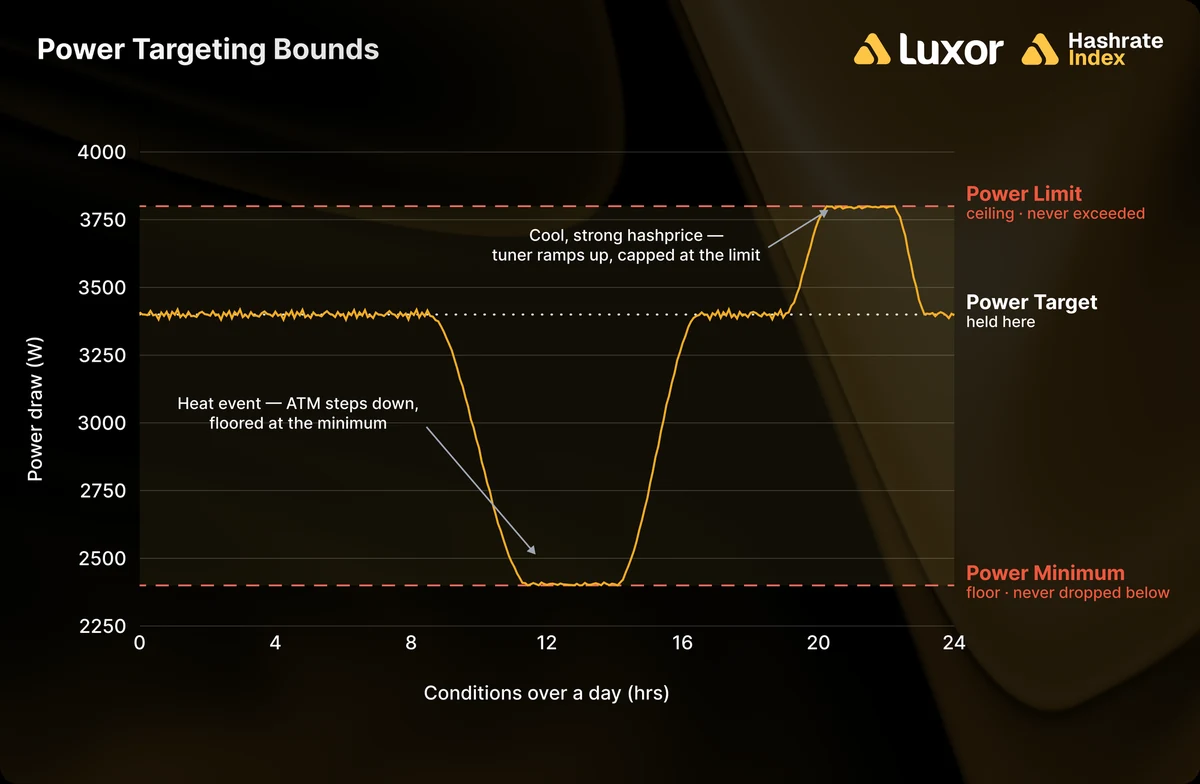
A mixed fleet contains devices with different efficiencies and operating ranges. Giving every machine the same power target may be simple, but it may not produce the best useful output within the site's limit. The allocation should account for measured performance and stability.
For illustration, a 100 kW miner budget could support 25 devices at 4 kW or roughly 33 at 3 kW, but those arrangements cannot be judged without their accepted work and operating limits. The number of powered machines is not the objective. The objective is useful production under the actual electrical and thermal constraints.
Allow the controller to settle
Changing a target can create a transition period while the system adjusts. Evaluate the settled result rather than the first seconds after a command. Record whether the actual consumption remains within the intended band and whether accepted work stays stable.
If targets are changed frequently, define how the control system handles delays, missing measurements or devices that cannot reach the requested point. A reliable fleet policy needs predictable behavior for those exceptions. Otherwise a nominal site limit can be undermined by a small group of machines operating outside the expected response.
Connect power targeting with commercial decisions
The power budget can change with electricity prices, cooling conditions or site requirements. Keep the reason for each scheduled change visible in the operating record. This makes it possible to assess whether the policy improved contribution or merely reduced production.
A useful test compares total accepted work and total energy over matched intervals. Include the effect on auxiliary cooling and maintenance if those change materially. Power targeting is most valuable when it translates a real site constraint into a measurable operating policy, with enough margin to remain reliable under ordinary disturbances.
Source: Hashrate Index / Luxor ↗
Mining calculator ↗