Electrum 4.8.3 closes a wallet trap: check before raising a Bitcoin fee
Source report: 2026-10-24 · Editorial analysis published: 2026-10-25
Electrum disclosed an actively exploited flaw on October 24. Older wallets could be tricked into signing a different payment during a fee increase; version 4.8.3 adds a signature check.
A small update with a real reason to act
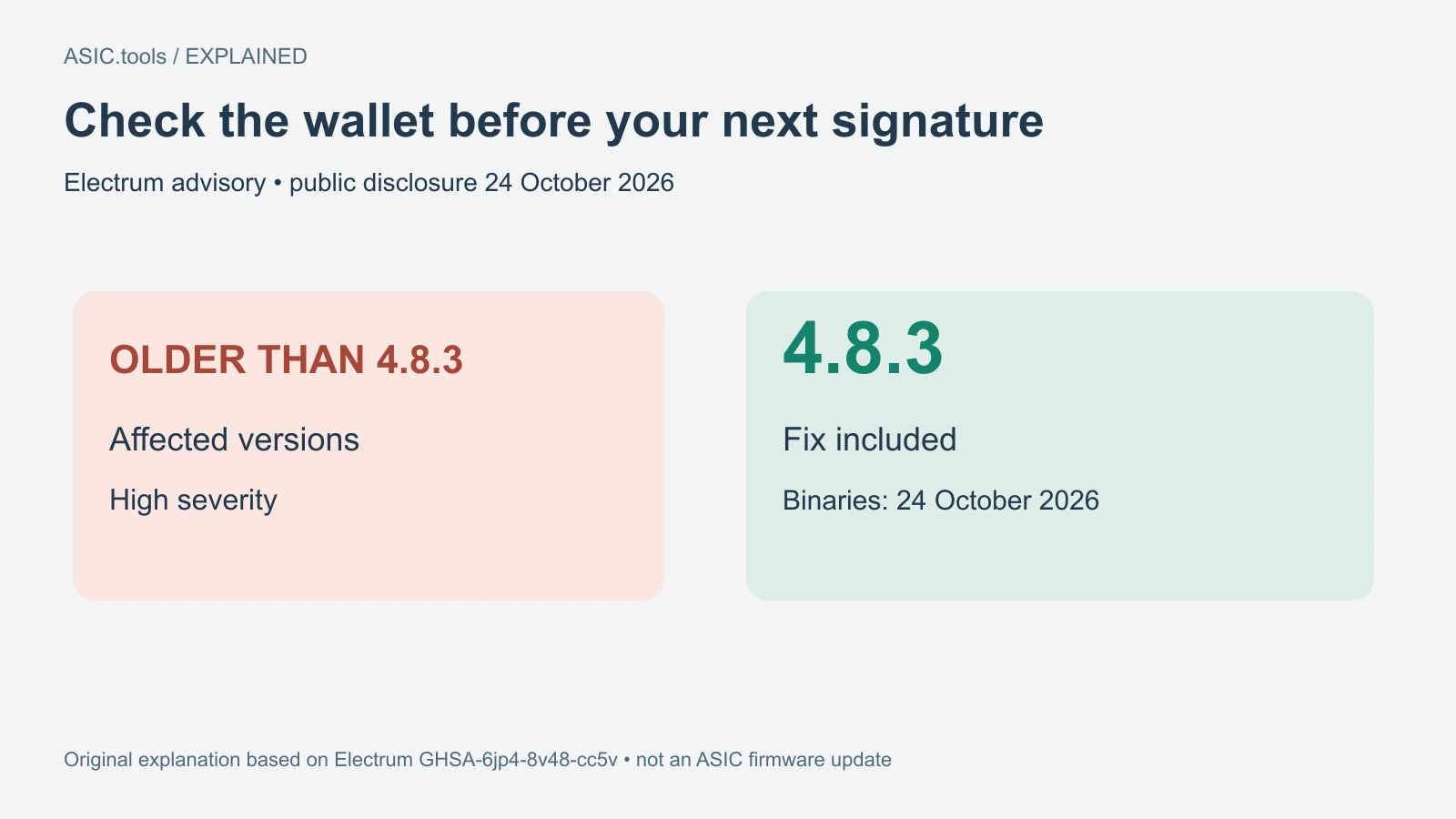
Electrum published a security advisory on October 24 for a flaw affecting versions earlier than 4.8.3. The developers say malicious servers are already exploiting it, and one reported user lost money after increasing a transaction fee. For someone who stores mining payouts in Electrum, the useful action is to check the wallet version before signing another payment.
The advisory rates the issue High. Version 4.8.3 contains the fix: its source tag and release notes are dated October 23, while the advisory dates the downloadable binaries and public disclosure to October 24. Those are different stages of the same release, not two separate security incidents.
This concerns the wallet used to authorize spending. Installing an ASIC firmware update, changing a pool or altering the payout address would not install the Electrum correction. First identify which program actually holds or signs for the coins you intend to spend.
How the trap works
Electrum is a lightweight wallet: it asks servers for blockchain information rather than maintaining a complete validating Bitcoin node itself. A transaction that has not yet entered a block is unconfirmed. The flaw involved how the wallet accepted certain unconfirmed transactions into its history.
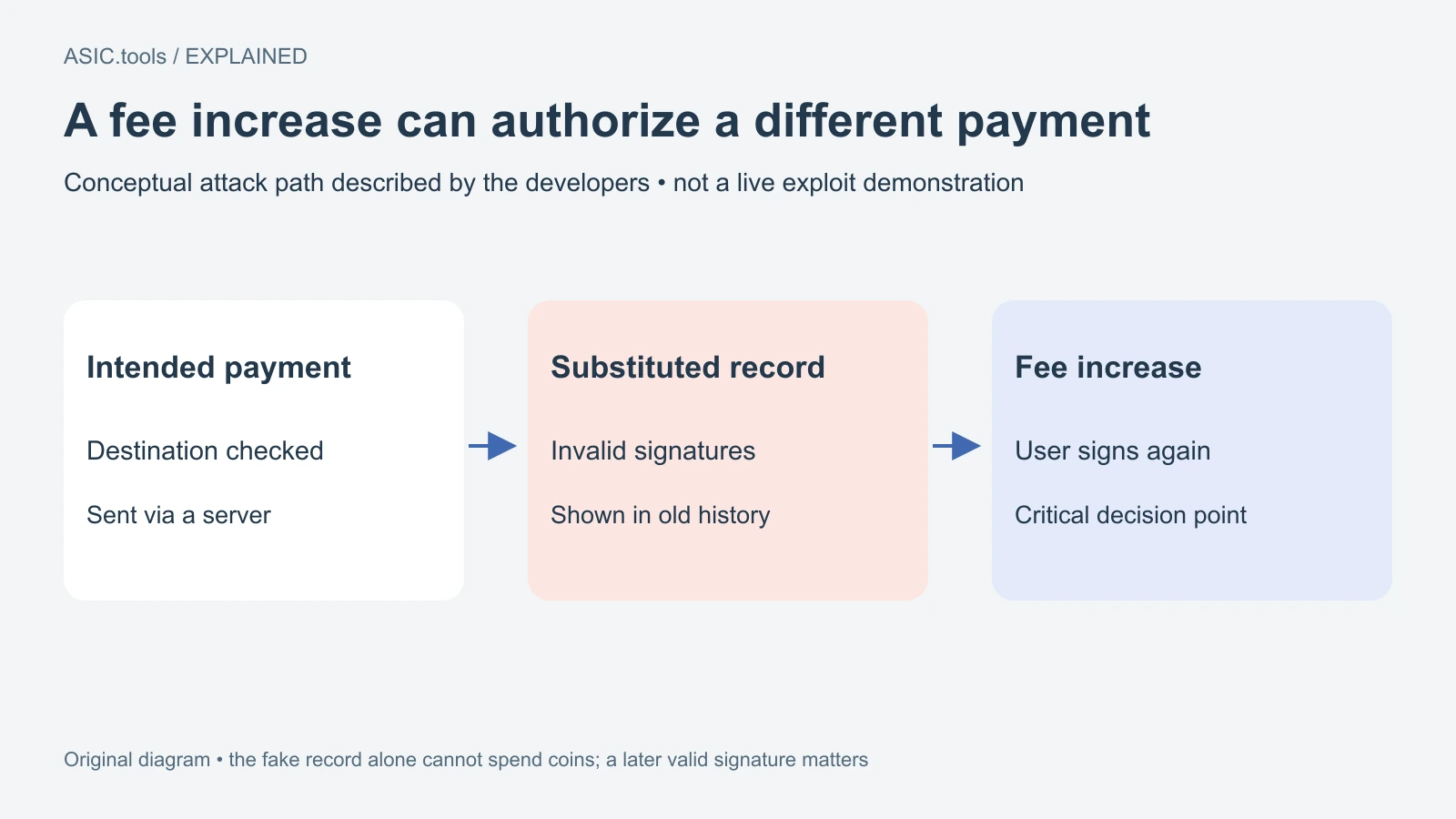
According to the developers, a malicious server could hold back a newly sent payment and instead show a conflicting, invalid transaction with an attacker’s destination. At that point the substituted transaction did not have valid signatures. The dangerous next step was the user choosing to increase its fee and authorizing a newly signed version.
It is like checking one payment order, then approving a changed copy because its label still looks familiar. The problem was the connection between the displayed history and a later signing action. It does not mean a fake unsigned transaction alone can spend everyone’s Bitcoin or that the Bitcoin network accepted invalid signatures.
Why a fee increase is another payment decision
Replace-by-Fee, usually shortened to RBF, lets a suitable unconfirmed payment be replaced by one offering a higher fee. People use it when a payment is waiting and they want miners to prioritize it. The replacement still requires a valid authorization to spend the wallet’s coins.
That is why a fee-adjustment screen deserves the same attention as the original send screen. Check the destinations and amounts again. The advisory says the reported attackers made destination addresses whose final four characters matched the intended address; comparing only a short suffix was not enough.
The developers also describe a reported fake transaction with a zero fee, apparently intended to encourage a fee increase. A strange fee or unfamiliar history entry is a reason to investigate the actual transaction, rather than assume that pressing the fee button will repair every problem.
What 4.8.3 changes
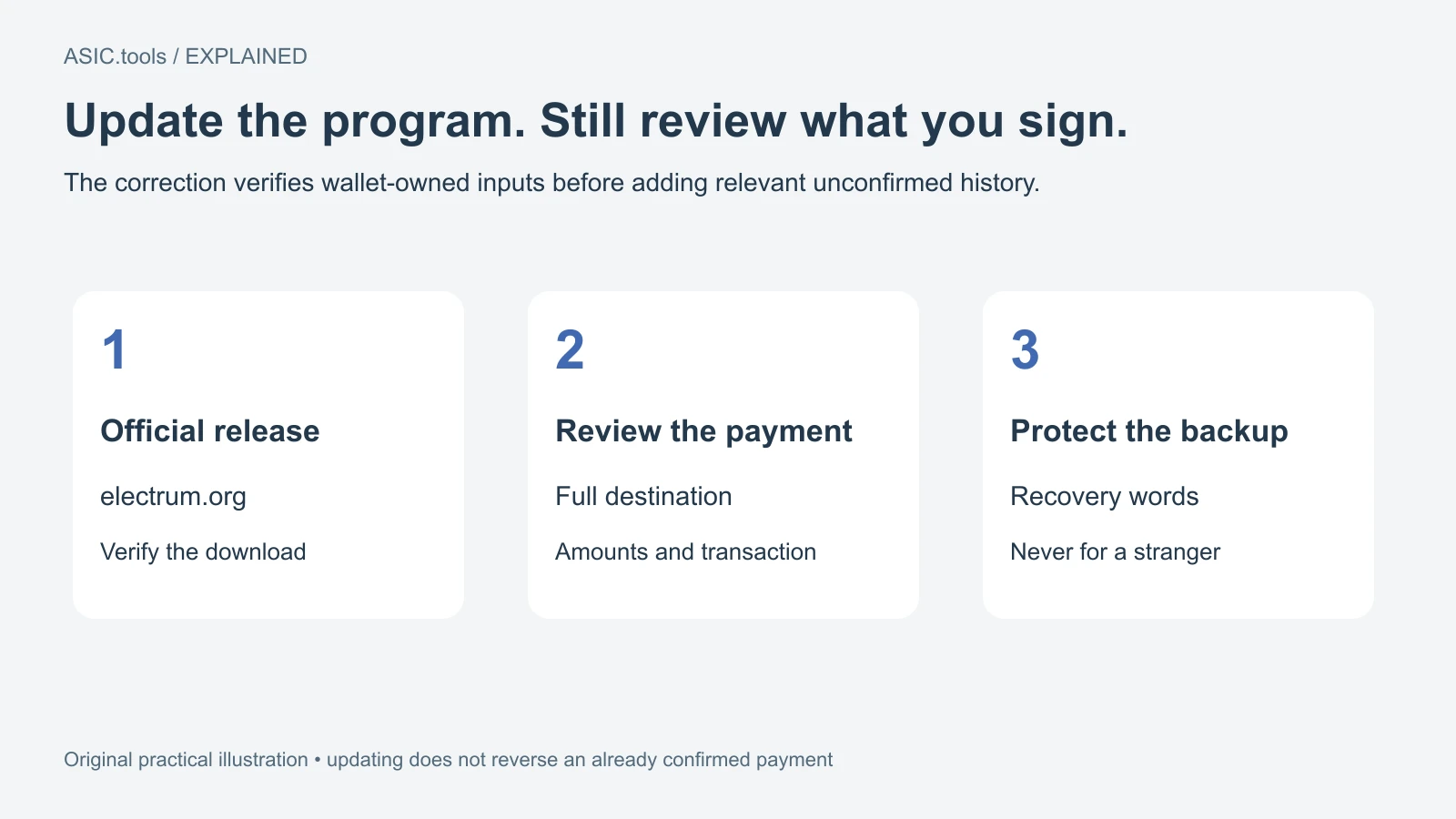
Before adding a relevant unconfirmed transaction to local history, the updated wallet verifies signatures for inputs belonging to the wallet. An input identifies coins being spent. This check addresses the described route from an invalid substituted transaction to a later valid signature.
It does not turn Electrum into a full validating node. The advisory explicitly distinguishes wallet-owned inputs from incoming transactions, which are not covered by that same added check. There is no need to infer a wider protection guarantee from the fact that this particular flaw is fixed.
The developers say clients connected to servers they trust, for example their own server, are not affected by this server-based attack. Their general recommendation remains to upgrade regularly. Running your own server also involves maintaining it; choosing any server with a reassuring name is not the same arrangement.
Update through the official route
Use electrum.org to obtain the release for the platform you actually use. The project warns against downloads from other sources and provides digital-signature verification instructions. A digital signature helps check who produced the download and whether it has changed.
Do not follow an update link from a private message or hand a recovery phrase to someone offering to patch the wallet. The recovery phrase is the backup that can restore control of the coins; it is not needed by a support stranger to identify an installed version.
If a payment already looks wrong, compare its full destination, amount and transaction identifier with your intended payment before authorizing another spend. The advisory reports real losses but does not provide a total loss figure or a promise that updating reverses a transfer already signed and confirmed.
What this means for mining payouts
A pool balance, a payment arriving at a wallet and a later outgoing payment are separate stages. The described attack targets the spending workflow in Electrum. A payout appearing in a history list is not the same event as the owner signing a replacement transaction.
For a home miner, the wallet application may be easier to overlook than the mining device. Yet an efficient machine cannot protect a later payment signed to the wrong destination. Keeping the wallet current and reviewing each authorization protects a different part of the same income path.
The practical takeaway is specific: check Electrum, install the official corrected release and treat a fee increase as a fresh signing decision. The software advisory is not a change to Bitcoin’s mining algorithm, block reward or the amount a pool owes you.
Source: Electrum ↗ · Official download and signature verification ↗ · 4.8.3 release notes ↗
Mining calculator ↗