Dash warns against Eclipse after users report losses in attempted swaps
Source report: 2026-11-07 · Editorial analysis published: 2026-11-08
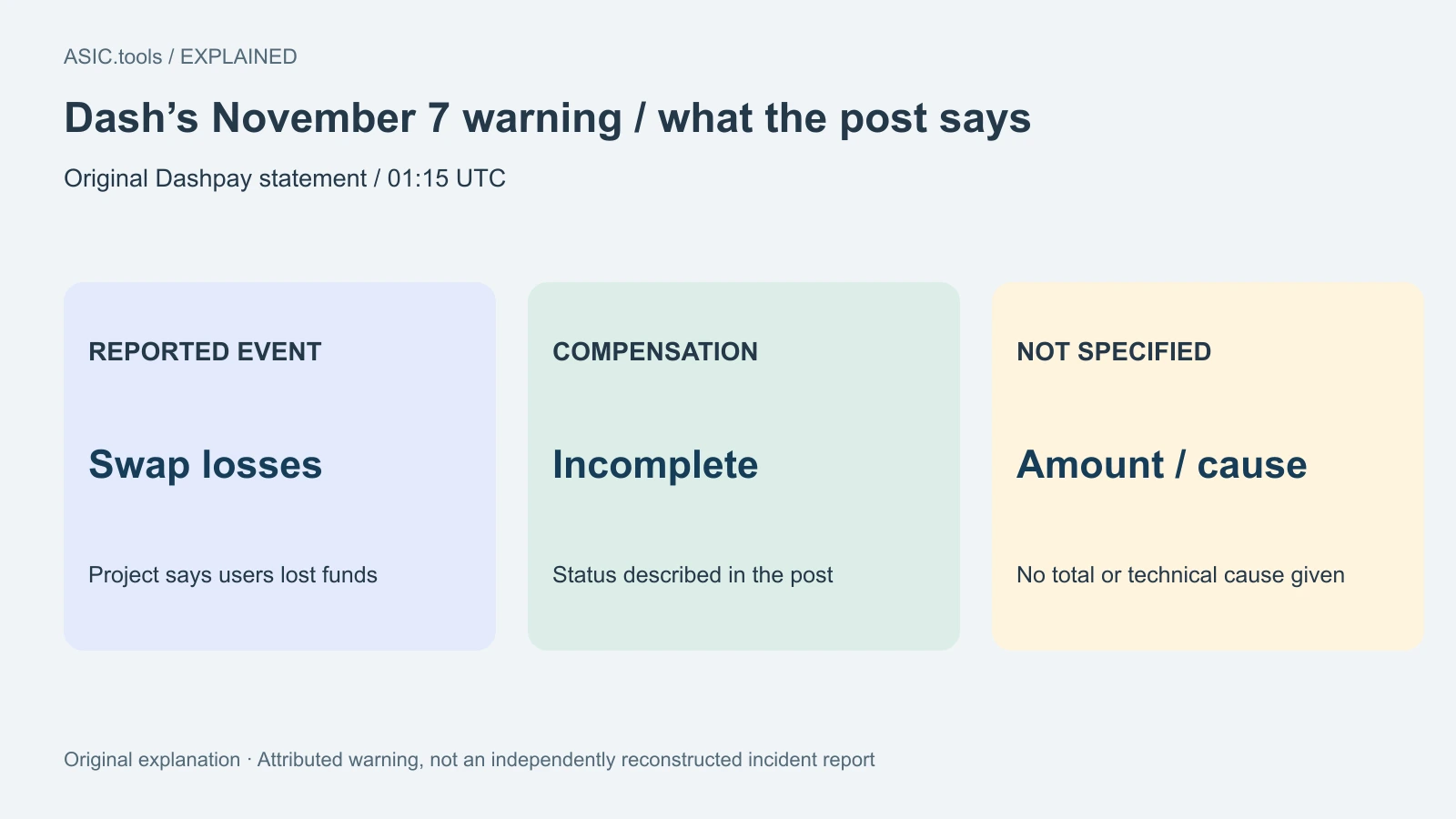
The original November 7 post says users had not received full compensation. It does not publish a loss total or technical cause.
Dash tells users to avoid Eclipse
Dash warned users on November 7 not to use Eclipse, saying people had lost funds while attempting trades and had not received full compensation. For miners who later exchange their earnings, the warning concerns the step after receiving coins: a successful mining payout does not by itself make the next swap safe.
We verified the original Dashpay post through X’s public syndication and embed responses. It was published at 01:15 UTC on November 7. Dash’s own contact page links to that account. The warning is an attributed statement from the project, rather than an independently reconstructed list of affected transactions.
The post does not state a total loss, affected-user count, technical cause or compensation deadline. It names Eclipse in the exchange context without supplying a service URL. We therefore do not map that name to a different similarly named blockchain, application or website, or claim that every product using the name is affected.
The immediate point is to take the named warning seriously while retaining its actual scope. The article does not need a guessed loss figure or a claim that the Dash network stopped. It reports the project’s dated warning and explains which records help a miner distinguish earnings received from an exchange still unfinished.
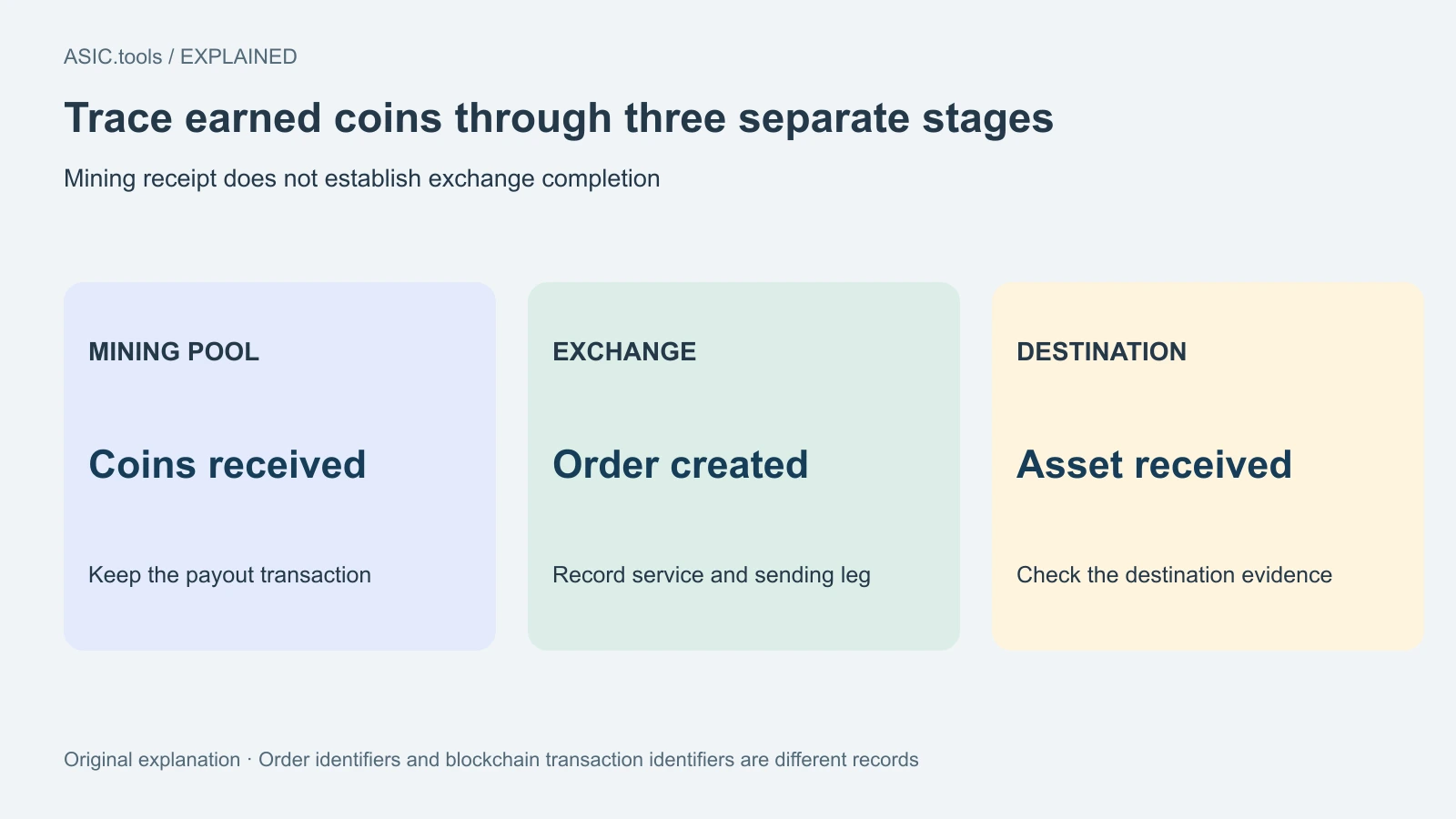
Mining and exchanging are different stages
Dash is a proof-of-work network using the X11 hashing algorithm, and its documentation describes ASIC mining. A miner’s pool payout is one event. Sending those coins into a later exchange is another event, potentially involving another asset or network and a separate service.
That distinction matters when reviewing an income record. Coins credited by a mining pool can subsequently encounter a problem in a trade. Combining both stages into one daily balance can hide where the interruption occurred. Keep the mining payout record and the exchange order record separately so each can be checked against its own evidence.
A simple route has a sending side, an exchange process and a receiving side. A transaction confirming on the sending network shows what happened there; it does not by itself prove that the promised asset arrived at the destination. The useful question is which stage has a verifiable transaction and which stage still has only a service status message.
Why Dash mentions visible swaps
The post names Maya Protocol and NEAR Intents as examples of exchanges where a user can see the swap through a block explorer. A block explorer is a public tool for reading transactions on a blockchain. That visibility is the reason stated in the warning, not a new safety certification issued by ASIC.tools.
A transaction identifier is useful when it corresponds to the right network, asset and operation. For a route involving different networks, record the sending transaction and any destination transaction separately. An order number inside a service and a blockchain transaction identifier are different kinds of evidence, even if an interface displays them together.
Visibility makes it easier to ask a precise question about missing delivery or a delay. It does not make every route risk-free, fix the amount an exchange will deliver, or guarantee reimbursement. The alternatives remain Dash’s examples; a reader still needs the current terms and actual route details of any service they consider.
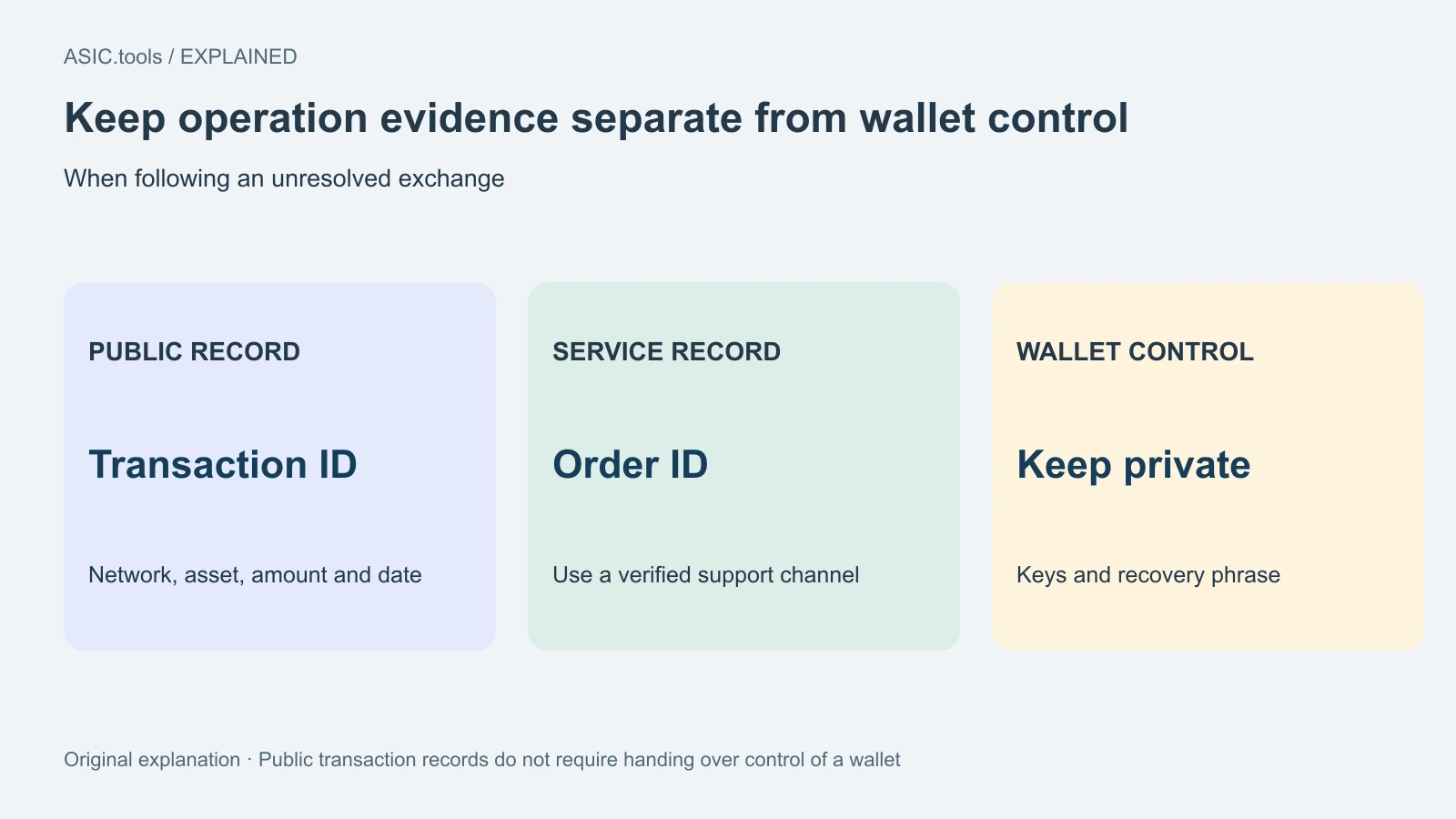
Keep an evidence trail for an unfinished exchange
If a trade is already unresolved, keep the service order identifier, the asset sent, the intended received asset, addresses and dated transaction records. These details identify the operation. A screenshot of an estimated quote alone may not show whether a transfer was broadcast or what reached the other side.
Use a verified support route and ask for the status of that specific order and its transactions. Dash’s standing safety documentation warns about impersonation and directs users to public support channels or its support desk. That is relevant background when a public loss warning draws unsolicited messages offering help.
A transaction record can be shared without handing over control of a wallet. Private keys and recovery phrases provide that control and should remain private. The records needed to explain an exchange problem are the public operation details; they are not a reason to give a stranger the means to spend unrelated mining proceeds.
Keep the amount of each asset and any service fee in its own unit. A DASH balance, an expected destination-token amount and a dollar valuation are different measurements. This makes a later support answer easier to compare with the original order without confusing a price change with a change in the number of coins.
Read compensation claims with their date
The phrase about incomplete compensation describes the state reported in the November 7 post. A later claim that users have been repaid would need its own dated evidence, including the operation and amount it refers to. A response to one user would not automatically establish the status of every affected person.
The linked primary warning is the starting point for updates. Keeping its publication time alongside any later service or project response prevents a short report from being silently turned into either a permanent loss total or a confirmed recovery announcement. Neither is supplied by this post.
For a miner, the practical lesson is to track the whole path of earned coins: pool receipt, the exchange request and the destination receipt. Dash’s warning shows why those stages deserve separate records. It supplies a specific reason to reconsider the named exchange, while the evidence still determines what can be said about any particular loss or repayment.
Source: Dash official Dashpay statement ↗ · Official Dash contact account links ↗ · Dash mining background ↗ · Dash safety and verified support guidance ↗
Mining calculator ↗