Clivet presents dual-shaft compressor for free-cooling-first data centers
Source report: 2026-10-15 · Editorial analysis published: 2026-10-16
The October 15 release claims up to 40% lower compressor power at the same cooling capacity under the described conditions. That is not a 40% saving for an entire data center or mining farm.
Analysis and practical implications
This section is our analysis and illustrative calculations, separate from the source report.
A cooling architecture presented at OCP
Midea’s Clivet brand announced a next-generation magnetic-bearing centrifugal compressor and a wider liquid-cooling solution at the OCP Global Summit. The release is dated October 15 at 22:54 Eastern Time, which is October 16 at 02:54 UTC. It describes an architecture intended to prioritize free cooling while retaining mechanical cooling when required. A product presentation is not evidence that every customer installation has completed performance testing.
The design uses independent variable-speed drives on two shafts and selectable one- or two-stage operation. At high pressure ratios, both shafts participate; at low ratios, the second stage shuts down and is bypassed. These are the supplier’s descriptions of how operating range is managed. They do not identify a new mining ASIC or change the permitted coolant conditions of an existing miner.
The headline percentages have different boundaries
Clivet claims compressor input power can fall by up to 40% at the same cooling capacity, and maximum inlet flow at low pressure ratios can rise by about 70%. These are distinct measures under specified operating circumstances. Neither is a measured whole-site electricity reduction, and the two percentages cannot be added or multiplied into one promised data-center saving.
The release does not publish a complete independent performance map covering all temperatures, pressure ratios and loads. The up-to qualification must remain visible. A result from a favorable mode should not be copied across every hour of operation or used as a guaranteed annual reduction. Comparisons need a defined baseline, operating point and measurement boundary for both the existing and proposed systems.
How a component saving reaches the site meter
Consider a hypothetical site drawing 1,000 kW, of which a compressor accounts for 100 kW. If that compressor’s demand fell by 40% with everything else unchanged, the saving would be 40 kW and the site would draw 960 kW. The site reduction would be 4%, not 40%. Those are chosen illustrative inputs, not the measured shares or consumption of a Clivet installation.
Fans, pumps, computing equipment and other loads remain separate parts of the balance. A component saving may be useful without representing the same percentage at the utility meter. Our mining calculator therefore should not replace a farm’s actual power input with the promotional compressor percentage. The device and facility measurements must still be established for the selected configuration and reporting interval.
Cooling capacity and input power must not be confused
Cooling output and electrical input are both expressed as power, but they describe different energy flows. At the same useful cooling output, reducing an input from 100 to 60 hypothetical units would increase the output-to-input ratio by a factor of approximately 1.67, or 66.7%. This is conditional arithmetic associated with a 40% input reduction, not a separately measured product coefficient of performance.
Similarly, a 70% increase in maximum inlet flow is not automatically 70% more useful cooling. Temperature, pressure, fluid properties and the actual process state would be needed to connect flow to heat transfer. The release’s upper flow description should not become an invented cold-plate flow requirement or a universal increase in the number of ASICs one system can support.
Free cooling still has a system-level energy balance
The release discusses cold-plate supply temperatures trending toward 45°C and dry heat rejection where water is constrained. This is application context, not an instruction to set every miner’s coolant to 45°C. A manufacturer’s device limits, climate, heat exchangers and the particular cooling design still govern the conditions that equipment can tolerate.
Prioritizing free cooling can reduce reliance on mechanical compression during suitable conditions, but the term does not mean that every fan, pump or control consumes zero electricity. A useful annual comparison would track the time spent in each mode and its actual power, rather than assuming one favorable operating point applies all year. The announcement supplies no universal annual site profile from which such savings can be calculated.
Smooth transitions need a defined test
Clivet describes single-stage startup and preconditioning to manage transitions between free and mechanical cooling, including faster cooling recovery after a power interruption. These remain supplier claims. The release does not provide an independently verified recovery time, a complete disturbance trace or acceptance evidence for every prospective customer site.
The important evaluation would identify the interruption, load, temperatures before and after the event, available power and transition interval. A smooth change of cooling mode is not the same event as uninterrupted electrical supply to computing hardware. No guaranteed outage coverage or fixed autonomy duration is inferred. Controls, mechanical response and the heat retained in the system should be assessed with their own boundaries.
Two shafts and compact packaging do not prove redundancy
Independent drives allow the two impellers to operate at different speeds in the described design. That operating feature is not, by itself, proof of two fully redundant cooling systems or a demonstrated fault-tolerance rating. Failure behavior would require its own protection design, operating limits and test evidence, none of which is replaced by the number of shafts in a compressor.
Clivet also says its integration maintains the axial dimensions of a traditional single-shaft unit. An axial dimension is not the complete plant footprint, installation clearance or maintenance-access requirement. A comparison should preserve that narrower geometric claim instead of promising every installation will fit an unchanged room. The relevant drawings and service requirements would be needed for a particular retrofit.
What would turn the showcase into a site result
Useful follow-up evidence would include configuration-specific performance curves, test conditions, accepted cooling capacity, electrical input, mode-transition behavior and customer operating data. It should also state which auxiliaries are included. Those results would allow the design’s claims to be compared on a common basis without treating ecosystem participation or a presentation award as proof of every technical parameter.
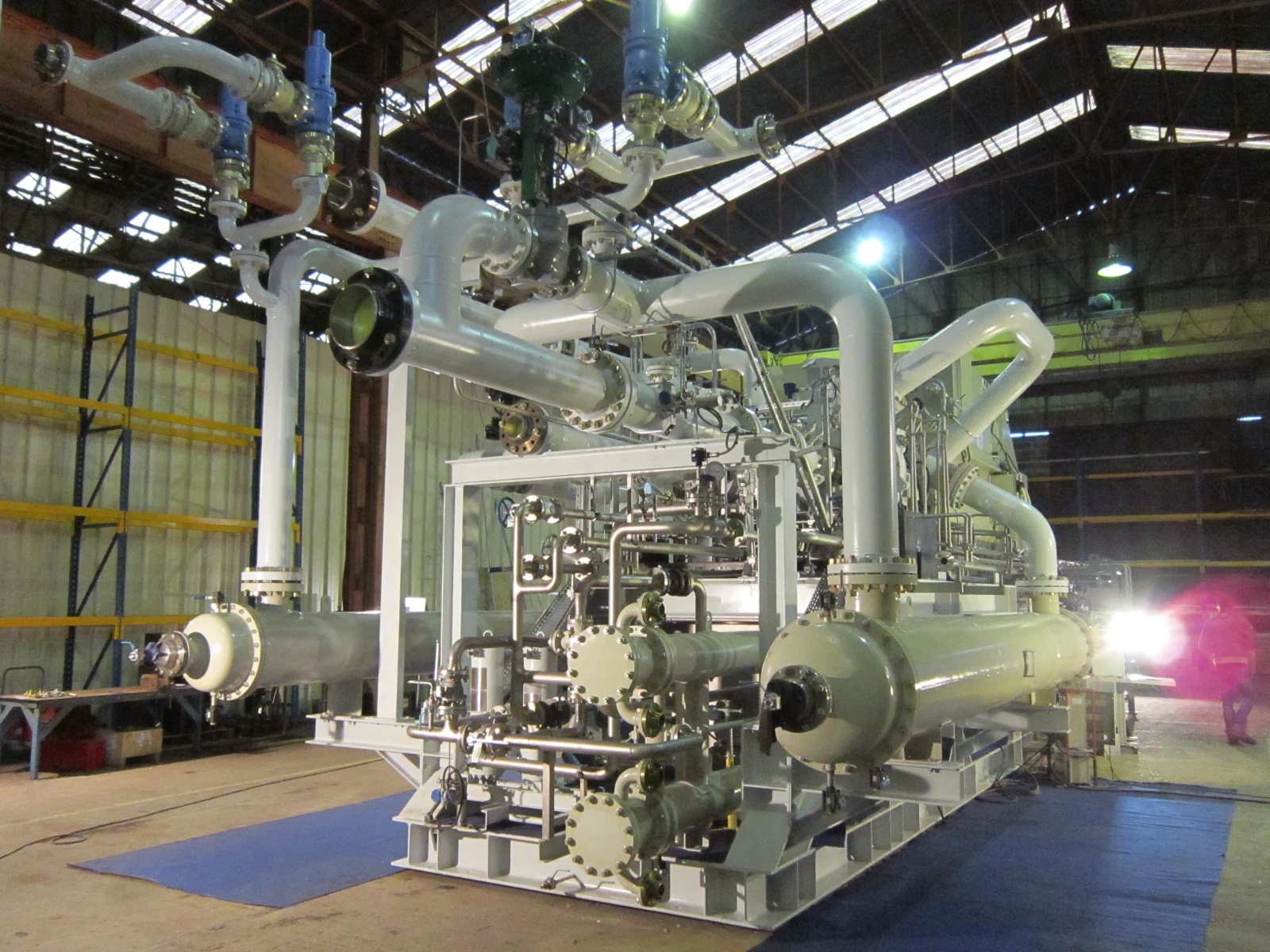
The photographs are archival cooling-equipment illustrations, not images of the new Clivet compressor or a verified customer deployment. The arithmetic examples are ours and explicitly conditional. The confirmed event is the product presentation; up-to-40% compressor savings, flow gains and transition performance remain attributed claims. No whole-farm saving, new miner specification or firmware requirement is inserted into the catalogue from the announcement alone.
Source: Midea / Clivet ↗
Mining calculator ↗