Braiins OS 26.11 adds two hydro Antminers and guards against hot starts
Source report: 2026-11-25 · Editorial analysis published: 2026-11-27
The November 25 release adds the S23 Hyd. and S21j XP Hyd. It prevents supported hydro equipment from starting when the inlet is above 55°C or its sensor is unavailable.
Two new model names on the compatibility list
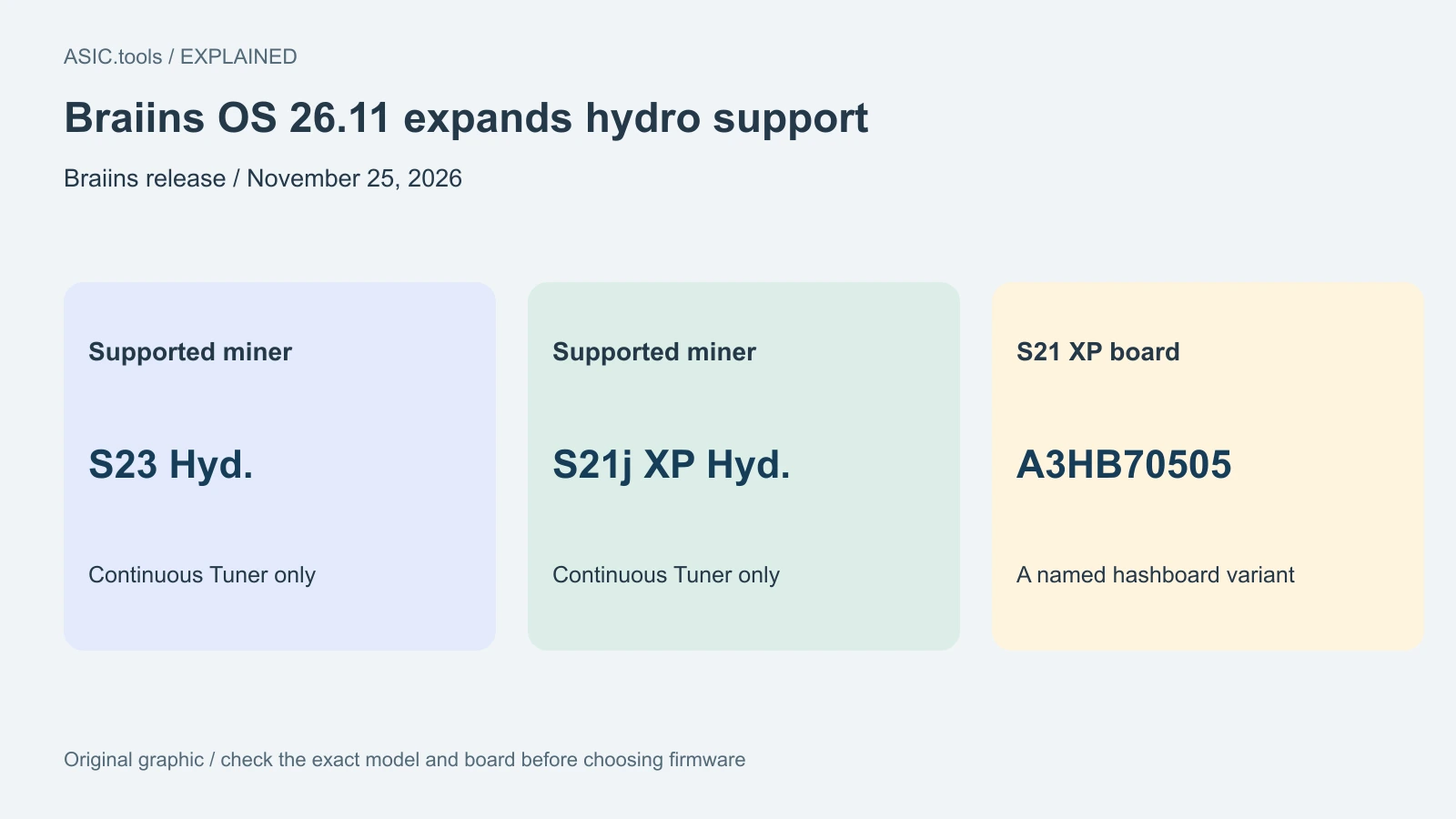
Braiins published Braiins OS 26.11 on November 25. The firmware adds support for the liquid-cooled Antminer S23 Hyd. and S21j XP Hyd. Both run exclusively on its Continuous Tuner, a feature that adjusts how the chips operate over time. The tuner is now out of beta and appears among the Performance settings. New liquid-cooled installations use it by default, according to the release notes.
The names matter when choosing firmware. S23 Hyd. is the model listed here. A machine with another suffix needs its own compatibility check, even if the casing looks similar. The same release also adds a named S21 XP hashboard, A3HB70505. A hashboard is the board containing mining chips. That entry names a board variant, while the two hydro entries refer to complete miner models.
Before a fleet rollout, identify the exact machine and board rather than relying on a product-family label. Firmware controls the hardware directly. The manufacturer’s release page and supported-device information supply names that can be compared with the labels on the equipment and the version currently installed.
The distinction is especially useful at a mixed site. One release can name a complete new miner and a board added to an existing mining model at the same time. Keep the full model, board and current software together in the inventory so the right update notes stay attached to the right unit.
Why a hot machine may wait
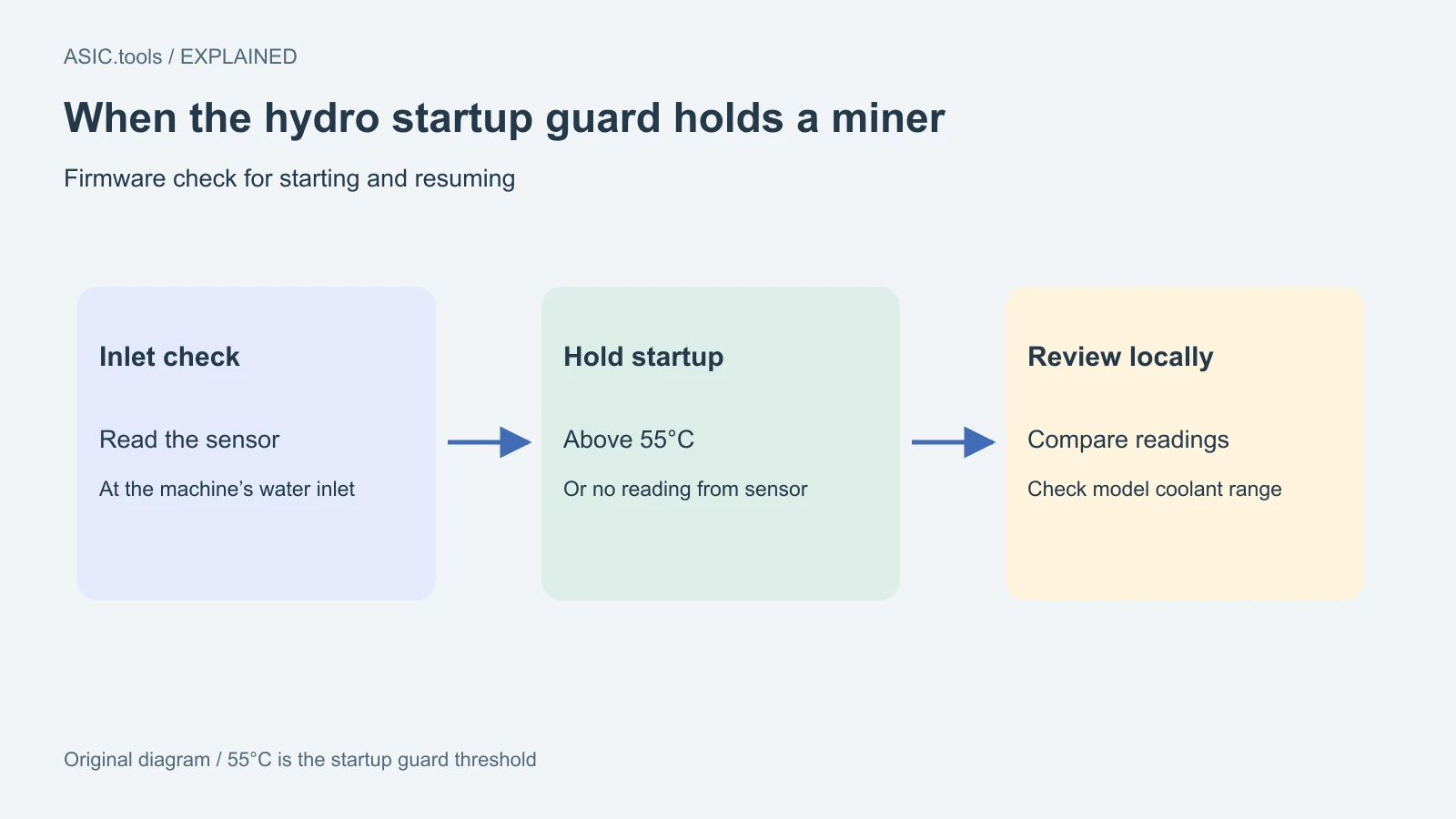
Braiins says hydro miners on this release will not start or resume if their incoming water is above 55°C or if the inlet sensor does not report. The inlet is where cooling water reaches the miner. A facility can have pumps or cooling equipment in operation while one machine receives water that is too warm. An unavailable sensor has a separate effect: the firmware cannot verify the inlet reading, so the protection also keeps the miner stopped.
The threshold describes the firmware’s start protection. For normal operation, the facility still needs the coolant range and other requirements for its model. A restart delay is reason to check site telemetry and the sensor condition. Changing an operating target alone would not restore a missing measurement.
A miner may look offline in a pool dashboard when the cooling guard prevents it from starting. Compare the restart timestamp with the inlet sensor and device log before treating the drop as a network problem. Available cooling and an available temperature reading are both relevant to the startup decision.
Look at the chips as well as the board
On listed models using Continuous Tuner, an optional setting can lower the frequency of individual overheating chips. A lower frequency makes a chip work more slowly and can reduce its heat output.
This gives the firmware a way to respond at chip level. It does not provide a fixed hashrate or energy-saving promise. The release also says changes to three dynamic-power settings no longer restart the bosminer process.
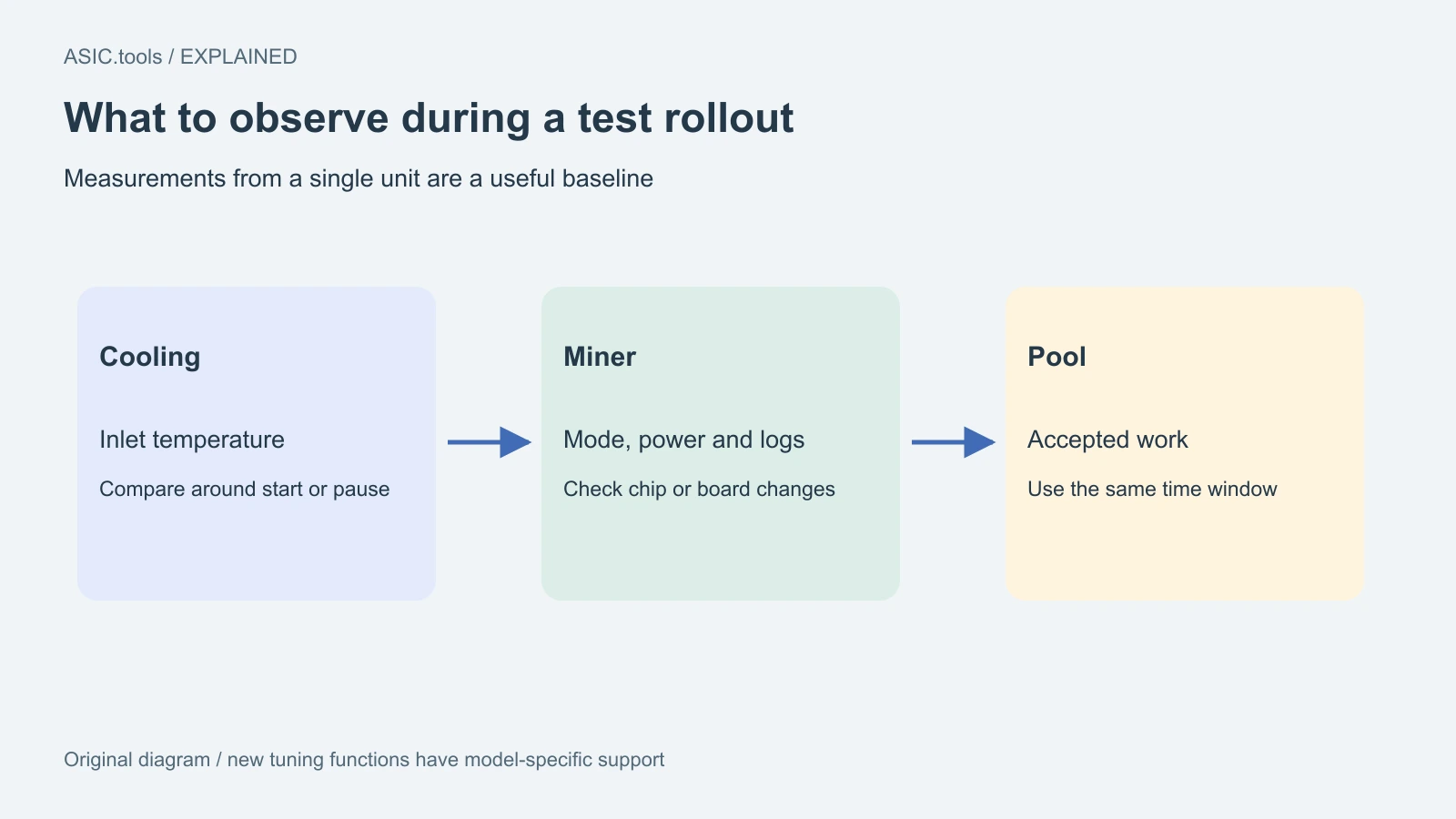
For a small pilot, keep a record of inlet temperature, operating mode, wall power and accepted work in the pool. Look at the logs if startup remains blocked or if speed changes. A built-in protection event and a pool connection interruption can look similar from the outside. The data help tell them apart. The useful change in 26.11 is support for the named machines and more ways to see why a miner paused or slowed.
The official per-chip compatibility list includes S21, T21, S21 Immersion, S21 Hyd., S19 XP+ Hyd., S21j XP Hyd. and S23 Hyd. The option applies when the machine is on Continuous Tuner and the operator enables it. The list helps distinguish firmware compatibility from support for this particular setting.
Braiins also added a dashboard shortcut to the miner log and separate logs on the hashboard-health screen. If a temperature or power change occurs during a test, those records offer a place to review the timing alongside the site data. Use the observed readings to decide whether to continue the roll-out.
Source: Braiins ↗ · Braiins OS official release and downloads ↗
Mining calculator ↗