Energy Economics study models a Bitcoin “productivity trap” for efficiency gains
Source report: 2026-09-01 · Editorial analysis published: 2026-09-26
An open-access Energy Economics paper argues that more efficient mining hardware can expand equilibrium resource use without increasing Bitcoin output. Its model also finds that surplus renewables may cut emissions while increasing hardware turnover, and evaluates a global Pigouvian tax as a policy response.
Analysis and practical implications
This section is our analysis and illustrative calculations, separate from the source report.
What the paper studies
The September 2026 Energy Economics article “Bitcoin’s productivity trap” is written by Maximilian Gill, Jona Stinner and Marcel Tyrell and appears in volume 161 as article 109505. It develops a formal economic model of proof-of-work mining, input-efficiency changes, network adjustment and environmental externalities. The authors focus on an unusual feature of Bitcoin: additional hashing strengthens competition and security expenditure, but the protocol still produces blocks on a fixed schedule. The paper is open access, allowing readers to inspect its equations, assumptions and policy simulations rather than rely only on the highlights.

Why the authors call it a productivity trap
In ordinary production, a more efficient input can raise useful output. Bitcoin difficulty adjusts so that, over time, blocks do not arrive faster simply because miners deploy more efficient ASICs. The paper argues that lower cost per hash can invite more hashing and equipment until competition absorbs the saving. Aggregate electricity or hardware use can therefore rise even though the network produces essentially the same scheduled block output. This is a model of equilibrium behavior, not a claim that every new ASIC immediately increases global power or that efficiency has no value for an individual operator.
Efficiency still matters to each miner
A lower-joules-per-terahash machine can improve a specific farm’s margin, extend operating hours and displace an older unit. The productivity-trap result concerns what happens after many profit-seeking participants respond and difficulty changes. Early adopters may earn more temporarily; later, network competition can erode that advantage. Operators should separate private efficiency from system-wide resource use. Procurement models need electricity price, hardware cost, delivery date, uptime and projected difficulty, while environmental analysis needs total active fleet, generation mix and the rate at which equipment enters and leaves service.
Renewable surplus changes emissions but not every externality
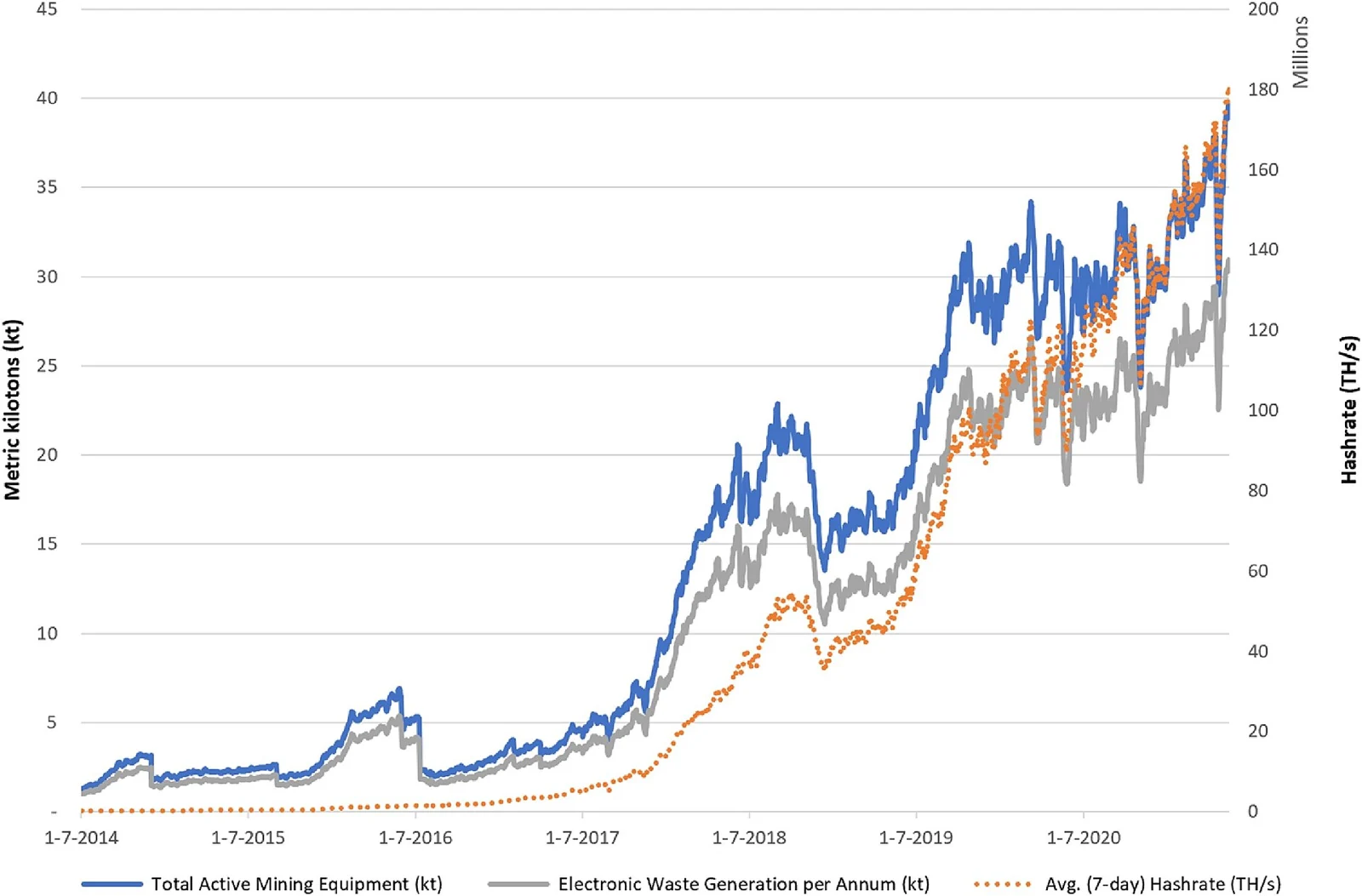
One highlighted result says surplus renewable electricity can reduce carbon dioxide emissions associated with mining. However, cheaper or otherwise unused energy can support additional rigs, raising electronic waste in the model. The conclusion does not mean all renewable-powered mines create the same outcome. Results depend on whether electricity is truly surplus, whether mining affects transmission or alternative uses, how long ASICs remain active and what happens after retirement. A credible project should document hourly power source, curtailment counterfactual, equipment lifetime, resale, refurbishment and certified recycling.
E-waste depends on definitions and lifetime
Estimating mining e-waste requires deciding when hardware becomes waste. An ASIC removed from a high-cost site may be sold to a lower-cost operator, used in education, harvested for parts or stored rather than discarded. Conversely, obsolete boards can become waste before their physical failure when hashprice no longer covers power. Researchers should publish lifetime assumptions, secondary-market treatment, device weight and recycling recovery. Operators can reduce impact by repairing control boards and power supplies, maintaining cooling, documenting parts and using take-back channels instead of treating every efficiency upgrade as immediate disposal.
The proposed Pigouvian tax result
The authors model a global Pigouvian tax intended to price environmental externalities and report that it can mitigate them without reducing Bitcoin network security. In economic theory, such a tax aligns private cost with social damage. Implementation is the difficult part: authorities would need a measurable tax base, environmental coefficients, jurisdictional cooperation and enforcement that does not simply move mining to unobserved regions. Security itself also needs an operational metric. Policymakers should treat the result as a model comparison and test sensitivity before turning it into a rate or claiming that one instrument is universally neutral.
Limits of translating a model into policy
Formal models simplify heterogeneous electricity contracts, grid constraints, machine generations, transaction fees, hedging, demand response and strategic behavior. A global tax is especially different from the fragmented rules governments can actually enact. The paper’s value is that it makes mechanisms and assumptions explicit, not that it forecasts a precise number of terawatt-hours or tonnes of waste for every scenario. Useful follow-up work would compare predictions with fleet shipment data, difficulty, hourly power consumption, regional generation and verified recycling records, then show where observed behavior departs from equilibrium assumptions.
What miners and regulators can use now
Miners can use the paper as a warning that a better J/TH rating does not guarantee a lasting network-wide profit improvement. They should test purchasing decisions against difficulty growth and residual value, and build repair and resale plans before deployment. Regulators can ask whether incentives reward measured emissions reduction and longer hardware life rather than labels such as renewable or efficient. The practical conclusion is not to stop efficiency progress, but to measure total effects: power source by hour, grid response, fleet turnover, useful life, recycling and security outcomes. Those data determine whether a policy or project improves the system beyond a single machine.
Source: Energy Economics ↗
Mining calculator ↗