Bitcoin hashprice lost 17.27% across October: November starts near $33 per PH/day
Source checked: 2026-11-02 · Editorial analysis published: 2026-11-02
Primary hourly index points show a weaker revenue base entering November. A 200 TH/s, 3 kW example explains why the same miner can clear its power bill at one tariff and fall short at another.
A weaker starting point for November
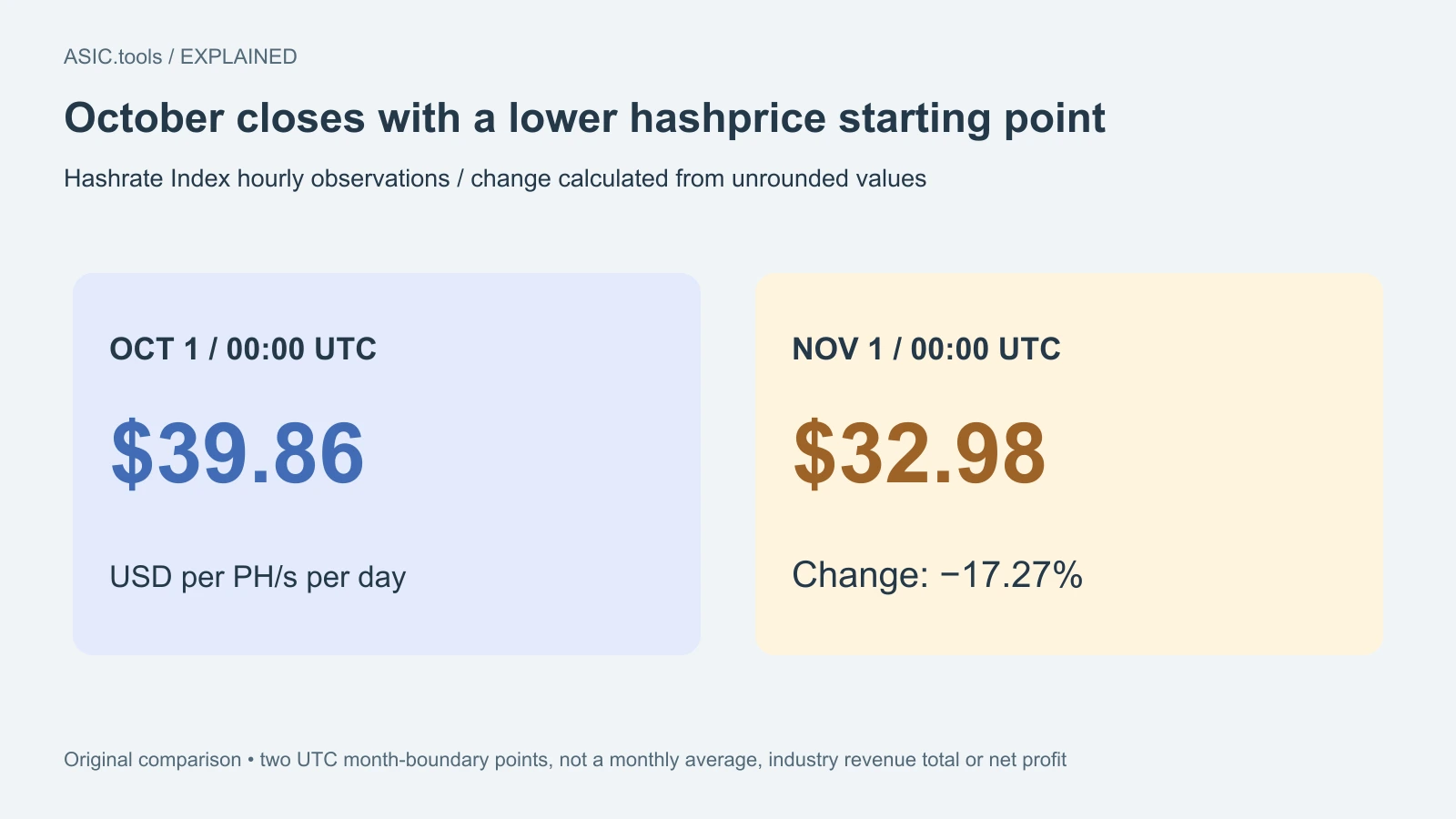
Bitcoin mining entered November with substantially less dollar revenue available for each unit of computing power than at the start of October. Hashrate Index's hourly USD series records $39.856987 per PH/s per day at October 1, 00:00 UTC and $32.975021 at November 1, 00:00 UTC. Calculated from the unrounded values, that is a 17.27% decline across those month-boundary observations.
At November 2, 07:00 UTC, the same provider's shorter hourly series shows $33.240417, or about $33.24 per PH/s per day. These are dated index observations, not a monthly average, a forecast or a miner's net profit. The point is the weaker starting revenue base for the new month, rather than another announcement of the already reported October difficulty adjustment.
What hashprice means for one machine
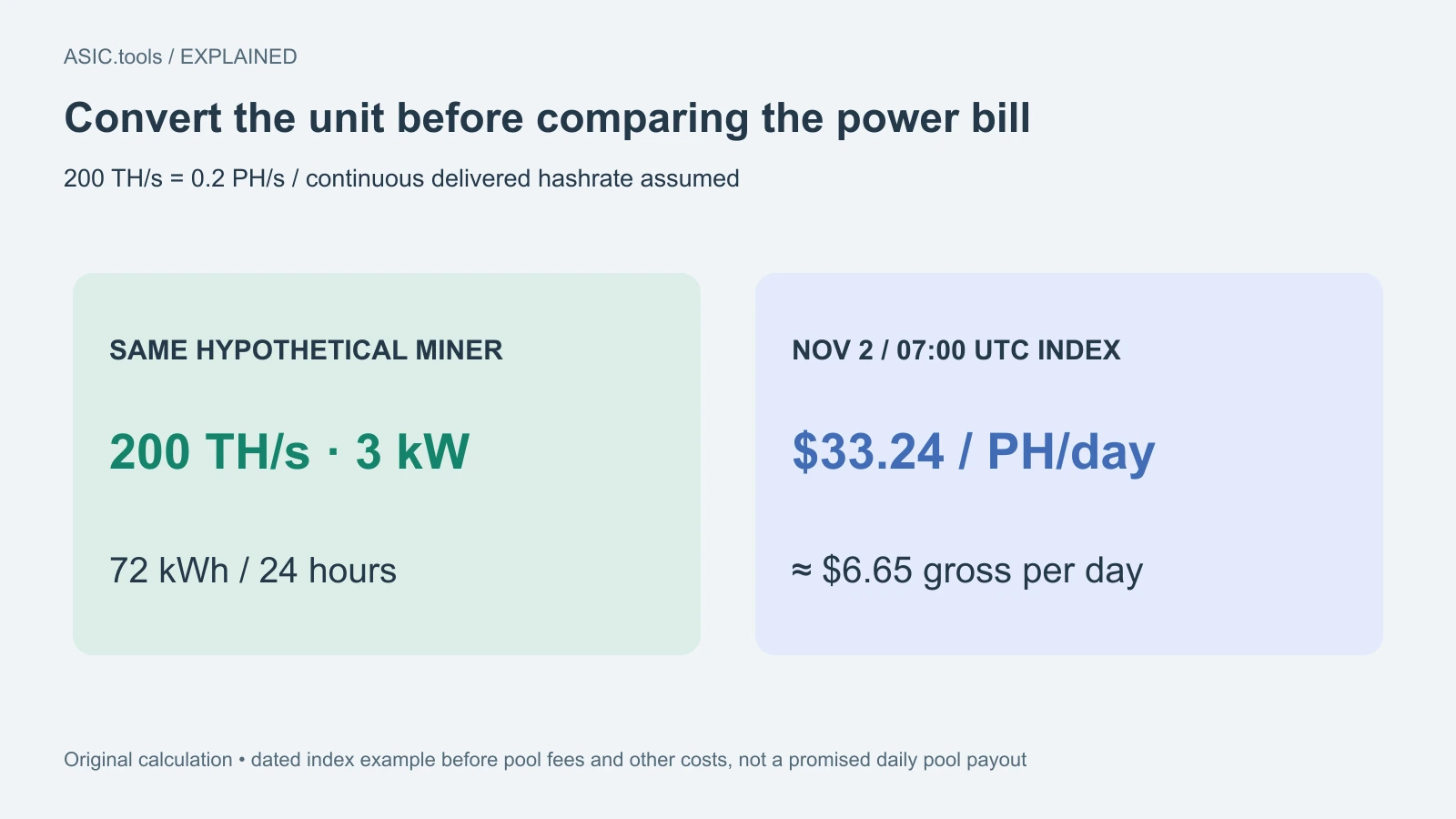
Hashprice expresses expected gross mining revenue for a given amount of Bitcoin SHA-256 hashrate over a day. One petahash per second is 1,000 terahashes per second. A miner rated at 200 TH/s therefore represents 0.2 PH/s. At the November 2 observation, that amount of continuously delivered hashrate corresponds to roughly $6.65 in daily gross revenue before the operator's costs.
That is an index-based illustration, not a promise that a pool pays exactly $6.65 every day. Pool terms, fees, accepted work, uptime and actual performance affect the result. The calculation also says nothing about whether a device's purchase price has been recovered. Gross revenue, money left after electricity and full business profit are three different figures.
The provider explains that its index depends on Bitcoin's price, network difficulty, block subsidy and transaction fees, with a trailing 144-block simple average used for fees. A dollar index can change even when the machine's displayed hashrate does not. This is why an old dollar-income figure should not be treated as a permanent specification of the hardware.
The electricity comparison in plain numbers
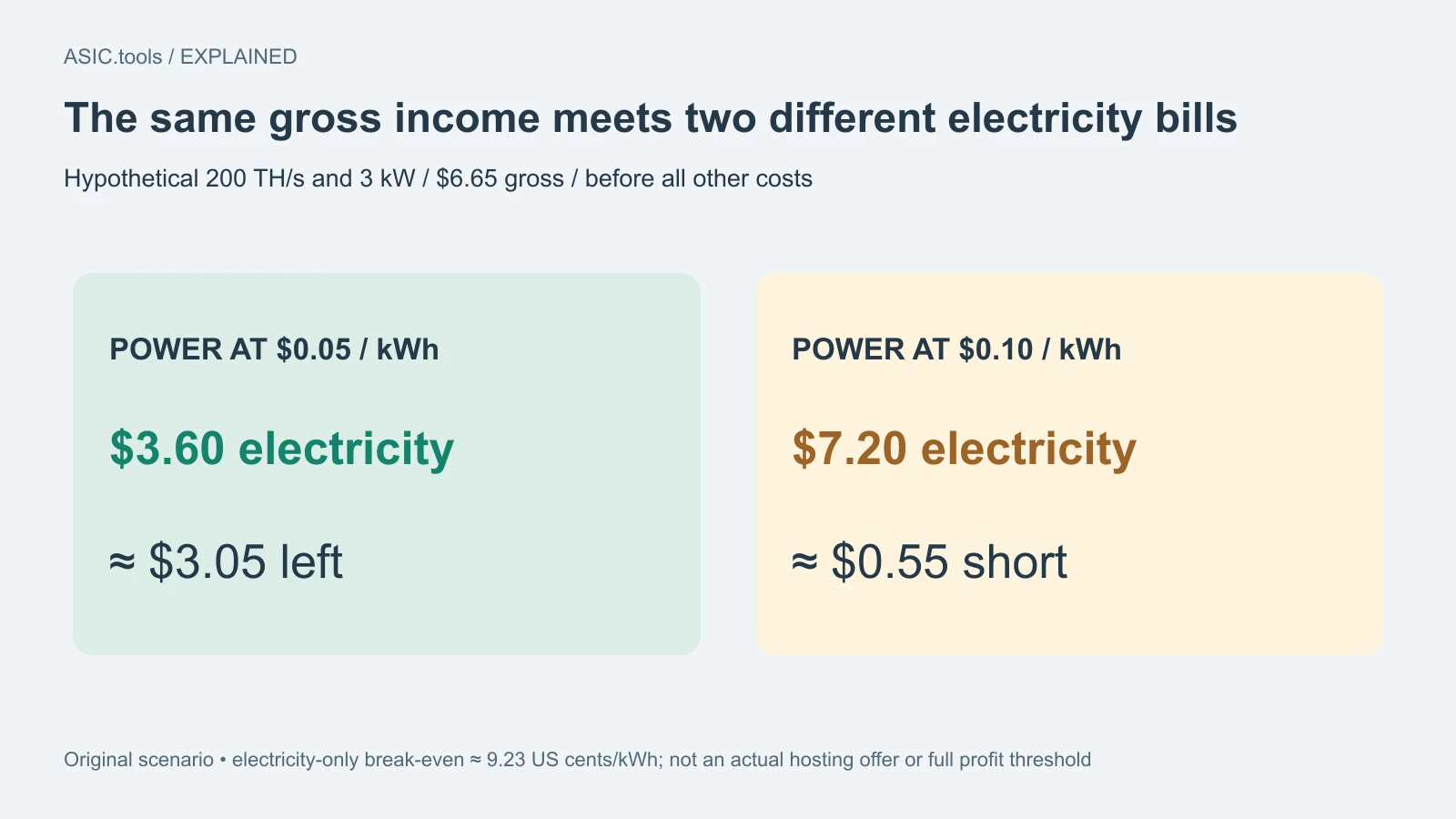
Consider a hypothetical 200 TH/s machine drawing 3 kW continuously at the wall. It consumes 72 kWh over 24 hours. At $0.05 per kWh, electricity costs $3.60, leaving about $3.05 from the illustrated $6.65 gross amount before pool fees and other expenses. At $0.10 per kWh, electricity costs $7.20, about $0.55 more than the illustrated revenue.
The electricity-only break-even price is approximately $0.0923 per kWh, or 9.23 US cents. That is not an affordable hosting quote or a complete profit threshold. Pool fees, maintenance, cooling outside the measured load, interruptions and other charges reduce the available room. The example is deliberately tied to one hashrate, one measured power boundary and one dated index point.
The same 0.2 PH/s illustration would correspond to about $7.97 gross per day at the October 1 point and $6.60 at the November 1 point, around $1.38 less. Electricity for an unchanged continuous 3 kW load would still be 72 kWh. This isolates the income-side change; it does not reconstruct what a particular miner earned throughout October. The separate November 2 illustration uses $6.65, because that is a different dated index observation.
Compare like with like
The October change above compares two hourly points at midnight UTC. It should not be relabelled as the change in October's average hashprice or as a fall in the whole industry's total monthly revenue. Those are different calculations. We could not independently retrieve the historical monthly Newhedge total, so no secondary estimate of that total is presented as verified here.
The selected November 1 boundary is identical in the provider's one-month and three-month series. Two other edge-hour values differed between those responses and were excluded from the comparison. The latest $33.24 observation comes from the shorter series at its stated time. These checks keep the period and units explicit without pretending a changing dashboard is a permanently fixed price.
What to update in a mining budget
For an owner, the useful response is to refresh expected revenue using the hashrate actually delivered and compare it with metered electricity and the applicable contract. A hosting tariff may include services or power that a home meter comparison does not. Conversely, a chip-only power reading can omit the rest of the machine and supporting equipment. Use matching boundaries before deciding how much margin remains.
A lower hashprice does not prove that every miner should stop, and a positive remainder after electricity does not prove the operation is profitable. It shows that less revenue is available to absorb costs. November begins with that practical constraint: keep the income assumption dated, distinguish gross from net and let the actual tariff and operating record decide the result.
Source: Hashrate Index ↗
Mining calculator ↗