Bitcoin difficulty rises 5.54% to 148.36 trillion: the forecast is now a real adjustment
Source report: 2026-10-29 · Editorial analysis published: 2026-10-30
Block 973728, timestamped October 29 at 19:14:58 UTC, starts the new difficulty epoch. At unchanged hashrate, the subsidy-only expected BTC yield per unit of work falls about 5.25%.
A higher difficulty is already in force
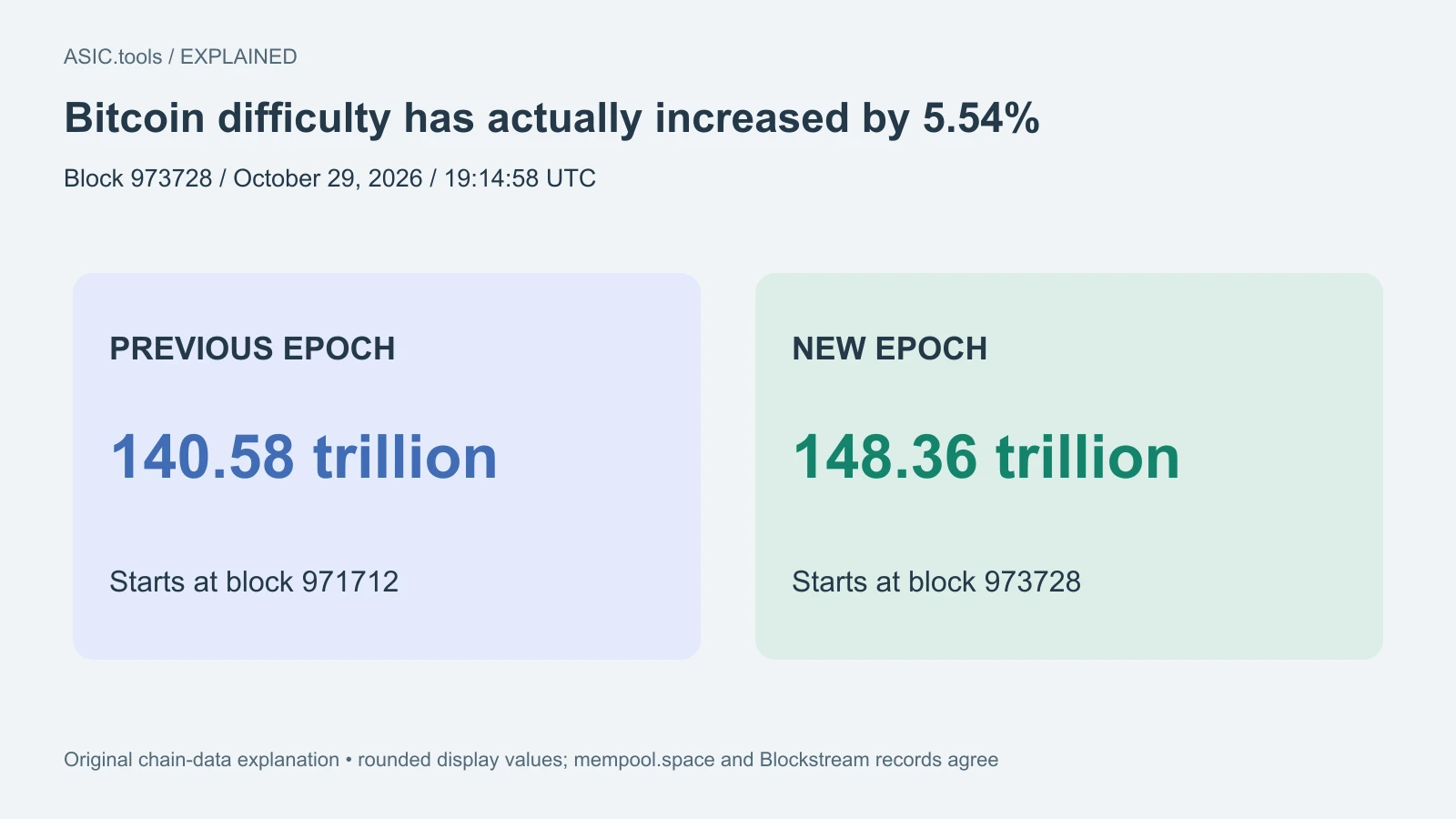
Bitcoin raised its mining difficulty at block 973728 on October 29. The block header records 19:14:58 UTC, or 21:14:58 in Kyiv. The new value is 148,364,561,003,867.4, compared with 140,577,680,051,919.6 in the previous period: an increase of 5.5392%, rounded to 5.54%. Matching records from mempool.space and Blockstream confirm the same block hash, timestamp and difficulty.
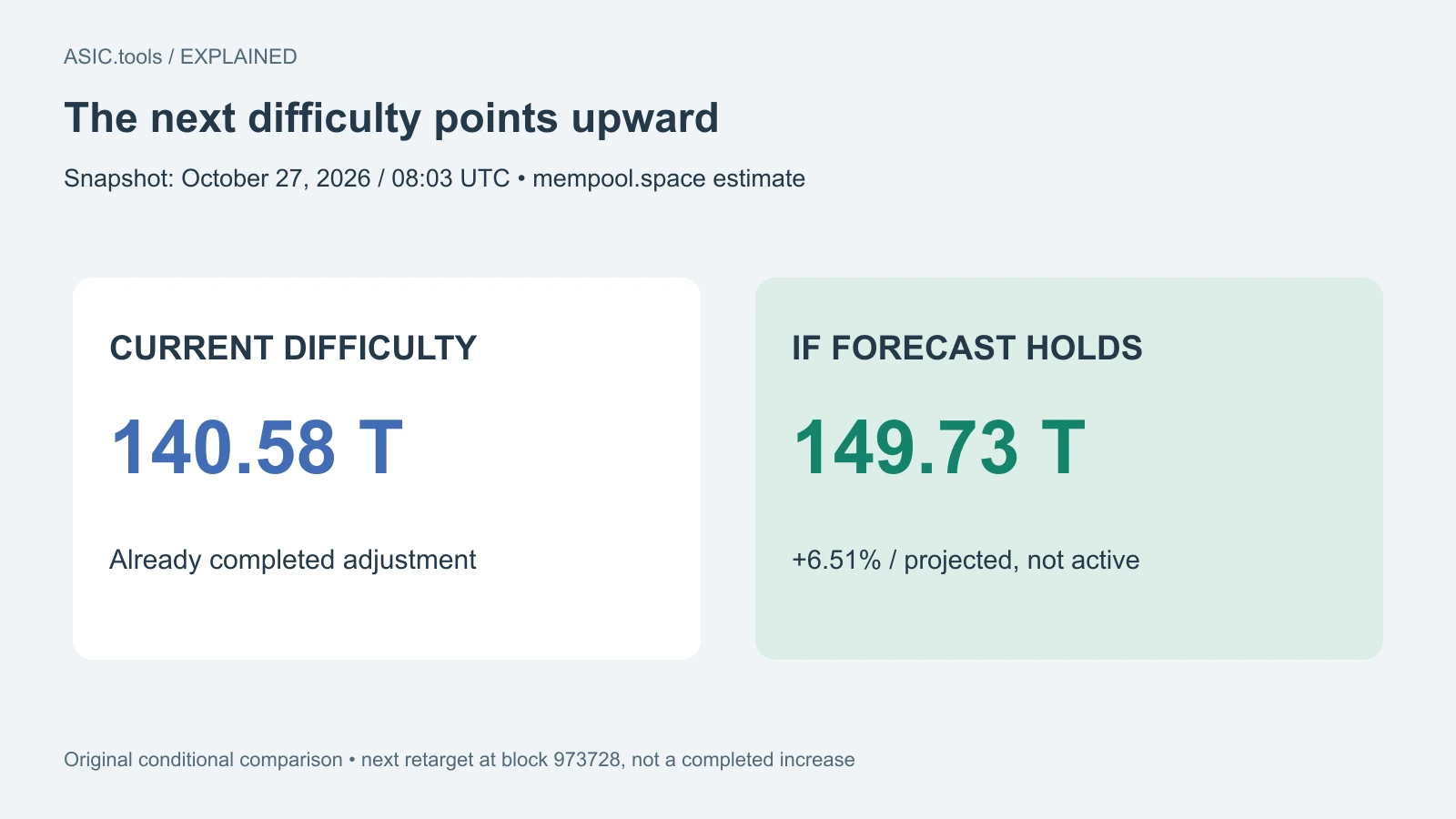
This is the completed event that earlier forecasts tried to estimate. Our October 27 report described a moving projection of 6.51%; that estimate was not the eventual result. Keeping both dates matters: readers can distinguish information available before the boundary from what the chain actually applied. The new difficulty is a network rule, not a price set by a pool or the speed reported by an ASIC dashboard.
Why expected Bitcoin output falls by about 5.25%
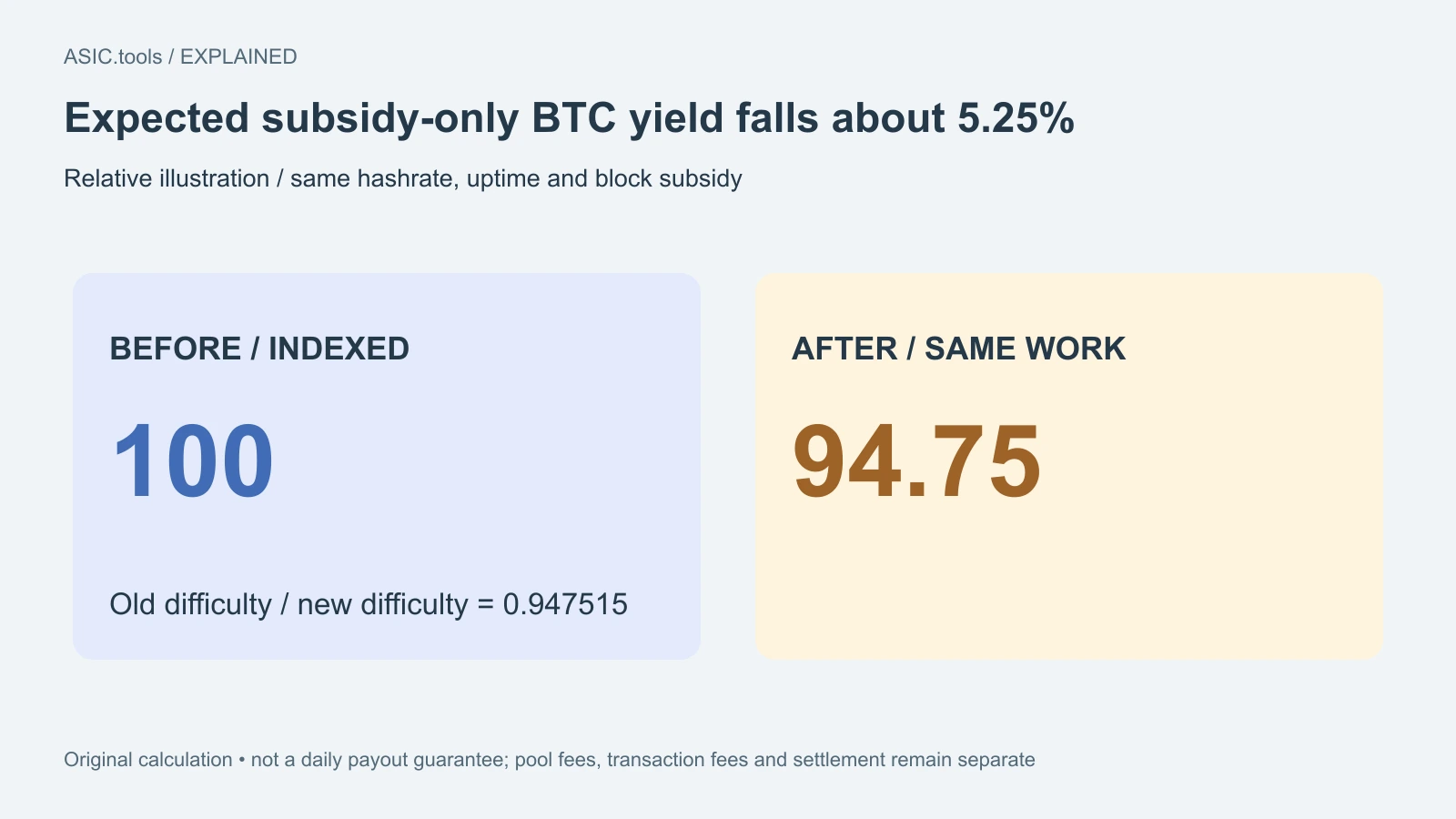
Difficulty measures how much work is expected to find a valid block. A higher value means the same number of hash attempts buys a smaller expected share of block discoveries. With unchanged personal hashrate, uptime and block subsidy, the relevant ratio is old difficulty divided by new difficulty. That ratio is about 0.947515, so the expected subsidy-only BTC yield falls by approximately 5.2485%, or 5.25%.
The percentage is not simply the difficulty increase copied with a minus sign. As a relative illustration, an expected yield previously indexed at 100 becomes about 94.75 under otherwise identical assumptions. This is an expectation over repeated work, not a promise about tomorrow’s payout. Pool fees, transaction-fee revenue, payout rules and luck can make an actual account balance behave differently.
The machine does not use less electricity automatically
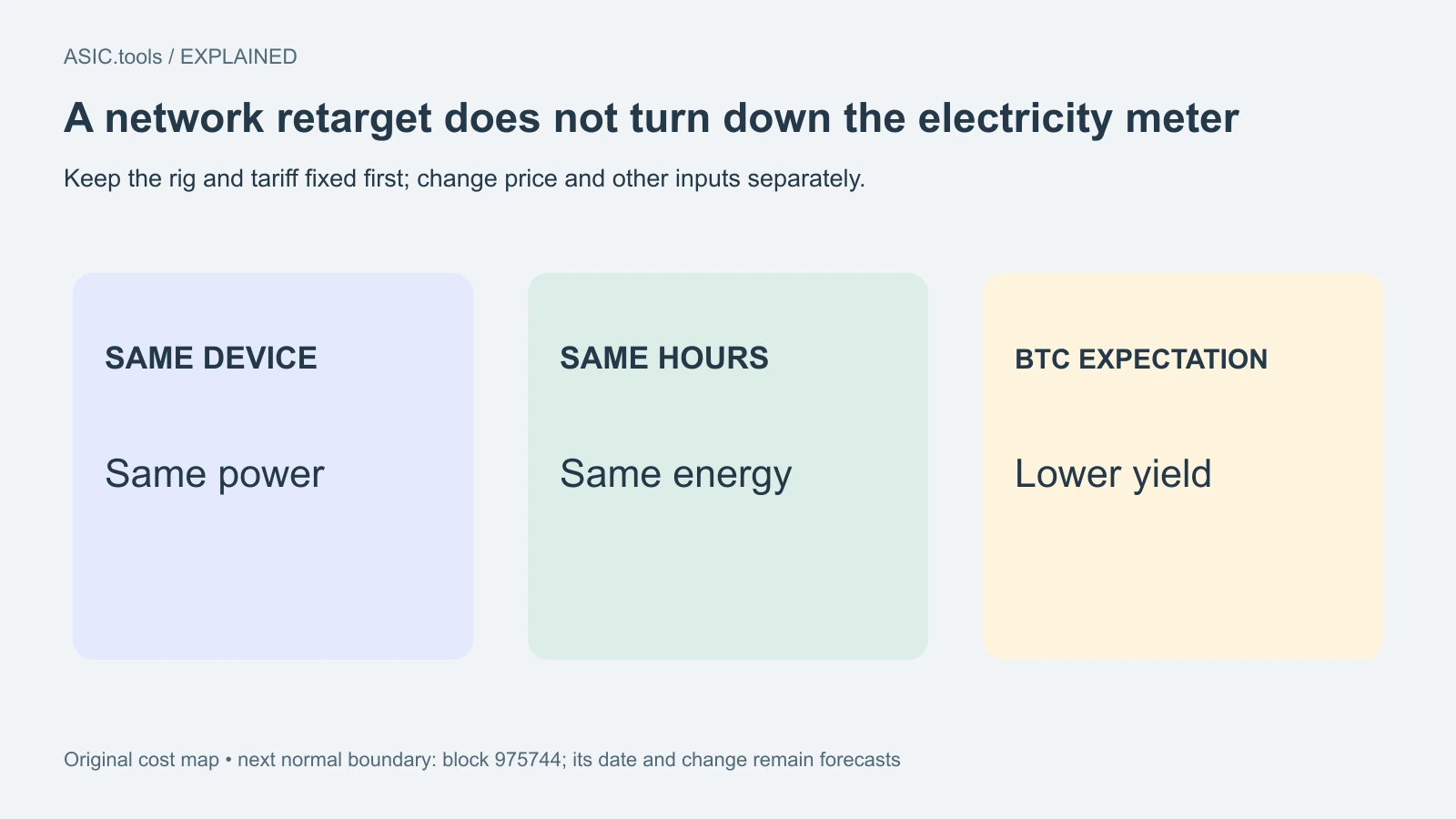
The retarget changes the network’s target, not a miner’s power setting. A device drawing the same wall power and running for the same hours still consumes the same electricity. Lower expected BTC output therefore reaches an operator whose energy bill has not automatically declined. A price rise could offset some impact in money terms; a price fall could amplify it. Neither outcome follows from the difficulty change alone.
For a useful comparison, keep hashrate, uptime, electricity tariff and pool fee fixed first, and change only difficulty. Then update the Bitcoin price and any fee assumptions separately. Mixing several changing inputs hides why a calculation moved. A calculator using a separately dated hashprice snapshot also needs that revenue input refreshed: a new network difficulty display does not prove every revenue assumption elsewhere was updated.
Pool shares and a solo miner’s odds are different views
A pool often assigns its own share difficulty, a lower threshold used to measure submitted work. That setting is different from Bitcoin’s network difficulty. Seeing the same accepted-share rate or the same number on a pool dashboard does not establish that expected network rewards per unit of work stayed unchanged. Check the pool’s settlement method and reporting window before comparing balances across the boundary.
For solo mining, the retarget lowers the expected block-finding chance for unchanged hashrate over the same amount of time. It does not make any miner due for a win, nor does a recent successful home miner improve another device’s odds. Pool mining smooths the distribution through shared accounting; it does not remove the underlying change in how much network work is required for a block.
Review the operating margin before changing the rig
The next normal difficulty boundary is block 975744, another 2016 blocks later. Its calendar time and the size of its adjustment remain estimates until the chain reaches it. The October 30 data snapshot was already inside the new epoch; an early forecast for the next one should not be treated as a second completed cut or increase. This article records the October 29 event, rather than continuously replacing it with a live prediction.
An operator can now compare expected revenue with the installation’s actual electricity cost, including fans, pumps or other auxiliaries where relevant. If the margin is thin, check efficiency settings and measured accepted work before extending operating hours. The confirmed fact is a higher network difficulty; the right response depends on the device, tariff and payout method. No universal shutdown price or guaranteed daily income follows from the new number.
Keep the comparison window consistent. A partial day before the boundary and a full day afterwards include different amounts of work, while a displayed balance can also contain earlier earnings awaiting settlement. Match duration and the underlying work period before deciding that the retarget caused the whole observed change.
Rounding is useful for a headline but not for reconstructing the calculation. The two explorers supply the longer difficulty values used here; 148.36 and 140.58 trillion are display abbreviations. Keeping the full inputs makes the output ratio reproducible. Those chain values establish the network change, while a rig’s actual power, rejected work and account settlement still require the operator’s own records.
Source: Bitcoin network / mempool.space ↗ · Independent Blockstream block record ↗ · Difficulty adjustment history ↗
Mining calculator ↗