Bitcoin difficulty points to a 6.51% rise: what the October 27 snapshot means
Source checked: 2026-10-27 · Editorial analysis published: 2026-10-27
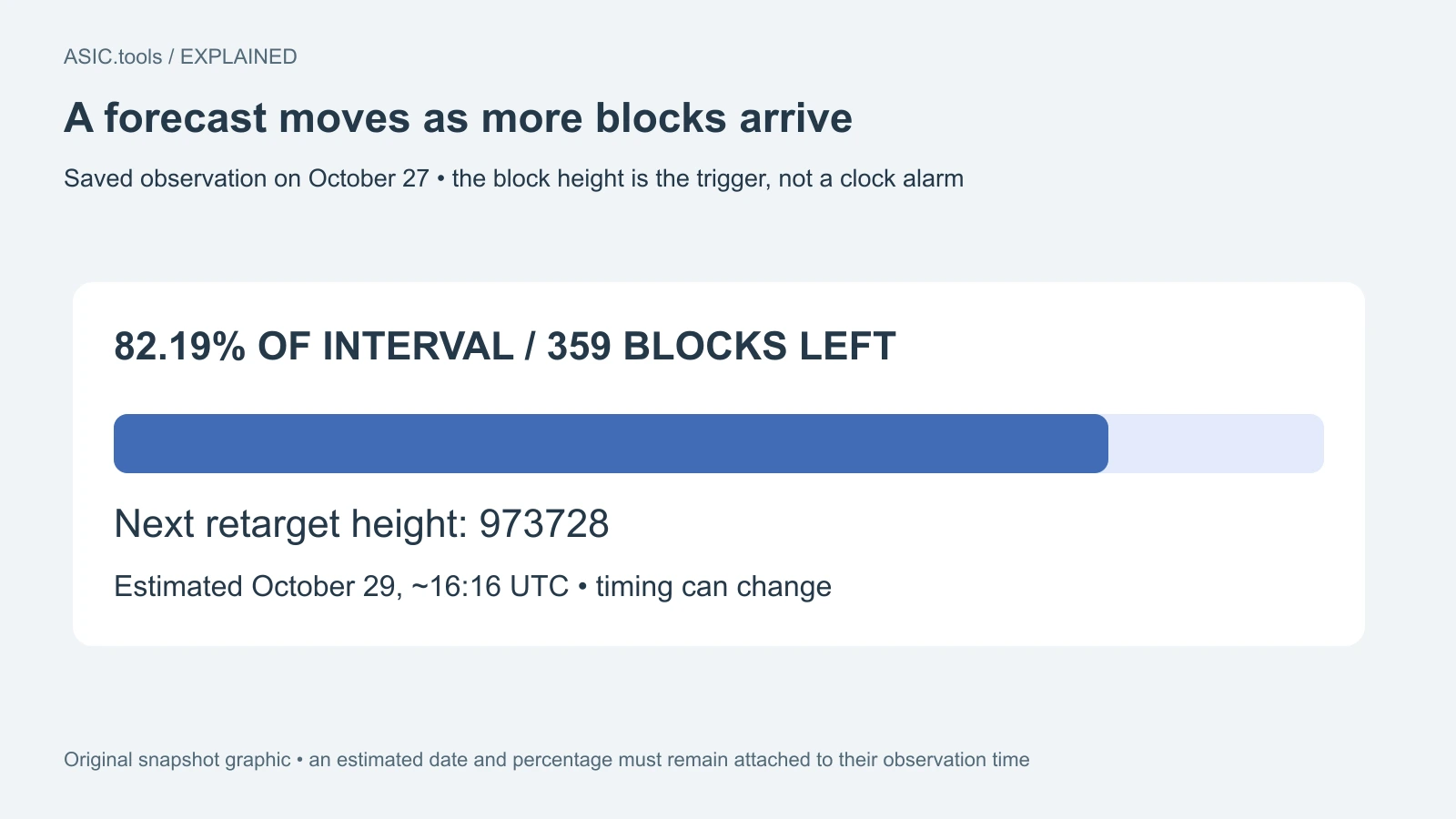
At 08:03 UTC on October 27, mempool.space projected +6.51% for block 973728, with 359 blocks remaining. It is a moving forecast; a miner’s expected BTC per unit of work changes inversely with difficulty.
The next adjustment is approaching, not completed
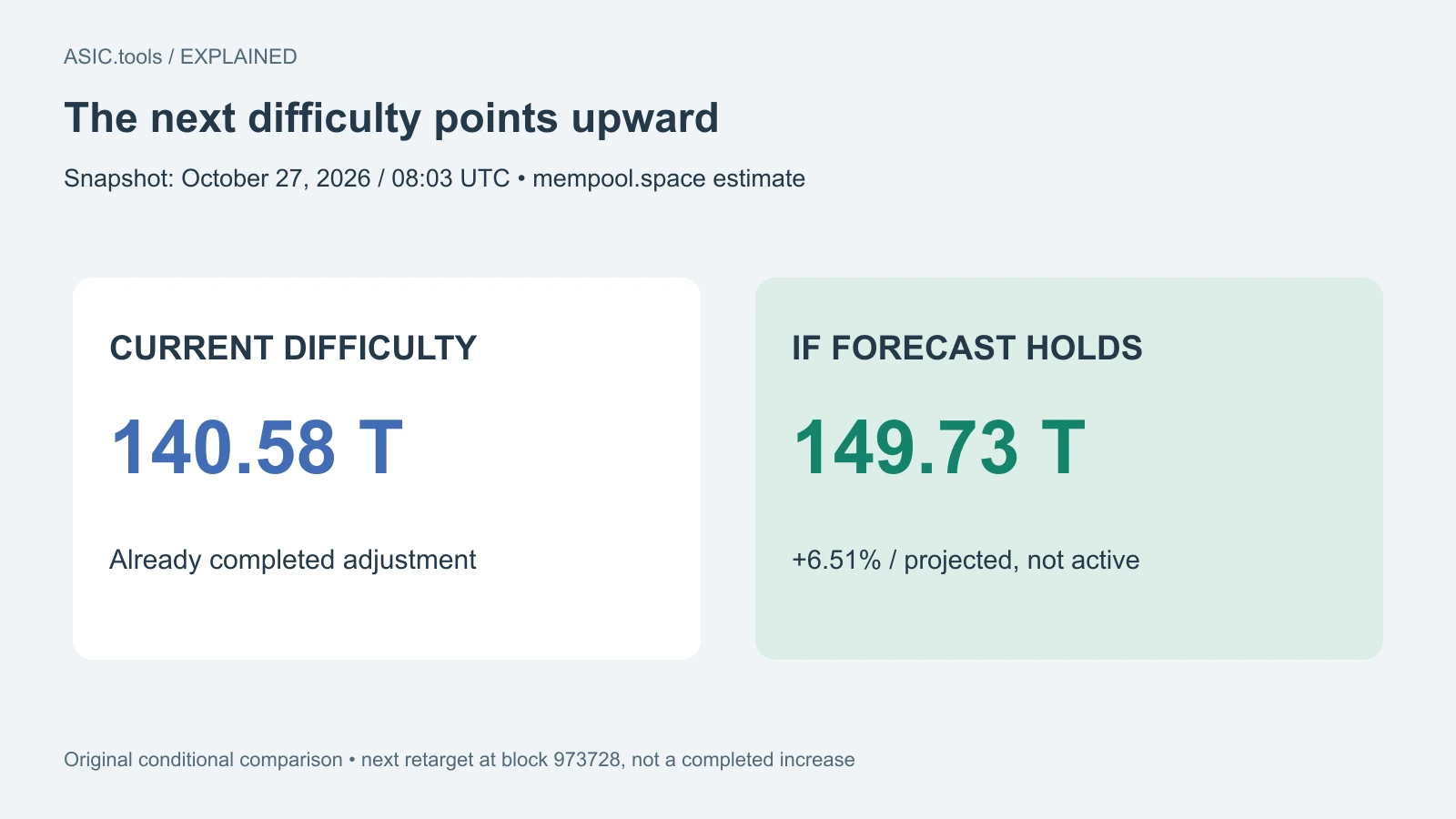
Bitcoin’s next difficulty adjustment was pointing upward in our October 27 check. At 08:03 UTC, mempool.space’s public API projected a rise of 6.5133% at block 973728. It reported 82.19% progress through the current interval, with 359 blocks remaining. That is a fresh dated forecast, not an announcement that the new difficulty has already taken effect. The observation uses UTC; in Kyiv, already on winter time, it was 10:03. This marks data retrieval, not publication or protocol activation.
The service estimated the adjustment for October 29, around 16:16 UTC, based on the pace observed at that snapshot. The block height determines when it occurs; the clock estimate can move as further blocks arrive. A reader looking later should expect the live dashboard to differ from the figures preserved here.
The current completed difficulty is about 140.58 trillion, following the previous 5.9237% increase. If the new projected percentage held, it would imply about 149.73 trillion. The conditional matters: 149.73 trillion is our calculation from the snapshot, not a value already adopted by the network.
Why faster blocks lead toward higher difficulty
Difficulty controls how hard it is to find an acceptable proof of work. Bitcoin aims for roughly one block every ten minutes and recalculates the target after each interval of 2,016 blocks. More computing work arriving during an interval can make blocks come faster; the later adjustment pushes the work needed for a valid block upward.
The snapshot’s average interval was about 563.649 seconds, or nine minutes and 23.6 seconds. That is faster than the ten-minute target and explains the upward direction of the estimate. A short period with very fast or slow blocks can move the forecast even without proving that a specific number of new machines was switched on.
We checked the public estimator’s code and Bitcoin Core’s adjustment logic as well as the API result. The estimate uses elapsed block timing; it is not an inventory of every miner in the world. We therefore do not turn the percentage into a claimed count of new ASICs, a shipment total or an exact measurement of hardware connected today.
A 6.51% difficulty rise is about a 6.11% yield reduction
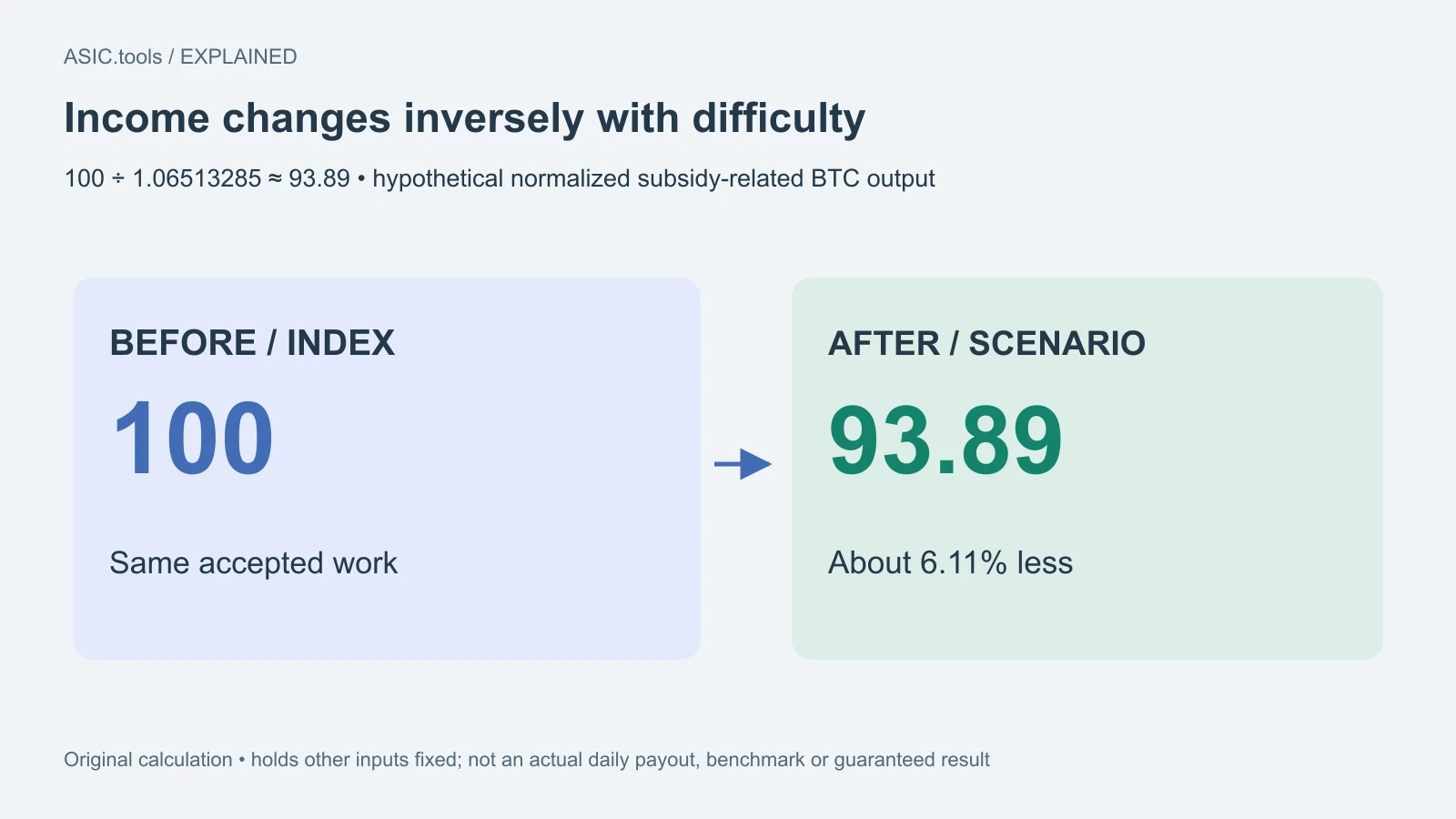
For the same amount of accepted work, the expected subsidy-related BTC return moves inversely with difficulty. Holding the other inputs fixed, dividing by 1.06513285 gives about 0.93885. In a simple normalized example, an expected 100 units of BTC output becomes about 93.89 units, a reduction of about 6.11%.
This example isolates one factor. Transaction fees, actual uptime, rejected work and a pool’s payment method can change realized receipts, while the BTC price changes their dollar value. The 100 units are an index for explanation, not a real daily payout, a device benchmark or a promise that every miner’s account will fall by exactly that percentage.
The distinction is useful because adding the same percentage to difficulty and subtracting it from income is only an approximation. A machine can show the same hashrate after a retarget while its expected share of newly issued coins per unit of time becomes smaller. Its fan noise and electricity use do not automatically fall with that revenue.
Electricity cost stays attached to the machine
For a miner already close to covering electricity, a smaller expected BTC amount can matter even if the headline coin price stays flat. The relevant comparison is expected revenue after the applicable service costs against measured consumption at the actual tariff. A device’s factory efficiency figure alone cannot settle that calculation.
A practical review can start with recent credited BTC, accepted hashrate and operating hours, then use the projected factor as a scenario for the next interval. Electricity and other recurring expenses remain separate. Keep an unchanged-difficulty scenario too, because this forecast can still move before the 359 remaining blocks are mined.
It is also worth checking what a pool balance represents: some payment systems settle on different schedules or have thresholds before a transfer reaches a wallet. A delayed transfer is not, by itself, proof that the machine has stopped producing work. The retarget changes network conditions; it does not silently rewrite a particular service’s contract.
Use the forecast as a dated planning input
This update concerns the next adjustment at 973728, distinct from the completed adjustment at 971712 reported earlier. It also differs from a Bitcoin-price story: the current signal is about how much work is expected to be required for a valid block, with the source time attached.
For a small operator, the useful preparation is to refresh the calculation near the actual retarget, check the pool’s accepted work and compare electricity scenarios. No equipment purchase is required to understand the change. A device advertised as profitable under an older difficulty and a different tariff needs its assumptions brought forward before those figures can inform a decision.
The saved observation remains October 27 at 08:03 UTC: +6.51% projected, 359 blocks left, and an estimated October 29 adjustment. The eventual percentage and time will be known only as the interval finishes. That preserves the forecast’s value as a planning signal without presenting it as a completed event or a guaranteed income forecast.
Source: mempool.space / Bitcoin Core ↗ · mempool difficulty-estimation source code ↗ · Bitcoin Core proof-of-work adjustment code ↗
Mining calculator ↗