Bitcoin difficulty reaches 374 days without a new high
Source checked: 2026-11-07 · Editorial analysis published: 2026-11-07
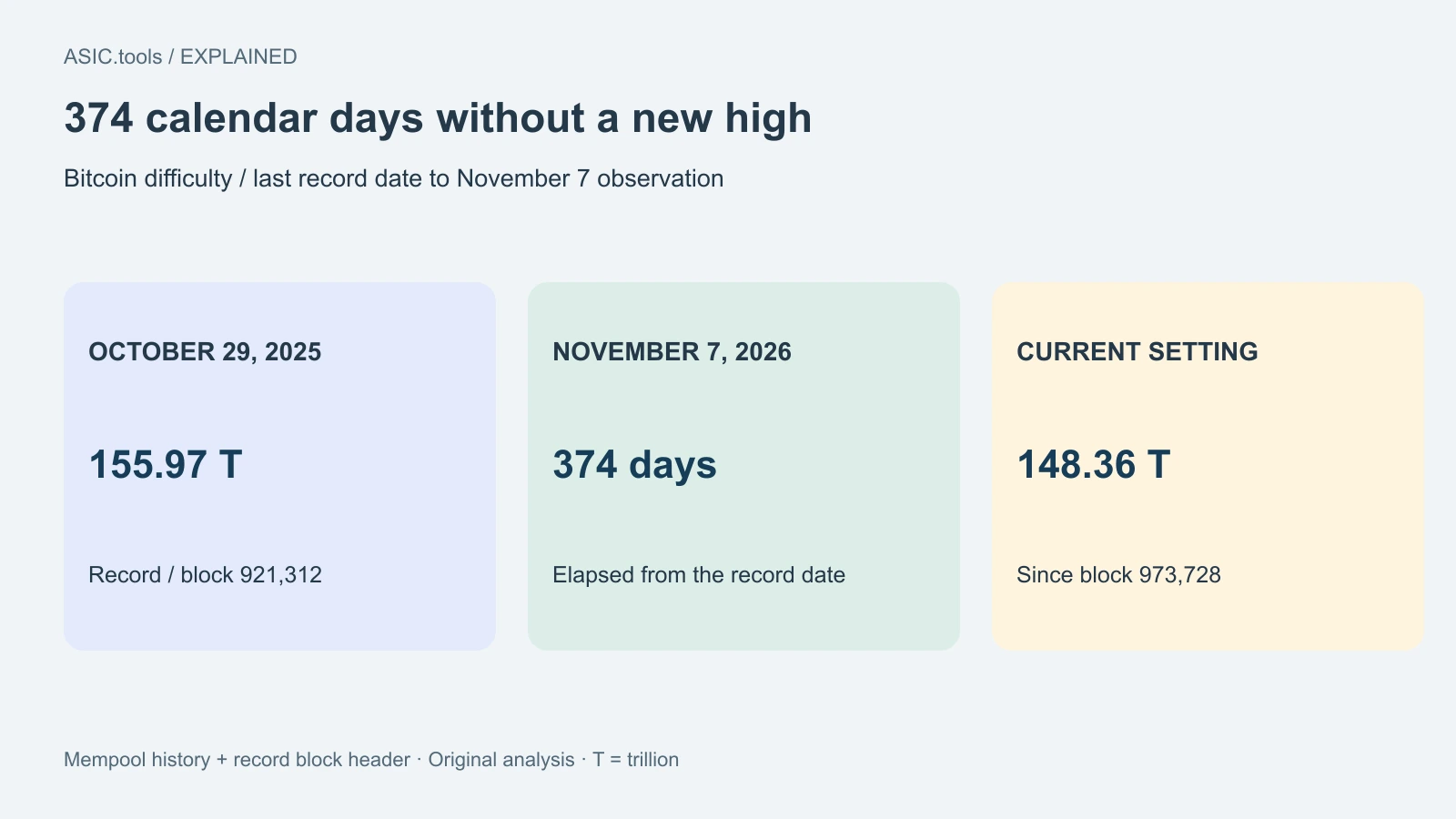
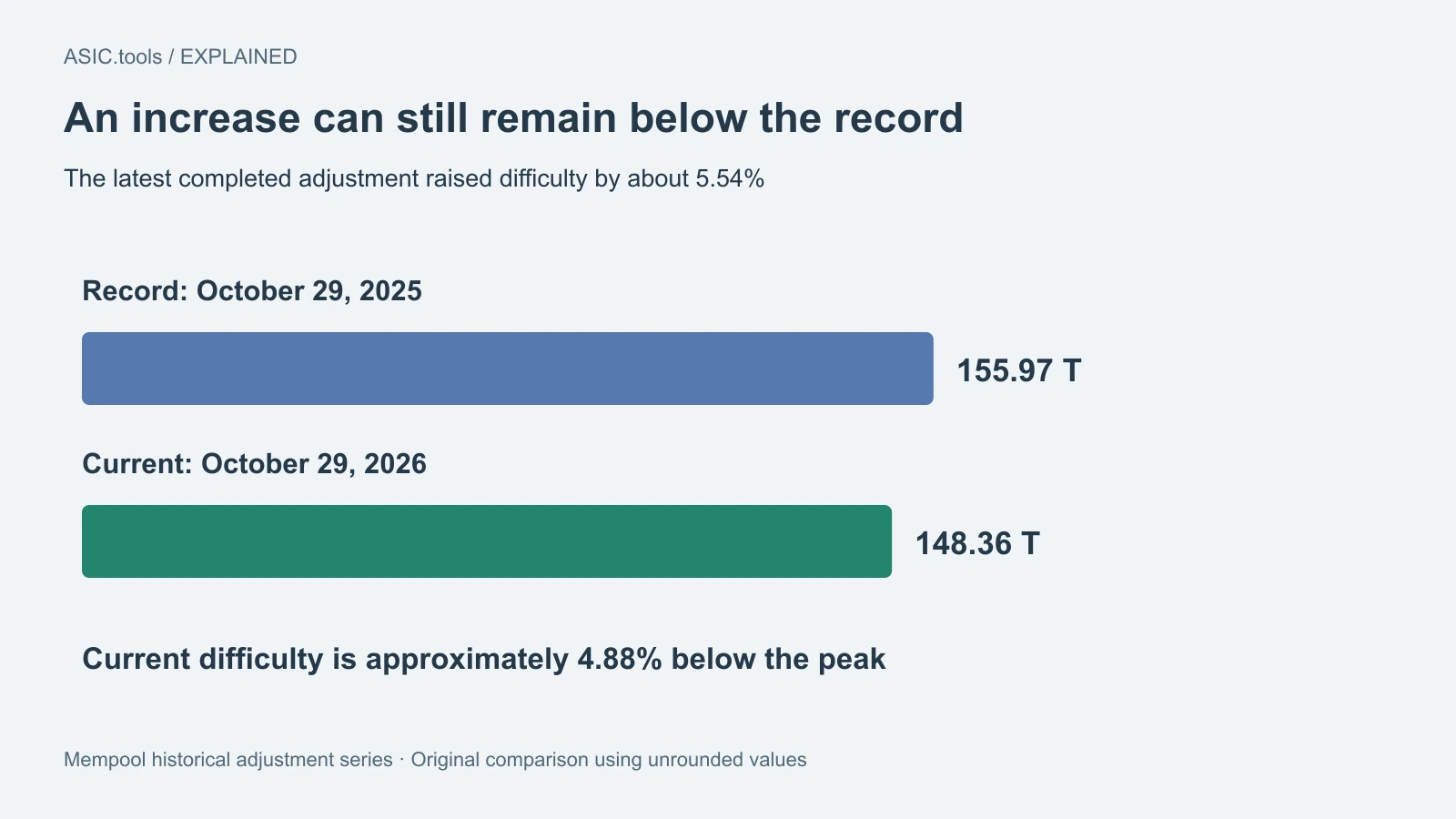
On November 7, block history still places the record at 155.97T on October 29, 2025. The current 148.36T is about 4.88% lower, following October’s increases.
A year without a new difficulty record
Bitcoin's mining difficulty reached November 7 without setting a new high for 374 calendar days. Mempool's historical data still place the maximum at about 155.97 trillion, introduced at block 921,312 on October 29, 2025. The current value is about 148.36 trillion, roughly 4.88% below that level.
The current setting took effect at block 973,728 on October 29, 2026, after an increase of about 5.54%. Difficulty is the network parameter that controls how much hashing work a valid block requires on average. The T in these figures means trillion. It is a numerical index of the work threshold.
The elapsed time is counted from the date of the last record block. That record value remained in force until the following adjustment, so the 374-day measure describes time without a new maximum. An original check of the historical series and the record block header supports the comparison.
The historical comparison has a clear starting point
Our calculation reviewed 469 entries in Mempool's full difficulty history and identified every new maximum in order. The longest completed gap between successive record dates was 364 calendar days, from August 1, 2011 to July 30, 2012. The current interval is longer and is still open.
The record block's header contains the target in a compact field called bits. Expanding that target and comparing it with Bitcoin's reference target reproduces the difficulty reported by the historical series. This check ties the old maximum to a particular block.
A long gap between records can coexist with several increases. In October 2026, difficulty climbed to around 140.58T and then 148.36T. Both values were above the previous adjustment but below 155.97T. A miner can therefore face rising competition during a period that has produced no new all-time high.
What the difference means for a working ASIC
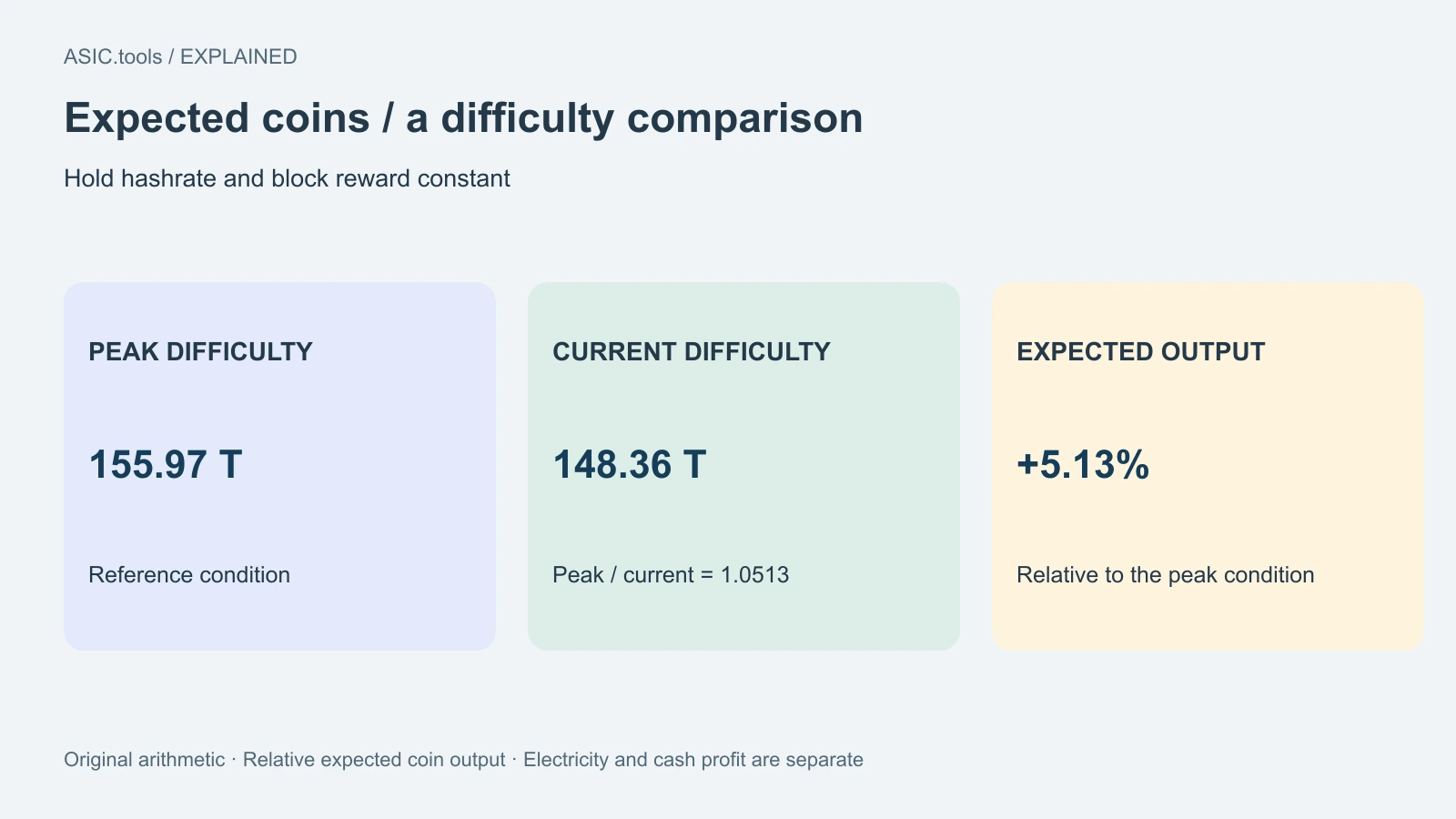
At the same hashrate and block reward, expected coins per unit of work move inversely with difficulty. Using the unrounded historical values, the peak divided by the current difficulty is about 1.0513. That means roughly 5.13% more expected coin output per unit of work than at the peak under those fixed assumptions.
This is a relative calculation. Electricity price, the machine's power draw and the Bitcoin price are separate inputs to the cash result. Pool charges, accepted work and operating hours also affect what appears in a miner's account. A difficulty comparison is most useful when those other inputs are kept visible.
For a farm with several devices, each machine still contributes its own useful hashrate and energy cost. The difficulty setting applies across the network. The proportion of a bill spent on cooling or an older power supply belongs to the installation. Keeping network data and measured site consumption together makes the comparison usable for the machines that actually run.
The next change waits for a block boundary
Bitcoin retargets difficulty on a 2,016-block cycle. The next boundary after block 973,728 is 975,744. Dashboards estimate the timing and size of that change using the blocks already observed, and those estimates move as more blocks arrive.
The adjustment rule compares elapsed time with the intended two-week span. A sequence of faster blocks tends to push difficulty up at the boundary, while a slower sequence tends to push it down. The implemented rule limits the size of an individual adjustment. The current value continues to apply before the next boundary is reached.
For planning, keep a completed adjustment separate from a forecast. A pool estimate can help form a scenario for the following period. The value encoded at the boundary is the one that governs the actual next period. Neither a calendar anniversary nor a dashboard refresh itself changes a miner's work requirement.
A correction to our September report
An earlier ASIC.tools report described the September 132.76T value as an all-time record. The historical block data show that wording was wrong. We have corrected the title and record references in all five editions and added a dated correction to the article.
The original September facts remain, including the 4.16% increase at block 967,680 on September 19 and the value observed on September 26. The corrected page now links the historical data and the October 2025 record block. Its original publication date remains visible alongside the correction.
The November 7 observation uses the record block as the baseline, the current completed adjustment for today's difficulty and the next boundary for future changes. Those three dates and values give readers a way to check what has changed in the network and what remains an estimate.
Source: Bitcoin block data / Mempool ↗ · Record block 921312 ↗ · Bitcoin Core retarget implementation ↗
Mining calculator ↗