Alberta power gets cheaper wholesale, while a published variable rate rises
Source report: 2026-10-19 · Editorial analysis published: 2026-10-20
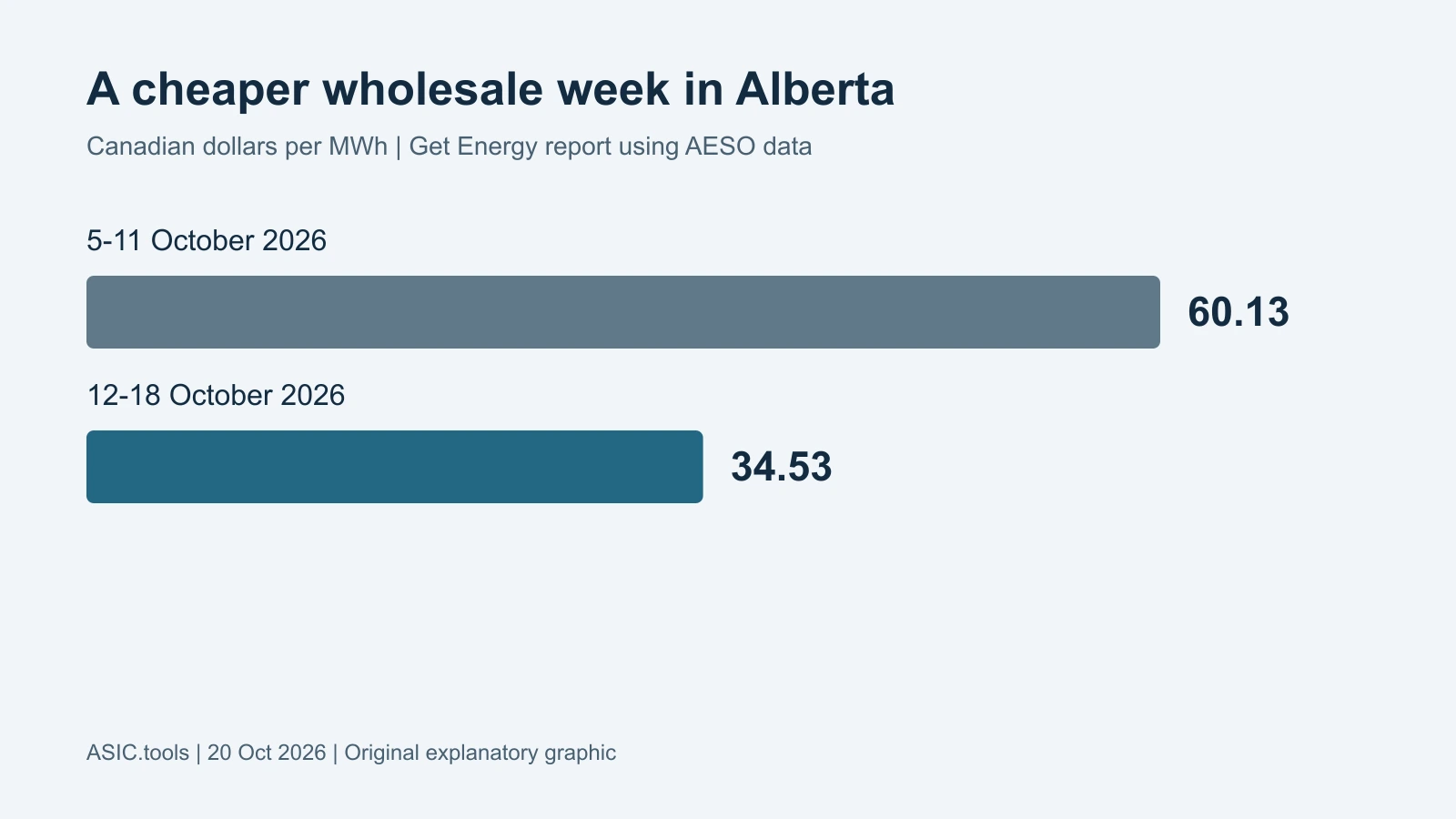
Get Energy’s October 19 report shows a 43% weekly fall in wholesale electricity prices. Its retail rate moved the other way because it was calculated over an earlier rolling period.
The two prices are telling different stories
Alberta’s wholesale power price averaged C$34.53 per megawatt-hour during October 12–18, down from C$60.13 the previous week, according to Get Energy’s October 19 report using AESO data. That is a fall of about 43%. Yet the retailer’s published variable electricity figure rose by 1.27 Canadian cents to 5.95 cents per kilowatt-hour.
There is no need to assume a contradiction. The wholesale figure covers that particular week. The retail figure was calculated on October 13 using a trailing 30-day window, so it included the earlier October 7 spike and did not yet include most of the cheap days described by the new weekly report. The dates and averaging windows differ.
A weekly average can hide an expensive evening
The same report records a peak hourly price of C$805.28/MWh on October 13, alongside 34 hours at or near zero during the week. Those two facts can coexist. A week can be cheap on average while a few hours remain very costly. An average is a summary of many observations, rather than the price paid in every hour.
For equipment operating continuously, the way electricity is billed matters. An hourly indexed contract exposes a consumer to a different pattern from a fixed energy rate or a supplier’s monthly average. A machine’s physical power use may stay almost unchanged while its electricity cost changes with the contract and the hours in which it operates.
Megawatt-hours and kilowatt-hours, without the jargon
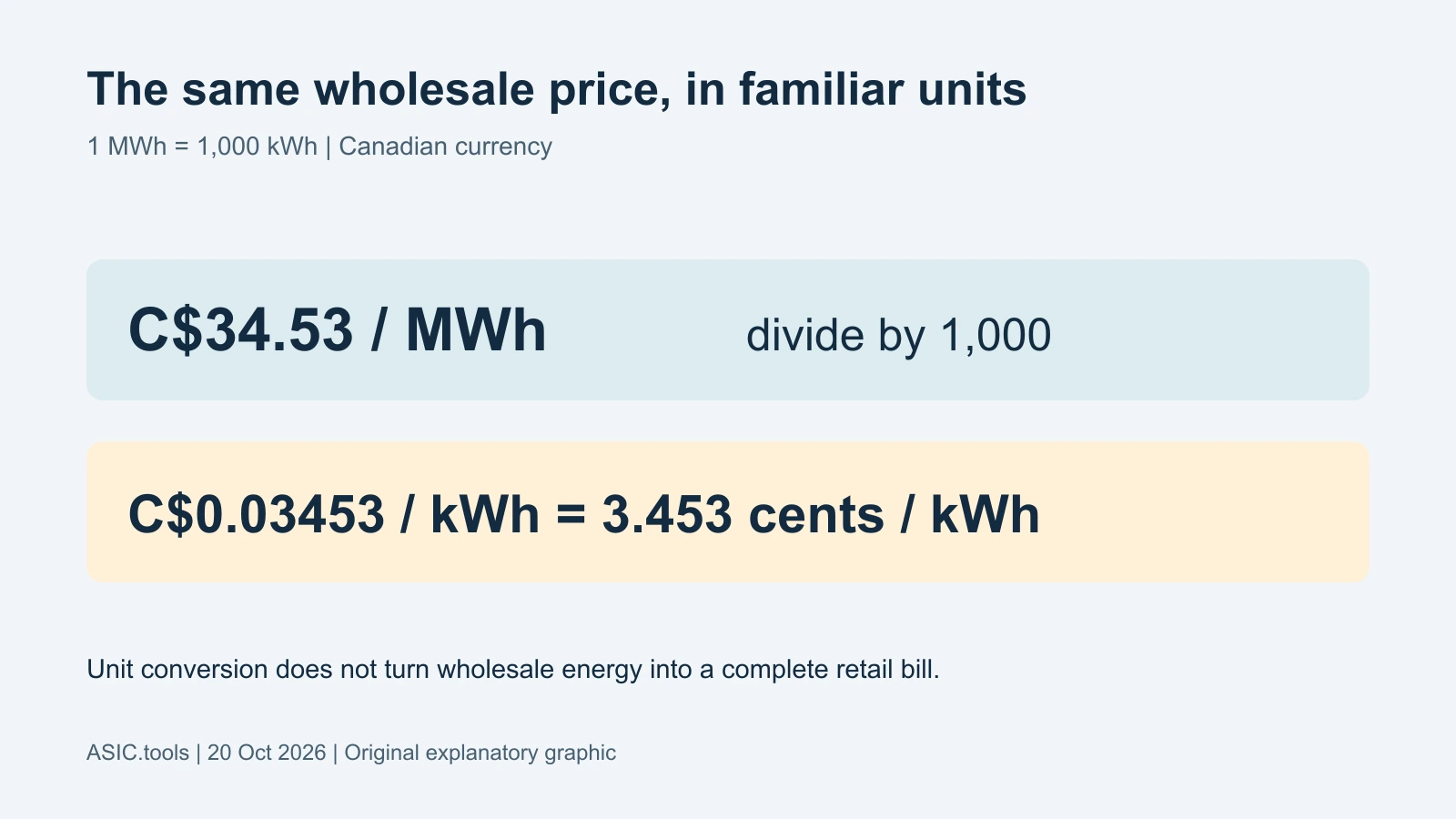
A kilowatt-hour, written kWh, measures energy: for example, a device drawing one kilowatt for one hour uses one kWh. A megawatt-hour, or MWh, is 1,000 kWh. This is why a wholesale price of C$34.53/MWh equals C$0.03453/kWh, or 3.453 Canadian cents per kWh. It is not C$34.53 for each household unit.
That conversion aligns the units; it does not turn a wholesale quote into a complete retail bill. Network delivery, administration, tax and the particular supply contract can add or change charges. All money figures in this article refer to Canadian dollars or Canadian cents. They are Alberta examples, not a new electricity tariff for readers in another country.
What the supplier actually published
Get Energy’s rate sheet identifies 5.95 cents/kWh as its 30-day variable figure as of October 13. It also describes its variable pricing as wholesale power plus a transaction fee of 0.70 cents/kWh. The supplier lists a monthly administration charge of C$9.97 per metered site and says its plans are subject to GST, the Canadian goods and services tax.
The important point is to check the contract’s full charge structure, rather than mistake one displayed energy figure for every line of the bill. The weekly report does not establish what every Alberta household or mining site pays. A supplier’s advertised plan and an individual account’s actual terms are related information, but they are not automatically identical.
A small mining example shows why this matters
Suppose a machine draws a steady 3 kW and runs for 24 hours. It uses 72 kWh. If an energy component alone were 5.95 Canadian cents/kWh, multiplying 72 by C$0.0595 gives C$4.284, or about C$4.28 for that component over the day. This is an illustrative calculation, not a bill quote, and excludes extra charges.
To estimate mining profit, the owner would still need revenue and the other operating costs. If the bill is time-dependent, the hours matter too: replacing every hour with the weekly average can conceal an expensive operating period. The useful lesson is to match the tariff’s rules to the equipment’s real consumption, rather than paste a market headline straight into the calculator.
Switching off changes consumption, not every charge
An important distinction is between costs that change with each kWh and charges that are fixed for the billing period. If a fee is fixed per month, reducing running hours does not automatically remove it. Lower consumption and a lower all-in average cost per unit are not necessarily the same thing.
Nor does a high wholesale hour mean every fixed-rate customer pays that hourly price. Switching off avoids the energy that would have been consumed, but the value of that saving follows the customer’s contract. A decision also changes time available for mining. Treat the electricity avoided, any remaining fixed charges and the lost production as separate parts of the calculation.
What to check on your own bill
Find the energy rate, its unit, the period it covers and the extra charges. Then establish whether the price is fixed, changes monthly or follows individual market hours. A trailing average looks backward, so a falling market can take time to appear in the displayed rate; the same delay can work in the opposite direction when prices rise.
The new report is useful because it shows that timing in a concrete way: a cheaper October 12–18 wholesale week sits next to a variable calculation dated October 13. Neither number alone settles the cost of running a miner. For that decision, the relevant input is the tariff that actually applies to your meter and operating period.
Source: Get Energy ↗ · Get Energy rate sheet ↗
Mining calculator ↗