Automating responses to summer power peaks
Source report: 2026-06-04 · Editorial analysis published: 2026-09-10
The 4CP analysis explains how brief summer peaks affect later transmission charges and why operators automate load reduction around them.

Analysis and practical implications
This section is our analysis and illustrative calculations, separate from the source report.
Peak-related charges reward a different kind of measurement
An energy invoice can depend on more than total kilowatt-hours. Some arrangements include charges associated with demand during defined system peaks. In such a structure, the timing of consumption matters as well as the quantity consumed.
The source discusses a particular peak mechanism. Operators should verify current requirements and contract terms with the relevant provider rather than treating a news summary as an operating instruction. The general lesson is to understand which measured events determine the bill.
Automation needs a reliable chain of evidence
An automated response depends on the signal, the controller, the responding equipment and the meter. Each part needs a defined role. A correct signal is not enough if some machines ignore the command, and a successful controller log is not proof that the required change appeared at the billing meter.
Use synchronized records to compare the instruction with the measured load. Document exceptions and manual interventions. This provides evidence for evaluating the response and helps identify whether a problem originated in detection, communication or equipment behavior.
Avoid treating every warning as a guaranteed peak
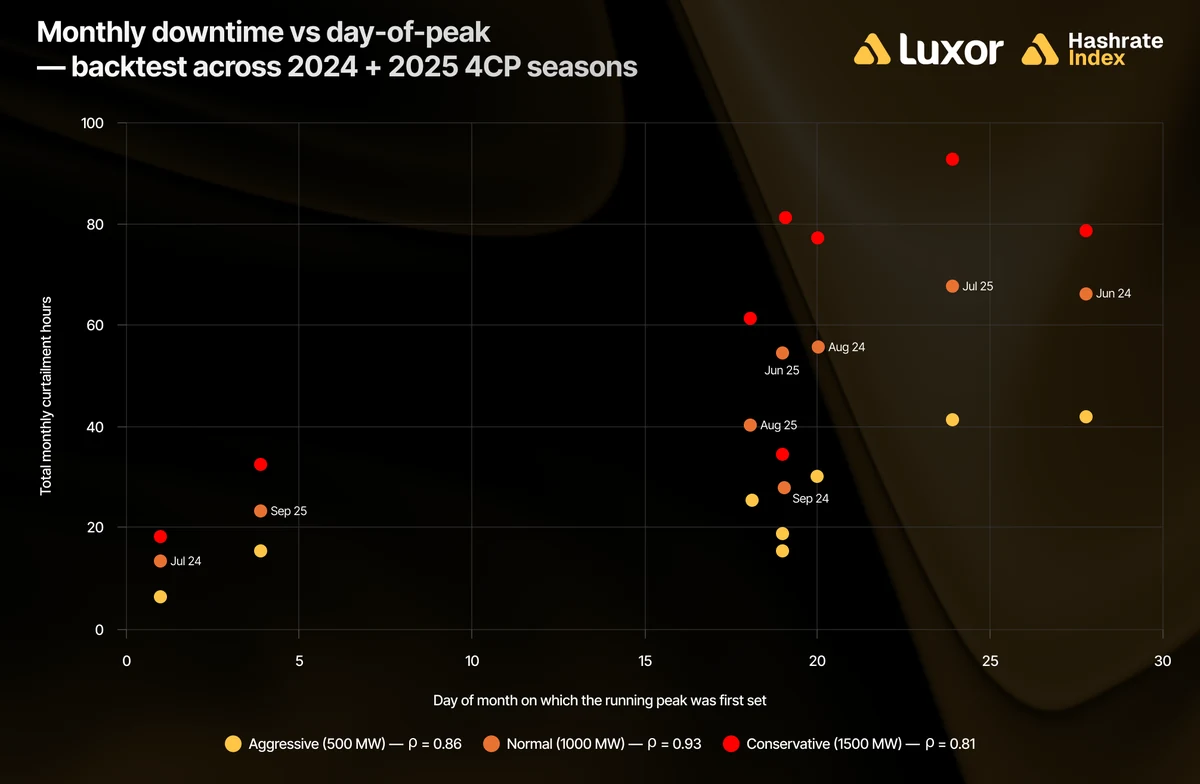
A prediction or warning can be useful without being certain. Reducing production whenever a possible peak is signaled can create lost receipts even during events that do not determine the eventual charge. The operating policy should account for that uncertainty.
Compare the cost of unnecessary reductions with the possible cost of failing to respond. The appropriate balance depends on the actual charging method and the site's commercial conditions. Keep the assumptions visible so that the policy can be reviewed after the season.
Reconcile the season before changing the policy
At the end of the relevant period, compare the response history with the events that actually affected charges. Include mining receipts forgone, recovery time and any operating problems. This turns an automation claim into an assessment of a specific site result.
A useful control policy can evolve from that record. Improve signal handling, exception management and measurement alignment before assuming that more aggressive switching is better. The aim is a dependable operating process that reduces total cost under the actual tariff structure.
Source: Hashrate Index / Luxor ↗
Mining calculator ↗