SunBit reports 30 Bitcoin heating systems: useful heat still needs an electricity budget
Source report: 2026-11-08 · Editorial analysis published: 2026-11-09
A November 8 interview describes operating installations. Official case studies show different heating roles, while continuous mining and useful household heat are not the same quantity.
Thirty systems put mining heat to work
In a November 8 interview with CoinDesk, SunBit founder Elmeri Suomi reported 30 operating Bitcoin heating systems, all but one in Finland. The company began production deliveries in 2025, and its case studies include an earlier industrial installation. The operating fleet spans different heating arrangements, from replacing a district connection to working alongside an existing boiler. For a homeowner, those differences matter when comparing what a mining heater would actually replace.
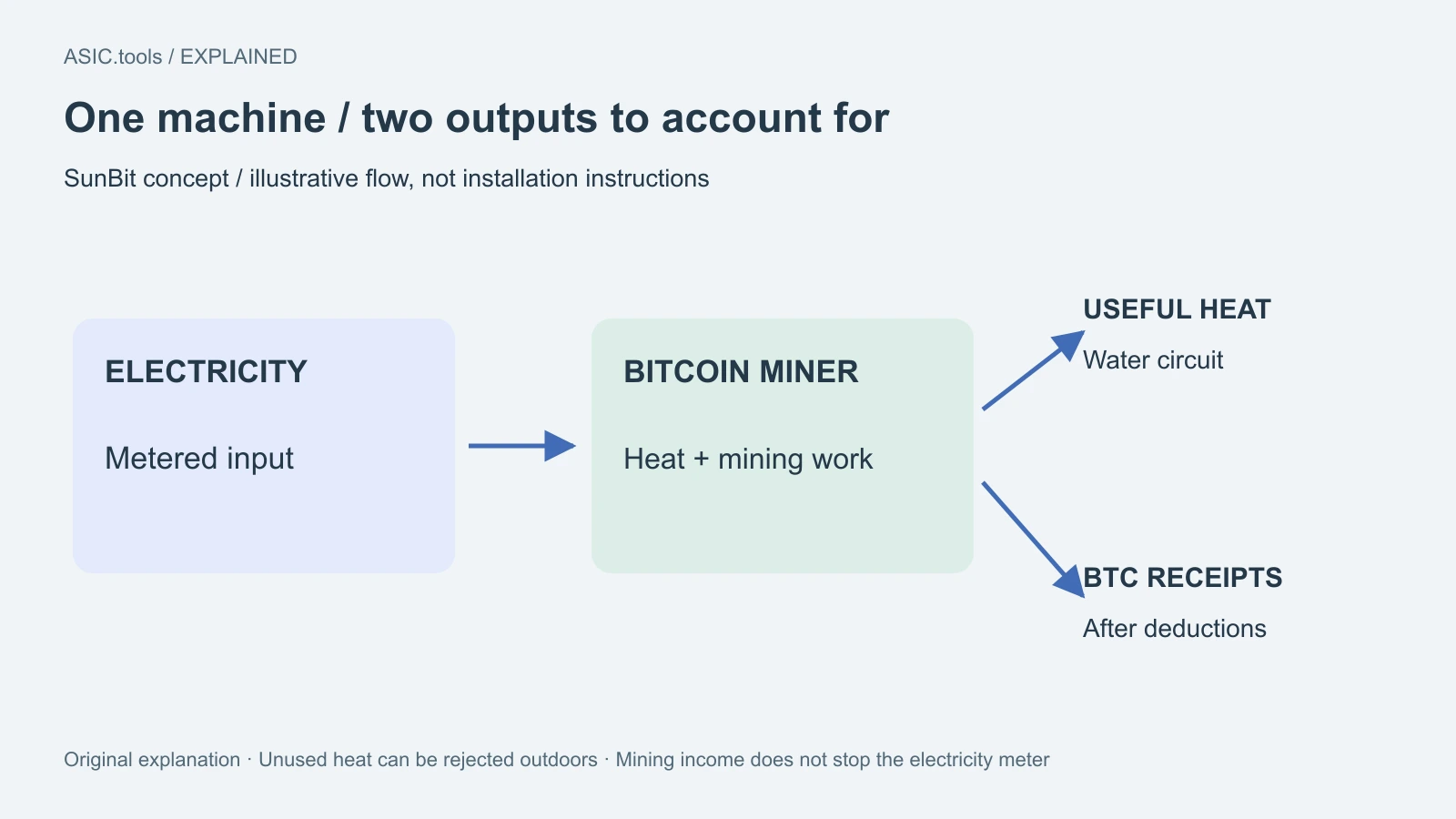
The idea is straightforward: specialised Bitcoin mining computers use electricity and release heat, which the system transfers to the building's water circuit. The owner keeps the equipment and the mining proceeds while paying for the electricity. For a household, the useful comparison is its existing heating cost plus the new system's full costs and income. Mining changes the financial flows; it does not make the electricity meter stop recording consumption.
The case studies have different jobs
SunBit's own case page says a 180-square-metre house in Nokia replaced district heating and added a separate domestic hot-water tank. In Kotka, a 200-square-metre house uses the Bitcoin Boiler as its main heat source while retaining an oil boiler as backup. These are two different arrangements. A complete replacement in one property is not proof that every installation can dispense with backup heating.
The official page also describes a Tampere manor using a Bitcoin Boiler alongside a wood boiler and a 1,500-litre tank at 50–60°C. A Vimpeli industrial hall is an earlier, custom immersion-cooled system from 2024, alongside oil and an air-to-water heat pump. It can use surplus power from a 30 kW solar array. These are the supplier's installation descriptions, not independently metered performance records from ASIC.tools.
Heating power becomes a substantial energy bill
The product page gives heating outputs of 5.3 or 10.6 kW, room for two liquid-cooled miners, a three-phase grid supply and water at 60°C. A tank and outdoor unit are sized to the property. These are system descriptions: the example miner is priced on the order date, so a boiler-output figure is not a newly confirmed factory hashrate-and-power profile for the catalogue.
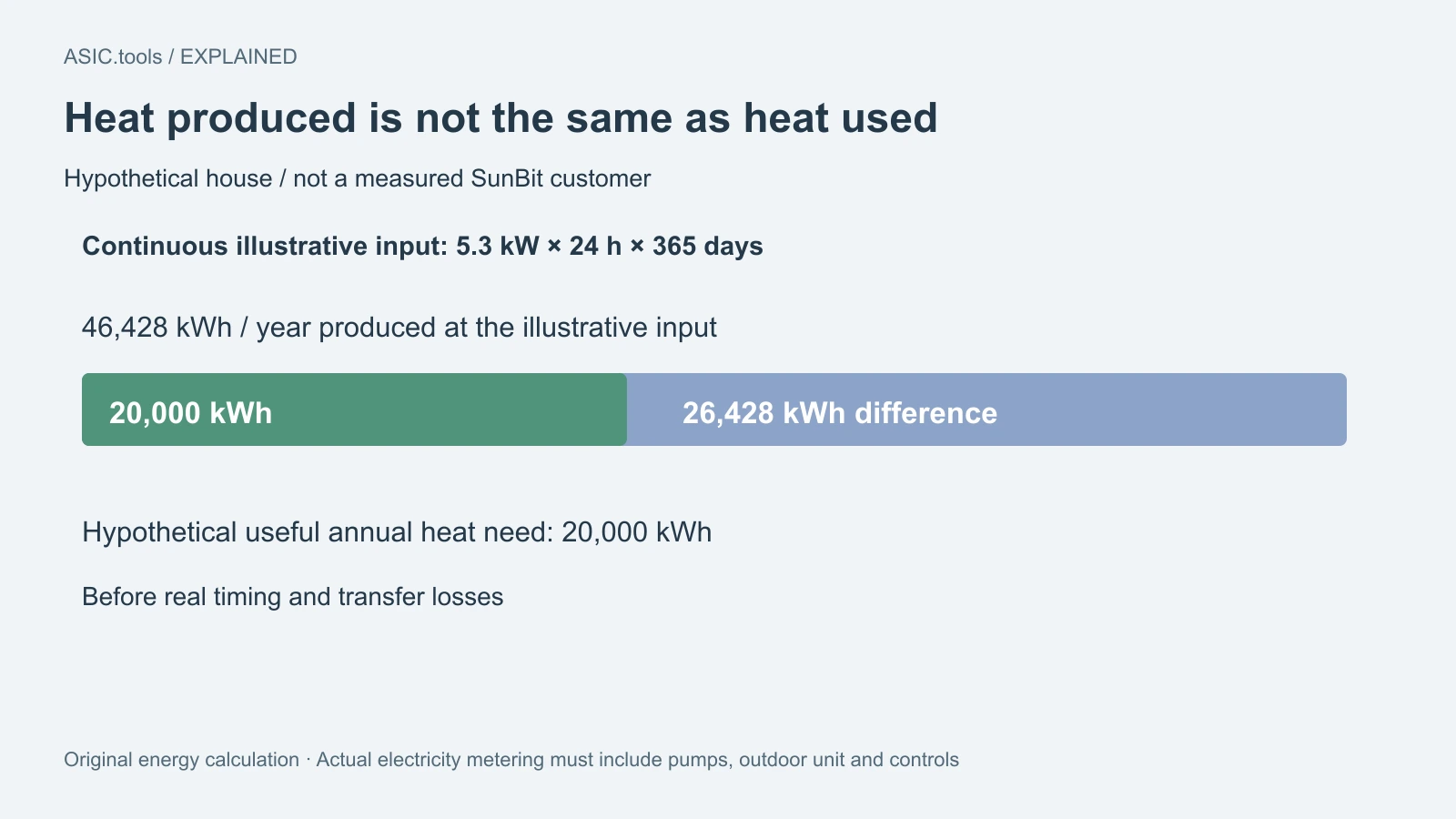
The scale is easy to see without predicting a bitcoin price. At a constant 5.3 kW for 24 hours, energy use is 127.2 kWh; running at that level for 365 days gives 46,428 kWh, about 46.4 MWh. This is an illustrative continuous-use calculation, not a measured customer's bill. Multiply the energy actually purchased by the applicable all-in electricity price, retaining network and fixed charges where relevant. A daily average power figure and an annual heat requirement are not interchangeable. For a real bill, meter circulation pumps, the outdoor unit and controls as well: a stated heating output is not a measurement of every electrical load.
Heat produced is not always heat the house can use
SunBit says excess heat can be rejected outdoors through a condenser. Its FAQ describes both full operation during cheap summer electricity and operation according to heat demand, shutting miners down when heat is not needed. These are alternative operating choices, not free extra heat savings. Heat sent outside may accompany mining revenue, but it has not replaced heat a household would otherwise have bought.
Consider an illustrative property needing 20,000 kWh of useful heat in a year. Even if the constant 5.3 kW machine produced 46,428 kWh, the household cannot credit all of it as avoided heating consumption. The difference is 26,428 kWh before considering real timing and transfer losses. This example only separates the quantities; actual winter peaks, hot-water needs and summer surplus must be assessed for that property rather than inferred from its floor area alone.
Surplus solar electricity also has an alternative use. In SunBit’s Vimpeli case it can feed mining rather than being sold, but a household should compare the actual export payment it gives up with the net mining income and useful heat it obtains. Self-generated energy is not automatically zero-cost energy. Export rates and electricity purchase rates can differ, and the times when panels produce, the house needs heat and mining earns most do not necessarily coincide. Those records belong in the same comparison.
Income and ownership need their own columns
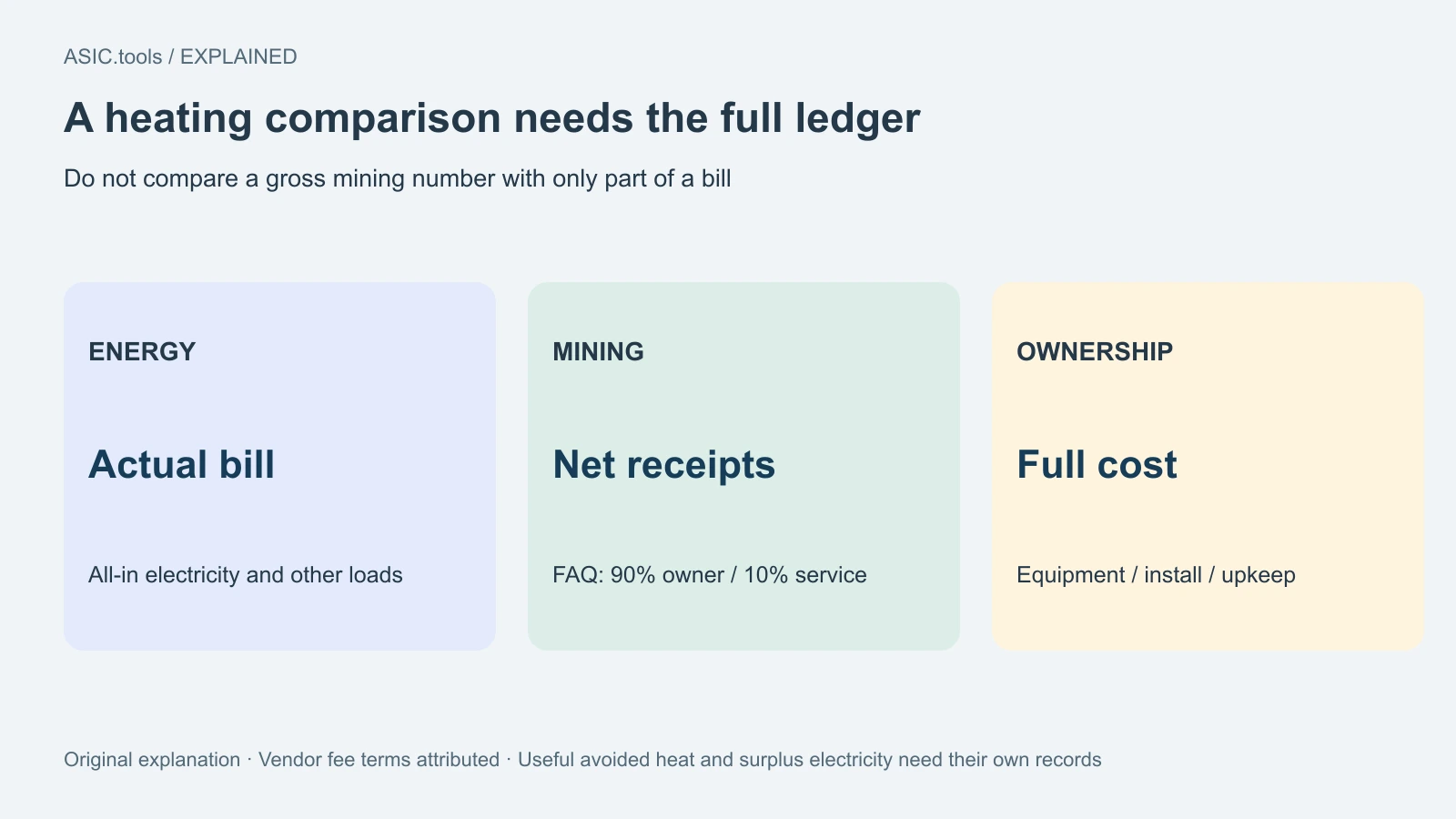
The supplier's FAQ says the owner receives 90% of mining income and SunBit takes 10% for remote management. Mining income and electricity expense must therefore be compared after the relevant deductions and over the same interval. The FAQ's quoted revenue range is a company assumption, not a live income guarantee. Bitcoin price, network competition, transaction fees and operating hours can change the result while the heating hardware still produces warmth.
Installation is a separate cost. SunBit's product page gives an example €14,500 plus VAT, with a separate tank and condenser potentially taking it to about €18,150 plus VAT, depending on the property. Hardware is priced on the order date and the final package is tailored. These are checked supplier examples, not a delivered quotation for Ukraine or an offer to buy. The electricity break-even price also differs from recovering purchase, installation, maintenance and financing costs.
A miner and a heat pump save money in different ways
A miner turns its electrical input into heat; a heat pump transfers heat from another place and can deliver more heat than the electrical energy it consumes. Thus, replacing direct electric heating and replacing an efficient heat pump are different comparisons. Mining may offset an energy bill with coin revenue, while a heat pump reduces the electricity needed for the heating job. The right result depends on the existing system and usable heat, not only a mining dashboard's earnings.
The next Bitcoin subsidy halving is another reason not to extend one day's margin through a multiyear payback calculation. A smaller new-coin reward changes one income component; future price, fees and competition remain unknown. ASIC.tools checked the original November 8 interview and current official case, product and FAQ pages without independently testing a boiler. The evidence supports functioning installations and a clear heat-reuse design, with profitability still requiring the household's own energy and cost records.
Source: CoinDesk interview / SunBit primary documents ↗ · Official installation cases ↗ · Boiler specification and package scope ↗ · Ownership, service fee and summer operation ↗ · Vendor heating comparison calculator ↗ · Why heat pumps differ from resistance heating ↗
Mining calculator ↗