Vietnam cuts its average electricity price by 2%: check the tariff behind a mining bill
Source report: 2026-10-31 · Editorial analysis published: 2026-11-01
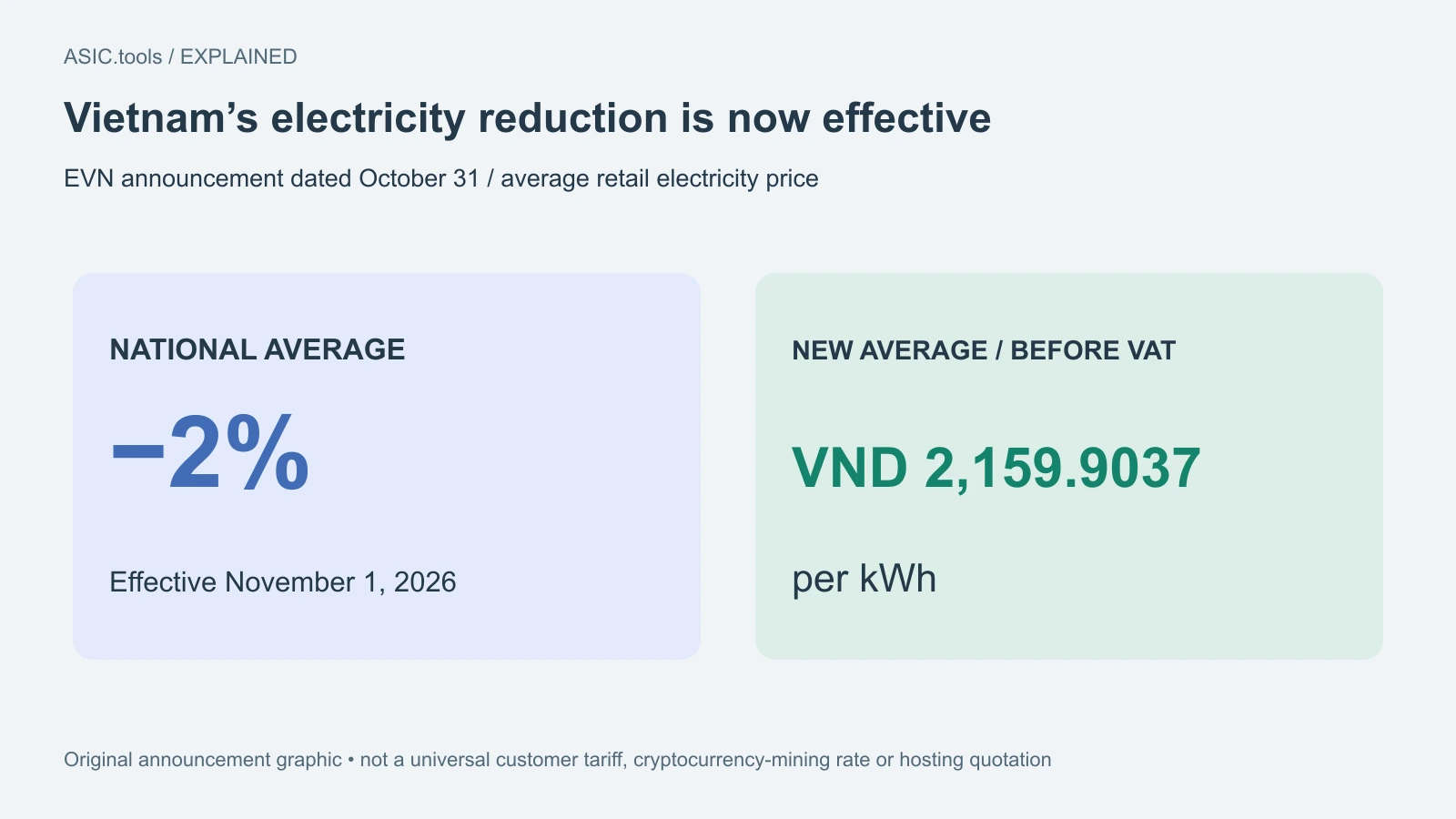
EVN’s October 31 notice makes the average VND 2,159.9037/kWh before VAT effective November 1. Actual customer prices follow their tariff group; the headline is not a universal mining or hosting rate.
A confirmed cut begins on November 1
Vietnam Electricity, or EVN, announced on October 31 that the average retail electricity price would fall by 2% from November 1. The new average is VND 2,159.9037 per kilowatt-hour before value-added tax. For someone paying to run mining equipment, this is a real change in electricity pricing, but the useful next step is to identify the new rate that applies to their own meter.
The official notice points to EVN Decision 1305 dated October 30 and Ministry of Industry and Trade Decision 2892 dated October 31. The latter establishes prices for customer groups and electricity retailers, effective November 1. The English notice, Vietnamese announcement and original press release agree on the average, reduction and start date; the event is a decision taking effect, not a forecast that prices might eventually fall.
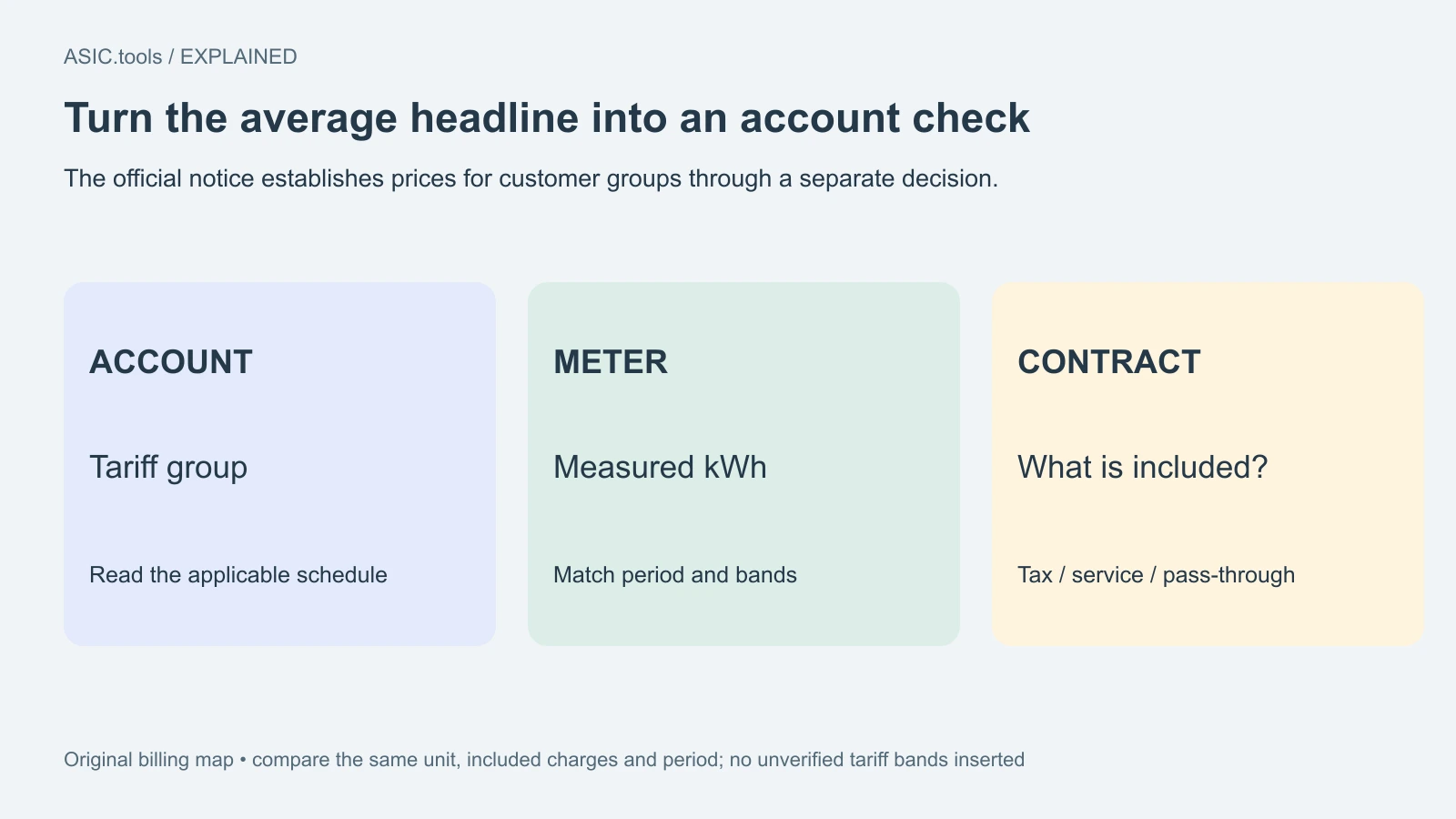
The national average is not a miner’s quote
An average brings different customers into one headline number. It is not a promise that every kilowatt-hour on every account will be invoiced at VND 2,159.9037. EVN explicitly refers to separate prices for customer groups. Find the account’s group and the applicable new schedule before replacing a calculator’s tariff with the published average.
The decimal notation matters too. In the English figure, the comma separates thousands and the point separates the fraction; Vietnamese writing uses 2.159,9037 for the same amount. The unit is Vietnamese dong per kWh, not thousands of dong per kWh. VAT is excluded. This report does not invent a VAT percentage or convert the amount to dollars using an unverified exchange rate.
For a meter billed under more than one applicable band, compare the relevant bands and their measured quantities. If a quoted energy price already includes tax or other items, keep the same basis when comparing old and new. A lower average and a differently formatted contract price cannot be compared fairly until the unit, included charges and billing period match.
A small cost change can matter to a thin margin
The cut changes the price of purchased electricity, not an ASIC’s watts, hashrate or block reward. Consumption still follows measured power and runtime, including power-supply losses and extra cooling. Keeping the device and operating hours the same helps isolate the effect of the applicable tariff; changing power settings at the same time makes the result harder to interpret.
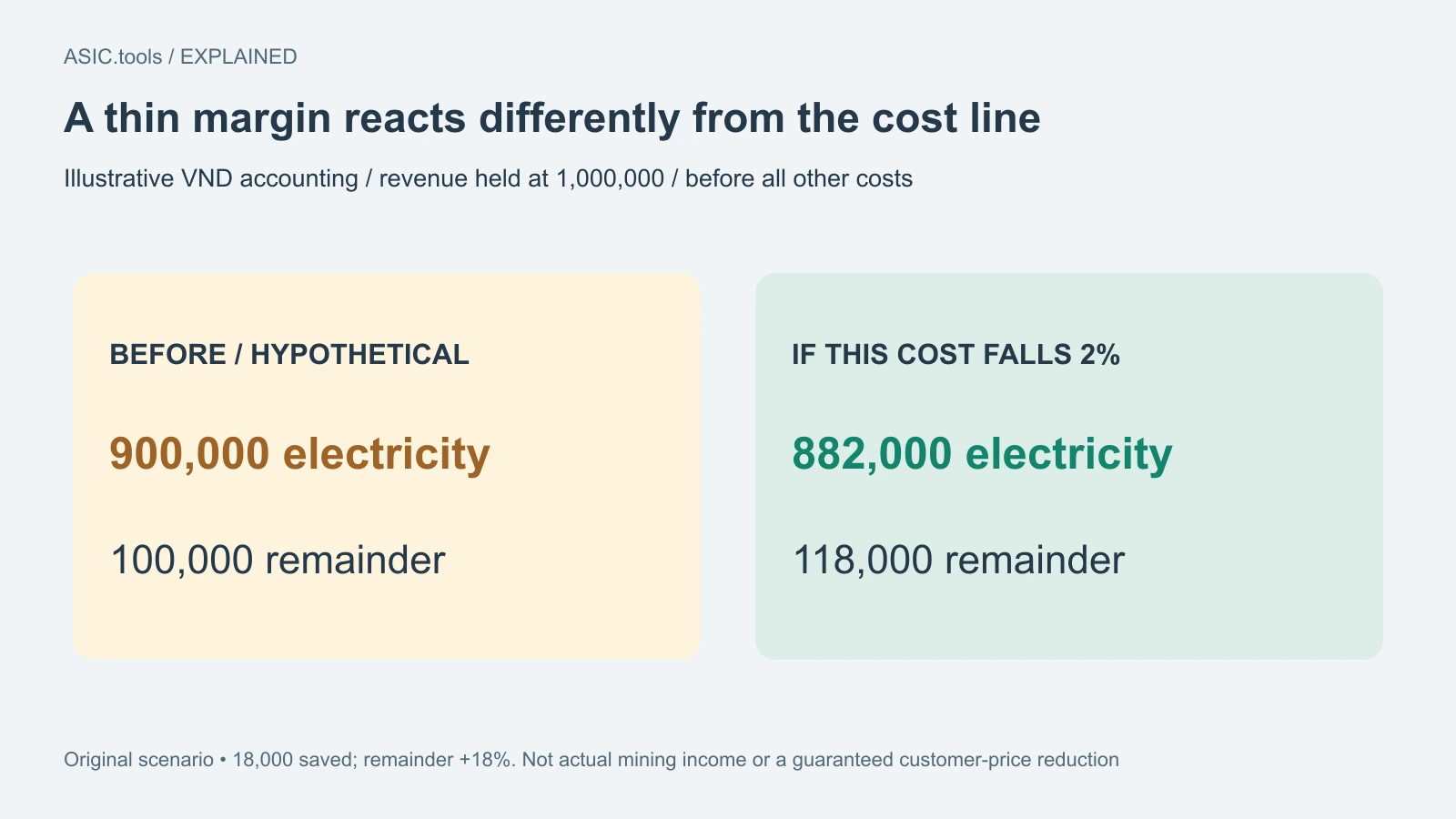
Consider a deliberately hypothetical accounting example, not a Vietnamese earnings quote: revenue of 1,000,000 dong and electricity cost of 900,000 leave 100,000 before other costs. If that particular electricity cost fell exactly 2%, the saving would be 18,000 and the remainder 118,000. The remainder rises 18%, even though electricity falls only 2%. Actual results require the account’s new rate and all other costs; the national average alone does not establish that saving.
Check who actually pays for power
A miner billed directly by a utility can compare the applicable schedule and meter readings. A hosted miner may instead pay a fixed package, an energy-linked charge or a separately itemised pass-through. The EVN announcement is not a revision of every hosting contract. Ask which clause determines whether, when and how a utility-price change reaches the customer’s next invoice.
Separate electricity from service fees, space, maintenance and any other included items. A package price can stay unchanged even while one underlying input changes, or the adjustment may appear in a later billing cycle. These are contract questions to verify, not claims about a particular provider. A written breakdown makes it easier to tell a real passed-through saving from a marketing promise based only on the national headline.
Make the first comparison reproducible
Keep the previous invoice, the new tariff reference and meter records around the effective date. If a billing period crosses November 1, ask the supplier how it allocates consumption across the change. Do not assume the whole period receives either the old or the new rate. A dated record is more useful than comparing two totals from months with different operating hours or equipment.
Compare like with like: electricity per measured kWh, the miner’s actual accepted work over the same interval, and the full cash expense. Falling coin prices, difficulty changes, pool fees and downtime can outweigh a modest power-price improvement. If useful heat replaces another expense, record that separately and only when it genuinely replaces a purchase; do not count it twice as both free electricity and extra income.
The decision gives operators a concrete reason to revisit electricity costs now. It does not settle a hardware purchase, prove profitability or assign a special tariff to cryptocurrency mining. Update the rate supported by the actual account and contract, preserve the old assumptions for comparison, and judge the benefit from the resulting bill. That keeps a welcome 2% national reduction connected to the cost a real mining setup pays.
Source: Vietnam Electricity (EVN) ↗ · Original Vietnamese EVN announcement ↗ · EVN official press release ↗
Mining calculator ↗