Odesa’s damaged grid cannot deliver enough power; critical sites get partial restoration
Source report: 2026-11-22 · Editorial analysis published: 2026-11-22
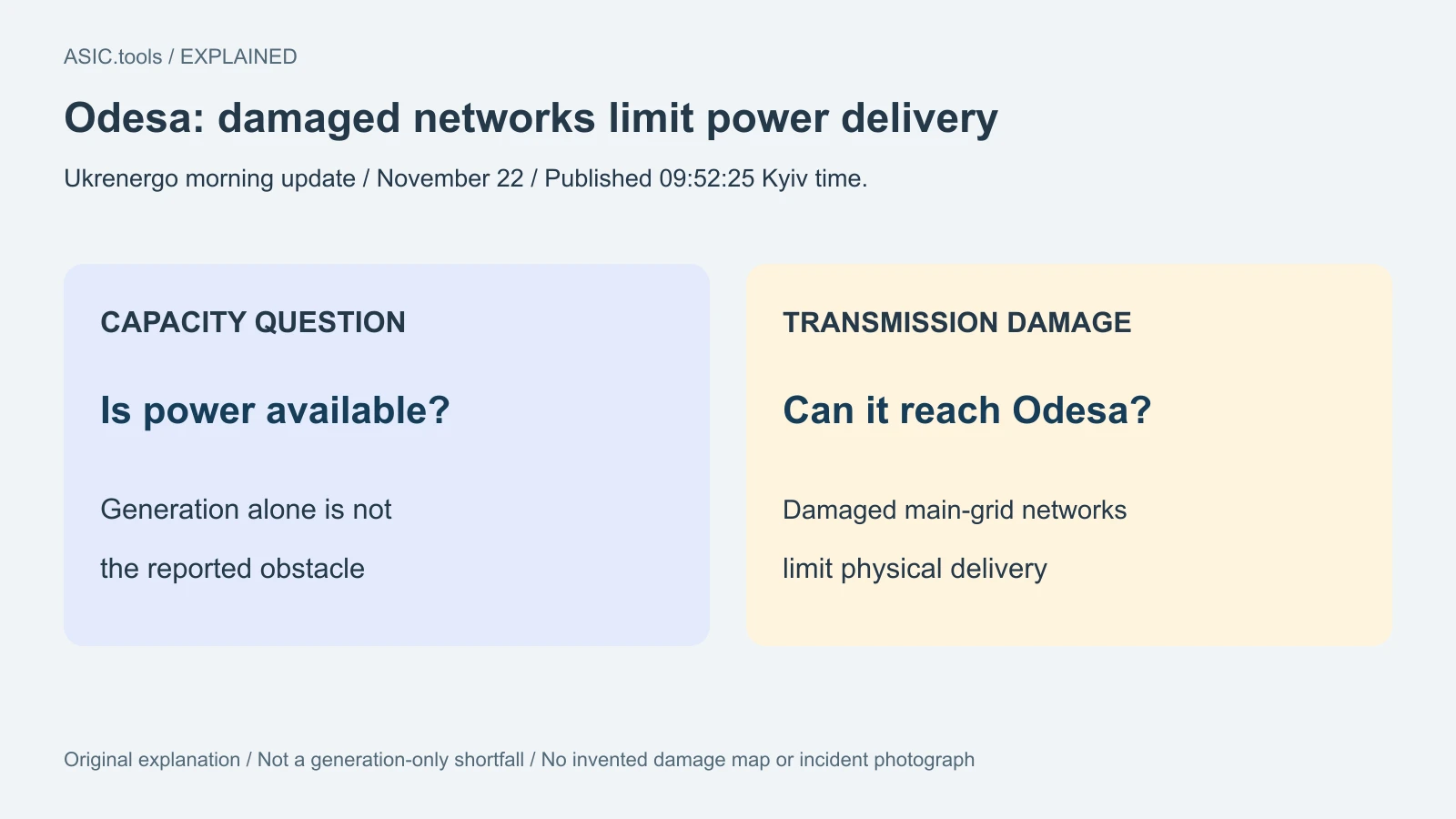
Ukrenergo’s November 22 morning update says the obstacle is damaged transmission infrastructure, not just missing generation. Repairs continue without a full-restoration deadline; planned queues remain separate.
Odesa’s damaged grid cannot deliver the electricity it needs
Ukrenergo said on November 22 that damage to main electricity networks leaves it physically unable to transmit the volume of power needed by Odesa and nearby areas. The problem is not simply a shortage of generation. In the morning, partial restoration began for critical infrastructure. For a miner, this makes an announced timetable different from proof that the local connection is ready to run.
The official update was published at 07:52:25 UTC, or 09:52:25 Kyiv time. Ukrenergo described the situation as extremely difficult, with repair work continuing through the previous day and night, interrupted by attack threats and air alerts. It gave no deadline for full restoration. Separate planned restrictions for November 22 still cover part of Ukraine, including1–2.5 consumer queues and industrial power limits.
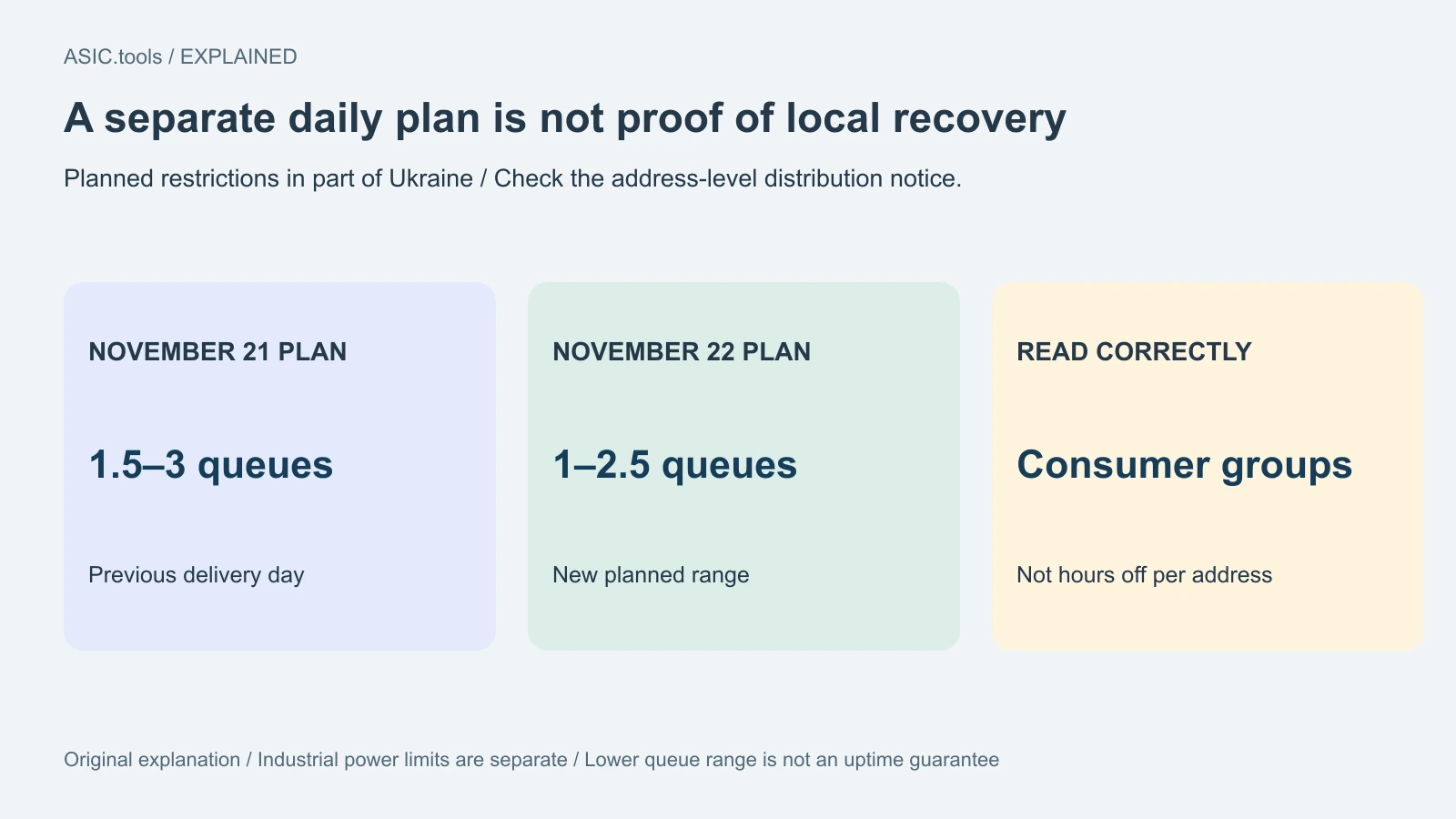
A queue is a group of customers, not an hour
The range 1–2.5 describes how many groups of consumers can be disconnected at once. It does not mean a particular home loses power for one to two and a half hours. The local distribution operator maps a customer's address to a group and publishes the relevant timetable. That address-level information is needed before making a plan for an individual mining machine.
The November 20 notice for November 21 had given a range of 1.5–3 queues. Today's planned range is lower, but the two announcements alone cannot establish how many more hours any particular address will receive. Local conditions and later operational instructions still determine its actual schedule. This is a comparison of the published limits, not a claim that electricity supply has returned to normal.
The industrial restriction is also a separate measure: a limit on a site's allowed power is not necessarily the same as an all-or-nothing household interruption. A business needs the instructions and contract applicable to its own connection. Neither the queue range nor the industrial heading supplies an electricity price or a universal mining tariff.
The new morning update separates damage from a generation shortage
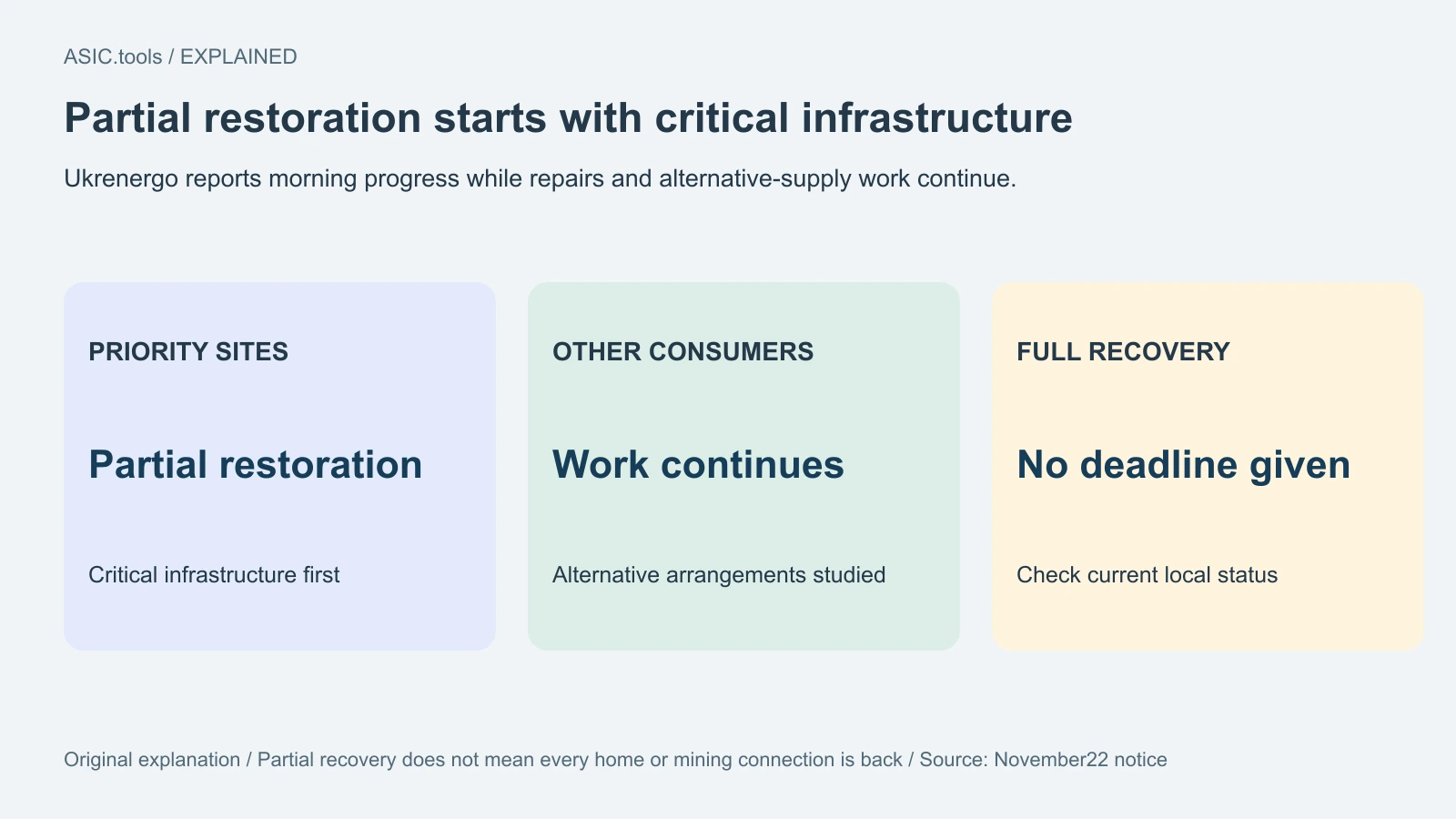
The November 22 notice explicitly distinguishes damaged key infrastructure from a simple capacity shortfall. Repair crews had worked all day and overnight; threats and air alerts prevented continuous work. Critical infrastructure received the first partial restoration in the morning, while alternative supply arrangements were being examined for other consumers. Partial restoration of that priority group does not mean all households or mining connections have returned.
DTEK's evening explanation likewise described protection operating after damage to main-grid networks, repeated attacks on restored facilities and air alerts slowing repairs. It warned that voltage can briefly rise or fall when supply returns. This is a description of the reported situation in Odesa, not evidence of a new fault at every customer's address or an instruction to modify electrical equipment.
For a mining site, the distinction is between a planned operating window and observed availability. A regional repair announcement cannot guarantee that a particular connection, router and miner have all resumed normal operation. The operator's latest address check and the site's own records answer that practical question more directly than a national headline.
Keep today's income calculation tied to actual work
An ASIC, a specialized mining computer, cannot send fresh work to a pool without power and a working network connection. A pool is the service that receives that work and accounts for rewards. When reviewing November 22, use accepted work and the real operating interval, rather than assuming the machine ran for twenty-four hours because a calculator uses a daily estimate.
Previously credited work and later payments remain separate. A payout arriving during a cut does not establish that the miner is still running; a worker appearing online does not by itself show how much work was credited. Keep the interruption, resumed accepted work and payment timestamps, with the relevant time zone. This avoids turning a display update or delayed settlement into a false operating record.
What to check before the next session
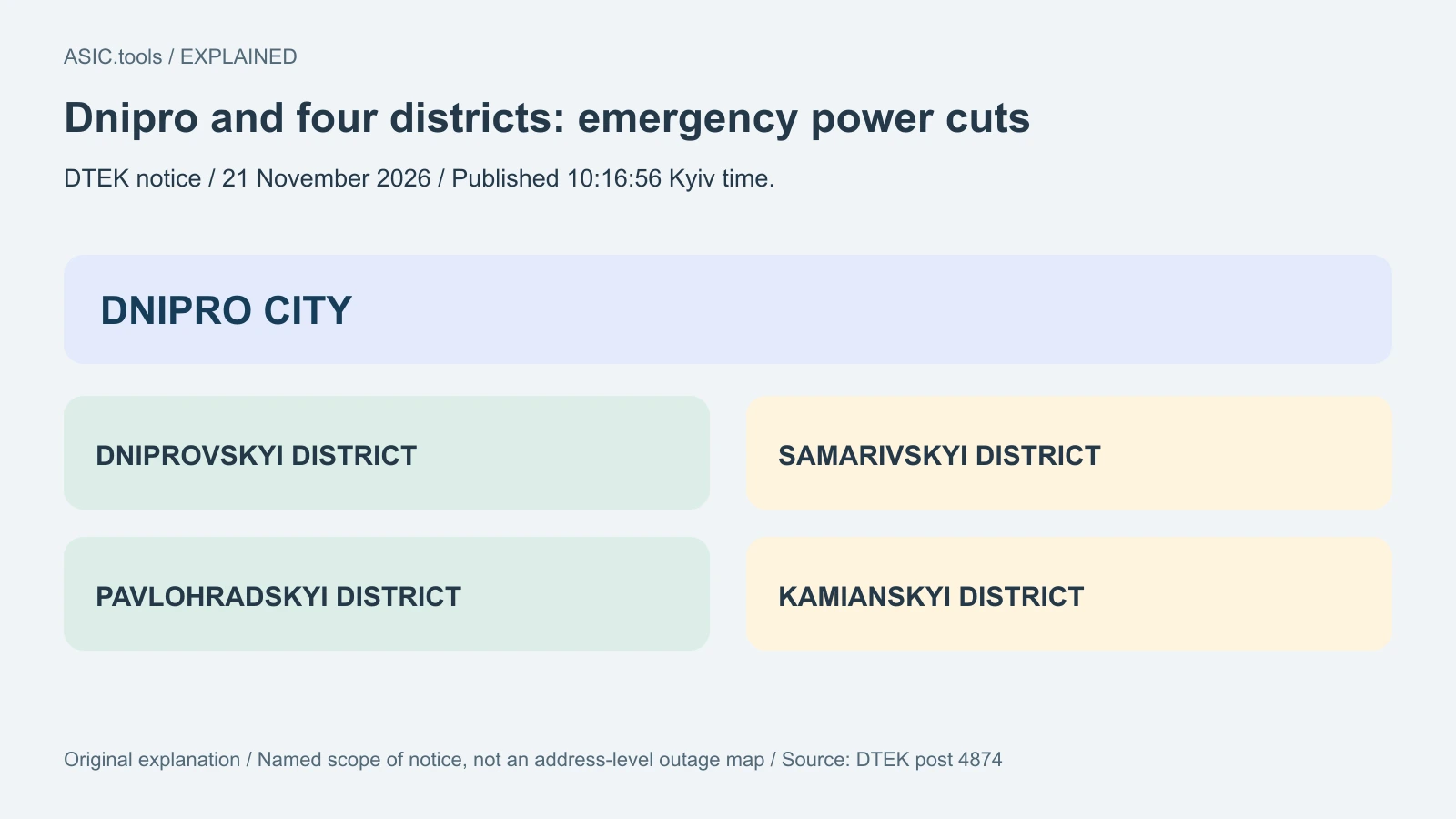
Use the current timetable from the distribution operator serving your address and check whether a later emergency instruction has replaced it. Ukrenergo's November 22 plan and yesterday's DTEK emergency notice for Dnipro are different notices. A later national plan does not, by itself, prove that a particular local emergency regime was formally cancelled.
Follow the site's established shutdown and restart procedure and the equipment instructions. DTEK advises disconnecting powerful appliances during cuts to protect equipment when supply returns; it gives household examples such as boilers and heaters. That statement is not a design assessment of a mining installation or proof that a domestic backup system can carry a full farm.
Our original illustrations explain the new queue range, the separate industrial measure and the difference between a plan, a local notice and actual accepted work. They are explanatory diagrams, not damage photographs or an address-level outage map. The sources were checked for this report on November 22; before the next session, consult the newest local update rather than extending this dated plan into a promise about future supply.
For a calculator or My farm entry, uptime should represent the period being reviewed. As a purely illustrative example, 12 hours of operation in a 24-hour day is 50% uptime. That is not a forecast of twelve hours of cuts on November 22. Replace the example with actual recorded hours before using the result to assess your own session.
Source: Ukrenergo / DTEK ↗ · Separate planned November22 restrictions ↗ · Ukrenergo update on Odesa restoration and repeated attacks ↗ · DTEK November 21 evening explanation ↗ · Earlier planned restrictions for November 21 ↗ · Earlier ASIC.tools report on local Dnipro emergency cuts ↗
Mining calculator ↗