A weekly solo-mining census counts 16,766 Bitaxes: the group is not one miner
Source report: 2026-10-19 · Editorial analysis published: 2026-10-21
SoloLuck’s October 19 edition covers seven publicly reporting pools and a week of device data. It offers a useful snapshot of small miners, provided counts, averages and shared probabilities are kept separate.
A dated snapshot of small Bitcoin miners
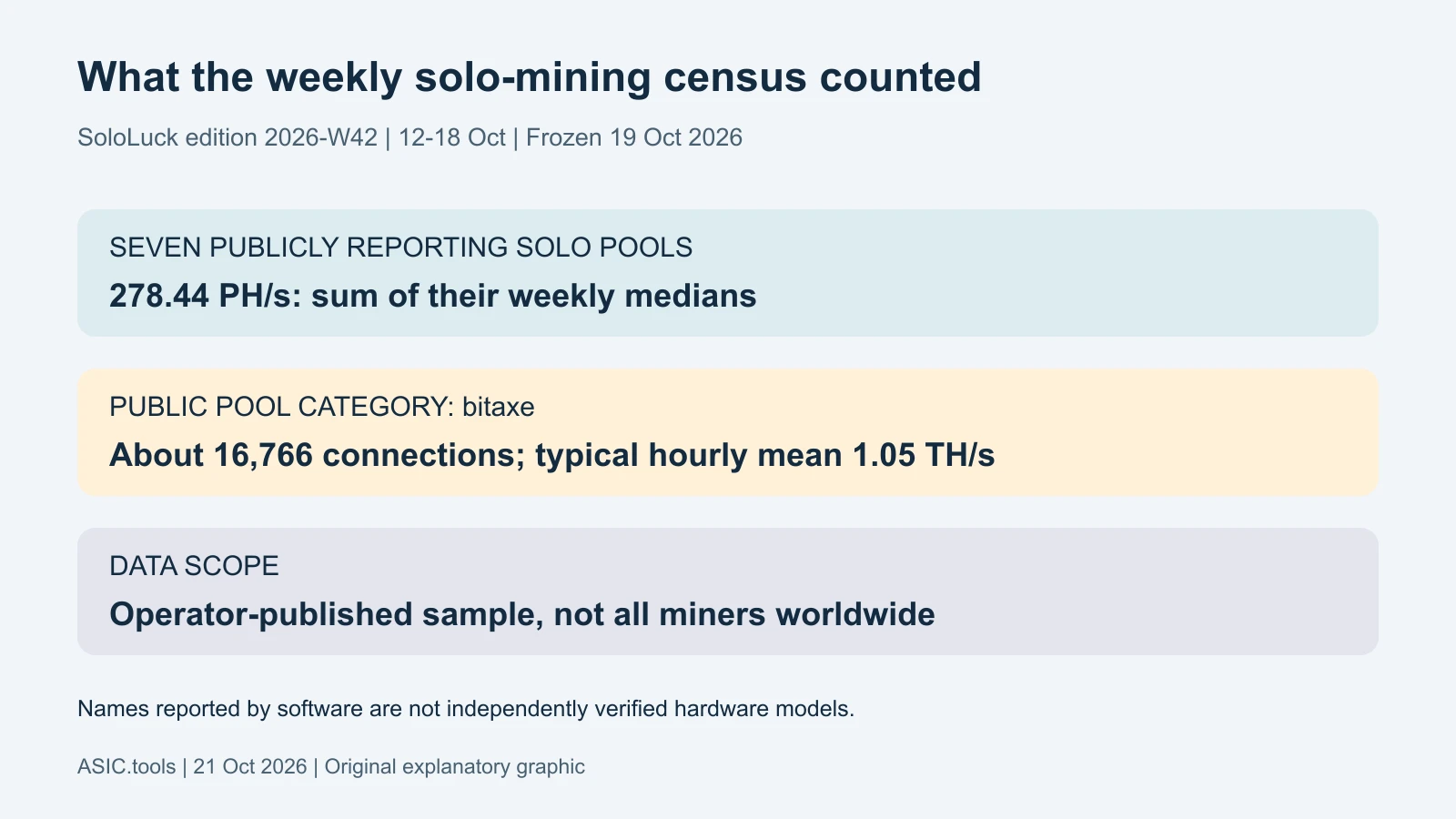
A new weekly edition of the Solo Mining Census puts numbers behind the small devices seen on desks and home networks. The edition, frozen on October 19, covers October 12–18 and reports a combined 278.44 PH/s across seven solo pools with public statistics. Its Public Pool device table lists about 16,766 connections reported under the name bitaxe, with a typical hourly average of 1.05 TH/s each.
The census is published by SoloLuck, which also operates one of the pools included. That interest is disclosed by the author and matters when reading the report. We checked the dated JSON and CSV files and their published hashes; this verifies which edition and numbers were used, not an independent audit of every pool’s underlying equipment. The story is about a newly frozen weekly dataset, not a claim that all these miners joined on October 19.
How the census avoids one misleading headcount
The collector reads the pools’ own public statistics once an hour. A weekly median is the middle value in the week’s readings, which reduces the influence of a short spike. The headline 278.44 PH/s is the sum of each pool’s weekly median, not one simultaneous measurement of the whole world. PH/s and TH/s measure computing work per second; one petahash per second equals one thousand terahashes per second.
The publisher deliberately does not add every pool’s miner count together. Some services count addresses; others count connected devices or workers. A worker is a named mining connection, not necessarily one person or one household. Adding these different counters would create a big but unreliable population total. The same care applies to CKPool’s regional endpoints: they are parts of a reported total, so adding both the endpoints and that total would count the same activity twice.

What the Bitaxe figure can actually tell a buyer
The Public Pool table is organised by names reported by connected mining software. Under bitaxe, the census gives roughly 17.60 PH/s combined and an hourly-average median of about 1.05 TH/s per connection. These observations describe that category in this sample. They are not a new manufacturer specification, a laboratory test of a particular Bitaxe model or proof that every unit will perform identically in a home setup.
The method computes an average for each hour from the category’s total hashrate and connection count, then uses the median hour. That is not necessarily the same as dividing two separately rounded weekly headline figures. Different models, settings, connectivity and reporting can sit behind the same name. The data does not provide model-specific power draw or a household’s electricity price, so it cannot by itself establish an individual device’s profit or justify a new calculator preset.
Why an 11.7% group estimate is not your monthly chance
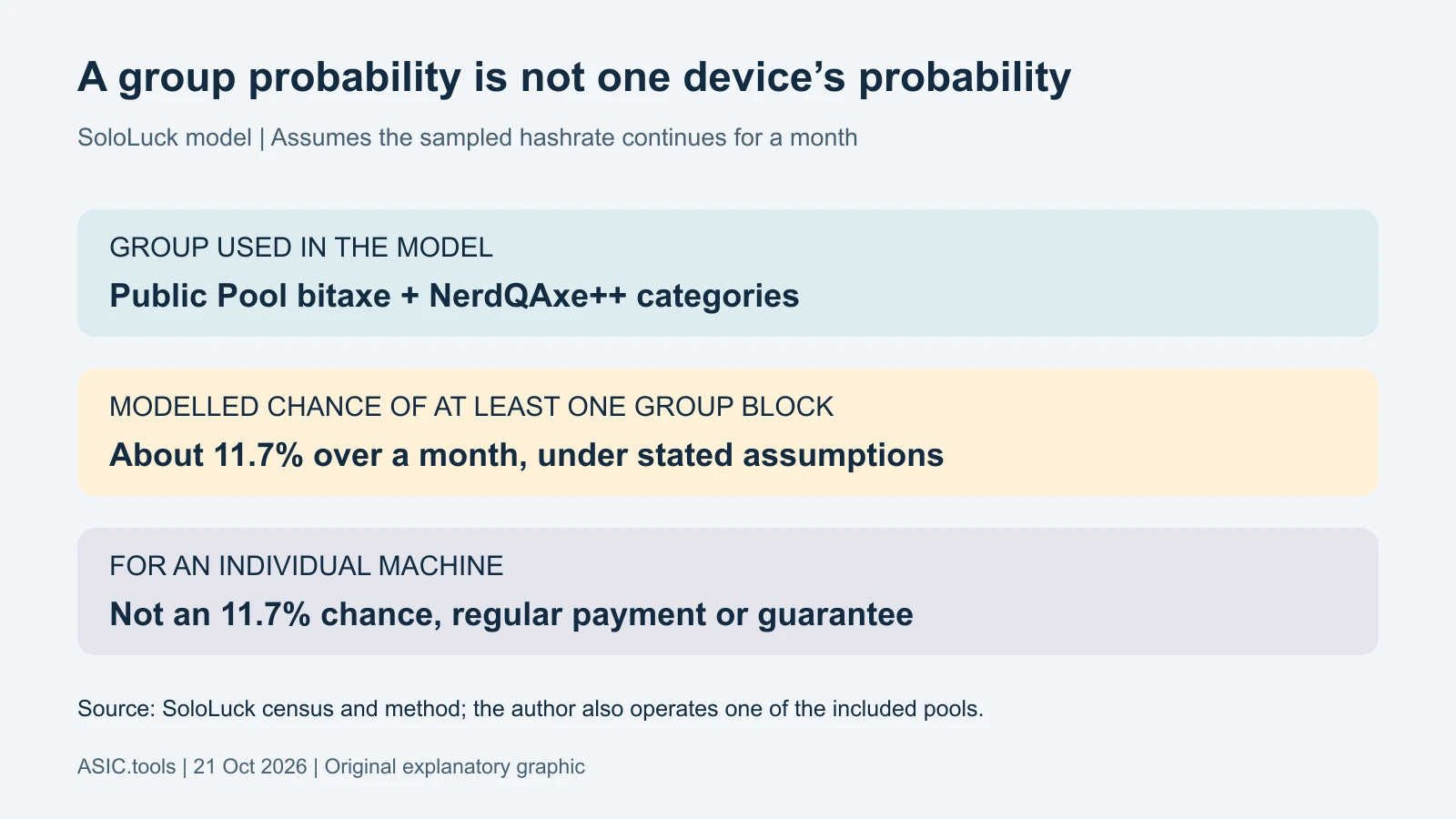
The census also publishes a modelled monthly chance of at least one block being found by the combined Public Pool bitaxe and NerdQAxe++ categories: about 11.7%, under its stated assumptions. This is a group calculation using those categories’ combined work and a network-rate estimate derived from difficulty. It assumes the sampled hashrate continues for the month. It is not an 11.7% monthly chance for every machine, every owner or each pool participant.
An everyday comparison is a large collection of lottery entries versus one entry: the chance that somebody in the group wins is different from the chance that a particular entry wins. Bitcoin’s calculation is based on hashes and network difficulty rather than purchased tickets, but the distinction between group and individual still holds. Nor does an unsuccessful month make the next month owed a block. A probability is a model of uncertain events, not a payment schedule.
What remains outside this picture
The edition has 168 hourly collection slots, but coverage differs by source: Public Pool’s main statistics appear in 159 hours, its device table in 160, and SoloLuck in 166. Other listed pools have their own coverage and averaging windows. Pools without usable public data are outside the sum. That means the sample is incomplete, not that miners at an unobserved pool have stopped working or that its hashrate is zero.
There are further limits to the word home. A software-reported device family does not prove where a machine is physically installed, and seven reporting pools do not represent all solo activity. The author calls the selected-group probability a lower bound because more devices exist outside those categories. It is still a conditional estimate from an operator-published dataset. We do not turn it into a verified global household census or a recommendation to move to a particular service.
The practical use: compare measurements, not dreams
For a small miner, this dataset is most useful as a reference for the scale of reported participation and the way mining statistics are constructed. Compare your actual accepted work over a suitable period, check which units are displayed and keep electricity costs separate from a chance of a rare block. A history of accepted shares shows work submitted; it does not promise a regular solo payout. A past block found by a service is also not a personal performance guarantee.
The report’s open files and method make its claims easier to inspect, while the disclosed operator interest and incomplete coverage keep the limits visible. The fresh finding is that thousands of connections labelled bitaxe were present in this particular week’s sample. The important lesson for readers is how to use that fact without turning a group count into unique owners, a sample average into a universal hardware specification or a shared probability into an individual income forecast.
Here a mining share is a submitted piece of work used in the pool’s accounting, not an ownership share like the units of an investment fund. Similar words in different financial and technical contexts can refer to very different rights.
Source: SoloLuck Census ↗ · Census methodology and scope ↗
Mining calculator ↗