Two Solo CK blocks created 6.2762 BTC before service fees
Source checked: 2026-11-08 · Editorial analysis published: 2026-11-08
November 7 block records show the subsidy, transaction fees and two main outputs after the solo service’s fee.
Two Solo CK blocks on November 7
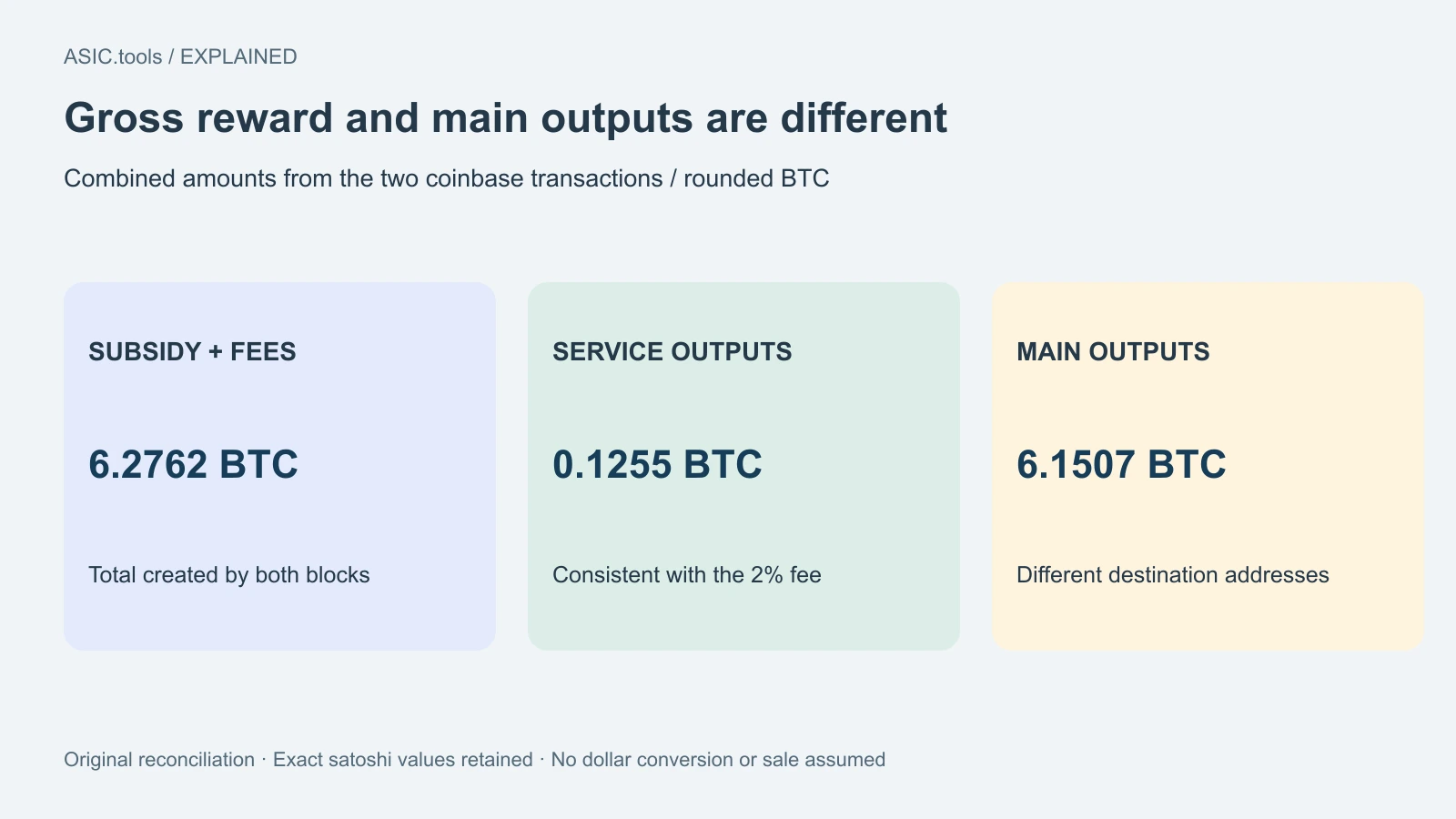
Bitcoin blocks 974,893 and 974,930 carry the Solo CK identifier and November 7 timestamps. Together their coinbase transactions created 6.27619232 BTC in subsidy and transaction fees. The two main mining-address outputs total 6.15066848 BTC after the service-fee outputs. That distinction matters when a headline describes a solo miner’s prize.
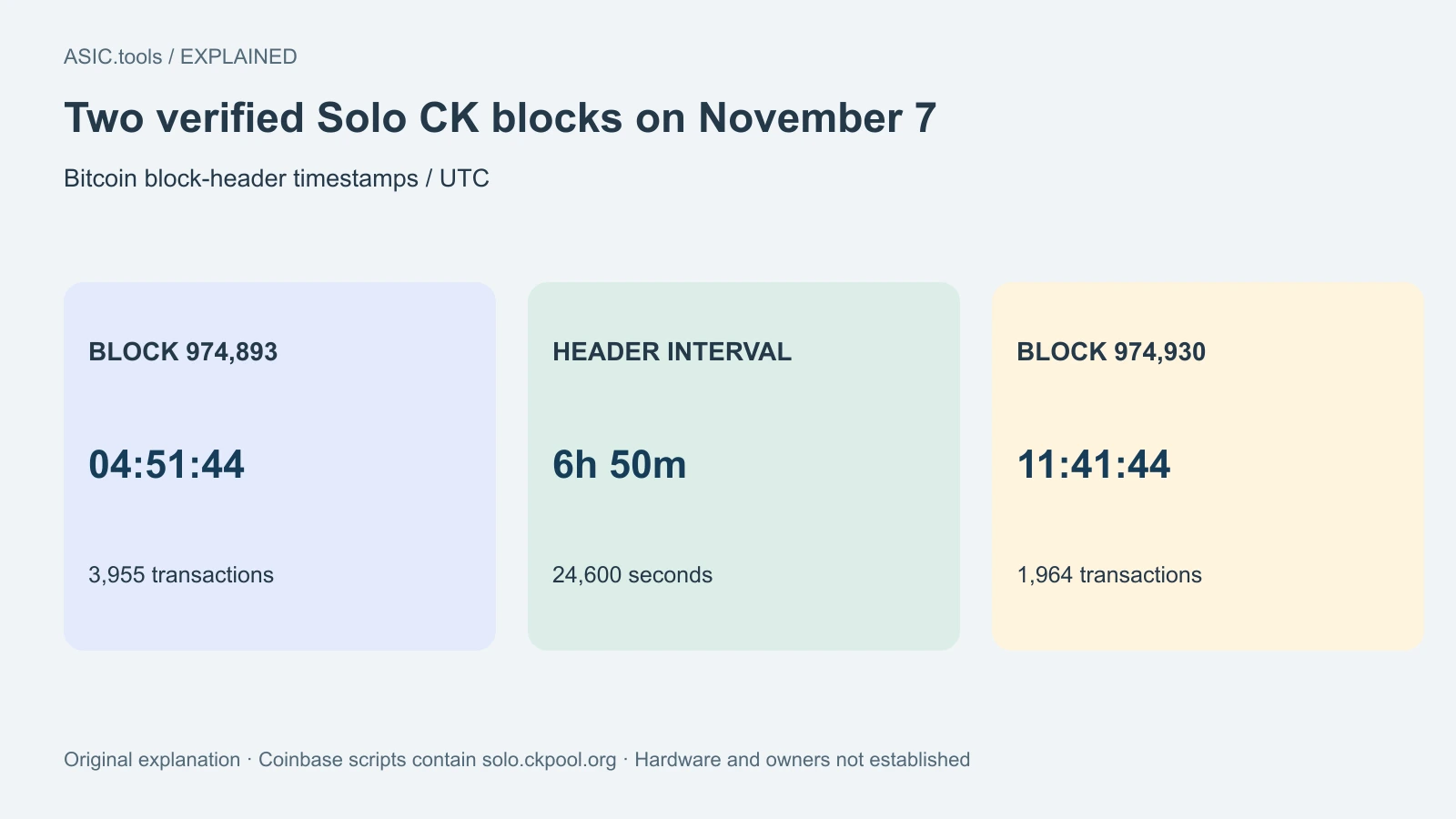
The block headers are timestamped 04:51:44 and 11:41:44 UTC, a gap of six hours and 50 minutes. We checked the headers, the first transaction of each block and Mempool’s pool attribution. Both coinbase scripts contain solo.ckpool.org, providing a direct link beyond a news outlet’s description.
The main rewards go to different addresses. That establishes different payment destinations, not the owners’ identities, equipment or hashrates. The checked records do not justify calling either setup a single cheap desktop miner. The event is two successful Solo CK blocks, with their actual rewards visible on-chain.
Separate the subsidy, fees and service charge
Block 974,893 contains 3,955 transactions. Its total reward is 3.13350232 BTC: the 3.125 BTC subsidy plus 0.00850232 BTC in transaction fees. Its main mining-address output is 3.07083228 BTC and its service-fee output is 0.06267004 BTC.
Block 974,930 contains 1,964 transactions. Its total reward is 3.14269000 BTC, including 0.01769000 BTC in fees above the same subsidy. Its main mining-address output is 3.07983620 BTC and its service-fee output is 0.06285380 BTC.
The service describes its fee as 2%, consistent with the outputs after satoshi rounding. A satoshi is one hundred-millionth of a bitcoin. The combined gross reward is therefore about 6.2762 BTC, while the two main outputs total about 6.1507 BTC. Dollar amounts would require a separately dated exchange rate and would not establish that the coins were sold.
The fee outputs track the full reward, including transaction fees, rather than only the fixed subsidy. Both coinbase transactions also contain a zero-value data output. It is not a third monetary prize. Adding the actual output values is the useful reconciliation, rather than counting how many output rows an explorer displays.
Solo service does not mean shared rewards
Solo CK’s own page says it is a service for solo mining, despite the pool in its name. It provides infrastructure so an operator can submit work without maintaining a full Bitcoin node. Its published arrangement sends a found block’s reward to the miner’s address, with the service fee deducted.
That differs from a conventional pool payment system that distributes rewards according to contributed work. A solo participant can submit valid shares for a long time without finding a network-valid block. In this arrangement those smaller shares provide operating feedback; they are not a balance that must eventually turn into a block prize.
The coinbase transaction is the block’s special first transaction, which creates the subsidy and collects transaction fees. Bitcoin requires coinbase outputs to mature for 100 blocks before spending. The chain tip in our November 8 check was beyond that interval for both blocks. Maturity is a protocol condition, separate from whether an owner later spends or sells the reward.
A short gap does not change the next attempt
Two successes in one day make a vivid story because solo results are uneven. They do not make the next hash more likely to succeed. Hashrate measures how many attempts a machine performs per second; difficulty sets how demanding a valid block result must be.
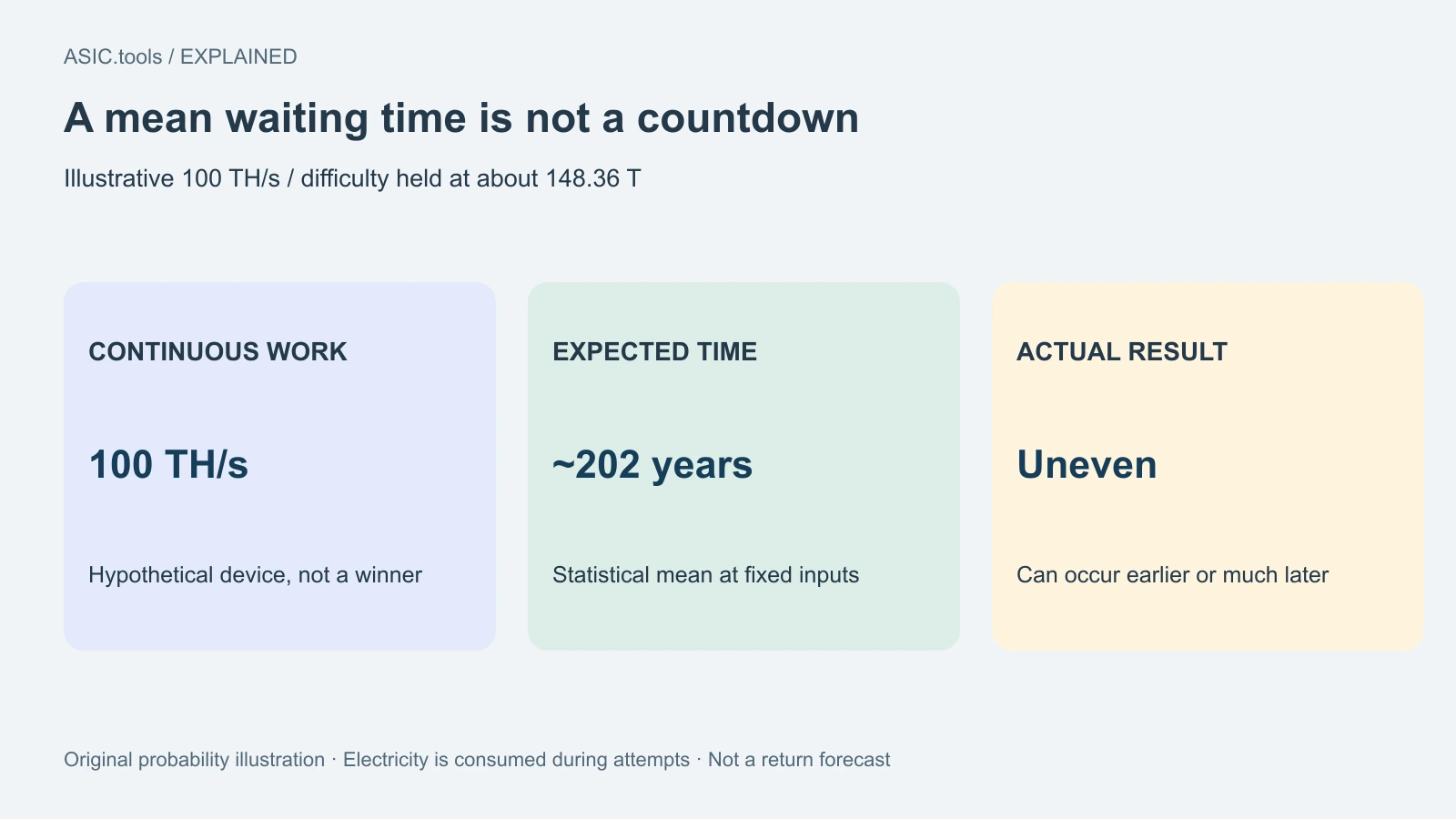
As an illustration, hold difficulty at about 148.36 trillion and assume a miner works continuously at 100 TH/s. The usual expected-time approximation, difficulty multiplied by 2 to the power of 32 and divided by hashrate, gives roughly 202 years. This is a statistical mean under fixed assumptions, not a waiting period that a particular machine must complete.
A block can arrive earlier or much later, and a participant may never find one during the machine’s life. Electricity is consumed while attempts continue. The illustration describes a hypothetical 100 TH/s setup, not either November 7 winner, and makes no claim about a device’s current purchase price or profitability.
Read a payout record before a jackpot story
The public records let readers verify the block numbers, timestamps, coinbase identifiers and reward outputs. They do not reveal everything about the rigs behind them. A picture of a home miner next to a story would not supply that missing link, so this report uses original diagrams of the checked records.
For an operator comparing payout methods, the practical issue is the pattern of income: a conventional shared system and a solo service can have very different cash timing. A device can be online and submitting shares while its solo block income remains zero. That should be separated from connection failures or rejected work when reviewing a dashboard.
The November 7 event is fully visible without inventing a hardware story: two blocks with Solo CK tags, a six-hour-50-minute header interval and about 6.1507 BTC in the main outputs after service fees. It shows what these two successes paid under this arrangement, not what the next small miner should expect to receive on a schedule.
Source: Bitcoin block records / Solo CK ↗ · Second verified block ↗ · Solo CK fee and payout arrangement ↗ · Bitcoin coinbase maturity rule ↗
Mining calculator ↗