Public Pool’s Bitcoin block 977,488 paid 3.17830651 BTC
Source report: 2026-11-25 · Editorial analysis published: 2026-11-26
The November 25 block records one spendable reward output. Its public record establishes the payout, while the winning worker’s equipment and hashrate remain unknown.
The block label and the reward agree
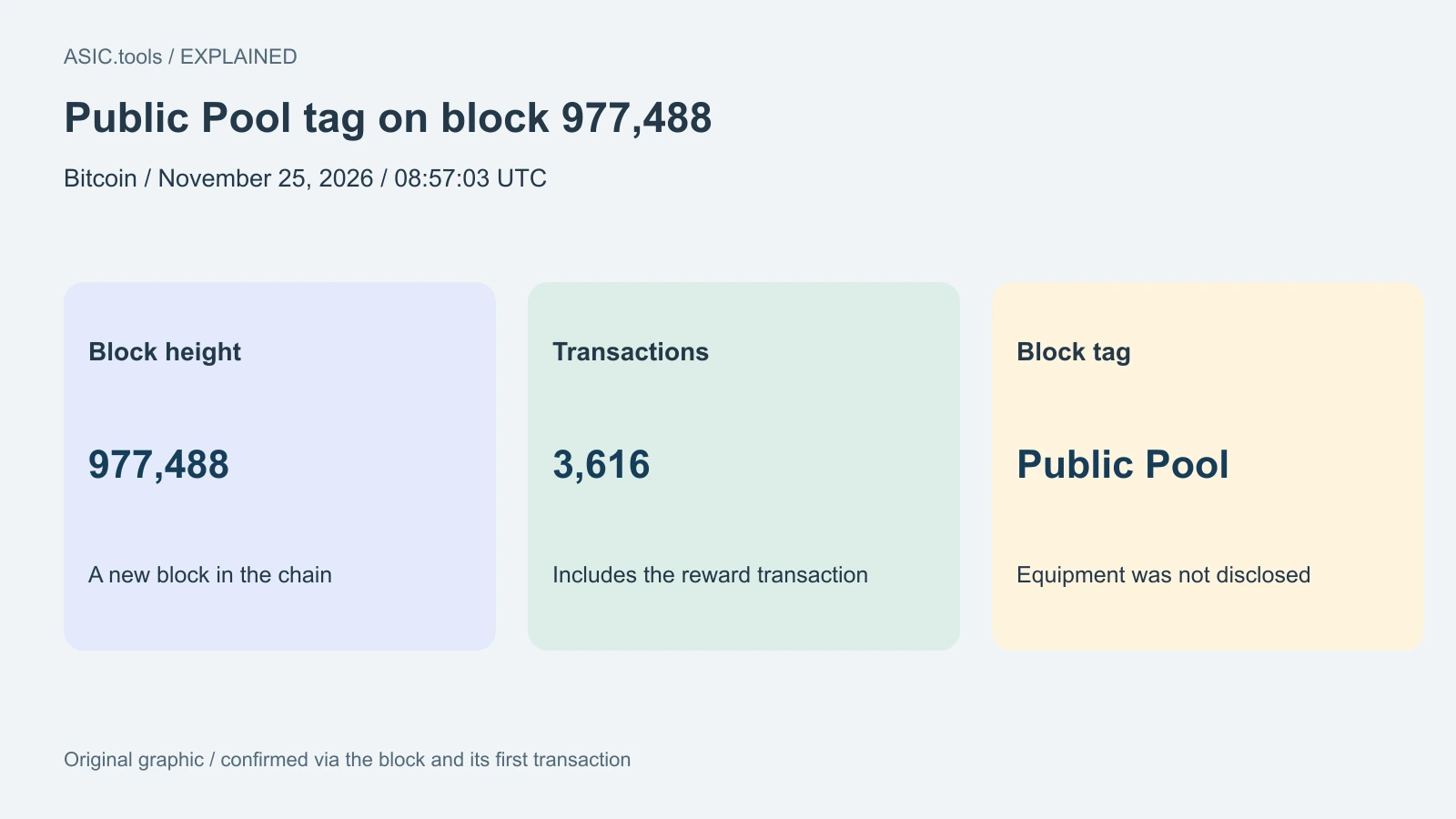
A Bitcoin block bearing the Public Pool identifier recorded a 3.17830651 BTC reward on November 25. Block 977,488 has a timestamp of 08:57:03 UTC and contains 3,616 transactions, including the first one that claims the reward. The figures come from the block and transaction themselves. It is a separate find from block 977,057, recorded on November 22 under Solo CKPool.
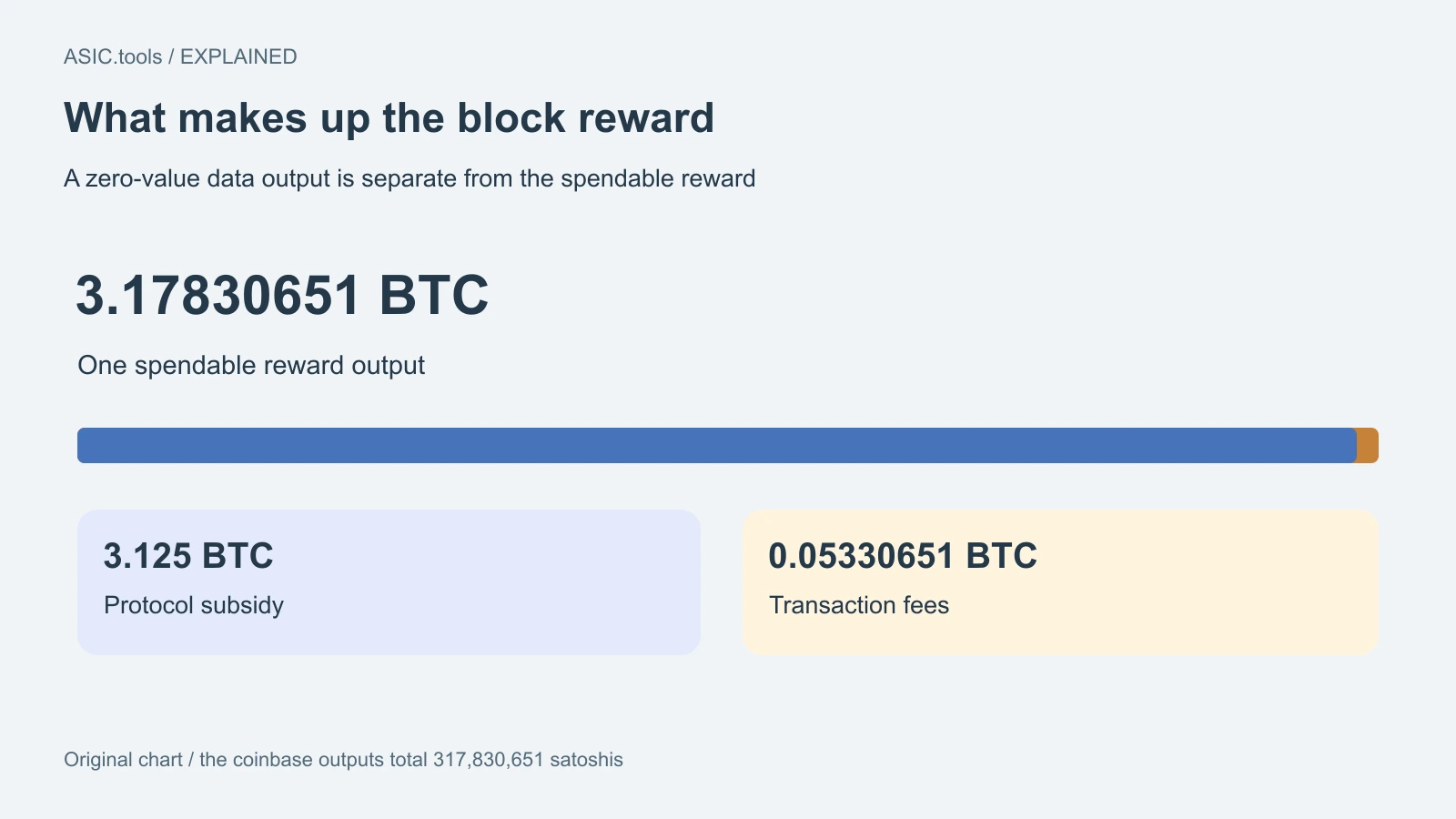
The first transaction is called the coinbase transaction. Here the name refers to a part of Bitcoin’s block format. The transaction includes a Public Pool tag and a single spendable output of 317,830,651 satoshis, equivalent to 3.17830651 BTC. A separate zero-value output carries data. This visible record lets readers check what was claimed, without relying on a screenshot of a mining dashboard.
The reward consists of the 3.125 BTC block subsidy and 0.05330651 BTC from transaction fees. The subsidy is new bitcoin issued by the protocol. The fees come from users whose transactions were included. Other blocks can carry different fees. The market value of the reward in a national currency changes with the time and price used to convert it.
What the blockchain leaves open
The tag identifies the pool name recorded in the block. It does not reveal a person, the type of ASIC, the number of devices, whether hashrate was rented or how long it had been pointed at the service. One spendable output also does not tell us who controls it or whether there was an agreement for what happened to the funds later. A payout and a claim about the winning hardware should be verified separately.
Solo pool software helps equipment obtain work and submit a solved block. The result is an unusually large payment when a miner actually finds a block, with no regular share of earnings merely for hashing.
Many shared mining pools instead use accepted work to calculate recurring payouts under their own rules. Similar total computing work can therefore produce very different cash flow from one day to the next.
How to read a solo win as a home miner
A solo find is evidence that a block was found, not a clock counting down to the next reward. To estimate the chance for a given device, you would need its actual hashrate, how much time it is online and the network difficulty.
The block’s success does not supply those inputs for the winner. Guessing the equipment from the payout would make any odds calculation look more exact than the evidence allows.
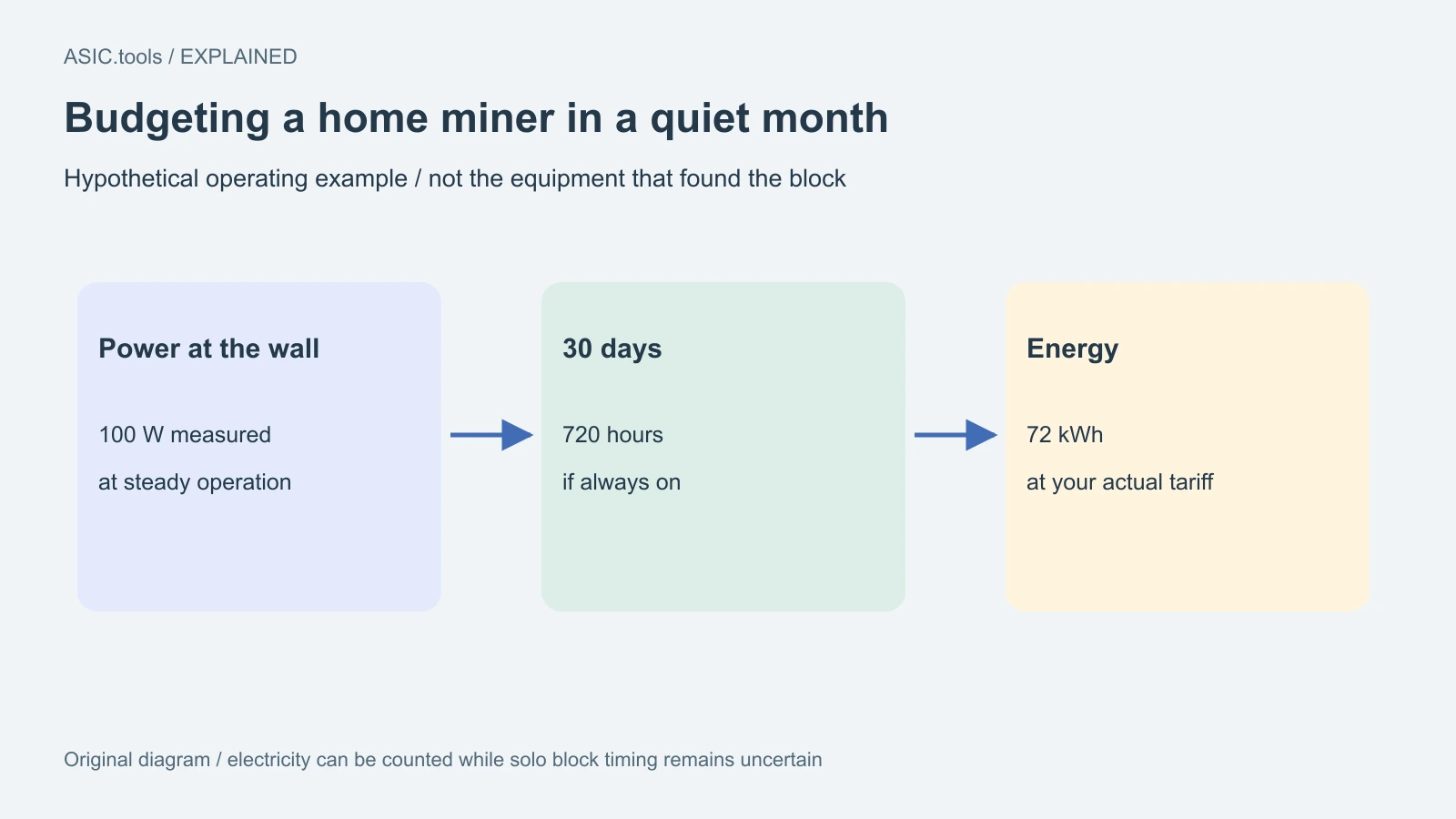
The electricity bill arrives even in a month without a reward. Take a home device drawing a measured 100 W continuously. Thirty days of operation use 72 kWh, before any separate equipment is counted.
At a given tariff, that makes the operating bill measurable while the timing of a solo block stays uncertain. Public Pool’s November 25 block is a clear example of what the chain can prove: the block, its time, its label and the amount assigned by its reward transaction.
A practical record keeps the public block evidence separate from what you measured yourself. Save the block number, timestamp and amount as one entry. For your own equipment, track metered operating hours and energy in another. That way a rare network event cannot accidentally become the revenue entered into a monthly budget for a completely different machine.
Source: Bitcoin blockchain / Mempool ↗ · Block record through Blockstream Esplora ↗ · Reward transaction through Blockstream Esplora ↗ · Public Pool source repository ↗
Mining calculator ↗