QBT reports live mining tests on an Antminer S9 and Bitaxe Gamma; measured gains are still pending
Source report: 2026-10-29 · Editorial analysis published: 2026-10-29
The October 29 update says Methods A, B and C are mining through pools on different test platforms. It describes comparison rigs and remote control software, not a consumer firmware launch or a proven profit increase.
A move from research claims to named live test setups
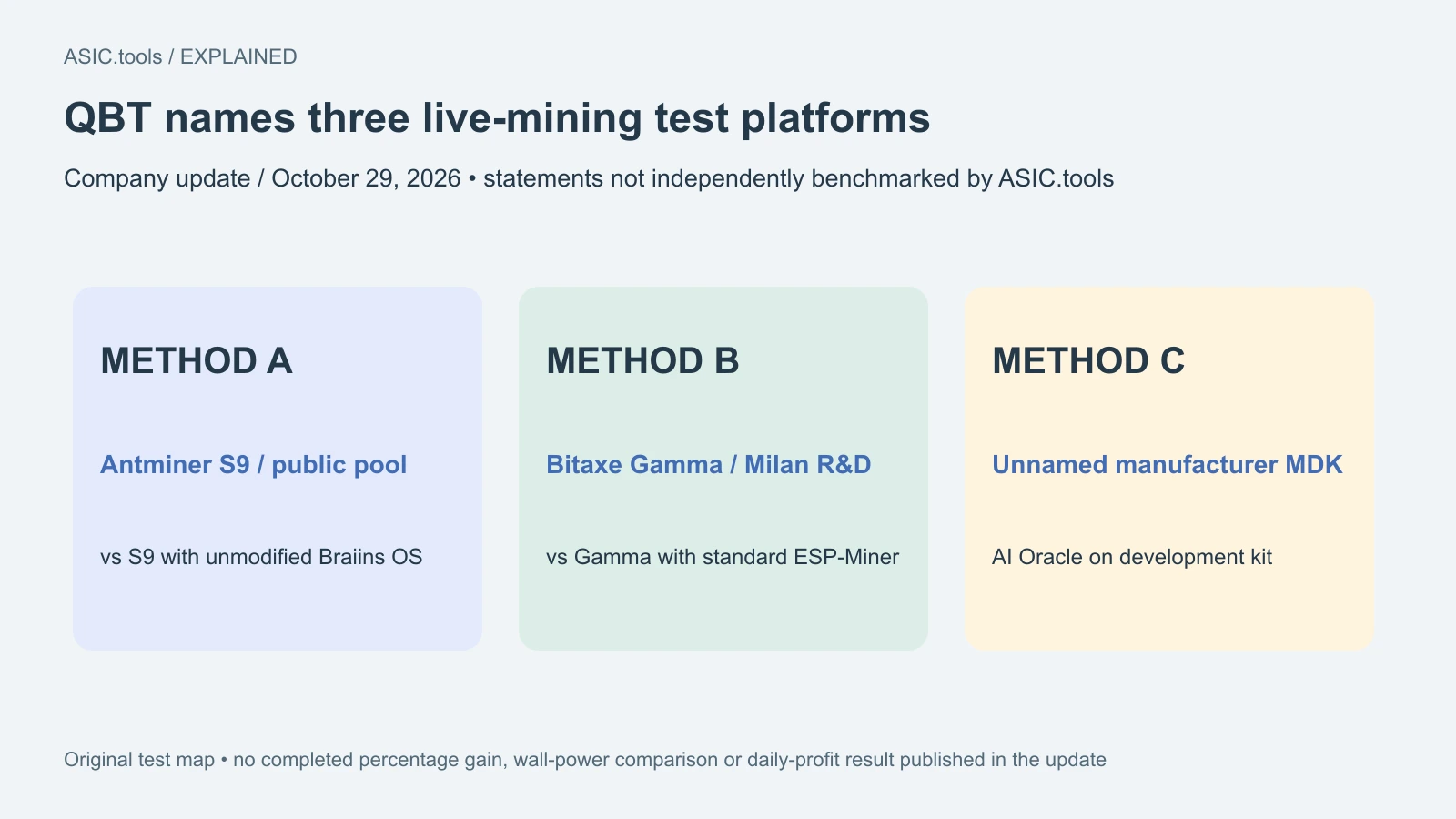
Quantum Blockchain Technologies said on October 29 that its three research methods are now performing live Bitcoin mining through pools. The update names an Antminer S9 for Method A, Bitaxe Gamma devices for a new Method B variant, and an unnamed ASIC manufacturer’s development kit for Method C, its AI Oracle. For ordinary owners, the useful development is the description of actual comparison setups, rather than another unexplained percentage in a marketing headline.
These are the company’s statements, not an independently verified performance test. The announcement says sustained testing is continuing and results will be reported after it finishes. It supplies no completed percentage advantage, wall-power comparison or daily-profit result for the setups. This is a new October 29 operating update, distinct from the company’s September interim report about earlier manufacturer-backed testing.
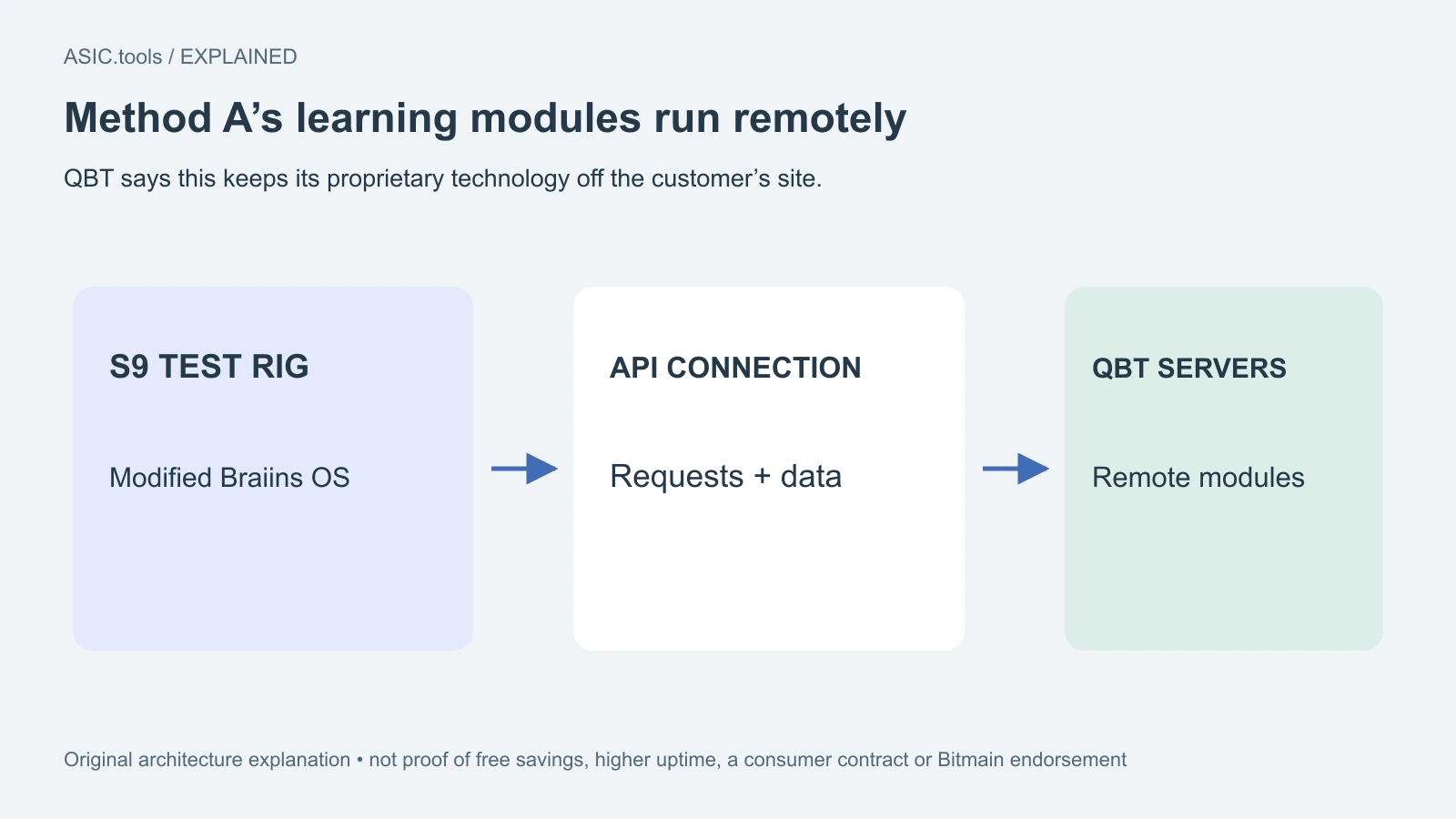
Method A uses an S9 and a remote software connection
QBT says it has finished modifications to Braiins OS on an S9, which is mining on a public pool under Method A’s control. A benchmark S9 runs unmodified Braiins OS on the same pool. That comparison is more specific than comparing unrelated machines on different networks, but it still needs the eventual results and operating conditions before a reader can judge how large or repeatable an advantage is.
The learning and trained modules run on QBT’s remote servers, connected to the rig by an application programming interface, or API: a software channel for exchanging requests and data. The company says this lets it keep proprietary technology off a customer’s site. That describes how it intends to protect its intellectual property; it is not evidence that remote control automatically improves uptime or removes all operational dependencies.
For an owner evaluating a future service, practical questions include what the rig does if the connection fails, how power is measured and whether any service cost is included. The update does not answer those questions with a consumer contract. Until figures and terms exist, remote execution should be read as an architecture choice, not free electricity savings or a downloadable upgrade for every S9.
S19 and S21 readiness is not the same as public deployment
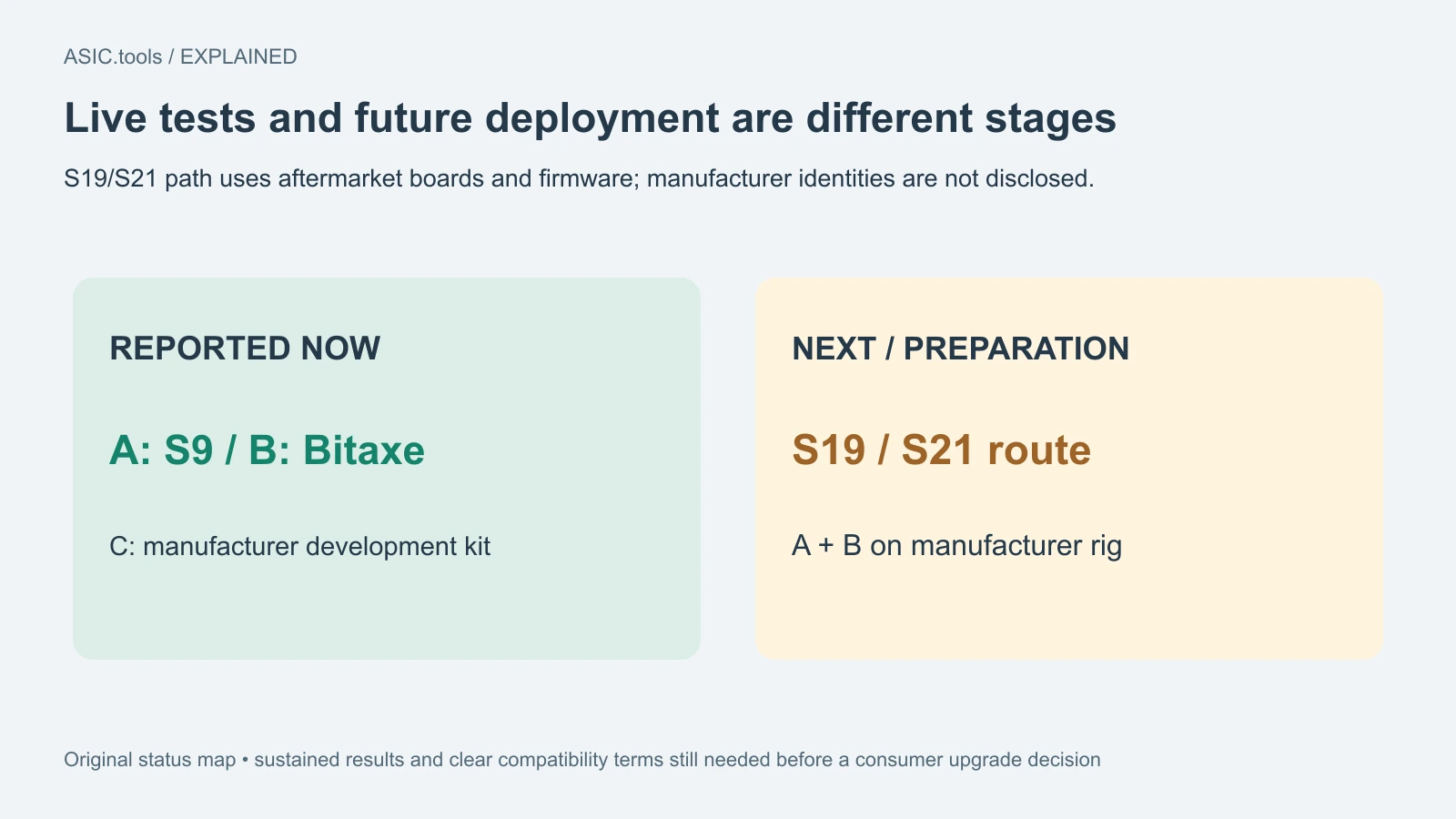
The update says Method A is configured for Bitmain S19 and S21 rigs through aftermarket control boards and firmware. QBT has engaged three manufacturers of those components with a view to deployment. It does not name them or announce that Bitmain has endorsed the modification. A route through third-party boards is a compatibility plan, not proof that every stock S19 or S21 board can run it unchanged.
That distinction matters because a model-family name alone does not identify the actual controller and software in a miner. The announcement provides no general installation package or completed public compatibility matrix for readers. Owners can follow the test results without treating the research update as an instruction to replace a working controller or install unofficial firmware immediately.
Bitaxe and the manufacturer kit test different methods
Method B’s chaos-mathematics variant, announced earlier on July 9, is now running on Bitaxe Gamma devices in QBT’s Milan research facility, according to the update. Its comparison is a benchmark Bitaxe Gamma with standard ESP-Miner. The new event is the described live test, not the original July announcement. Naming a common home-mining platform makes the experiment relatable, but does not make the research software a released Bitaxe feature.
Method C, the AI Oracle, is running on a manufacturer’s mining development kit after adaptation of its models to that architecture. The manufacturer is under a nondisclosure agreement and is not identified. The kit is a development platform, not a newly announced retail ASIC with published hashrate and watts. The word Quantum in the company’s name also does not turn this announcement into a launch of quantum-computing mining hardware.
The next milestone is usable evidence, not a profit promise
QBT also describes a generalized software layer for the methods to control the manufacturer’s platform. Dynamic data collection for Method A is still being finalized; A and B are then to be set up on the manufacturer’s rig to collect data toward commercialization. Those steps remain prospective. They should not be rewritten as A and B already commercially deployed on that rig.
When results arrive, accepted work, duration, power and the baseline will matter together. A faster displayed rate is not the same observation as more accepted work for the same electricity cost, and either is different from net profit after service charges. These are the kinds of comparison a miner needs; we are not filling the announcement’s missing results with our own performance estimate.
The practical position today is to watch the named tests and the promised sustained measurements. The update describes movement toward commercialization, not a retail product available to install now. We have not run QBT’s software, verified pool accounts or measured the machines. For an S9, S19, S21 or Bitaxe owner, this is a research development worth tracking, while a buying or upgrade decision still needs published evidence and clear compatibility terms.
Source: Quantum Blockchain Technologies ↗ · Regulatory announcement copy ↗
Mining calculator ↗