805 Mining opens preorders for a 160 W home Zcash miner
Source report: 2026-11-14 · Editorial analysis published: 2026-11-15
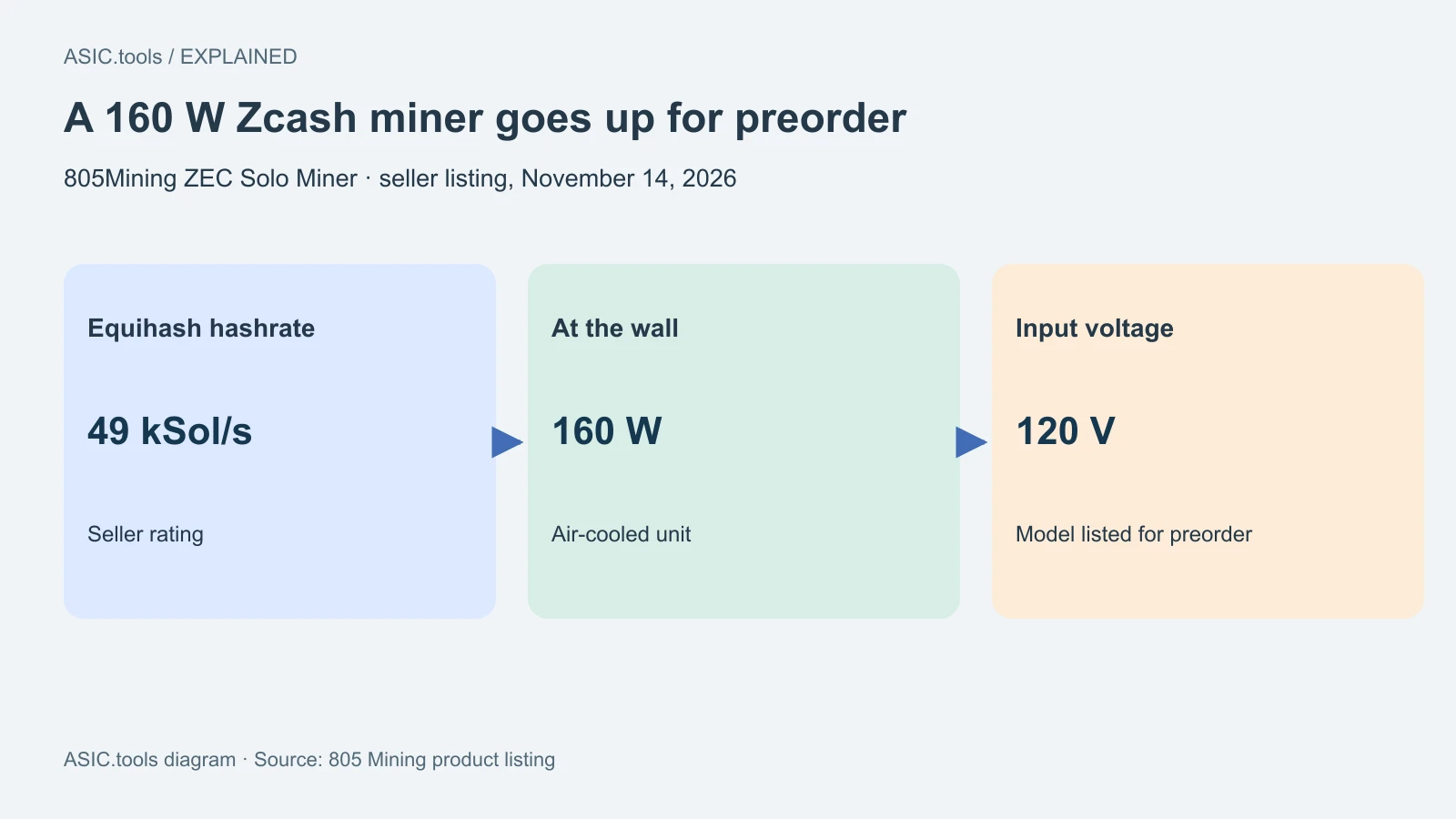
The seller rates the 120 V Equihash device at 49 kSol/s and lists it at $1,040. The model-specific description gives no shipping date.
A smaller Zcash miner goes up for preorder
805 Mining advertised a home Zcash miner on November 14. Its own listing puts the 805Mining ZEC Solo Miner at 49 kSol/s with 160 W drawn from the wall, air cooling and a 120 V input. The seller lists $1,040 and says it confirms the final price before payment. The power figure puts the proposal closer to a small appliance than a full-size rack miner. The figures come from the seller, and there are no independent measurements in the listing.
Availability needs a close read. The title and model specifications say preorder only and give no product-specific dispatch date. The same page also shows general language about U.S. stock and usual California shipping times. Buyers planning around a delivery date should ask for one in writing for this exact item, along with the final price, shipping charges and applicable warranty. The listing's image is a logo, so it gives no way to inspect the connectors or the enclosure.
What the rating means at home
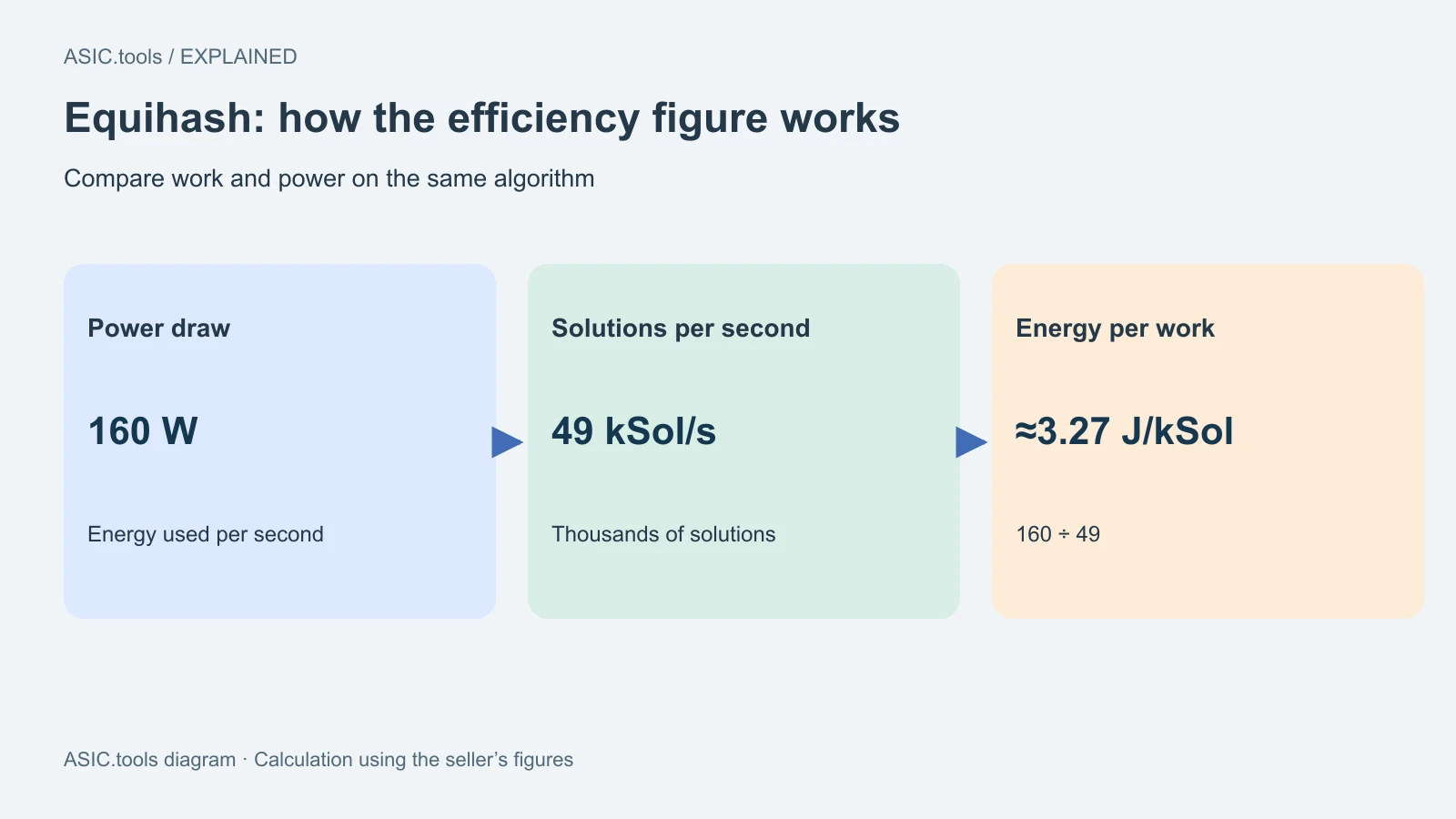
Equihash is the proof-of-work algorithm this machine is listed to run for Zcash. At 49 kSol/s, the seller is claiming about 49,000 solutions per second. This unit makes sense when comparing Zcash equipment on the same algorithm.
Bitcoin's TH/s figure counts work on SHA-256 and belongs in a different comparison. Dividing 160 W by 49 kSol/s gives about 3.27 joules per thousand solutions, consistent with the rounded 3.3 J/kSol on the card.
Power and the electricity bill
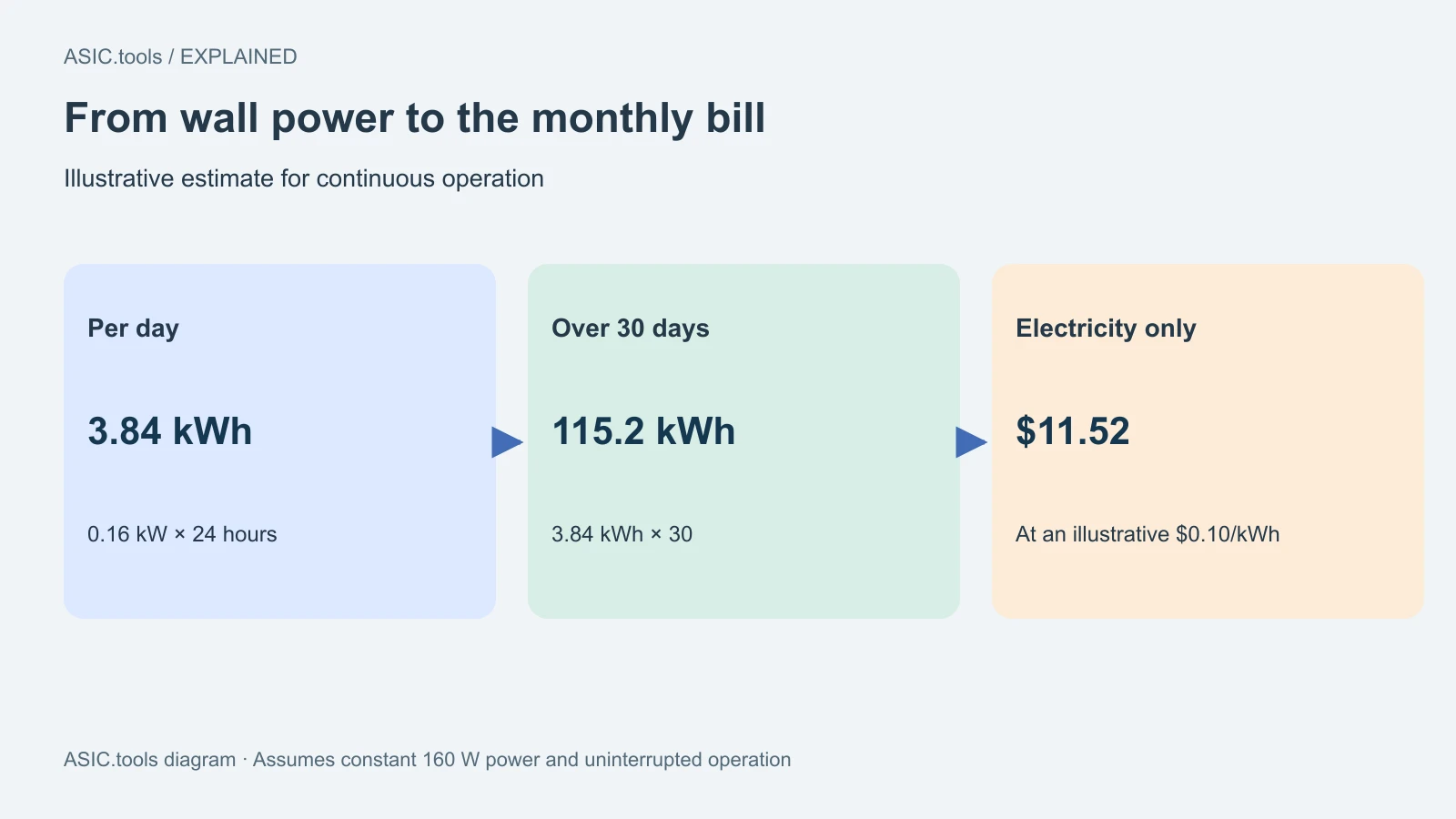
At the advertised power, running all day uses 3.84 kWh. Over 30 days it is 115.2 kWh. At an illustrative $0.10 per kWh, electricity alone costs $11.52 for those 30 days. A real meter reading and local tariff will determine the actual bill.
The published input is 120 V, so owners on a 230 V supply should check the exact power supply label and supported voltage before connecting anything. The seller gives no measured sound level or case dimensions.
Solo mining and a regular pool
The seller describes two ways to use the device. A solo pool attributes a found block to the individual miner who found it, under the service's rules. With a small share of network computing power, an operator may run for a long time without finding a block. A regular pool combines many miners' work and uses smaller work submissions called shares to account for contributions. Fees, minimum withdrawal thresholds and payout schedules depend on the pool.
A purchase comparison starts with the cost at the door, the power that can actually be supplied and the revenue assumptions for a supported Zcash pool. Pool connection details and accepted shares are the practical checks once a machine is running. They help separate a miner that is doing work from one that merely powers up. The listing is useful for comparing size and power classes while the shipment date, real-world noise and measured efficiency remain open questions.
Source: 805 Mining ↗ · 805 Mining preorder announcement, November 14 ↗ · Zcash Protocol Specification ↗
Mining calculator ↗