PowerCompute plans a two-stage S19 XP fleet refresh
Source report: 2026-09-23 · Editorial analysis published: 2026-09-25
PowerCompute says 1,000 S19 XP miners are due in Oklahoma and 940 more were ordered for Mississippi, targeting 862 PH/s after installation while retaining explicit delivery and performance risk.
Analysis and practical implications
This section is our analysis and illustrative calculations, separate from the source report.
Two linked replacement stages
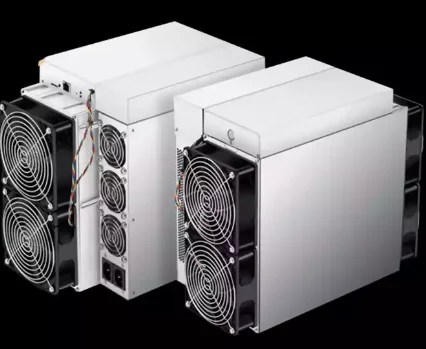
PowerCompute announced on September 23 that it expects to install 1,000 Bitmain Antminer S19 XP units at its Oklahoma site by September 30 and ordered another 940 units for October delivery to Mississippi. The first group is intended to replace S19J Pro machines rated at 100 TH/s or below. Those displaced units are then expected to move to Mississippi and replace older S19 machines averaging 95 TH/s. The second order targets those remaining 95 TH/s units. This is a staged fleet plan, not evidence that all 1,940 miners are already delivered, energized or hashing at the stated level.
The hashrate bridge can be checked
The company reports 771 PH/s as of June 30, approximately 822 PH/s after the Oklahoma installation and redeployment, and approximately 862 PH/s after the October order is online. Those steps equal gains of about 6.6% and 11.8% versus the June baseline. The release says the new machines average 132 TH/s, versus 95 TH/s for the units ultimately retired, which is roughly a 38.9% per-machine improvement. Fleet totals are lower than simply multiplying every nameplate figure because the process replaces existing capacity rather than adding every miner on top of the baseline.
Efficiency improves, but the power claim needs a boundary
PowerCompute gives approximately 21.5 J/TH for the replacement S19 XP machines and about 34 J/TH for the retired units. At 132 TH/s, 21.5 J/TH implies around 2.84 kW per miner; at 95 TH/s and 34 J/TH, the older unit implies about 3.23 kW. That supports a same-or-lower machine-level power claim, but it does not prove identical facility demand. Fans, transformers, networking, cooling and power-distribution losses also matter. A fair before-and-after report would publish wall-meter energy, average achieved hashrate, rejected shares and curtailment hours for comparable periods.
The revenue estimate is an assumption, not booked revenue
Across the 1,940 units, the company estimates about $1.2 million of incremental annual revenue capacity using a hashprice of $40 per PH/s per day as of September 21, before curtailment and downtime. Hashprice changes with Bitcoin price, transaction fees, network difficulty and block luck, so the annualized figure is a scenario rather than a forecast that can be banked. Operators evaluating a similar refresh should rerun the model at several hashprice levels and include pool fees, repair inventory, shipping, installation labour, taxes and the time between receiving equipment and producing accepted shares.
The disclosed purchase cost deserves context
PowerCompute states that the combined cost of the 1,000 September units and 940 ordered units is approximately $400,000, funded or expected to be funded from cash on hand and Bitcoin holdings. Dividing gives roughly $206 per unit, an unusually low headline amount for S19 XP hardware. The release does not provide serial numbers, condition, warranty, seller, shipping allocation or repair history. Readers should not treat the figure as a general market price. Used-fleet transactions can include mixed condition, nonstandard terms, excluded logistics or assets purchased through opportunistic channels.
Redeployment is an operating project of its own
Moving S19J Pro units from Oklahoma to Mississippi requires more than transport. Each device needs inspection, cleaning, firmware inventory, power compatibility, network configuration, pool credentials and a controlled start sequence. Older machines may also require fans, power supplies or hash boards before they can replace the 95 TH/s fleet. A staged cutover reduces the risk of losing too much hashrate at once. Site teams should record each serial number, pre-move health, destination rack, measured power and post-install acceptance result so that the claimed fleet gain can be reconciled.
Three energized megawatts remain optional capacity
The announcement says Mississippi has up to 3 MW of additional energized capacity available for expansion, but using it would require more infrastructure and capital. Energized capacity is valuable because it can shorten the path to service, yet it is not equivalent to a completed mining or AI deployment. The usable amount depends on transformers, breakers, cooling, network connectivity, permits and the service agreement. PowerCompute explicitly leaves the workload choice open between AI and Bitcoin mining. Investors should wait for equipment, customer, construction and commissioning evidence before assigning production to those megawatts.
What to verify after the announcement
The useful milestones are delivery receipts, installed unit count, average pool-side hashrate, total wall power, fleet efficiency, downtime and the actual retirement or redeployment of old machines. The release identifies delays, performance, financing and operating conditions as risks and uses forward-looking language for both stages. A successful refresh would show more accepted terahash per kilowatt-hour without a corresponding rise in failure rate or curtailment exposure. Until operating data is published, 822 PH/s, 862 PH/s and $1.2 million remain management targets built from stated assumptions.
Source: PowerCompute, Inc. ↗
Mining calculator ↗