Pennsylvania opens comments on emergency power-cut rules for large mining sites
Source report: 2026-11-21 · Editorial analysis published: 2026-11-21
The November 21 Bulletin starts new comment periods on a revised proposal that names cryptocurrency mining and a 50 MW site threshold. It is not a new operating ban or a final tariff.
A new comment window for large-load power-cut rules
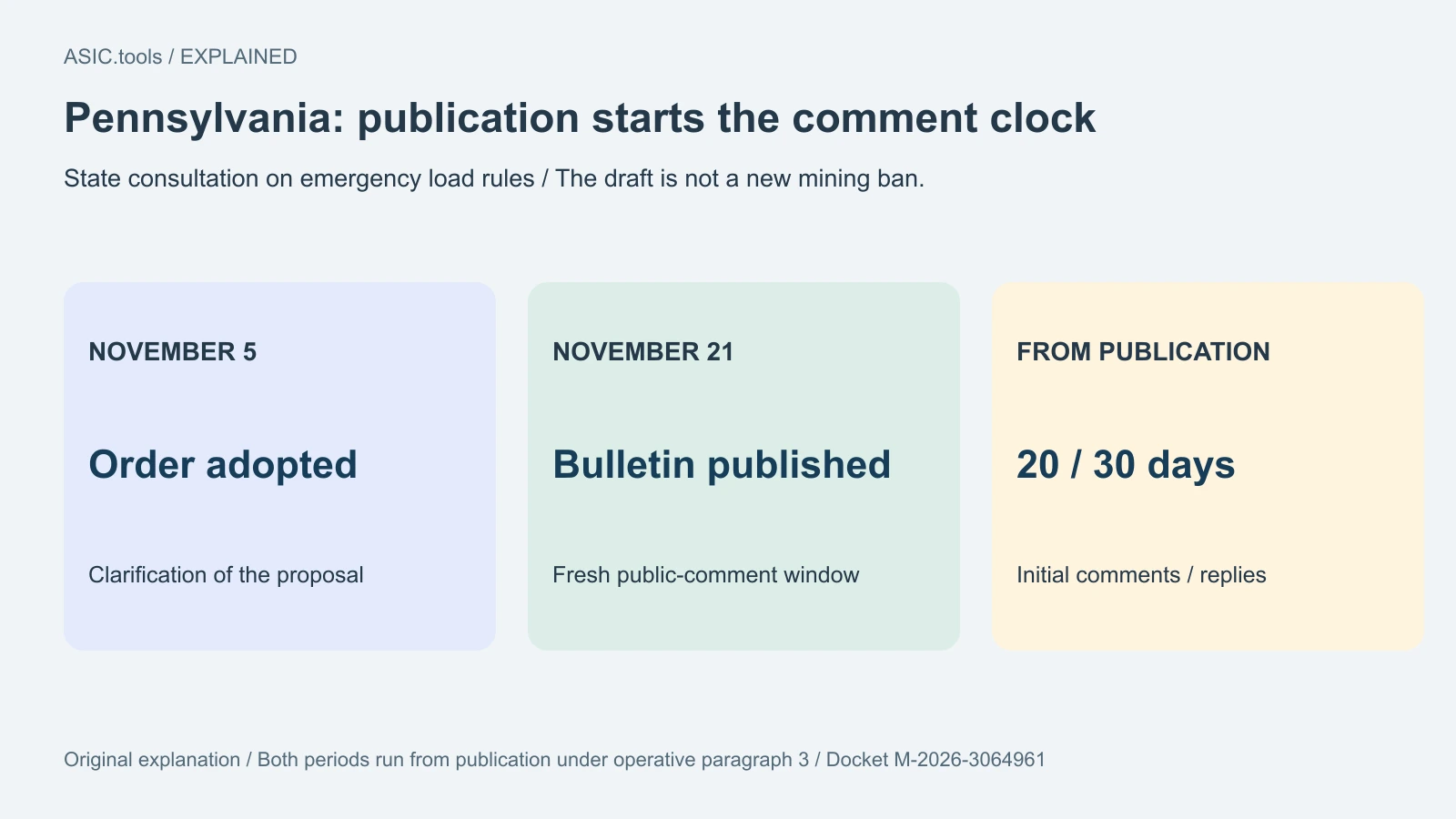
Pennsylvania's official Bulletin published a clarification of proposed electricity emergency rules on November 21. Large cryptocurrency-mining sites are explicitly among the computing facilities covered by the draft definitions. The immediate event is a new public-comment window, not an order to disconnect miners today: the underlying clarification was adopted and entered on November 5.
The Public Utility Commission, Pennsylvania's utility regulator, is asking how distribution utilities should manage large computing loads when electricity demand threatens available supply. Its stated aim is to protect essential services and ordinary customers during emergencies. A mining operator considering a large grid connection therefore has a reason to examine the proposed curtailment terms alongside the price of electricity.
The proposed threshold is a site, not one machine
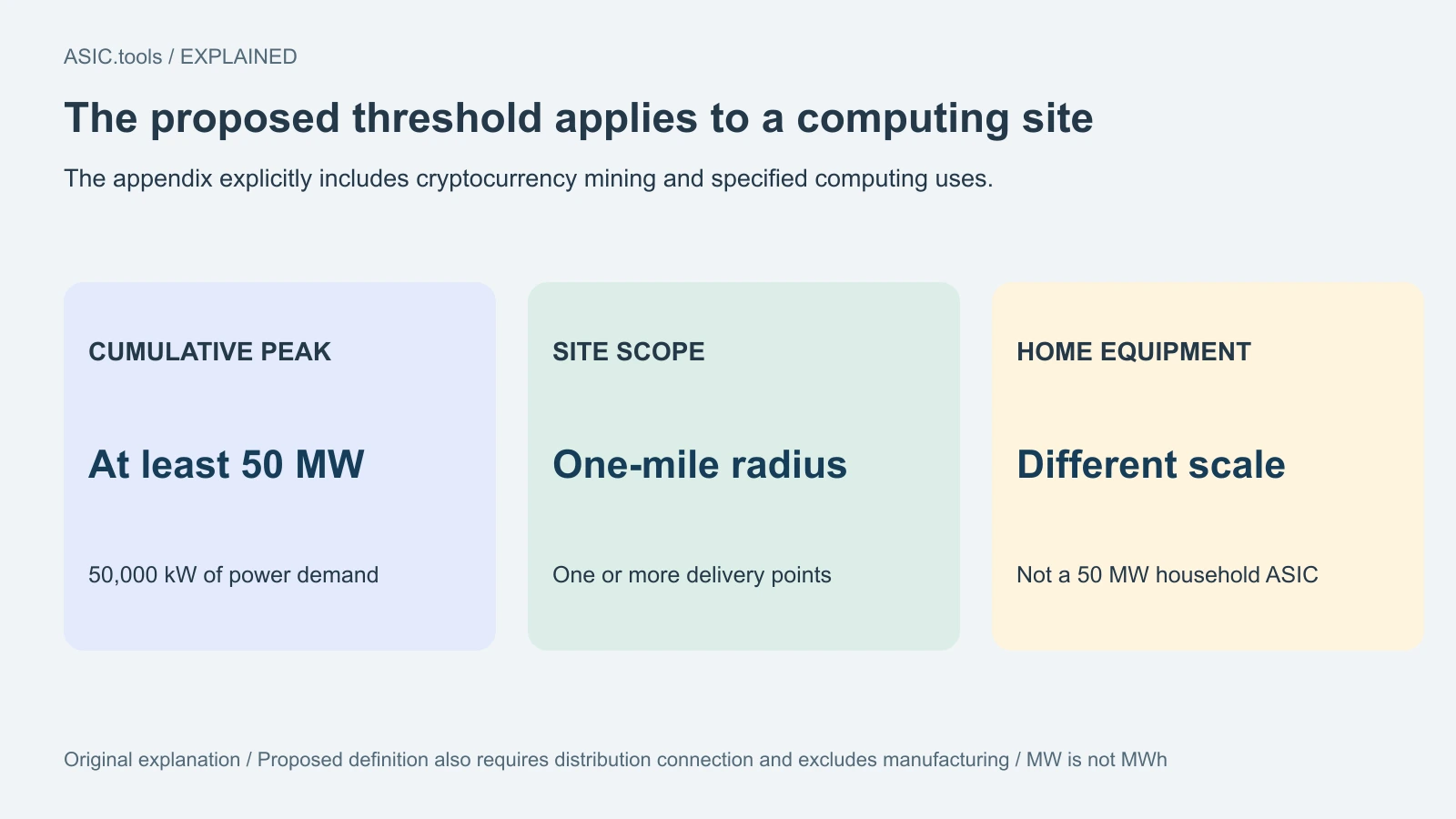
The appendix defines a computing site with cumulative peak demand of at least 50 megawatts at a single location, behind one or more delivery or connection points within a one-mile radius. Its main activities must include specified computing services such as AI or cryptocurrency mining, it must connect to a distribution utility, and manufacturing facilities are excluded under the stated definition.
Fifty megawatts equals 50,000 kilowatts. A household's individual ASIC is not a 50 MW site, and this definition should not be read as a new home-mining ban. At the other end, splitting a single large campus between several connection points does not automatically remove it from the draft's cumulative-site test. The wording concerns how a qualifying site is identified.
Having backup power would not automatically protect every task
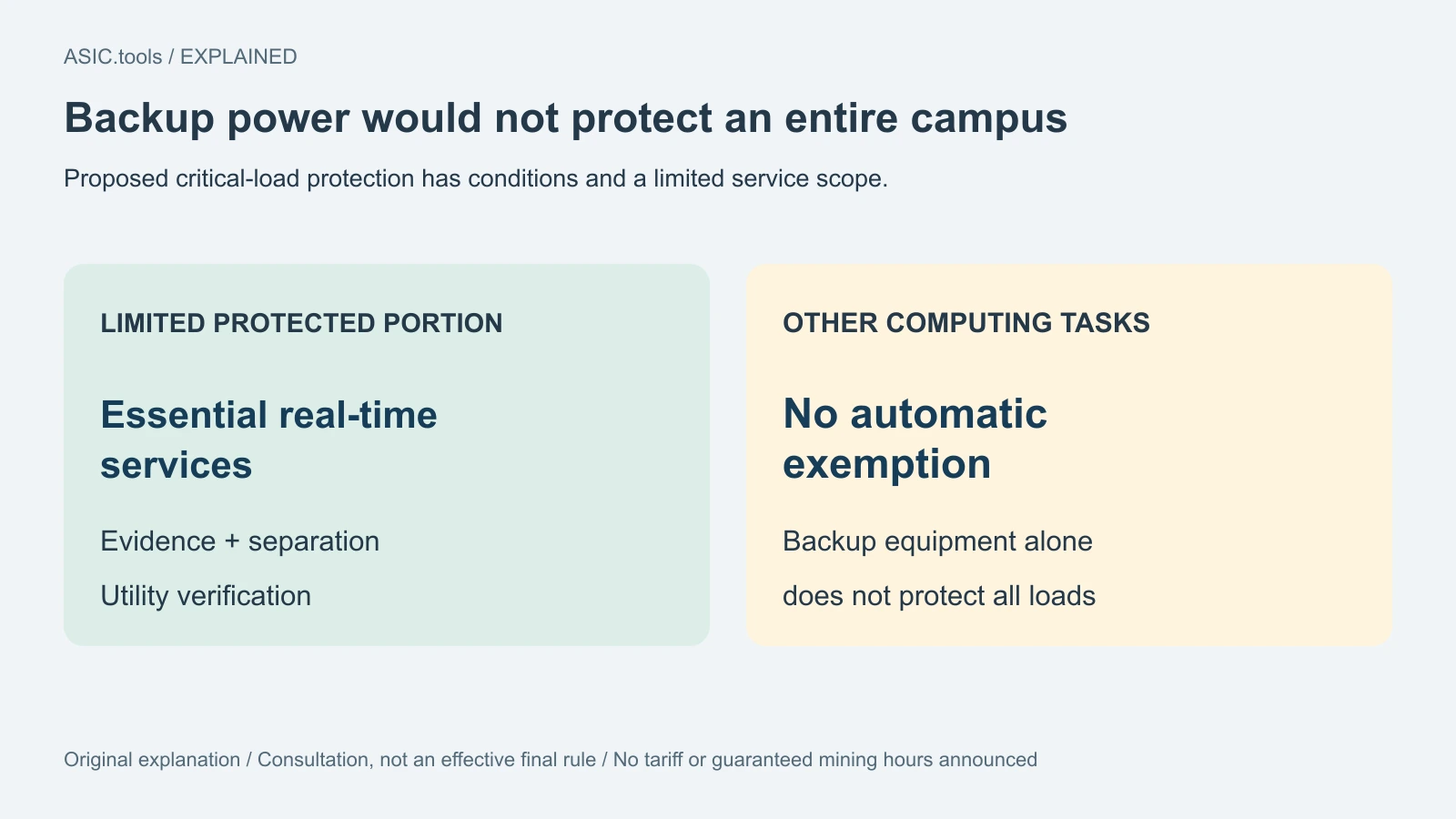
The draft distinguishes computing sites with and without an uninterruptible power supply, or UPS: equipment that provides nearly immediate backup and helps maintain power quality. Non-critical computing demand would not gain protection simply by being inside a data center or having backup equipment. The proposed protected categories focus on essential human needs and public infrastructure.
A narrowly defined category would cover the part of a qualifying UPS computing site's demand that supplies essential real-time services to the highest-priority facilities. It would require evidence, separation from non-essential operations and utility verification. That is not an exemption for every activity on the campus. The draft also limits when this protection applies in relation to backup failure, fuel depletion or permitted operating limits.
Different emergency stages would trigger different procedures
The appendix separates early emergency load control, interruption of interruptible load and emergency forced outages affecting firm load. It uses the grid's Energy Emergency Alert stages, commonly shortened to EEA. In plain terms, a request to reduce specially contracted load is different from a later emergency that requires wider disconnections to keep the grid functioning.
The proposed forced-outage procedure would curtail non-critical loads before critical ones, with defined priority levels. It also recognizes a practical exception where interrupting a non-critical customer would necessarily interrupt critical loads on the same arrangement. These are proposed classifications and procedures; the Bulletin does not publish a new cents-per-kilowatt-hour mining tariff or a schedule of operating hours for any particular farm.
Pennsylvania has narrowed the earlier proposal
The clarification explains that federal regulator FERC accepted PJM's large-load definition and registry in its October 9 decision, but rejected the core IRAS proposal as filed, including related bring-your-own-new-capacity and market-design elements. IRAS means Interim Resource Adequacy Service, an earlier proposed framework for handling insufficient resources. Those older proposals should not be described as an approved nationwide mining rule.
Pennsylvania consequently says it is no longer seeking comments on the earlier pre-emergency provisions specifically tied to the rejected IRAS action request. It continues seeking input on emergency load-control procedures and protection of critical services. This distinction matters: today's publication advances a state consultation with a revised scope, rather than reviving every element of the earlier PJM proposal.
The operative comment deadlines run from publication
Paragraph 3 of the order sets initial comments at no later than 20 days after Bulletin publication and replies at no later than 30 days after publication. Both periods run from publication; replies are not another 30 days after initial comments. The November 21 publication, November 5 adoption and earlier October proceedings should therefore remain separate dates in an operator's record.
Comments can be submitted to the Commission's Secretary, including through its electronic filing system, under docket M-2026-3064961. This is a chance to address proposed rules, not proof they are already binding. Our original diagrams explain the date sequence, the 50 MW site definition and the limited scope of critical-load protection. For a mining business, the practical question is what a connection contract permits during scarcity, not just how cheap its headline energy rate looks.
Keep power and energy units separate when reading the threshold. MW measures the size of a power demand; MWh measures energy over time. Annual electricity consumption cannot simply replace cumulative peak MW in this definition. The proposal concerns the peak-demand test, so the 50 MW figure should not be turned into a yearly energy allowance.
Source: Pennsylvania Public Utility Commission ↗ · Official Bulletin PDF, printed pages 7574–7579 ↗ · Pennsylvania PUC electronic filing ↗
Mining calculator ↗