Cornwall forecasts 32.54p/kWh electricity for January: what a home miner would pay
Source report: 2026-11-18 · Editorial analysis published: 2026-11-20
The final January–March 2027 forecast is not an Ofgem decision. Its combined gas-and-electricity headline is not a mining tariff; a steady 1 kW would use £7.81 of energy per day at the forecast rate.
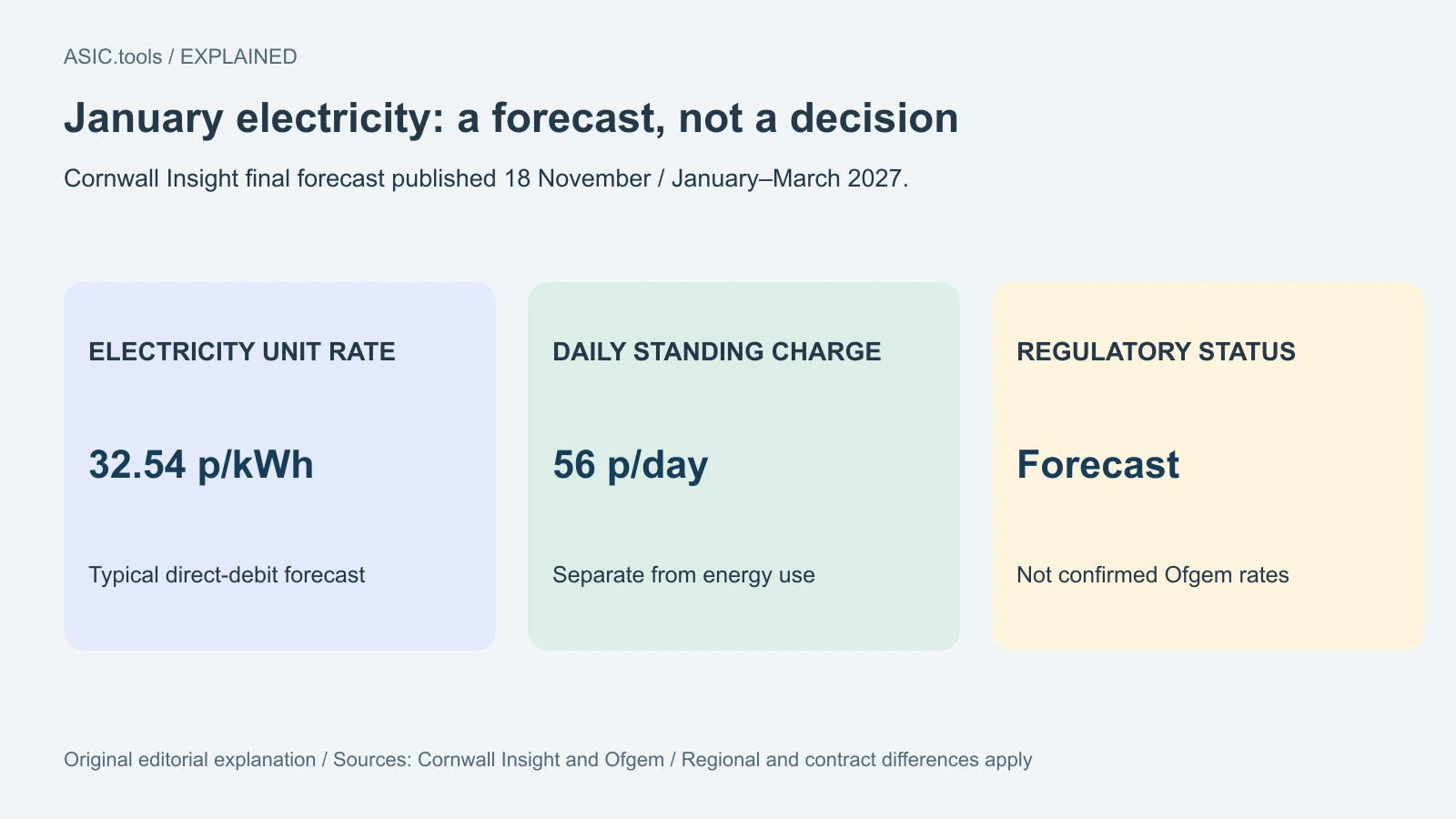
The January forecast puts electricity at 32.54p/kWh
Cornwall Insight's final forecast for January–March 2027 puts the typical direct-debit electricity unit rate at 32.54p per kilowatt-hour, alongside a 56p daily standing charge. Published on 18 November, it is a forecast of Great Britain's default tariff cap, not an announced Ofgem rate. For home miners, that unit price is the useful planning number; the widely reported 26% rise combines gas and electricity.
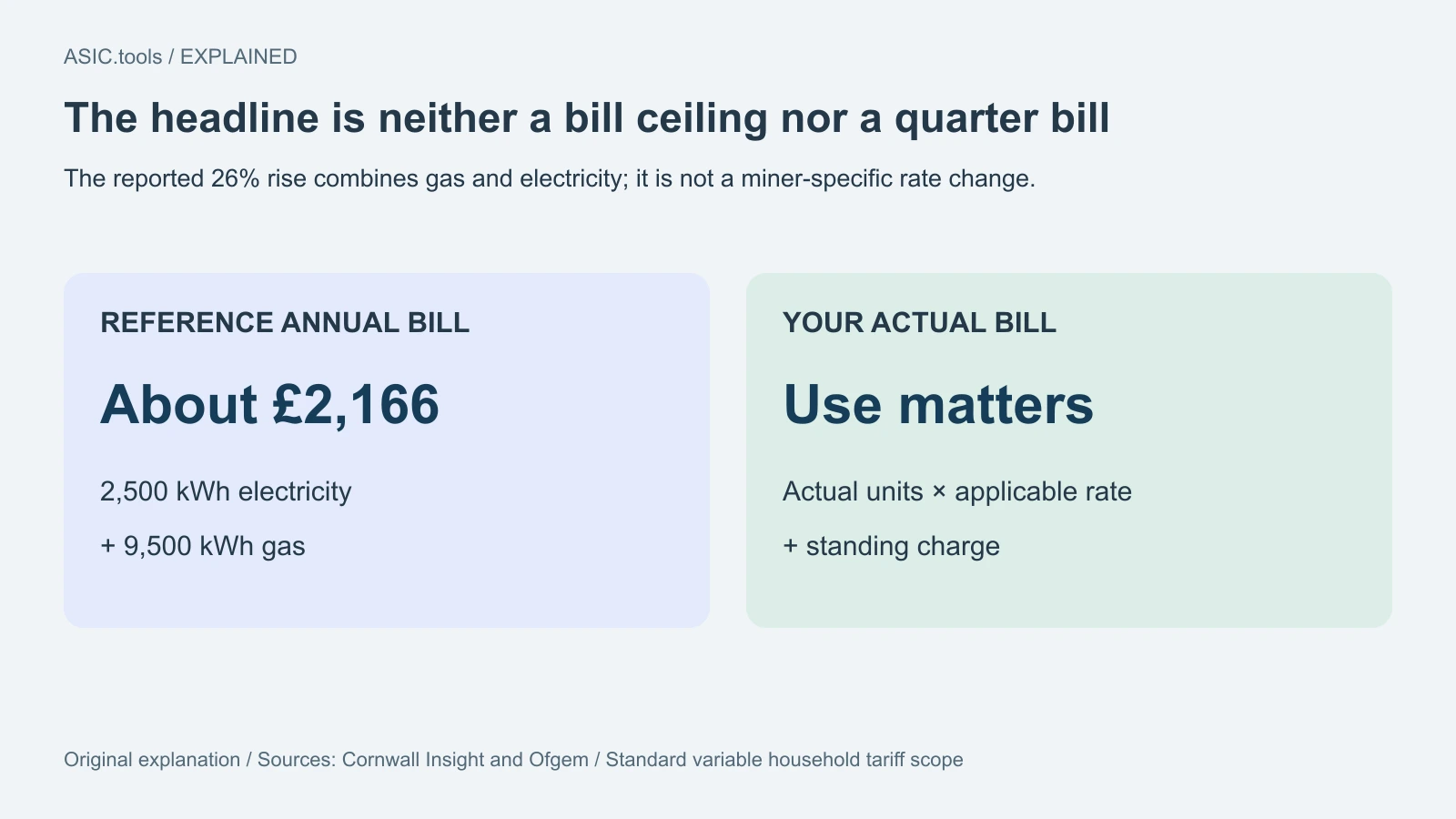
The consultancy expects the annualised bill for a typical dual-fuel household to reach about £2,166, up £443 from the current headline figure. That is not a maximum household bill and not a prediction that everyone will spend £2,166 during the three-month quarter. It expresses a year's standard consumption at the forecast quarter's rates.
Why the household headline does not price a miner
The forecast uses 2,500 kWh of electricity and 9,500 kWh of gas per year. A mining device adds electricity consumption, not that standard bundle of two fuels. Applying the 26% combined-bill change to a particular miner's electricity cost would mix different quantities. Start with the electricity rate in the table, then use the equipment's actual consumption.
Ofgem explains that the cap limits unit rates and standing charges together, while total bills still rise with use. The applicable level also varies by region, payment method, fuel and meter type. Its protection is for standard variable tariffs; fixed-price and business contracts are outside that protection. A commercial mining site's contract therefore cannot be priced from this household forecast.
A one-kilowatt example makes the cost visible
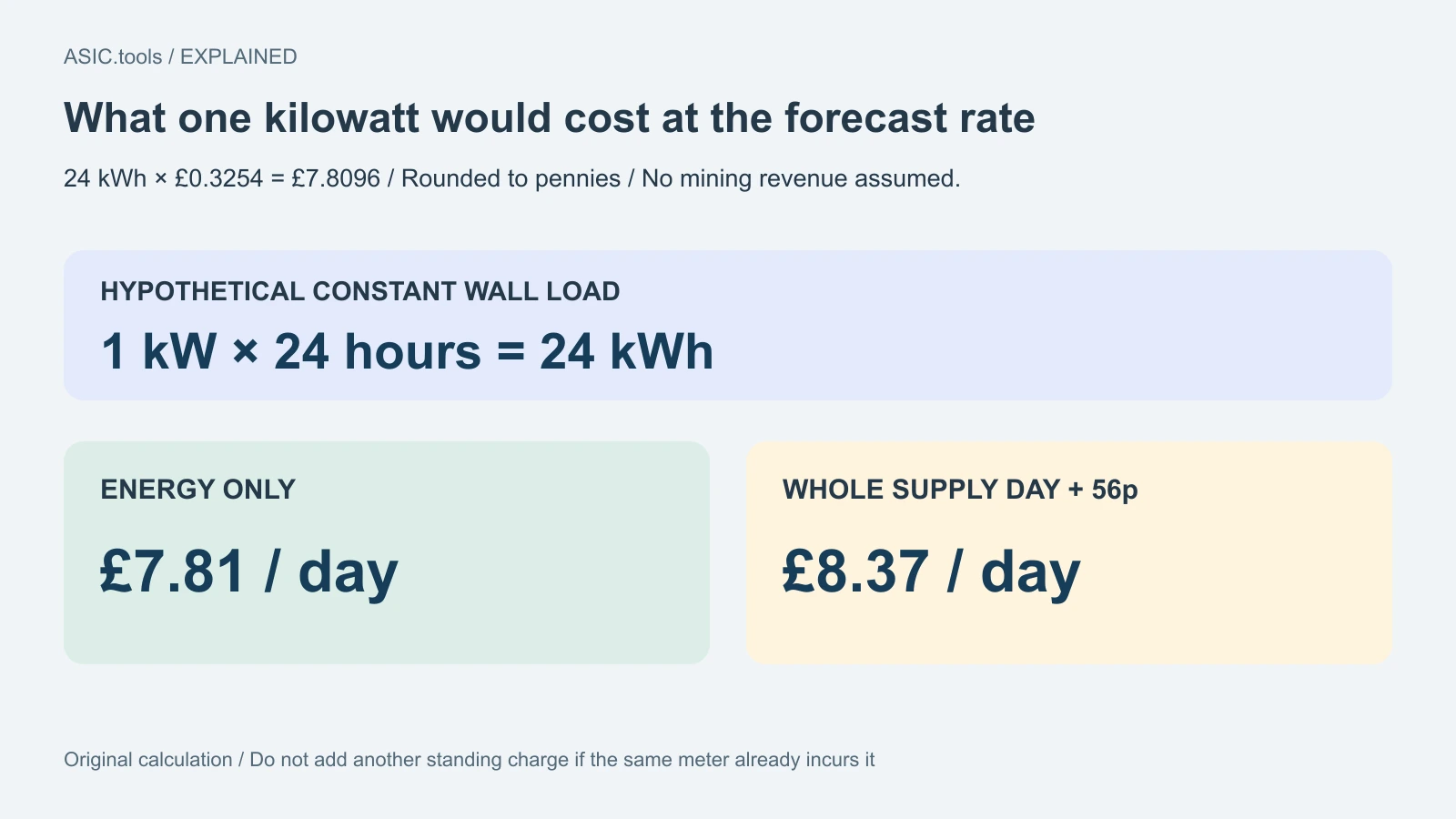
As an illustration, a setup drawing a steady 1 kW at the wall for 24 hours uses 24 kWh. At the forecast £0.3254/kWh, its electricity-only cost would be £7.8096, or £7.81 for the day. The example assumes that this forecast rate applies and the load runs all day; it is not a measured specification or a prediction of mining income.
The 56p standing charge is a separate daily amount, payable even without consumption. If the home already pays it for the same meter, adding a miner does not create another standing charge. If pricing an entire supply day from scratch, the example totals £8.37 including it. Keeping the two components separate avoids charging the same fixed amount twice when comparing whether to run a device.
Power and energy have different units: kW describes how much the setup draws at a moment, while kWh adds that use over time. The one-kilowatt example means a measured whole setup, including any auxiliary equipment within that measurement. If it is off for part of the day, use its actual operating hours; a power limit shown in software is not automatically a meter reading.
What support the forecast already includes
Cornwall Insight says the removal of VAT from electricity bills, extended until July 2027, is included in its forecast. It does not include the £100 Household Energy Payment for eligible Council Tax A–D homes in England, because that is a one-off payment outside the cap. That payment should not be presented as a permanent reduction in the pence charged for every extra kilowatt-hour.
The consultancy also leaves a proposed removal of household gas standing charges out of this forecast because the timing is unconfirmed. It attributes the pressure on costs to high and volatile wholesale markets, particularly gas, amid disruption linked to the Middle East conflict. Those are the forecaster's explanations; they do not establish the price of an individual mining contract.
Use it as a scenario before changing a setup
For a home miner, the practical response is to check the actual supplier contract, the electricity unit rate and measured wall consumption, then test a January scenario. A headline annual cap cannot replace those inputs. The same is true for hardware comparisons: a device's quoted hash rate does not tell you its electricity expense without its power draw and operating time.
The new event is the 18 November final forecast for the next quarter. The regulator's confirmed rates remain a separate decision. Our illustrations explain the forecast's scope, the one-kilowatt example and the difference between annualised reference consumption and a real bill. They are original editorial graphics, not copied Cornwall Insight charts or a promise that the forecast will be adopted unchanged.
The result of the example is an expense, not profit or a break-even threshold. To estimate a session's balance, revenue must be assessed separately for accepted work and applicable pool charges, then compared with electricity for that same session. A future tariff forecast alone supplies no future coin price, network difficulty or income. Keep assumptions dated when comparing January with today's operation.
Source: Cornwall Insight / Ofgem ↗ · Ofgem: price cap and standing charges explained ↗
Mining calculator ↗