Ontario’s new power rates begin today: cheap overnight mining comes with a peak-hour tradeoff
Source report: 2026-10-16 · Editorial analysis published: 2026-11-01
November 1 brings new TOU, ULO and Tiered prices, winter hours and a 15.7% electricity rebate. The 3.7 Canadian cents/kWh overnight rate is only one part of the choice for a home miner.
The change is taking effect, not being announced for the first time
Ontario’s new regulated electricity prices take effect on November 1. The Ontario Energy Board announced them on October 16; today’s event is their commencement, together with winter time bands and the residential tier threshold. For a home miner, this is a reason to revisit the electricity plan actually attached to the meter rather than keep using last month’s calculator inputs.
These prices concern eligible utility customers under the Regulated Price Plan, including households and small businesses. An energy retailer’s separate contract has its own price. All figures here are Canadian cents per kilowatt-hour, not US cents. They describe the electricity component; delivery, other bill items, taxes and applicable credits still matter when estimating the whole cost of running equipment.
The cheap night has a more expensive counterpart
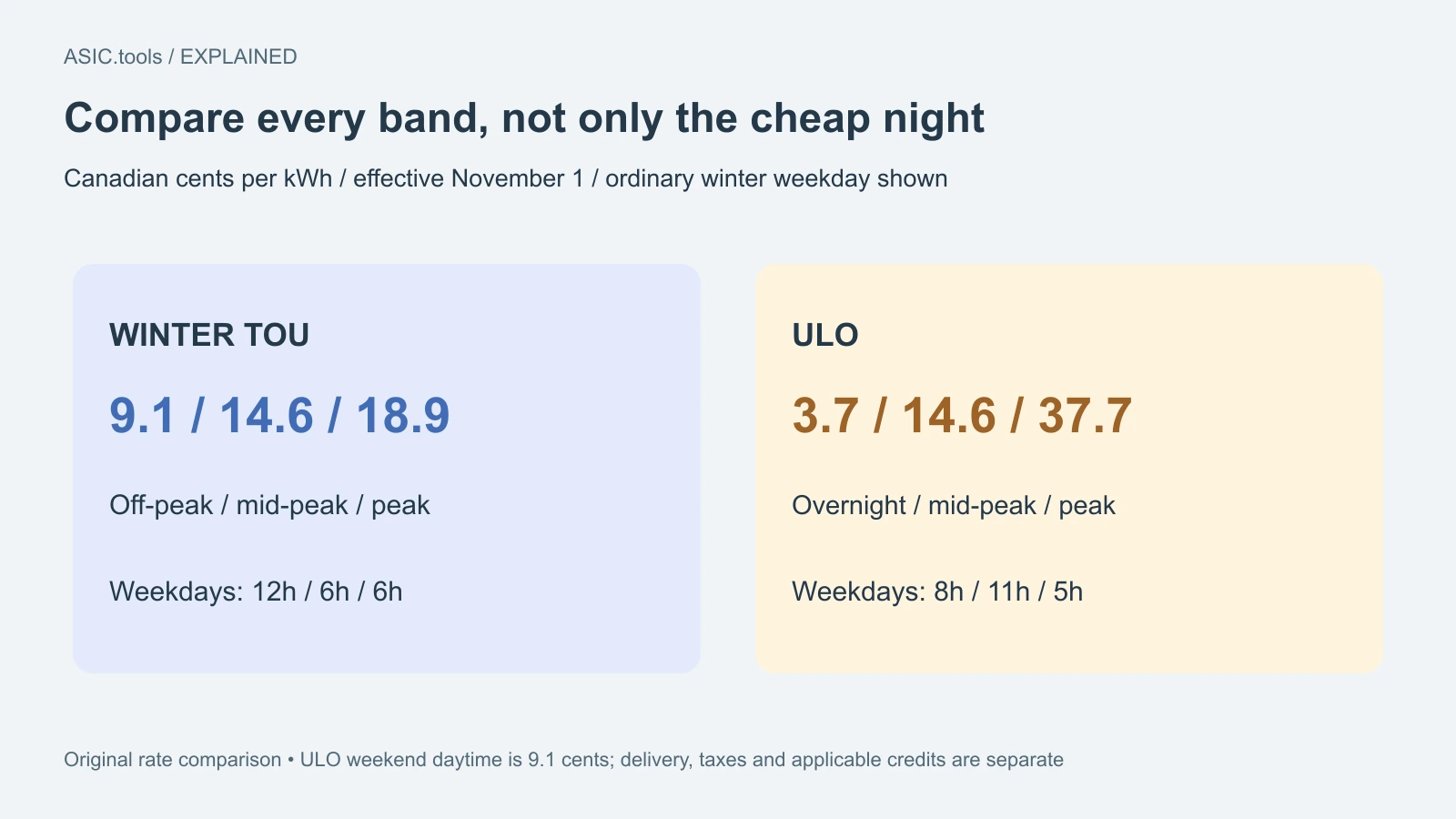
Under Ultra-Low Overnight, or ULO, electricity costs 3.7 cents/kWh every day from 11 p.m. to 7 a.m. The weekday peak is 37.7 cents from 4 p.m. to 9 p.m. Weekday intermediate hours cost 14.6 cents: 7 a.m.–4 p.m. and 9–11 p.m. On weekends and holidays, 7 a.m.–11 p.m. costs 9.1 cents, with the overnight band retained.
Under ordinary Time-of-Use, or TOU, off-peak costs 9.1 cents from 7 p.m. to 7 a.m. on weekdays and all day on weekends and holidays. Winter weekday mid-peak is 11 a.m.–5 p.m. at 14.6 cents. Peak is 7–11 a.m. and 5–7 p.m. at 18.9 cents. These winter hours run from November 1 to April 30; ULO hours do not change with the season.
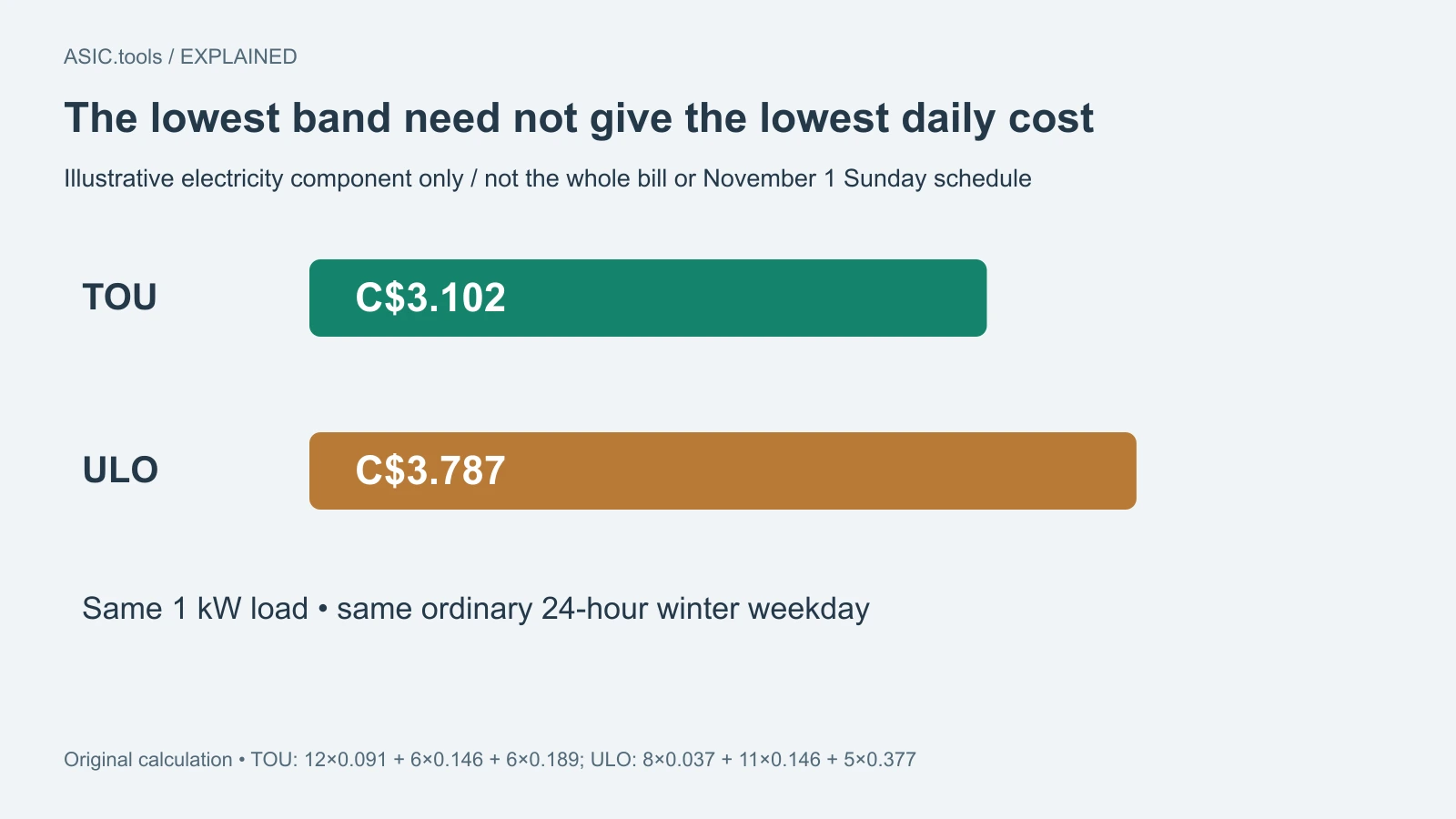
November 1 is a Sunday, so the weekday peak pattern is not today’s schedule. Plan a mining timer around the utility’s local clock, weekends and holidays, including clock changes. The examples below use an ordinary 24-hour weekday to make the plans comparable, not a promise that every calendar day has that exact pattern or number of hours.
Compare the whole operating window
A constant 1 kW load uses 8 kWh in an eight-hour overnight run. At ULO’s 3.7 cents, the electricity component is C$0.296. That calculation explains the appeal of scheduling, but an eight-hour run also offers only one third of a full day’s operating time. Compare the work and receipts from that shorter window with its costs rather than crediting it with 24 hours of mining income.
For the same 1 kW load running through an ordinary winter weekday, TOU totals C$3.102 for electricity: twelve off-peak hours, six mid-peak and six peak. ULO totals C$3.787: eight overnight hours, eleven mid-peak and five peak. Rounded, that is C$3.10 versus C$3.79 before the rest of the bill. The cheapest individual band therefore does not make ULO the cheapest choice for every always-on miner.
Tiered pricing and the rebate also change the answer
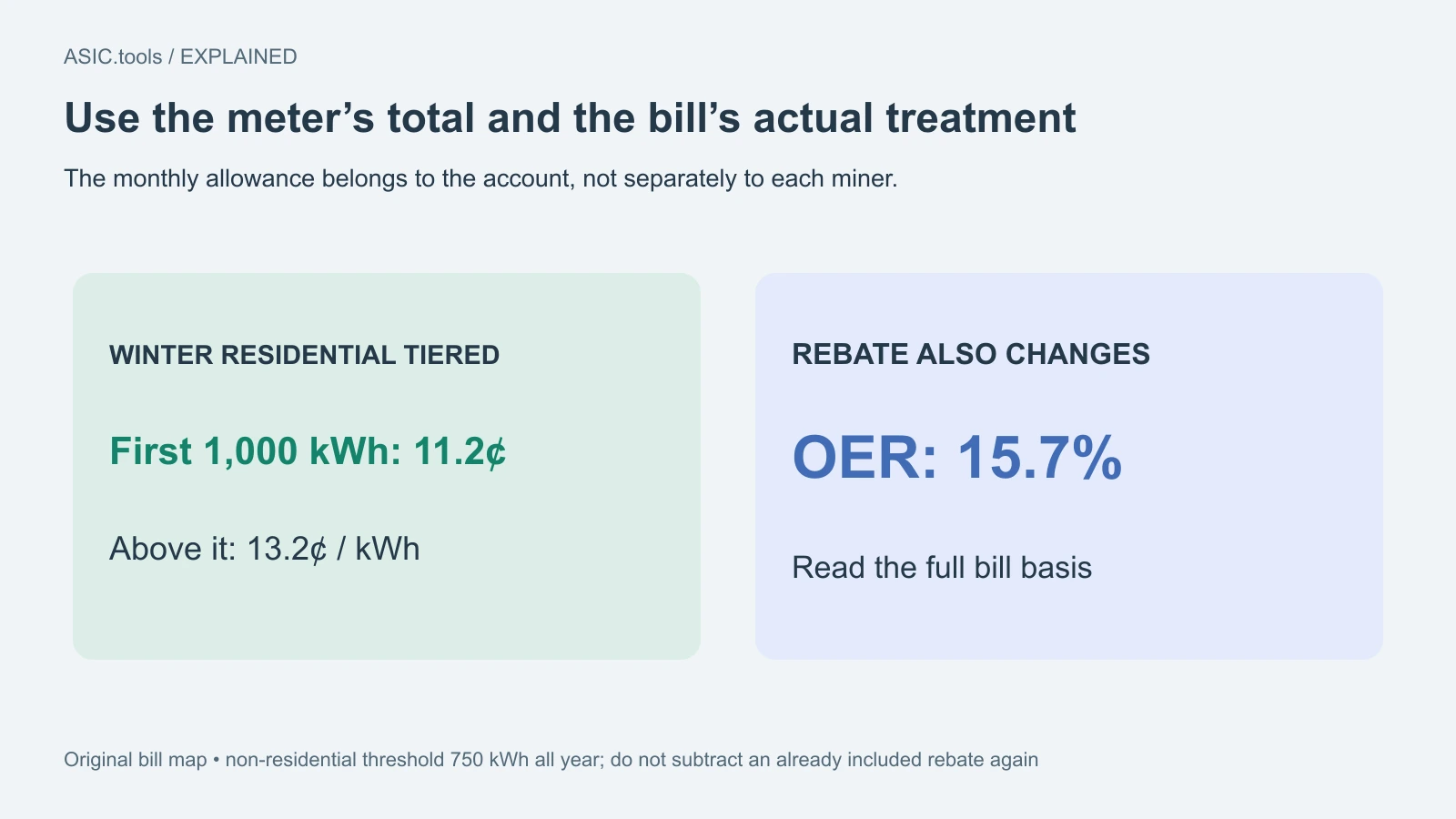
Tiered pricing uses monthly quantity instead of time bands. Residential winter consumption costs 11.2 cents/kWh for the first 1,000 kWh, then 13.2 cents above it. The summer threshold is 600 kWh; the non-residential threshold remains 750 kWh all year. The allowance belongs to the meter’s total use, not separately to each miner or appliance.
A 1 kW miner running continuously for a 30-day illustration adds 720 kWh before the home’s other consumption. Check where that extra energy lands in the tiers. The Ontario Electricity Rebate also changes to 15.7% from November 1. OEB says RPP electricity prices decrease year over year while the rebate is reduced, so a lower electricity line is not enough to predict the total bill. Do not subtract the rebate again if a quote already includes it.
Build the comparison from your meter and routine
OEB allows residential, small-business and farm customers to choose between these plans and offers a bill calculator. To change plans, follow the utility’s election process; staying on the existing plan does not require a change simply because the annual prices changed. Compare a representative interval-use record for the whole home, including other loads that cannot move to the cheap hours.
Use measured wall power for the miner, including its power supply and any added cooling. A timer may reduce electricity consumption by shortening runtime, but it also stops accepted mining work and may create restart time. The useful comparison is net income over the same period, with pool fees and actual uptime, not the lowest tariff multiplied by a full month of assumed production.
If mining heat replaces heating you would otherwise buy, record when that replacement really happens. It is not automatically useful during every cheap hour, and it is not a second payment from the utility. For today’s tariff change, the practical step is to update the plan, hours and bill treatment together, then choose the schedule that fits the household rather than the most eye-catching overnight number.
Source: Ontario Energy Board ↗ · Current OEB prices and time bands ↗ · OEB backgrounder ↗ · Hydro One price-plan details ↗
Mining calculator ↗