Oklahoma groundwater cooling restrictions take effect for data centers
Source report: 2026-05-14 · Editorial analysis published: 2026-11-01
SB 259 takes effect November 1. It restricts evaporative or once-through groundwater cooling and requires a low-consumption system to obtain a groundwater permit.
A cooling rule becomes effective today
Oklahoma's SB 259 takes effect on November 1, adding a specific groundwater restriction for cooling a data processing facility or data center. The law prohibits using groundwater through open-air evaporative systems or other cooling technology that consumes it through evaporation or discharge without recirculation. For a mining or hosting operator assessing a site, the water source and the full cooling design now deserve attention alongside the electricity connection.
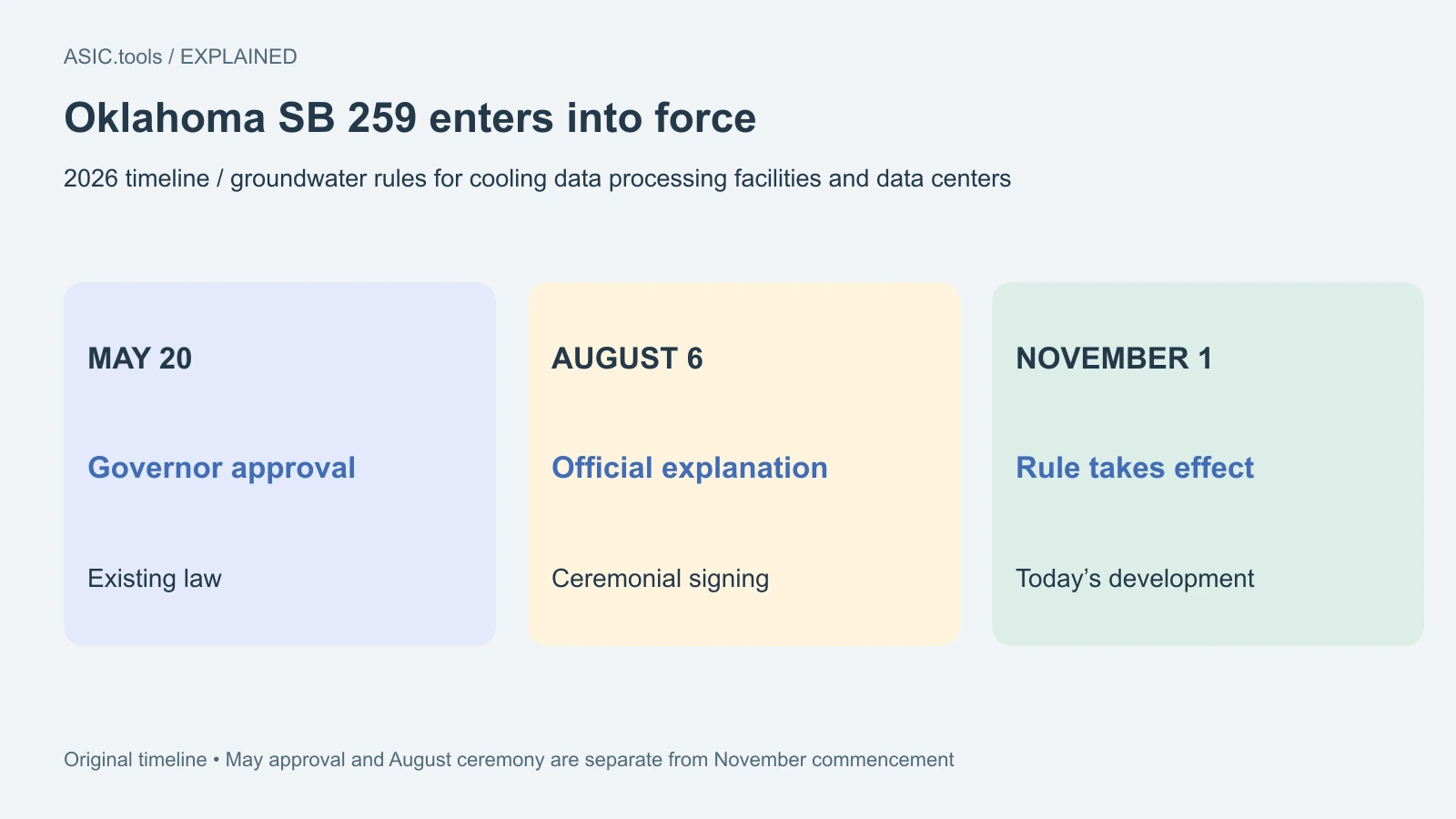
This is the commencement of an existing law, not a new decision announced today. The Oklahoma House says the governor approved SB 259 on May 20; an August 6 ceremonial signing notice explains the cooling provisions. The final enrolled text sets November 1, 2026 as the effective date. Those dates are kept separate so readers can tell what actually changes today.
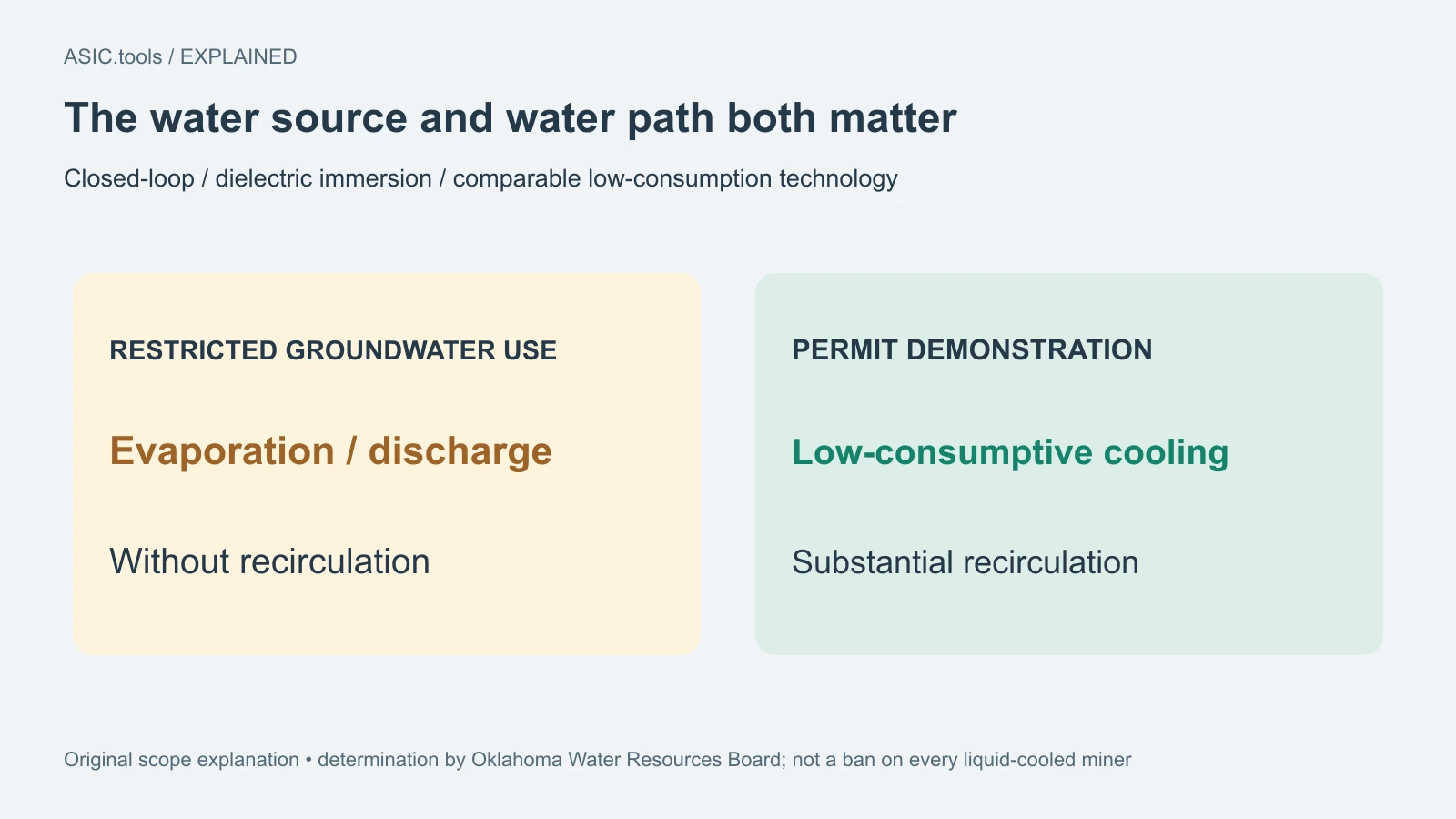
What a groundwater permit requires
The amended Section 1020.15 says permits for the covered facilities may be issued only when the applicant demonstrates closed-loop, dielectric immersion or comparably low-consumptive cooling. The technology must substantially recirculate groundwater and minimize consumptive loss, as determined by the Oklahoma Water Resources Board. Simply giving a system a fashionable name does not replace that demonstration.
The scope matters. The provision concerns groundwater and the named kinds of facilities; it is not a statewide ban on every use of water or on every liquid-cooled ASIC. The text does not set a mining-farm size threshold in this cooling clause. An operator needs to establish the site's facility classification and water arrangements rather than assume that every household machine or every hosting installation is automatically covered in the same way.
The official August announcement also discusses HB 2992, a separate electricity and large-load law that took effect July 1. Its electricity-cost protections are not the November 1 groundwater change. Keeping the measures separate avoids importing the other law's project conditions into a cooling rule that has its own wording and permit test.
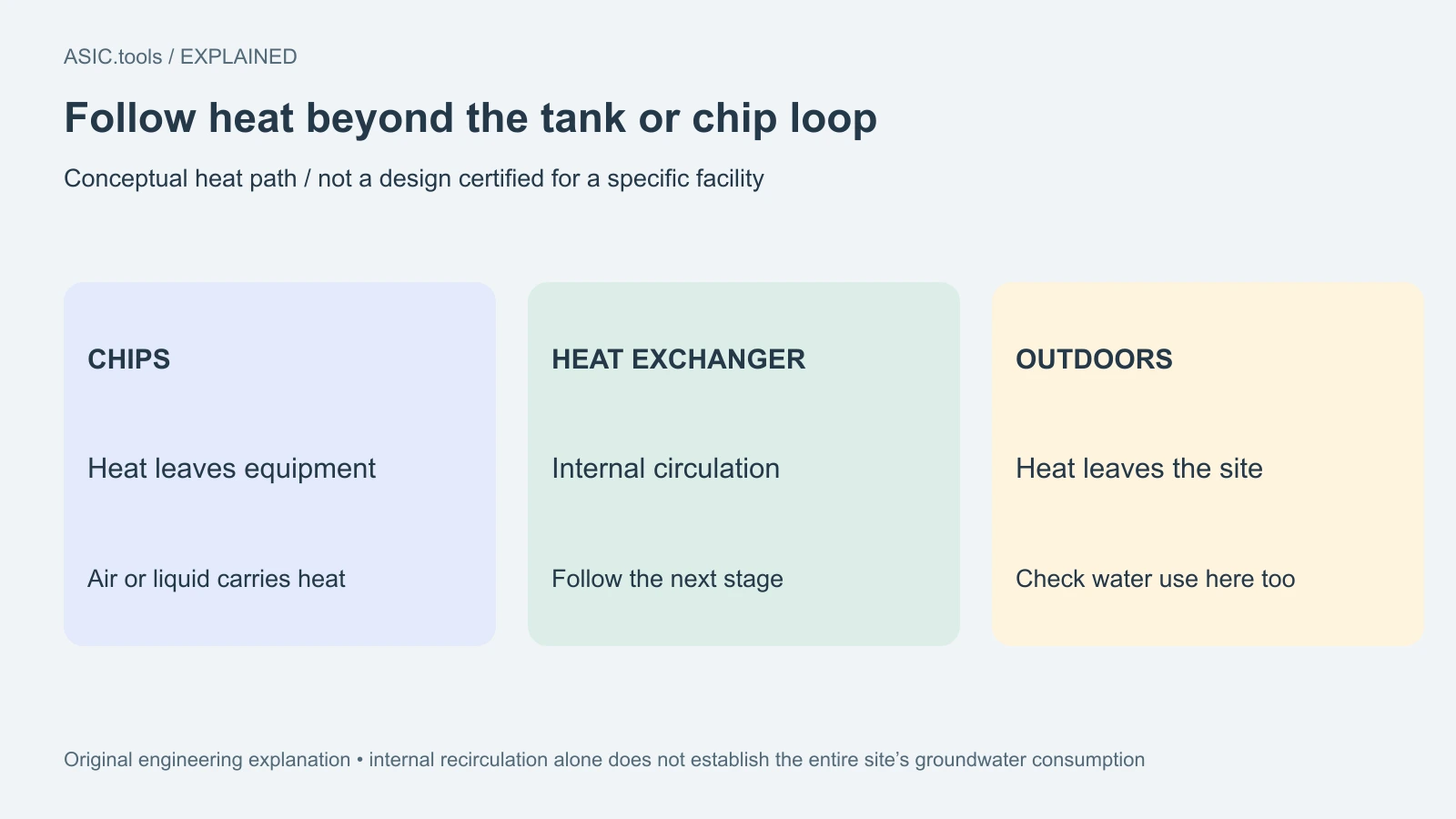
Follow the heat all the way outside
In a closed-loop cooling circuit, liquid carries heat away and returns to do the job again. In immersion cooling, equipment sits in an electrically non-conductive liquid. These descriptions explain how heat leaves the chips, but the heat still has to leave the facility. A design review should therefore follow the entire chain through heat exchangers to the final outdoor heat rejection equipment.
That distinction matters because a recirculating internal circuit can still be paired with equipment that consumes water outside. A photograph of an immersion tank alone cannot establish the whole site's groundwater use. The practical question is how water enters, circulates and leaves the complete system, and what the permit authority accepts. The law's determination belongs to the Board, not an illustration or a seller's label.
Groundwater describes the source, while recirculation describes the path through the equipment. Those are separate questions. A system drawing from a well and one receiving a different supply cannot be classified merely by looking at identical pipes. Nor does returning liquid inside a chip loop answer where the outside cooler obtains water or how much it loses. Record the complete arrangement before applying the provision to a specific site.
Reporting and enforcement also change
SB 259 also modernizes groundwater reporting and enforcement. Permit holders must report annual use in the period required by the Board. Willful failure to report may lead to penalties, fines or permit suspension after proper notice and hearing. The law directs the Board to receive, audit and review reports, modernize electronic collection, investigate waste claims and impose penalties for overuse or waste.
The text also says that nonuse, conservation or use below the permit maximum does not diminish the holder's future permitted equal proportional share. That helps explain the policy: water records and conservation matter, without making unnecessary consumption a condition of preserving that share. No fixed fine amount or universal reporting deadline is supplied here because the cited provisions do not establish one for every reader.
Questions to ask a hosting site
For a mining customer, the useful conversation with a host is specific: what water source supports cooling, what equipment rejects the heat, what permit applies, and what happens during maintenance or a cooling restriction? A customer using air-cooled machines may still depend on the building's wider cooling arrangements. The answer should describe that site rather than only the cooling label on an ASIC specification sheet.
For a hosting comparison, ask for the relevant site information separately from a price quotation. A contract may bundle electricity, cooling and service, so a physical design requirement cannot be translated into a universal per-kWh price change. Similarly, a new reporting duty does not by itself establish that a named operator has failed to report. Documents about the actual installation are the useful evidence for both discussions.
The law does not provide a ready-made change to a customer's hosting price or prove that a particular mine must close today. Costs and obligations depend on the actual installation and contract. The immediate development is a new effective legal standard for the covered groundwater cooling, with stronger reporting oversight. We verified the final law and official explanation; we did not audit or declare compliance for any individual facility.
Source: Oklahoma Legislature ↗ · Official House explanation and approval date ↗ · Official bill history ↗
Mining calculator ↗