Address linked to the OCEAN mining hijack spends three more reward outputs
Source checked: 2026-11-23 · Editorial analysis published: 2026-11-23
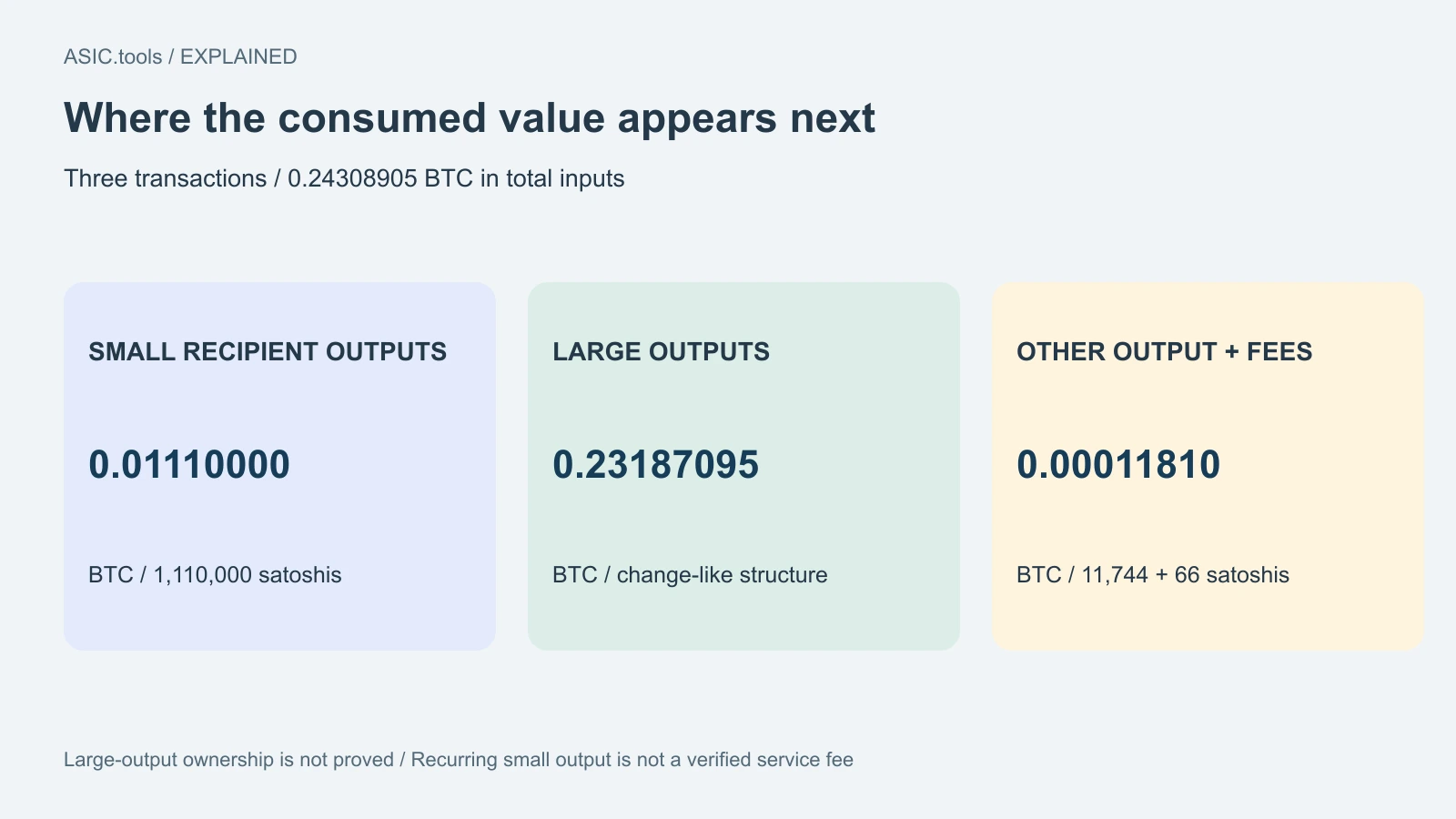
Three November 22 transactions spend rewards received on November 15–16. Small recipient outputs total 0.0111 BTC; the larger outputs must not be mistaken for a confirmed cash-out.
A new movement of old mining rewards
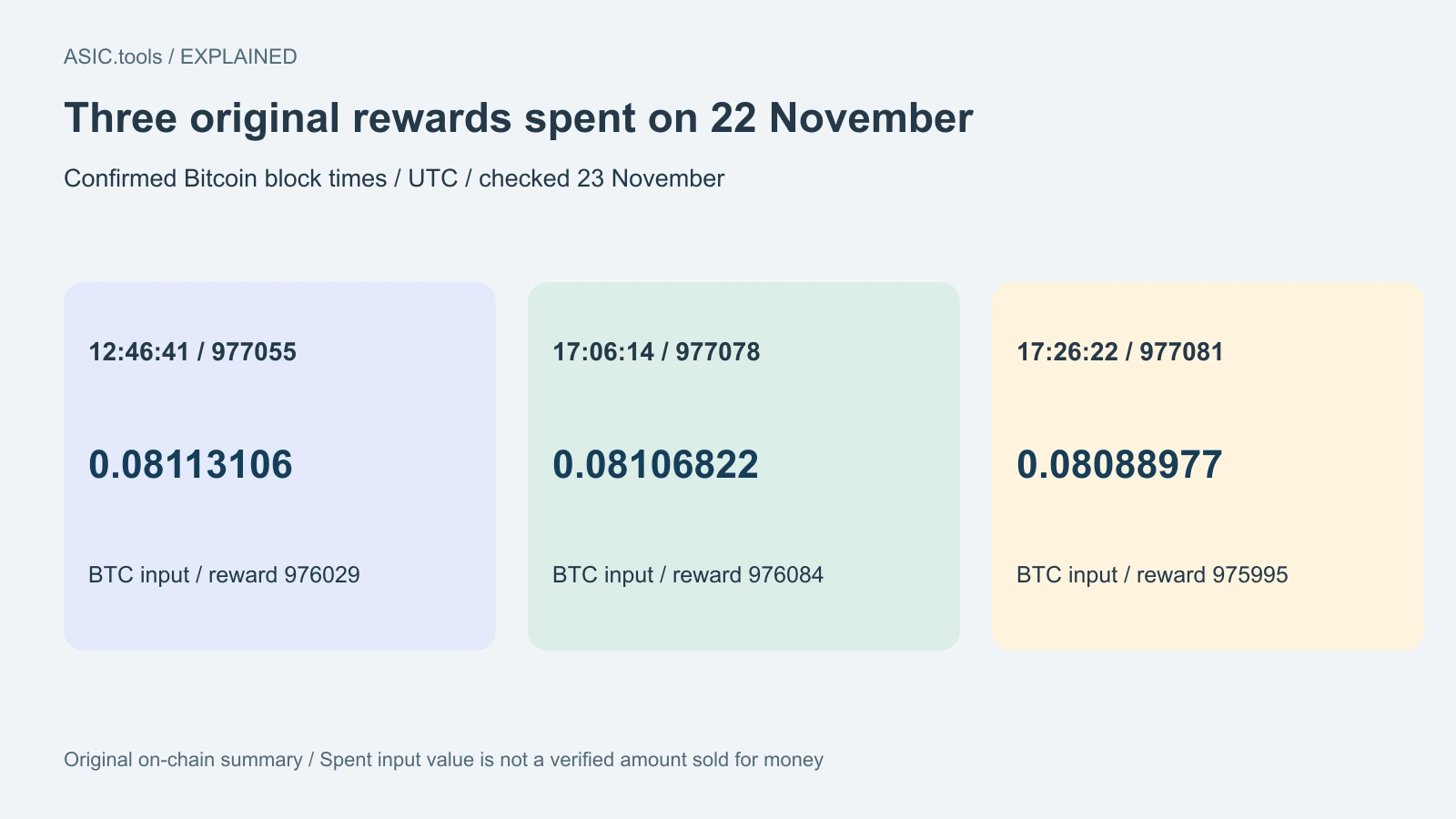
An address linked to the November mining-redirection incident spent three more OCEAN reward outputs on November 22. ASIC.tools checked the confirmed transactions through mempool.space on November 23. Their block times are 12:46:41, 17:06:14 and 17:26:22 UTC. The new event is movement of previously received coins, not evidence that another fleet was hijacked that day.
The flagged payout address is bc1qphuk…pcddrr. It had received four OCEAN block-reward payments on November 15–16 totaling 0.32445584 BTC. One was already spent on November 17. The three newly checked transactions consume the other three original outputs, which together held 0.24308905 BTC.
What the three transactions show
The first transaction spends the 0.08113106 BTC reward from block 976,029. Its outputs include 0.01 BTC to a recipient, 0.00006920 BTC to a recurring small-output address and 0.07106164 BTC to another address. The transaction was confirmed in block 977,055 and paid a 22-satoshi network fee.
The second spends the 0.08106822 BTC reward from block 976,084. It sends 0.0002 BTC to one address, 0.00002410 BTC to the recurring small-output address and 0.08084390 BTC to a larger output. It was confirmed in block 977,078, again with a 22-satoshi fee.
The third spends the 0.08088977 BTC reward from block 975,995. Its corresponding outputs are 0.0009 BTC, 0.00002414 BTC and 0.07996541 BTC. Confirmation was in block 977,081, with the same 22-satoshi fee. All three inputs link directly to the original OCEAN coinbase transactions, rather than merely sharing a similar-looking address.
Spending an output does not mean selling all its coins
Bitcoin accounts for coins through unspent transaction outputs, often shortened to UTXOs. Spending one consumes the whole original output and creates new outputs. It resembles paying with a banknote and receiving change: using an eight-unit note to pay one unit does not mean all eight units were handed away permanently.
In these transactions the three smaller recipient outputs total 0.0111 BTC, or 1,110,000 satoshis. The larger outputs total 0.23187095 BTC. Their shape is consistent with change, but that is an interpretation, not proof of who controls each new address. The remaining 0.00011744 BTC goes to the recurring small-output address, plus 66 satoshis in network fees. The sums balance to the 0.24308905 BTC consumed.
The recurring small-output pattern is also not, by itself, a verified description of a service fee. The earlier November 17 transaction had sent 0.055 BTC to a recipient. Adding that recipient amount to November 22's 0.0111 gives 0.0661 BTC, but this arithmetic does not establish exchange ownership, conversion into money, recovery by victims or the identity of the spender.
Keeping amounts in satoshis avoids rounding away these distinctions. One BTC equals 100,000,000 satoshis: the three network fees are 22 each, while the three recurring outputs total 11,744. They are different transaction components. Rounded headlines can be useful, but the underlying integers are needed to reconcile exactly what was consumed and created.
Why the mining connection matters
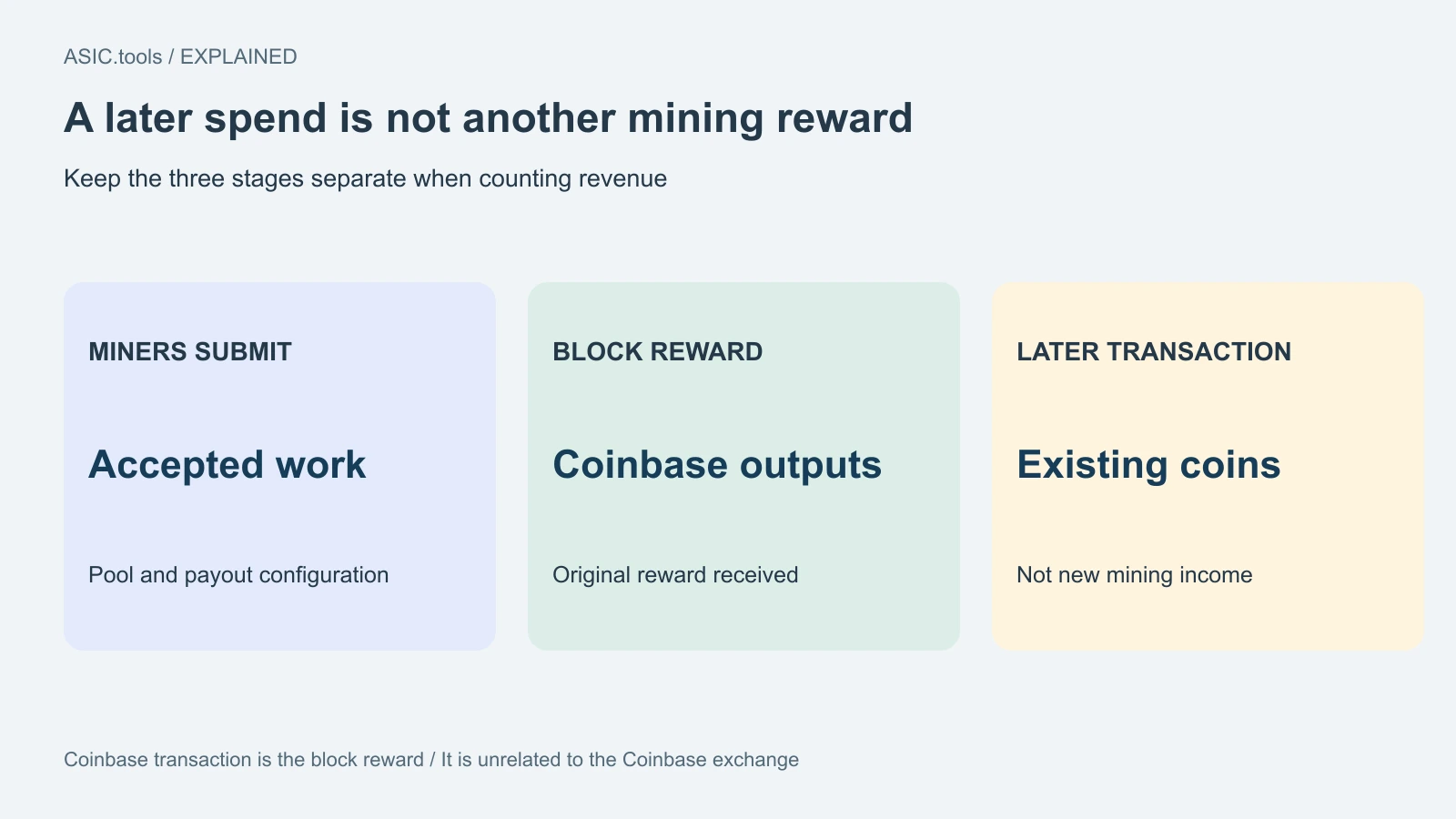
The original incident concerned miners' work being redirected and rewards assigned to an unfamiliar payout address. Machines can continue hashing and drawing electricity while the operator loses the revenue. A running fan or a normal-looking local hashrate therefore does not establish that the right account is receiving the work.
OCEAN pays miners through outputs in the block's reward transaction, called the coinbase transaction. This term has no connection to the Coinbase exchange. The reward records explain where the inputs came from; the later transactions show where those specific outputs went next. A later spend is not a new block reward and should not be counted as additional mining income.
What this check can and cannot establish
PublicAML's earlier investigation identifies the case and records its November 17 status. The new figures here come from the November 22 transaction records themselves. Its old balance statement should not be carried forward as a live balance, and the sum of the large new outputs is not a verified current wallet balance: subsequent movements and address control require separate checks.
For an operator, the practical control remains comparing configured pool destinations and payout identifiers with the pool's accepted-work and payment records, especially after remote configuration changes. No recovery requires giving an analyst a seed phrase or private key. This report confirms three dated spends and their amounts; it does not confirm a new breach, name the recipients or claim that the funds have been returned.
Source: Bitcoin blockchain / mempool.space ↗ · November 22 first confirmed spend ↗ · November 22 second confirmed spend ↗ · PublicAML earlier investigation, updated November 17 ↗ · Earlier ASIC.tools report on the original payouts ↗
Mining calculator ↗