Three OCEAN payouts to the address flagged in the Luxor Commander incident
Source report: 2026-11-15 · Editorial analysis published: 2026-11-16
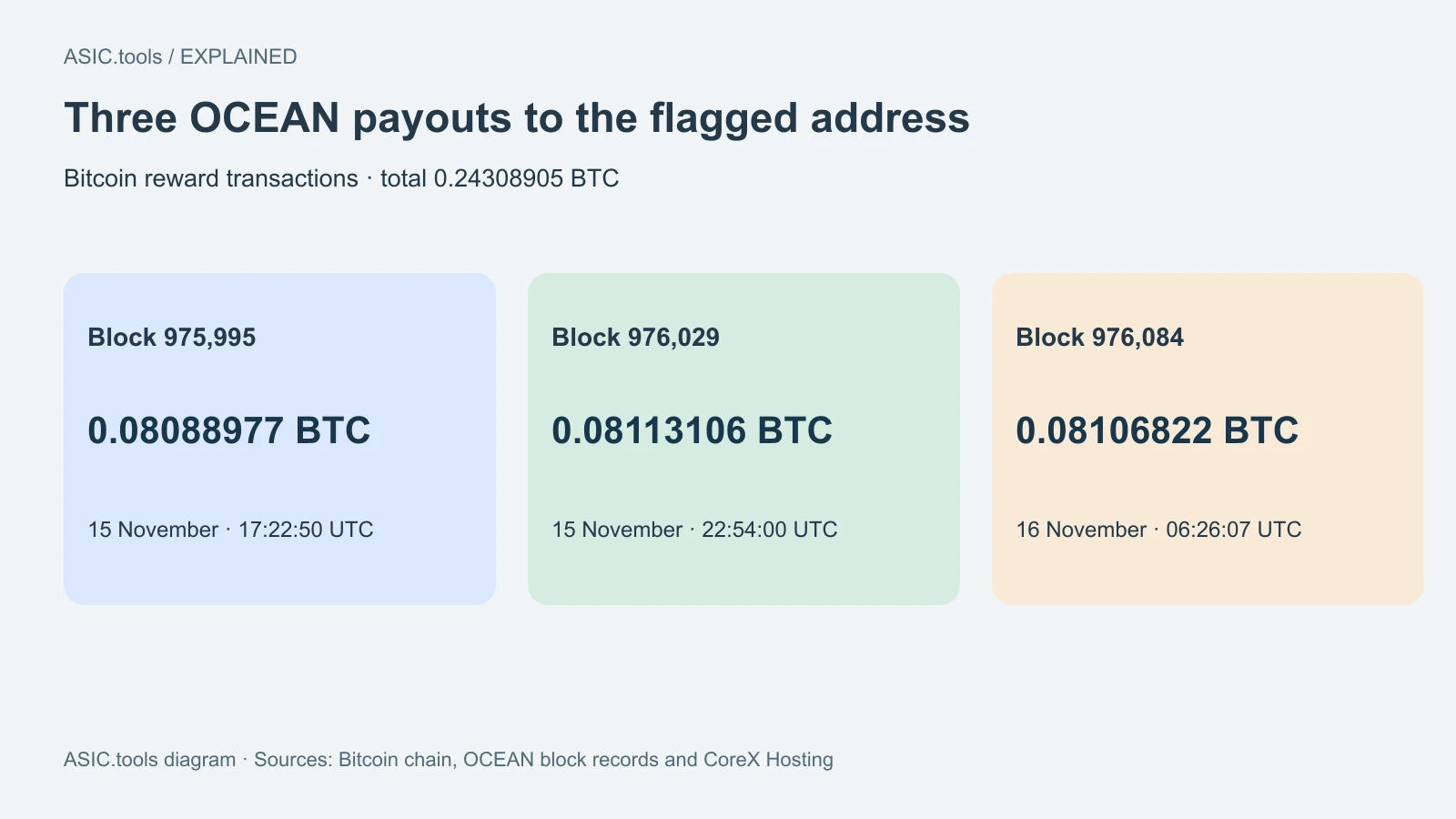
Bitcoin records show 0.24308905 BTC in three block reward payments through November 16. Luxor confirmed an unauthorized redirect through its fleet software.
Where the machines sent their work
Luxor said on November 15 that its monitoring detected an unauthorized redirect of mining work through Commander, its tool for managing fleets of machines. CoreX Hosting had raised the alarm earlier and pointed to a Bitcoin address on OCEAN. Three block reward transactions later paid that same address. The incident shows how a miner can keep computing and using electricity while the credit for its work goes somewhere its owner never chose.
Luxor counted just over a dozen client accounts and said the incident was isolated to Commander. It said Luxor Pool and the LuxOS firmware were unaffected. CoreX reported about 13 EH/s at the flagged address at one point. A widely shared estimate of 64,000 machines came from Bitcoin News, not Luxor’s account count. Those different numbers describe different things and cannot establish an exact fleet size or identify how the attacker gained access. Luxor says it patched Commander within two hours and promised to pay affected clients in full for their redirected work.
The three payments are visible on Bitcoin
On November 15, block 975,995 included an output of 0.08088977 BTC to the address CoreX identified. Block 976,029 sent it a further 0.08113106 BTC. On November 16, block 976,084 paid another 0.08106822 BTC. The three observed outputs total 0.24308905 BTC. OCEAN’s public block records give the same reward transactions as the blockchain. They confirm the destination and amounts, while ownership of the address and the full scale of the intrusion are separate questions. The block headers record 17:22:50 and 22:54:00 UTC on November 15 and 06:26:07 UTC on November 16.
A block’s first transaction distributes its reward. Seeing an output in that transaction proves it was credited to the address, regardless of whether someone has moved it since. It also does not show how much individual operators lost. A farm’s lost mining credit depends on its own affected machines, the length of the redirect and the payout terms it normally used.
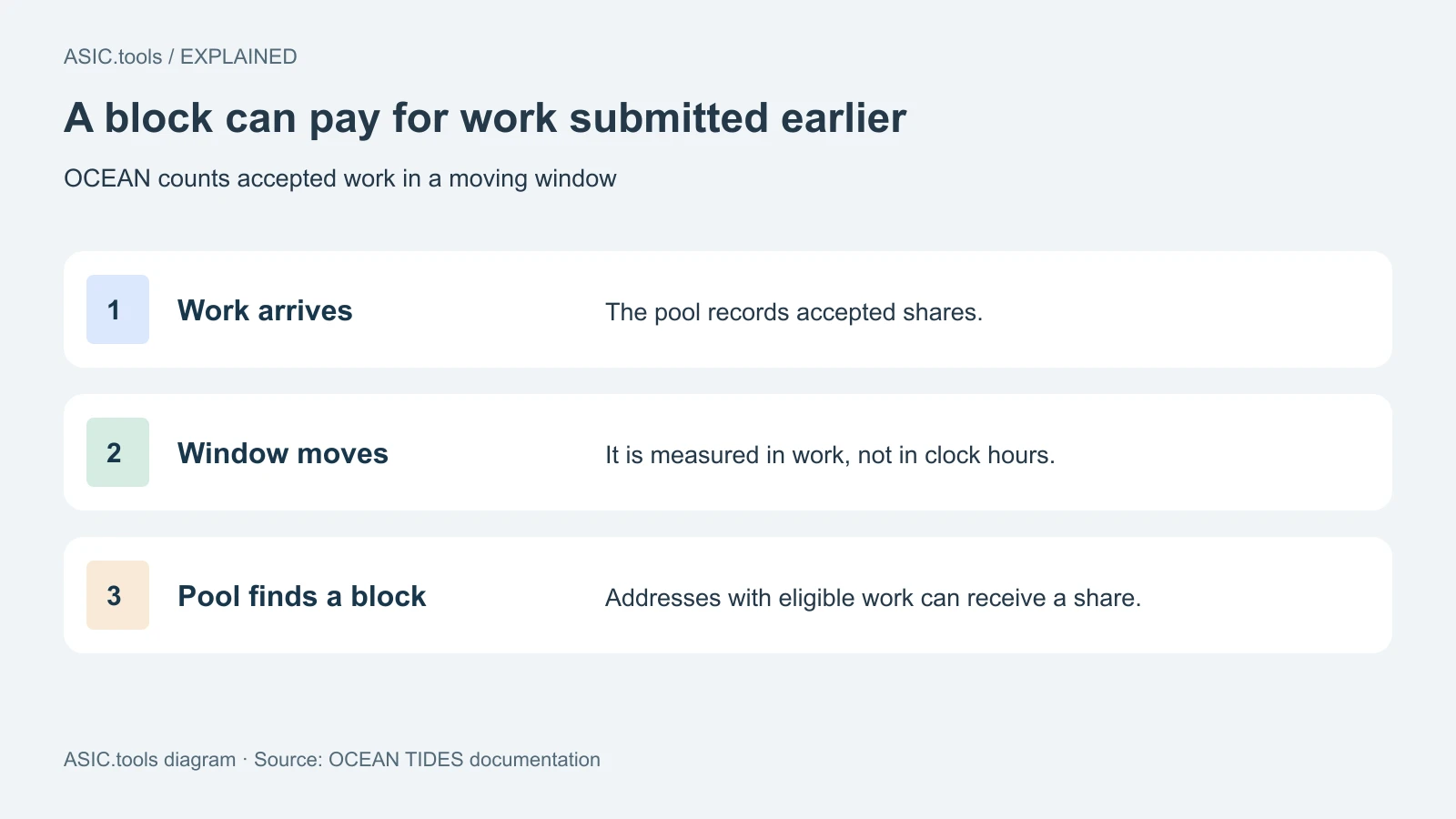
Why a later block can pay for earlier work
OCEAN calls its reward system TIDES. Miners send shares, which are smaller proofs that show how much work they have done. The pool counts work in a moving window measured by difficulty, rather than a fixed number of clock hours. When the pool finds a block it can pay an address that still has eligible work in that window, even if a different miner actually found the block. OCEAN defines the window as a quantity of work equal to eight times network difficulty.
That explains why the time of a payout and the time of the work behind it need not match. The three transactions are payments from OCEAN’s blocks. They do not show that the flagged address itself found those blocks, or that the machines were still redirected when the blocks arrived.
What an operator can check
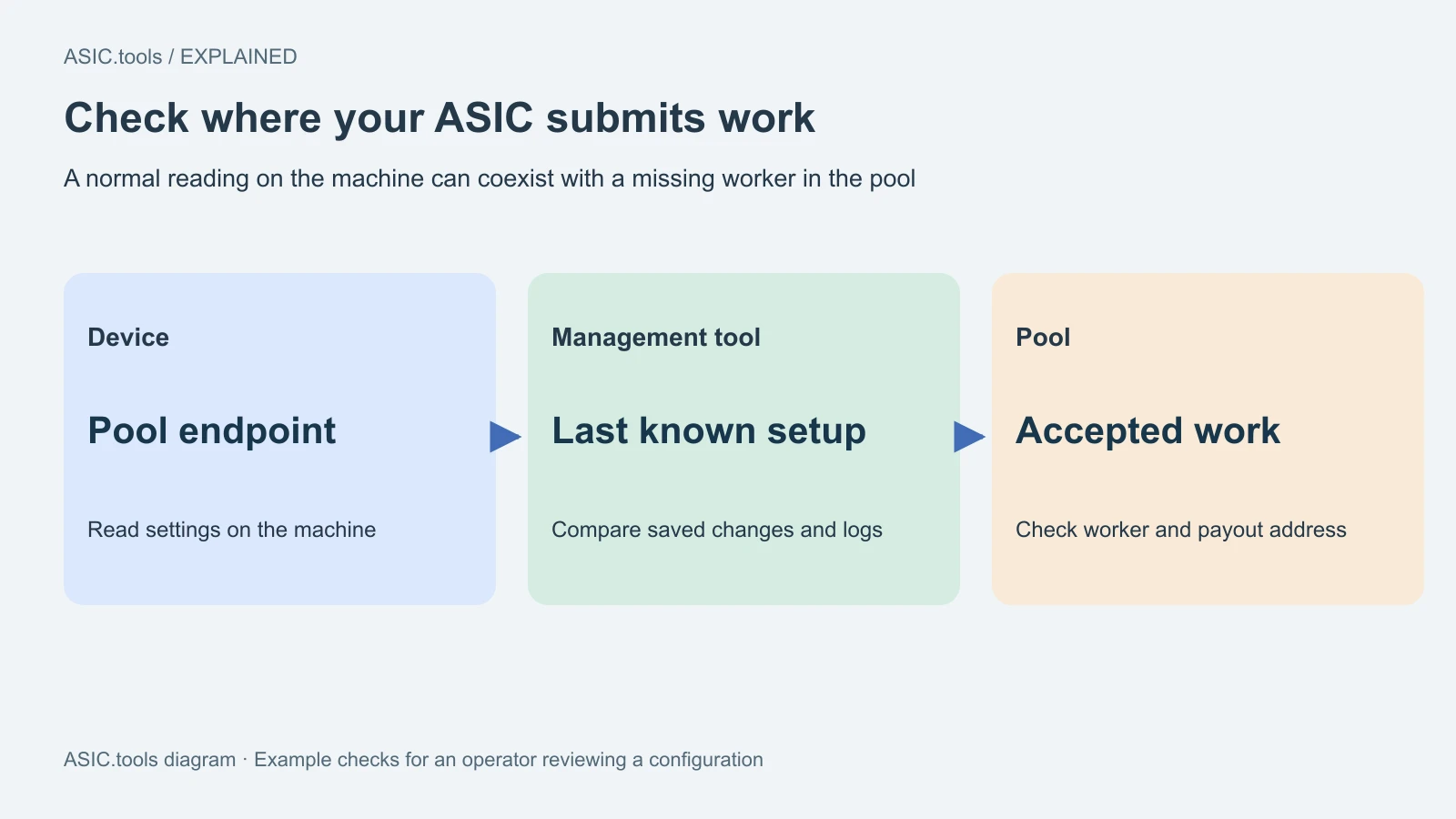
Start with the mining pool address and payout destination on a sample of machines, then compare them with the last known configuration in the management tool. Check both the device and the pool’s accepted work. A normal hashrate on the device is compatible with a missing worker on the expected pool. That mismatch is a reason to inspect the route the work is taking.
If any settings changed without approval, keep the configuration and event logs for the affected window. Review who can push bulk updates, remove access that should no longer exist and verify the settings at the machine after restoring them. Those steps address the part of mining where this incident was observed: control of the route between the machine, the pool and the address that receives credit.
Source: Luxor ↗ · CoreX Hosting alert ↗ · Luxor statement on affected services ↗ · OCEAN block records ↗ · Block 975,995 reward transaction ↗ · Block 976,029 reward transaction ↗ · Block 976,084 reward transaction ↗ · OCEAN TIDES documentation ↗
Mining calculator ↗