CashStratum 1.8 makes Bitcoin Cash pool labels easier to read in new blocks
Source report: 2026-11-15 · Editorial analysis published: 2026-11-17
The update moves pool text ahead of other data in the block reward transaction. Payouts stay the same, and operators get a warning when a candidate’s input would exceed the network limit.
Put the pool name where readers can see it
CashStratum 1.8.0 was published late on November 15 UTC, early November 16 in Kyiv. The Bitcoin Cash pool software moves the operator’s text closer to the start of the block reward transaction’s input data. Explorers and miner displays that show the field as text should now make it easier to spot a familiar pool label in a newly mined block. The pool’s payout rules and Bitcoin Cash’s block reward are unchanged.
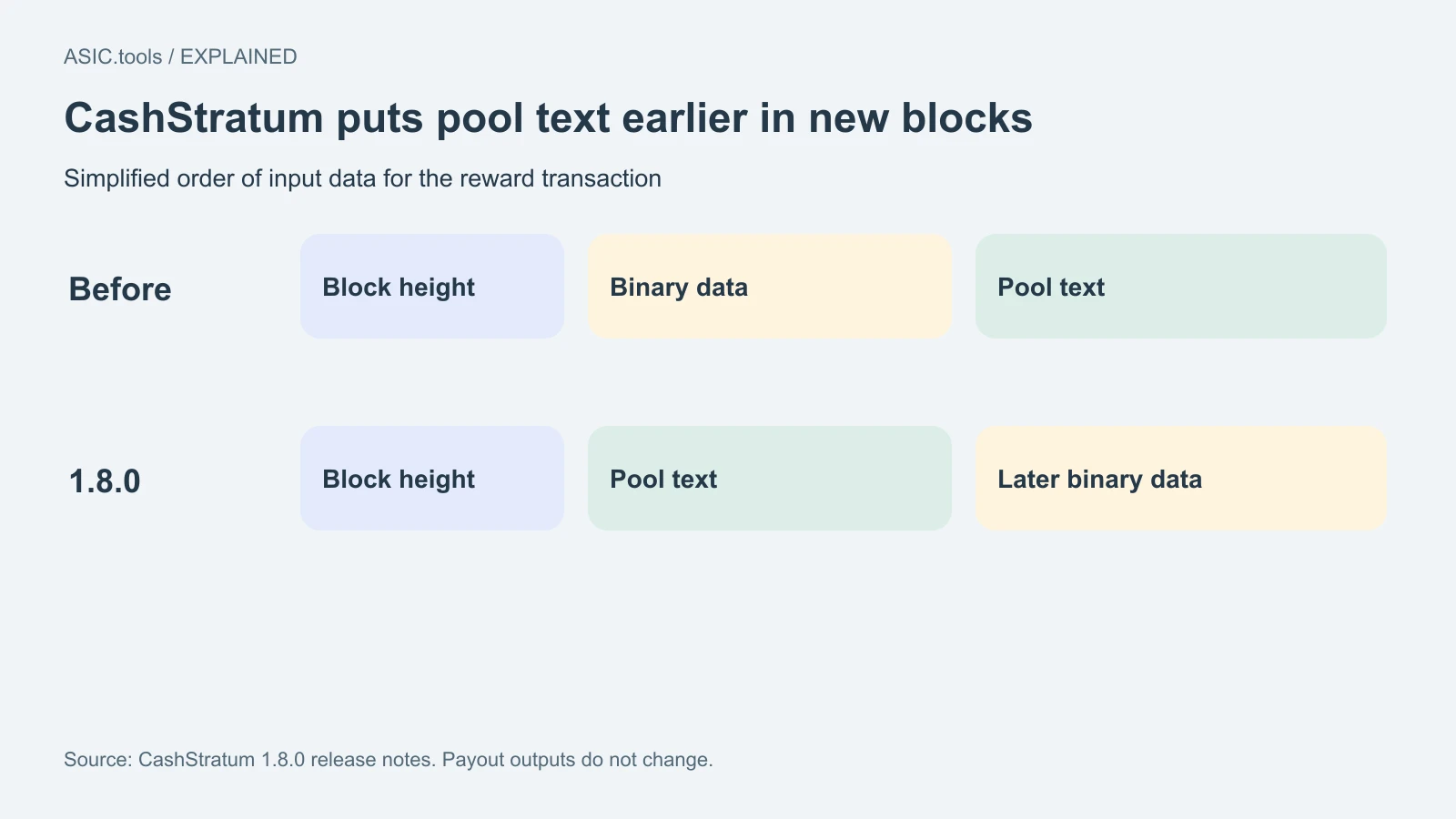
The first transaction in a mined block, called a coinbase transaction, claims the block reward. Its input has a short data field. A pool can put a label in it, alongside values the software uses to build mining work. When a viewer renders that data as text, binary bytes can turn into stray characters. For a reader scanning a block page, this made the optional label hard to notice.
What moved and what stayed put
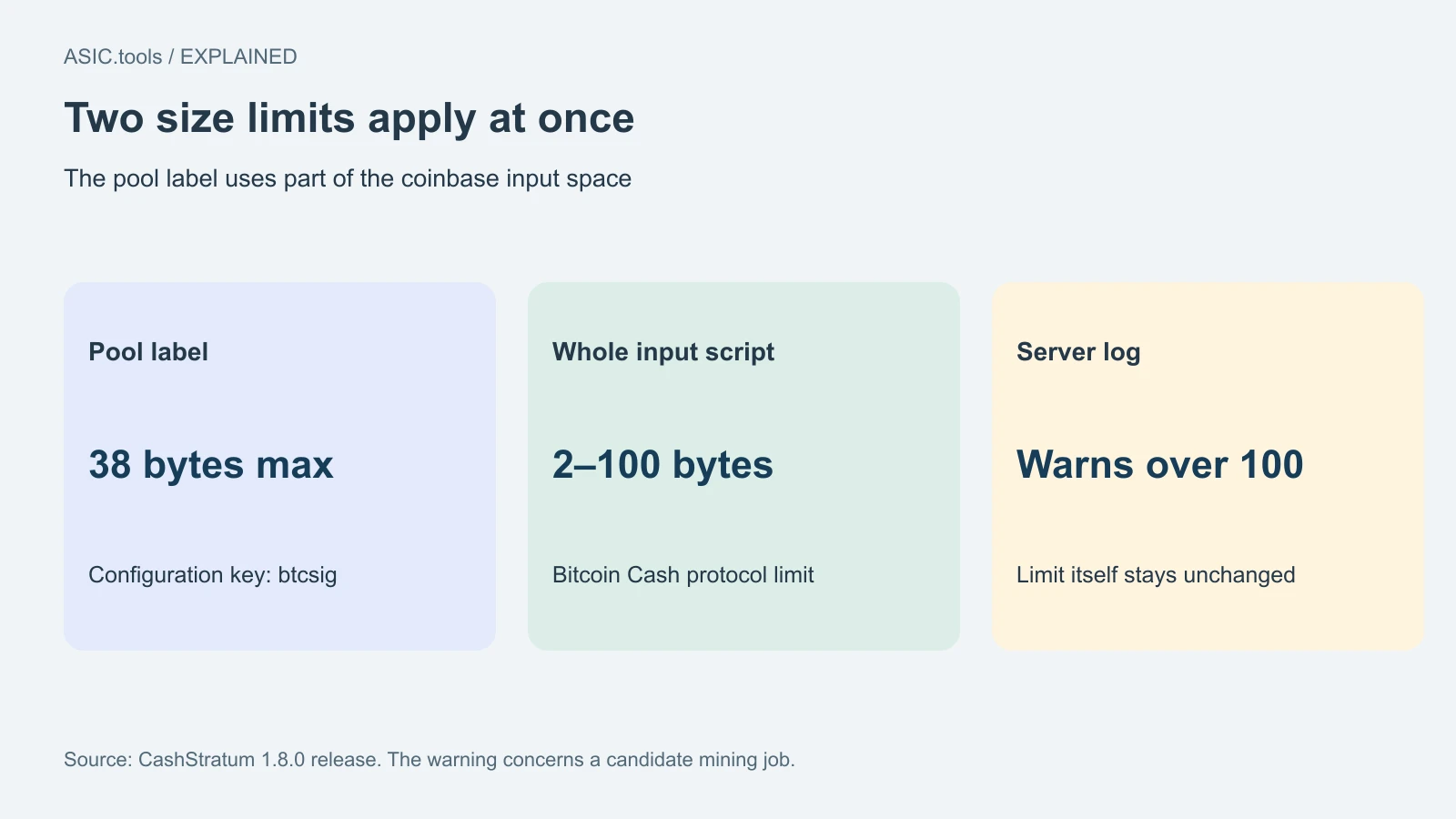
CashStratum stores the configured text under the name btcsig. Previously it wrote the label after an extra nonce and other data. An extra nonce gives miners another way to vary the work they try. With 1.8.0 the label follows the encoded block height, before the later binary fields, and the label no longer has an extra length byte. The cap on configured text remains 38 bytes.
This only affects blocks built with the new layout. A block already accepted by the network keeps the bytes it had when it was mined. Wallet recipients and amounts are recorded in outputs, a different part of the transaction. If you want to check where a reward went, compare those outputs; the readable label is a clue about the job, not proof of which entity took the money.
A warning for oversized jobs
The standard size range for a coinbase input script under the network’s rules is 2 to 100 bytes. A candidate built outside that range cannot be accepted. The release says the server now logs a warning if a new job would exceed 100 bytes. This helps a pool notice a problem before it counts on a miner’s work producing an acceptable block. It does not raise the limit.
The 38-byte cap applies to the pool text, not to everything in the input. Other data fills some of the same space. Use the warning as a signal to review the actual job data rather than treating an approved label length as proof that every job fits. The release includes a test that checks the bytes in order and an end-to-end test on a local network.
What changes for operators and miners
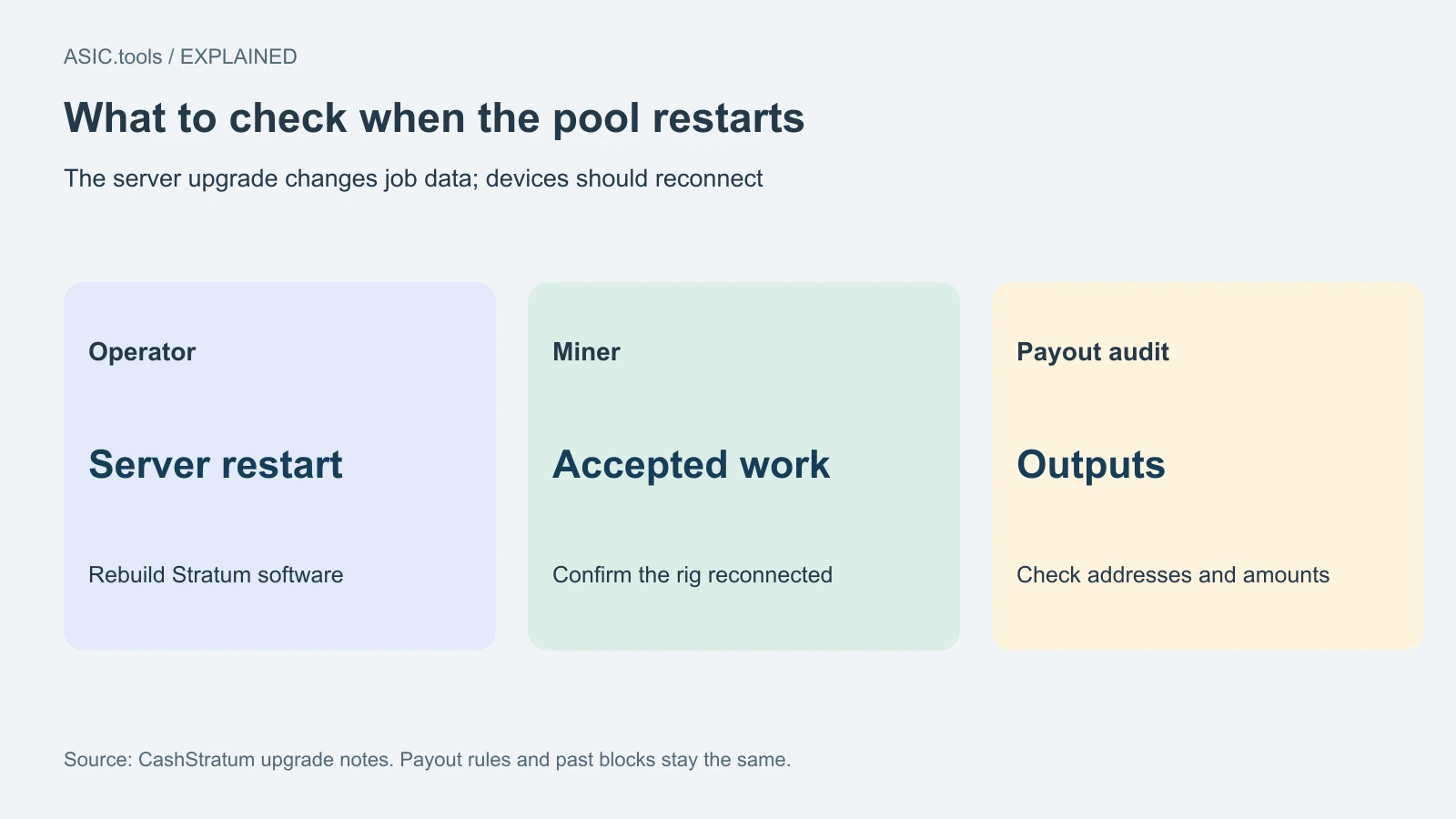
The project says operators have to rebuild and restart the Stratum server, the program that sends mining jobs to devices. The application interface, or API, can read jobs from the old or new server. Its coinbase endpoint returns the label in a new coinbase_message field when the server uses the new layout; with the old server the field is empty.
Miners are expected to reconnect on their own. Check that your device is submitting accepted work after the pool restarts. An ASIC owner does not need a firmware flash simply because the pool changed where it writes an optional label. And an older block not showing a cleaner label tells you nothing about whether a pool has upgraded today.
When the visible label is useful
For troubleshooting, an operator can compare a new job and a new block against the expected label, then check that the intended payout addresses are still in the reward transaction. A missing label could be due to an older server or how the explorer displays the bytes. Start with the pool’s job data before concluding that the mining device sent the wrong work.
This release gives operators a cleaner way to recognize their own work and one more signal when a job is too large. Check reward destinations and accepted work separately from the display. That is how a change meant to make blocks easier to read can also make the routine after a restart easier to verify.
A useful check after the switch
For a pool operator, compare a fresh job after restart with one from before it. If a dashboard shows the label but an explorer does not, first check whether the page is showing an older block or whether it renders the binary bytes differently. An empty API field can be normal while that API is still talking to the old daemon.
Because the limit is in bytes, operators should distinguish a short-looking label from a short byte sequence. Some characters take more than one byte. Then look at the rest of the input too. A readable tag, a valid job and a payout to the expected recipient answer three different questions, and only the last of those tells a reader which output received the reward.
Source: CashStratum ↗ · Official release record, including UTC timestamp ↗ · Version 1.8.0 byte layout tests ↗
Mining calculator ↗