Bitcoin Cash Node backs one-minute blocks for May 2027
Source report: 2026-11-14 · Editorial analysis published: 2026-11-15
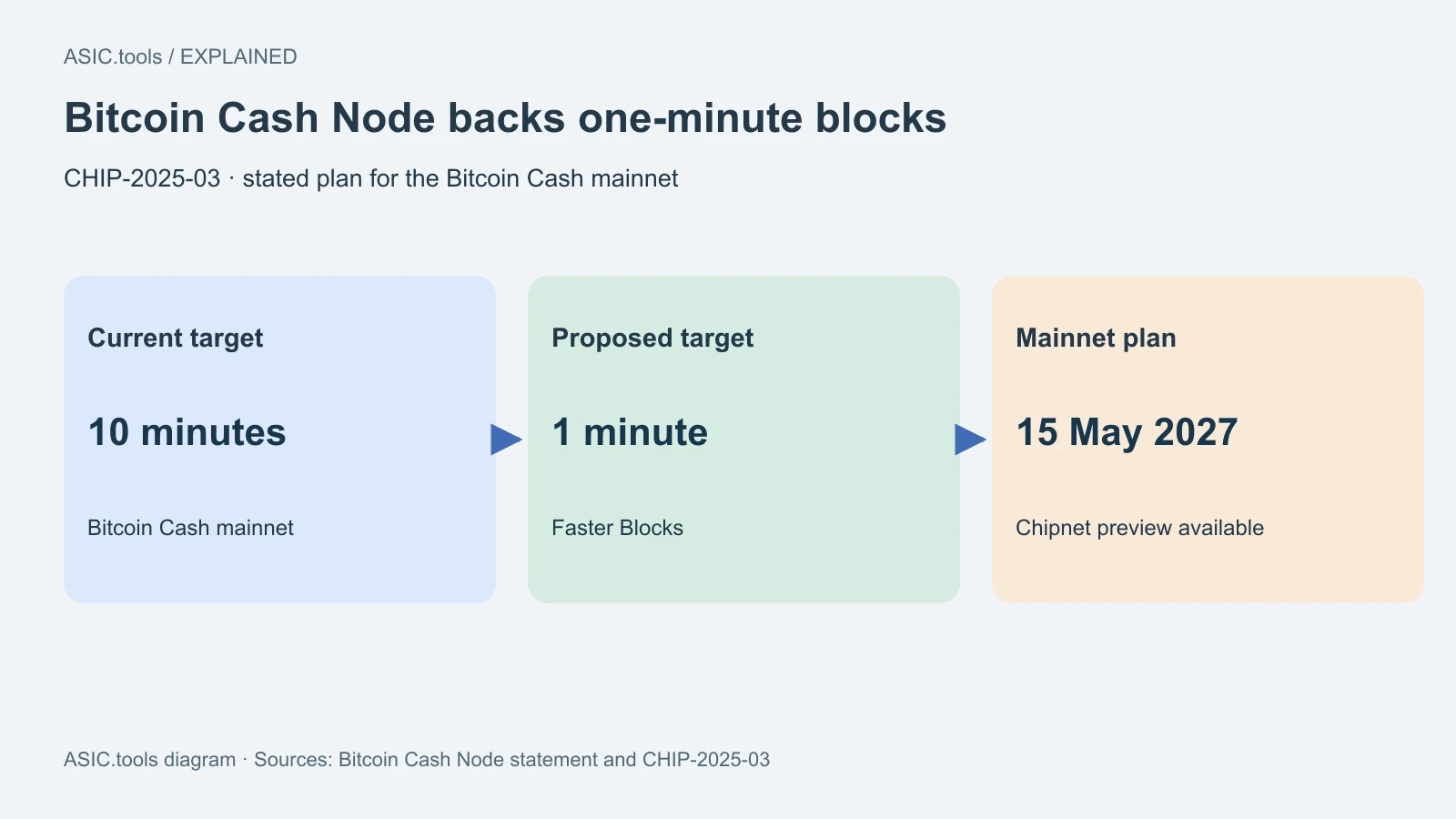
The developers plan to cut the target interval from ten minutes to one. A preview is available for Chipnet, while the main network has a May 15, 2027 target.
What Bitcoin Cash Node committed to
Bitcoin Cash Node’s maintainers said on November 14 that they will implement Faster Blocks in their next regular release. The proposal would move the network’s target interval from ten minutes to one, with mainnet activation planned for May 15, 2027. That would give transactions more frequent opportunities to make it into a block and change the pace at which pools issue fresh mining jobs. The announcement concerns a specific node implementation and a planned mainnet change.
The immediate release is a preview for Chipnet, a test network where developers, miners and services can exercise the new rules before they handle real funds. The specification labels the proposal Accepted, with a November 15 threshold for Chipnet and the separate May date for mainnet. The maintainers asked Chipnet operators and miners to upgrade promptly because common test builds are approaching expiry. People serving mainnet or other test networks were told to wait for a regular release. The preview download and the future mainnet release serve different points on the calendar.
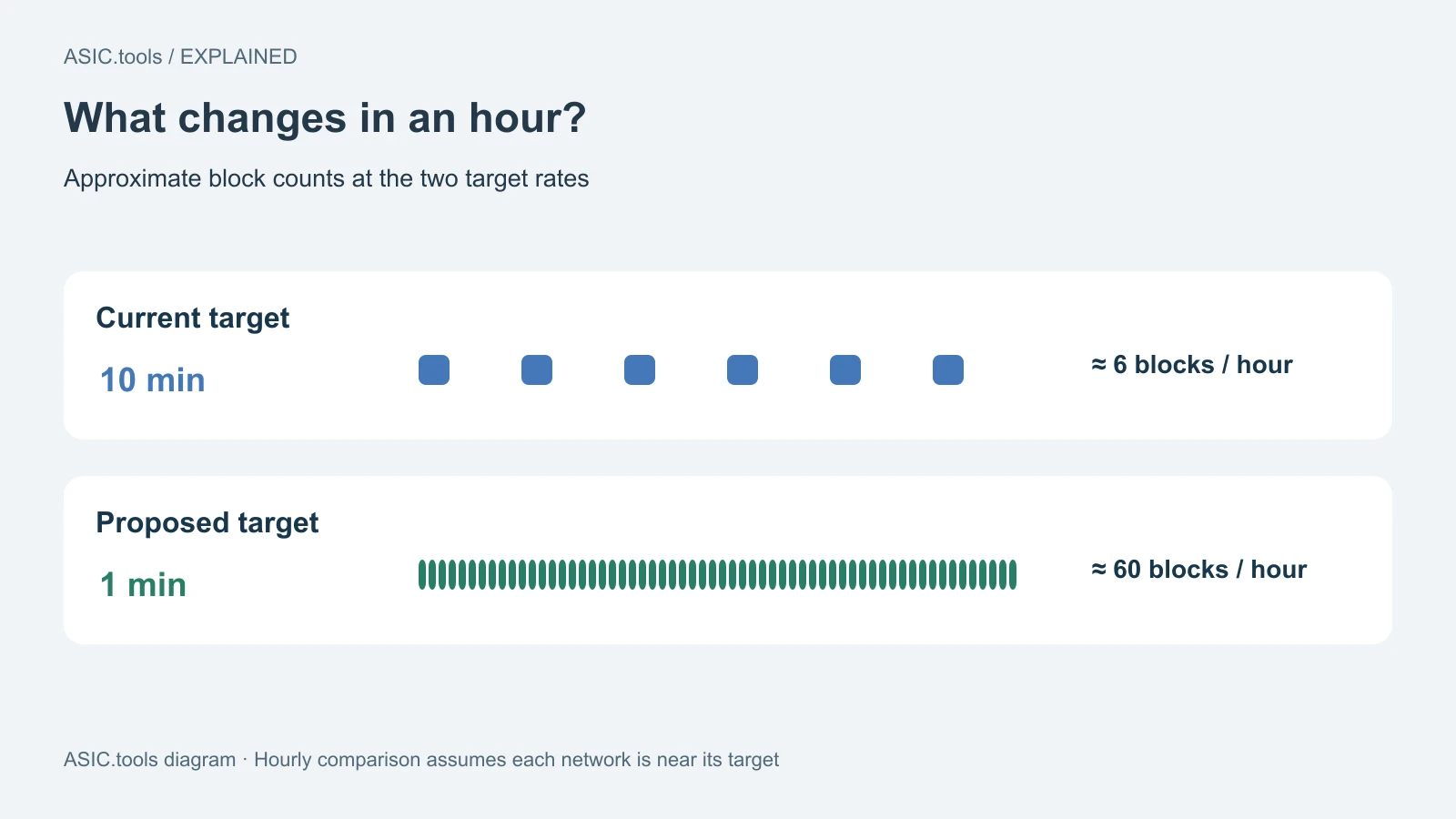
More block opportunities within an hour
A target interval is a long-run average. Mining is a race in which the winning result can arrive early or late, so changing the target does not put each payment on a one-minute timer. At the two targets, the simple hourly comparison is about six blocks versus about sixty, assuming the network stays near its respective targets. Someone making a payment may therefore get the first chance of confirmation sooner. A wallet or an exchange still decides how many confirmations, or how much accumulated work, it wants to see.
The Faster Blocks proposal scales the subsidy and difficulty per block together with the faster cadence. The subsidy is the newly issued portion of a block reward. In a simplified comparison away from a halving, ten blocks each paying about a tenth of the former subsidy add up to roughly the same amount of newly issued BCH as one old block. Fee income depends on the transactions miners collect. A higher block count alone is therefore a poor input for estimating future mining revenue.
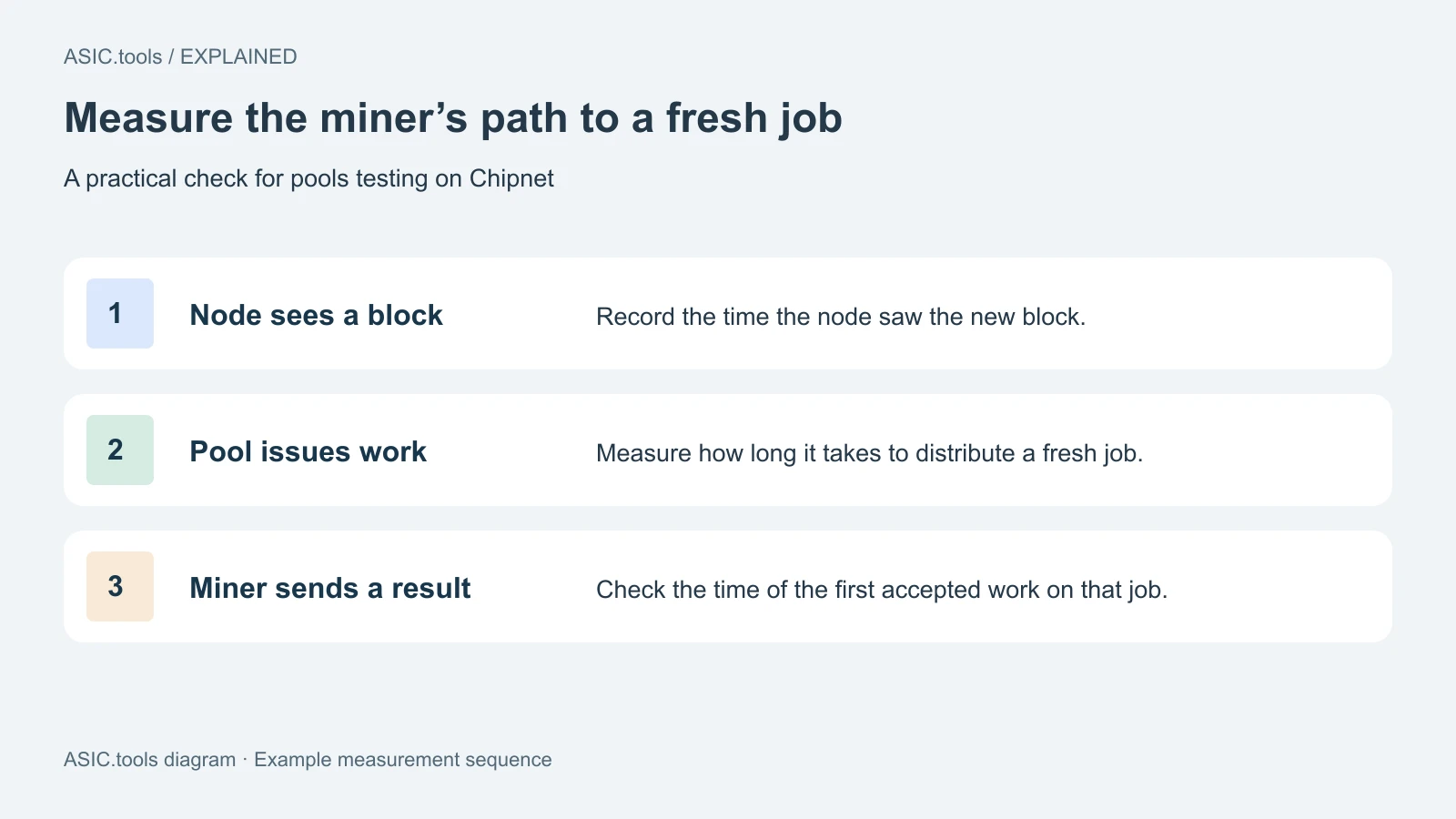
What a pool can measure on Chipnet
A pool will want to measure how quickly its node sees a block, how quickly it builds the next job and how long machines take to start on it. A mining job tells a device what work it should attempt. A short delay occupies a larger share of a one-minute target than it does of a ten-minute target. For a pool, comparing the time between a block arriving and the first accepted work on a fresh job can reveal delays that the ASIC’s own hashrate display will miss.
Shorter intervals may also change how often a small miner sees a successful result, because each block carries less work at the proposed target. Individual outcomes still fluctuate, and pool rewards depend on the payout method. Operators can compare old jobs, late work and pool credit over a representative test period. Those observations tell them more about their setup than a count of blocks alone.
What to watch before May
Mainnet miners can check which node version their pool plans to run and whether it has a public rollout schedule. Wallets, exchanges and explorers should review assumptions based on block counts, since a given count can represent a different span of time and amount of work under the proposal. Watching the official release and test results will help operators set a realistic rollout date.
A miner connected to a hosted pool should ask that pool how it will update the node and distribute jobs. An operator running its own setup can verify the node and pool together on Chipnet before scheduling work on mainnet. This announcement provides a concrete implementation target and somewhere to test it.
Source: Bitcoin Cash Node ↗ · CHIP-2025-03 proposal ↗ · BCHN Chipnet preview code ↗ · Chipnet preview builds ↗
Mining calculator ↗