HashedMax shuts four pools on November 20: save your mining history first
Source checked: 2026-11-17 · Editorial analysis published: 2026-11-17
The operator says it will settle held balances by November 20. The downloadable history will disappear when the Bitcoin, DigiByte, Bitcoin Cash and eCash pool sites go offline.
Four pool connections are about to stop
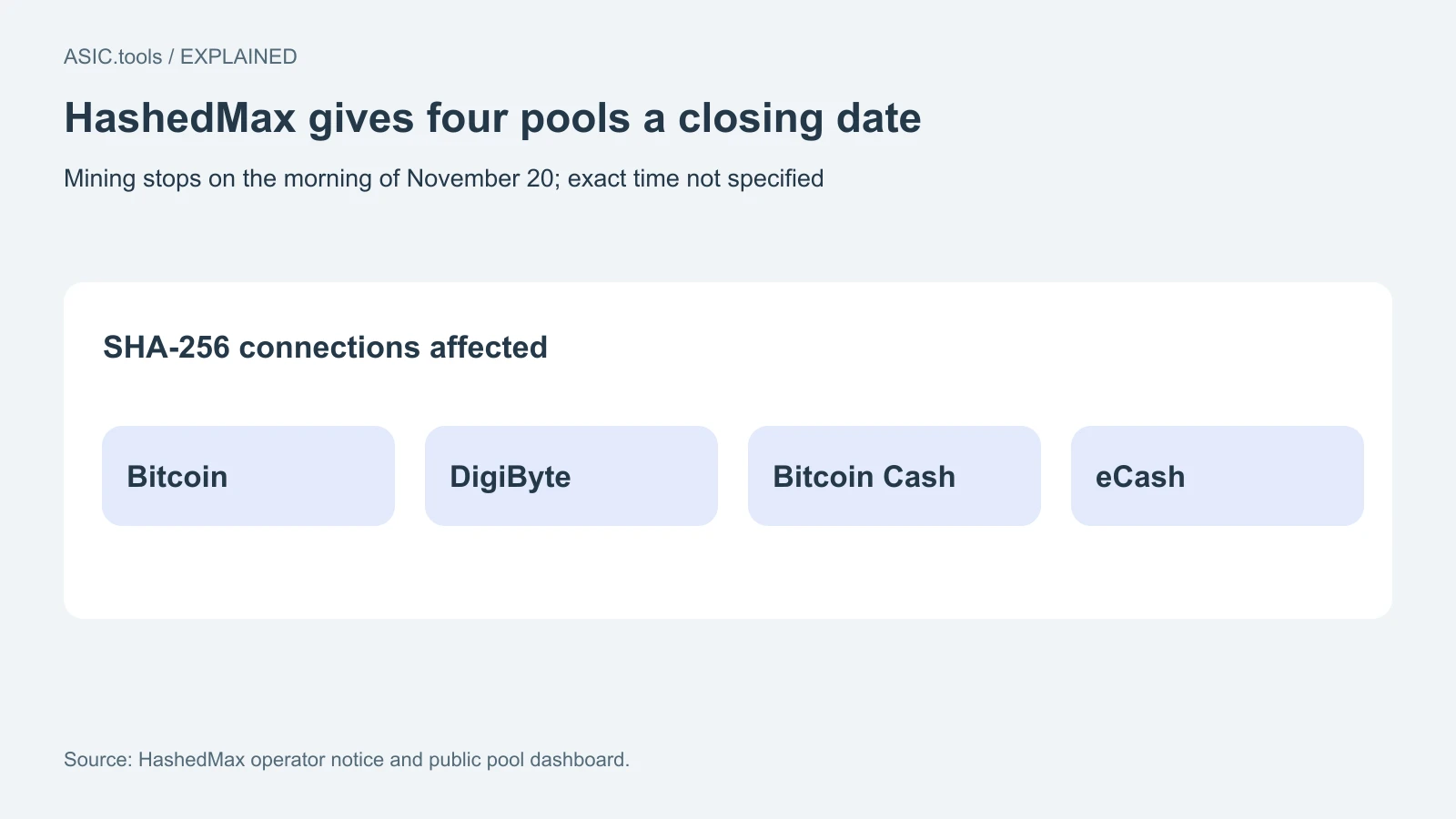
HashedMax says it will end all pool operations on the morning of November 20. Its public dashboard lists four SHA-256 pools: Bitcoin, DigiByte, Bitcoin Cash and eCash. Both the pool a miner normally uses and its backup may be affected. The operator gave no exact hour or time zone. If a machine still points to one of these servers, move it before Friday rather than guessing how long that morning lasts.
The team says the cost of maintaining the privately funded service made it unsustainable. It named HeliosPool as an option that has offered to help its miners. That is a referral to a separate service. Treat it as one option and check the replacement pool’s own list for the exact coin, algorithm and payout method you want. A mining device can often switch services without new hardware, but the connection settings still have to match that service.
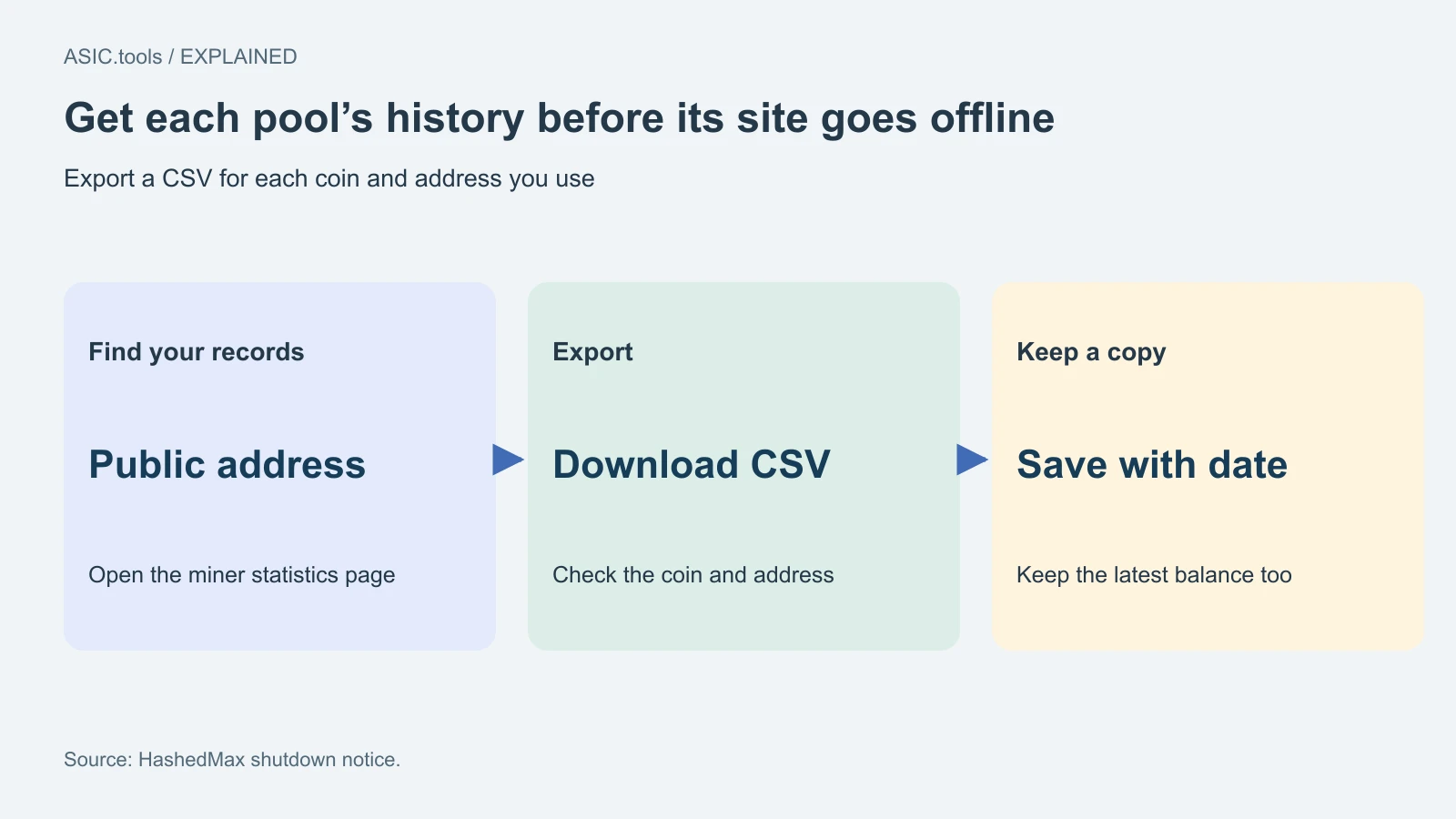
Download the CSV while it is available
The closure notice says the team added a download link to the miner statistics page of each pool. Look up the wallet you used there and save the history as a CSV file, a plain table that opens in spreadsheet software. If you have mined several coins or used multiple receiving addresses, look up each combination that applies. One export does not necessarily cover every record you have with the operator.
Check that the file opens and that the wallet and coin match the dashboard it came from. Keep a copy next to the most recent balance or payout record, labeled with the date. HashedMax warns that the download will not be available after the site goes offline. Even if you move a machine today, it is still worth visiting the old dashboards while they can supply that evidence. Use the public receiving address for this lookup. Your recovery phrase is for restoring the wallet and is never needed for a statistics export. If an export is missing, confirm that you opened the correct coin dashboard and used the address actually configured in the miner before assuming your record is gone.
A final payout is a separate task
The operator says held balances will be sent to the existing wallet addresses on or before November 20. A balance displayed on the pool site is an accounting entry; money you can spend should show up as a transaction in your wallet. Keep the existing receiving address accessible and compare the amount in the relevant coin. Save any transaction ID so you can look it up later.
Do not read the offered help from HeliosPool as a transfer of funds. The announced settlement comes from HashedMax to the wallet. The new pool begins keeping its own record of the work you send it. If a final transfer does not match the old record, the saved CSV and the wallet transaction history give you something more useful than a screenshot of a hashrate dial.
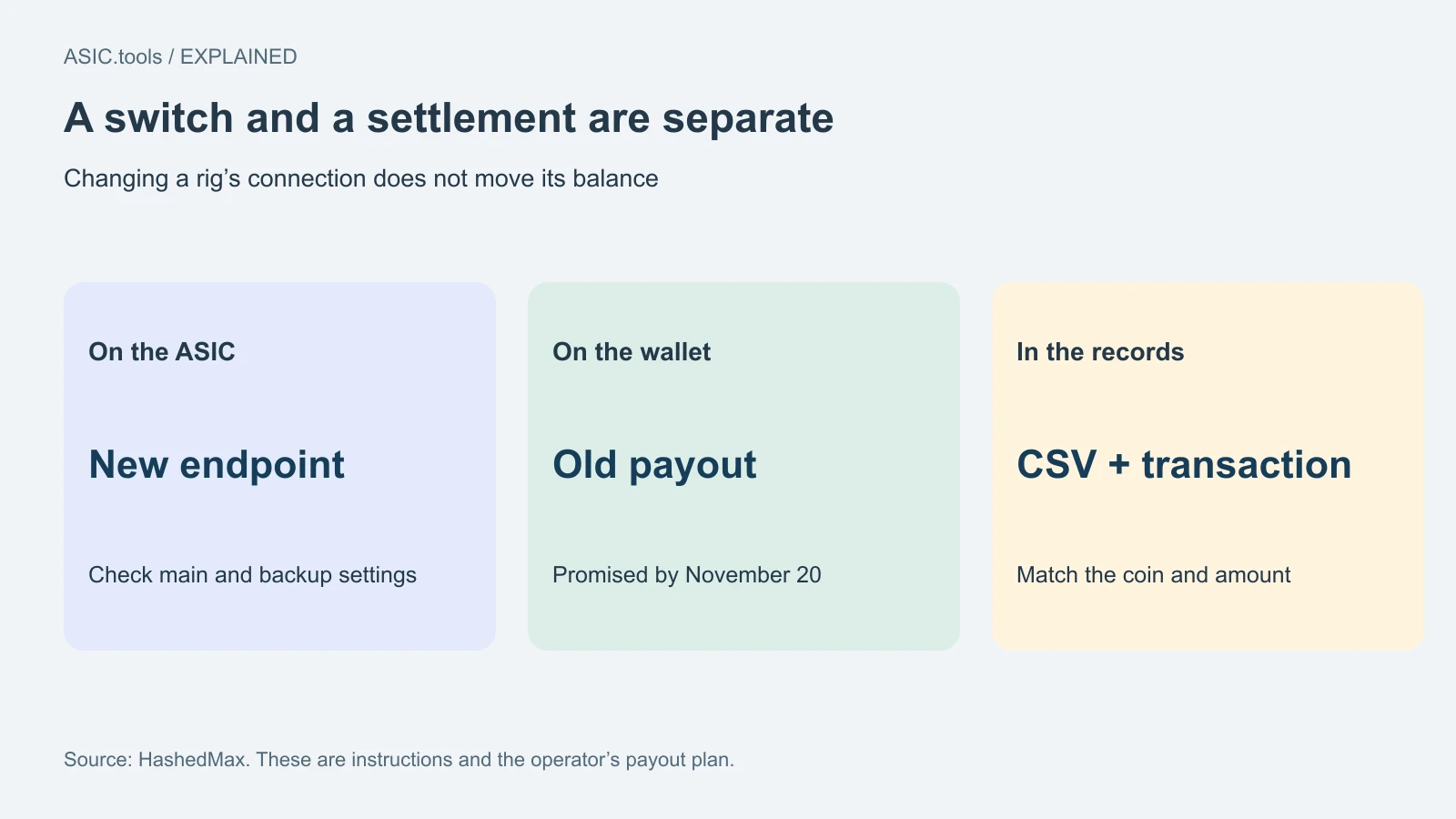
Check the main and backup connections
Open the pool settings for the machine, including the backup slots. A European server and a US server may both belong to HashedMax even if their addresses look different. Replacing just the first connection can leave a device pointed to another closing server the next time its main connection fails. Copy the replacement connection details from the pool’s own instructions and confirm that the wallet field is valid for the selected network.
Watch for accepted shares, the pieces of work a pool has checked and credited. A miner’s display can show that the chip is working before the new pool shows the correct worker or credits the right address. Give the dashboard time to register a low-powered machine, but check whether the miner is repeatedly reconnecting or sending rejected work. Those clues tell you more than the fan sound alone.
Keep useful records on both sides
Save the switch time so you know which pool should account for the work on either side of it. If you have several rigs, try the new settings on one first. Check the pool records before copying the configuration to the rest, and check again after the first eligible payout. When you compare pool terms, look at fees, payout thresholds and expected payout frequency together.
A final payment can arrive after your machines have already moved. The two things need not happen together. Keep the old CSV, the new settings and the eventual wallet transaction in separate records. A change of pool is easier to verify when the trail tells you both where the previous work was credited and when the new pool first began receiving it.
Source: HashedMax ↗ · HashedMax — four pool dashboards ↗ · HeliosPool — supported coins and connection options ↗
Mining calculator ↗