FutureBit Solo-tagged block earns 3.15418892 BTC; the winning device is unknown
Source report: 2026-10-26 · Editorial analysis published: 2026-10-27
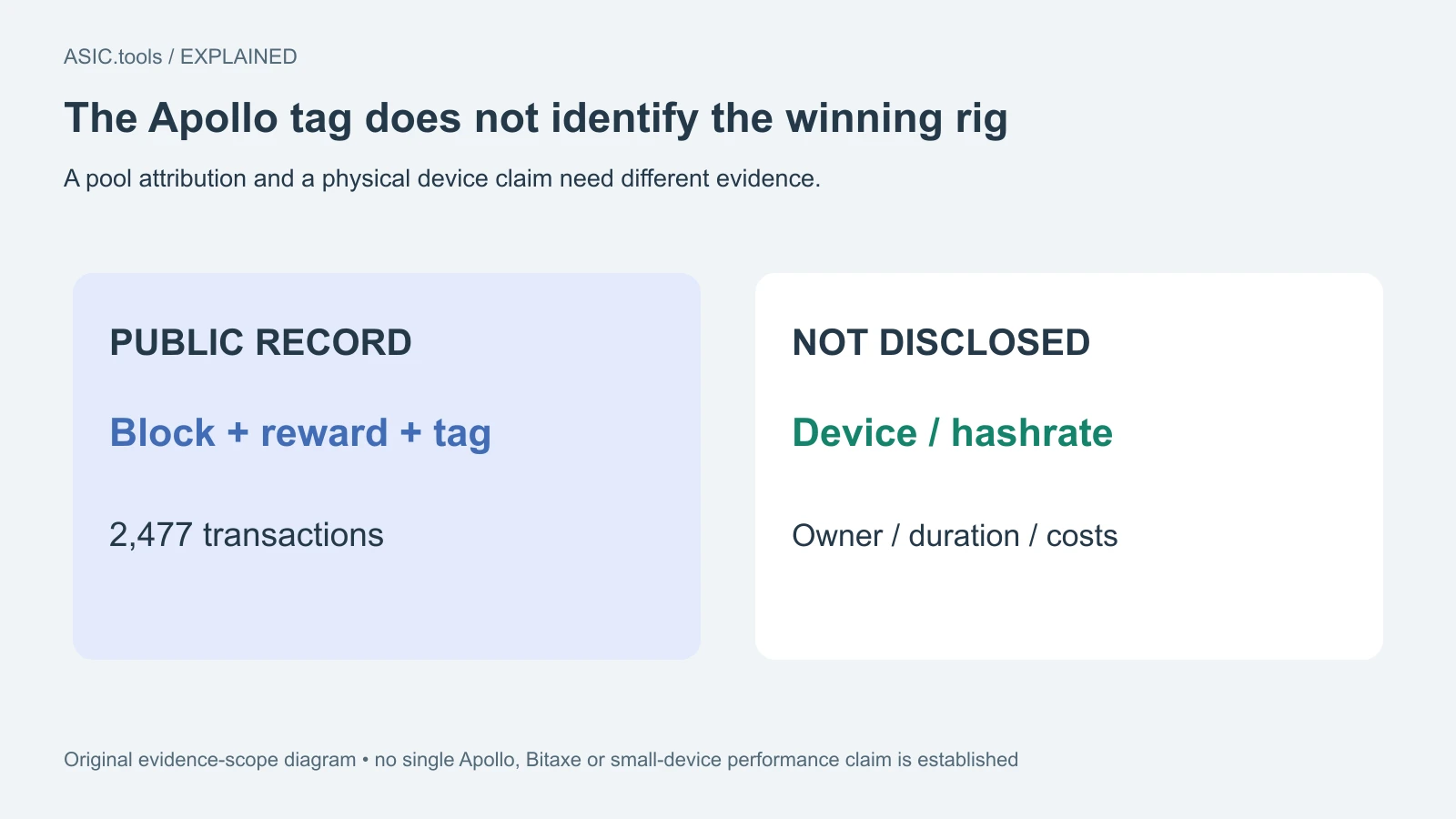
Block 973262 carries a FutureBit-Solo Apollo tag and an on-chain reward of 3.15418892 BTC. Two explorers agree on the block, but neither the device nor its hashrate can be read from that result.
A real block, with a limited identity claim
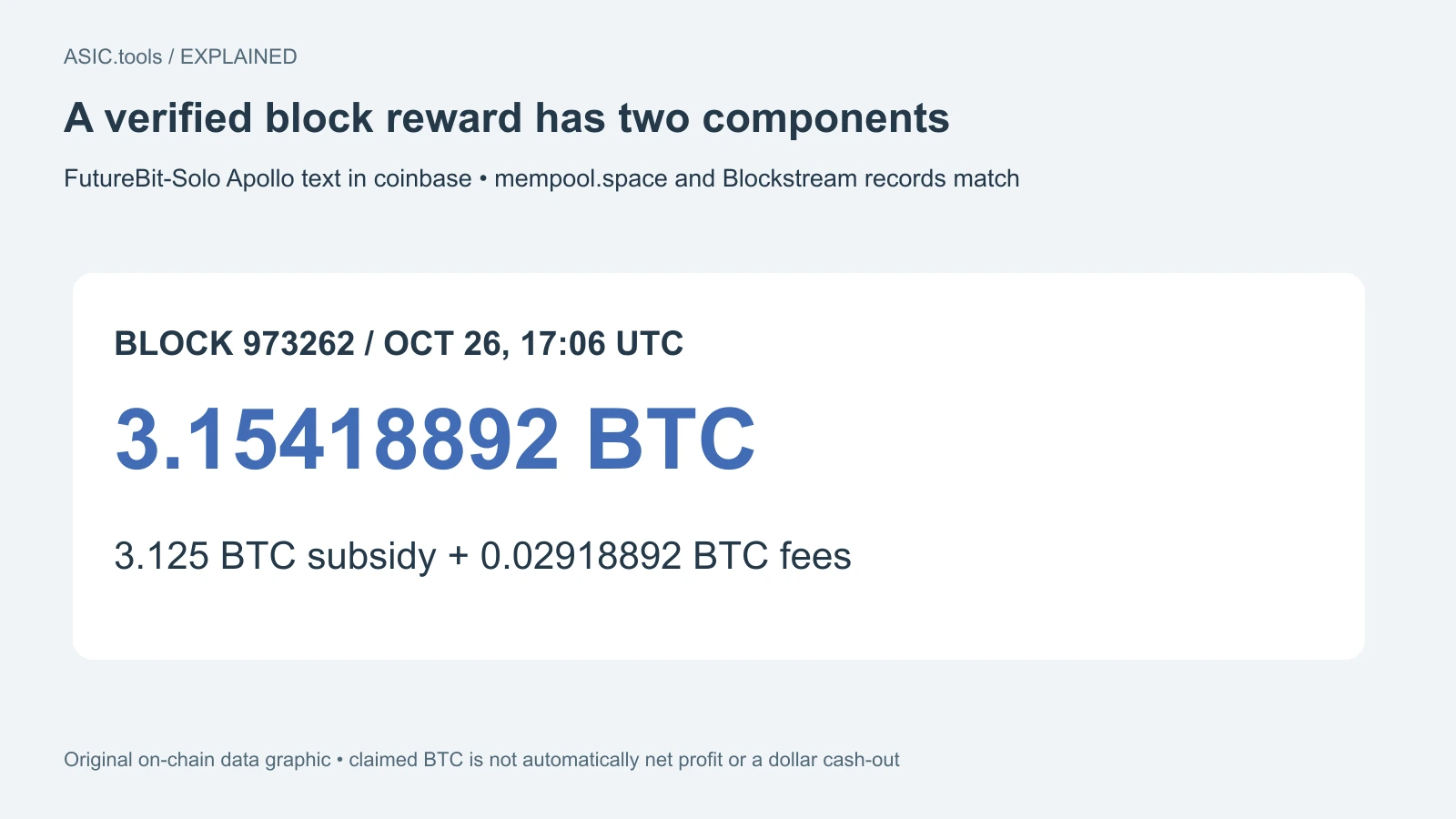
Bitcoin block 973262, timestamped October 26 at 17:06 UTC, contains the text FutureBit-Solo Apollo Run by Wilson in its coinbase transaction. Its reward transaction pays 3.15418892 BTC to one spendable output. This is a new confirmed mining result, not an estimate from a profitability calculator.
We compared the block record returned by mempool.space with Blockstream’s independent explorer. They agree on its hash, height, timestamp, 2,477 transactions, difficulty and other header data. We also checked the reward transaction separately through both services. Those records provide a firmer basis than a screenshot showing a dollar prize.
The coinbase is the special first transaction by which a miner claims the permitted reward; it is unrelated to the exchange of the same name. Miners can put identifying text in it. The Apollo wording supports a careful description as a FutureBit Solo-tagged block. It does not reveal the owner’s identity, the number of machines or the exact model that supplied the work.
The reward has two parts
At this height, the Bitcoin block subsidy is 3.125 BTC. Subtracting it from the claimed 3.15418892 BTC leaves 0.02918892 BTC in transaction fees. In the blockchain’s smaller unit, one bitcoin is 100 million satoshis: the reward output is 315,418,892 satoshis and the fee portion is 2,918,892.
Fees are what users of the included transactions contribute; the subsidy is newly issued bitcoin under the protocol’s schedule. The result is therefore neither a flat 3.125 BTC nor a second subsidy on top. For this block, the fees add a relatively small amount to the scheduled reward, and the exact total can be read without guessing an exchange rate.
The amount claimed on-chain is not automatically the owner’s net profit. Electricity, equipment and operating costs are outside the reward transaction, and the block does not document any service agreement. We have not asserted a zero service fee, a cash withdrawal, a sale price or a private split that the public records do not establish.
One success does not disclose the odds
Solo mining leaves the reward concentrated in a successful find rather than paying a steady share of many other participants’ blocks. That is why a genuine win can be large while the time between payments is very uneven. The Bitcoin developer guide describes this as higher variance: larger individual payments with longer gaps.
Neither explorer gives the winning machine’s hashrate for this event. A pool name containing Apollo is not enough to conclude that one small Apollo or a Bitaxe found it. The same public block data cannot tell us how many unsuccessful devices were trying, how long this owner had mined, or the operator’s total electricity bill.
Without the relevant hashrate and time spent mining, a personal success probability cannot be calculated from this result. The winning nonce is a field in one successful block header, not a counter of all attempts the owner made. Hardware changes other header data while searching, so the nonce’s position is not a measure of how much work or luck the miner used.
How to read the next solo-mining headline
The first check is a real block hash and height. Then read its coinbase text, reward output and transaction fees in an explorer. A second explorer helps catch transcription errors. That verifies the recorded event; separate evidence is still needed for a claim about the exact device, who operated it or how it was configured.
For a home miner, payout mode should be a deliberate choice. A shared pool can spread rewards across accepted contributions under its payment rules; a solo arrangement can leave a machine working without a block payment for a very long time. An accepted share shown on a dashboard is proof of lower-difficulty work submitted to a service, not itself a Bitcoin block.
The personal decision still depends on whether the owner can accept that pattern of receipts while paying electricity. A large prize in a headline does not change a device’s measured power or guarantee another win. This block is worth reporting because it happened, with its unknown hardware kept unknown, rather than because it proves an inexpensive machine will pay for itself.
The reward has a maturity rule too
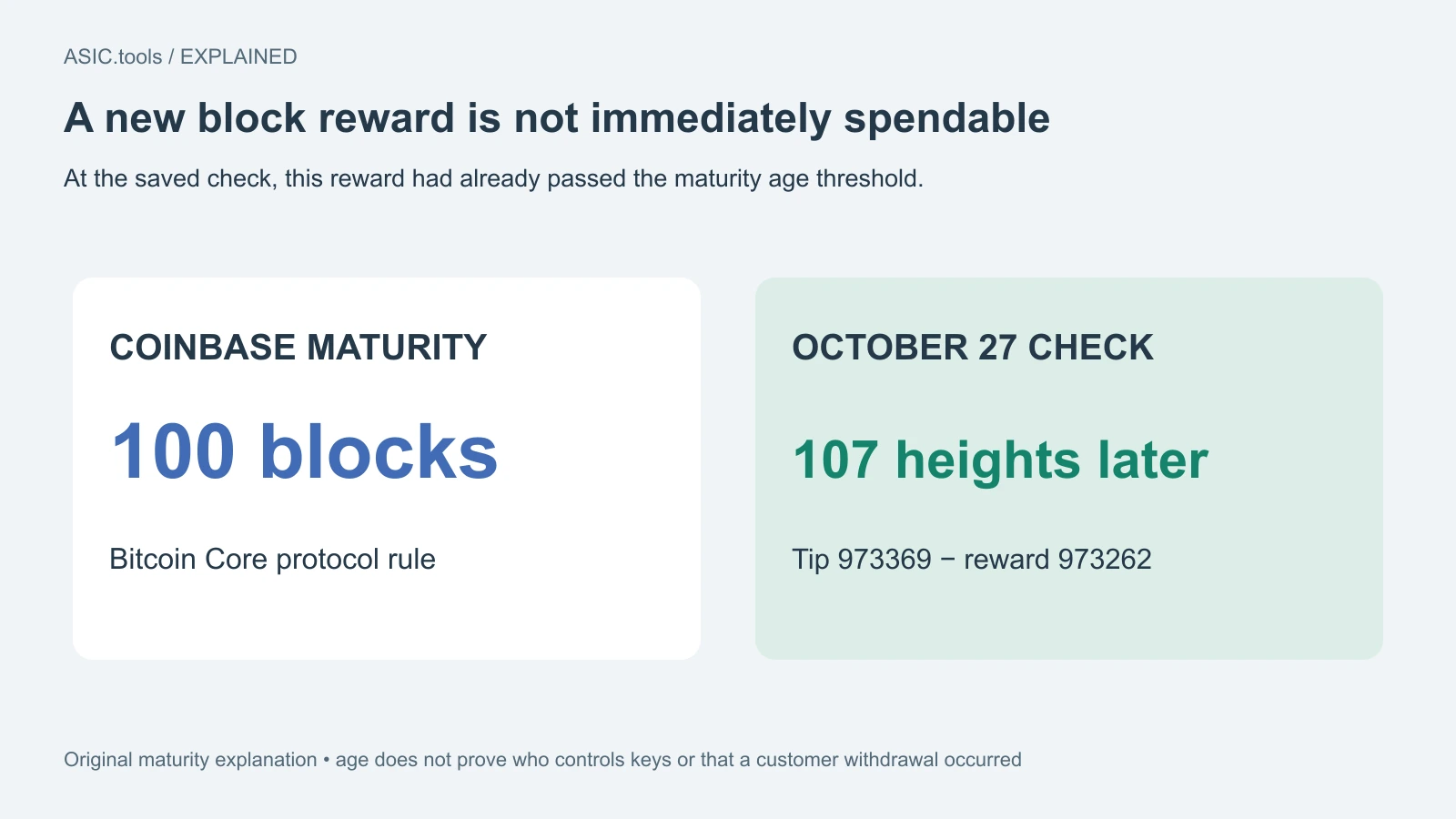
Bitcoin Core sets coinbase maturity at 100 blocks. That means a newly created block reward cannot be spent immediately as an ordinary transaction; enough later blocks must first extend the chain. It is a protocol rule about a coinbase output, separate from any pool withdrawal threshold or account-credit schedule.
Our October 27 check of the public chain tip returned height 973369, which is 107 heights beyond 973262. The block had therefore passed that age threshold by the observation. This does not identify who has the keys or prove a customer withdrawal took place. The reward transaction has one value-bearing output and a zero-value commitment output; only the former carries the stated BTC.
The header records October 26 at 17:06 UTC and the two explorers agree on 2,477 included transactions and approximately 140.58 trillion difficulty. Those details establish a checkable event. The useful lesson for a home miner is the full sequence: accepted block, recorded reward, maturity, and whatever personal or service arrangement governs access to the coins. A celebrated find is one stage in that sequence, not a recurring wage.
Source: Bitcoin blockchain / mempool.space ↗ · Independent Blockstream block record ↗ · Reward transaction ↗ · Bitcoin developer guide: solo and pooled mining ↗ · Bitcoin Core coinbase maturity rule ↗
Mining calculator ↗