ERCOT puts Texas large-load power cuts on its November 6 agenda
Source report: 2026-11-06 · Editorial analysis published: 2026-11-06
Texas grid operators are scheduled to discuss which large sites would register, how they would reduce grid demand and how those actions could enter power prices.
The November 6 agenda
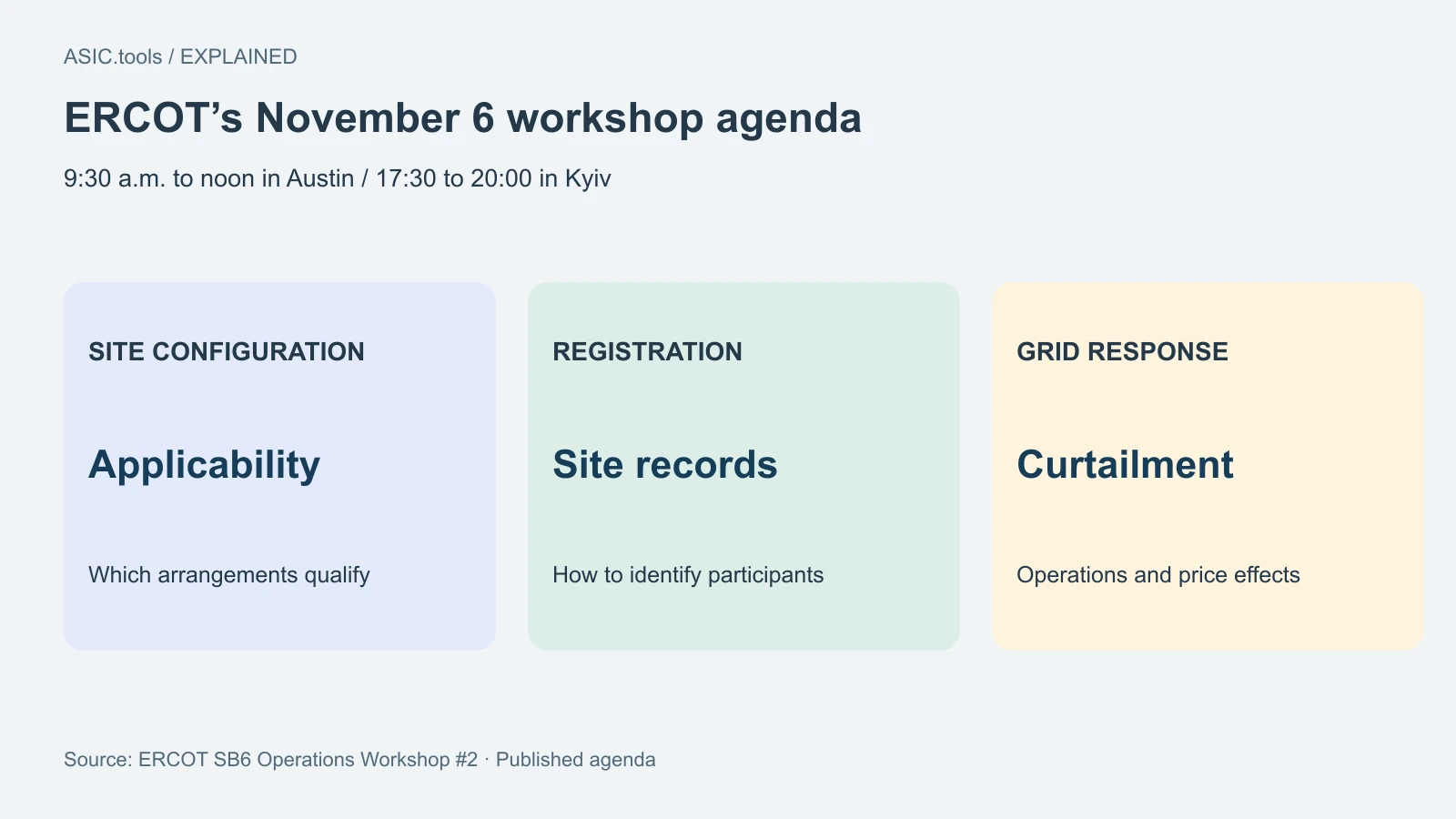
ERCOT, the operator of most of the Texas power grid, scheduled a November 6 workshop on how some large electricity users would reduce their demand during a grid emergency. The program covers which site configurations are affected, how to register them and how a reduction would be carried out. For a Bitcoin mining site, the details matter because drawing less power from the grid can mean switching to an on-site supply or pausing some machines.
The workshop is listed for 9:30 a.m. to noon in Austin, or 17:30 to 20:00 in Kyiv. It is the second operations workshop on these provisions of Senate Bill 6, following the first on October 6. The published agenda also sets aside time for possible effects on wholesale pricing, discussion and next steps. The program describes the topics for discussion.
ERCOT's September notice described a proposed system to manage large-load reductions. Registration is how the grid operator and the utilities would know which facilities can act, under which provision and how to reach them. For a facility operator, that connects a general obligation to a set of actions that staff can carry out when the grid is under stress.
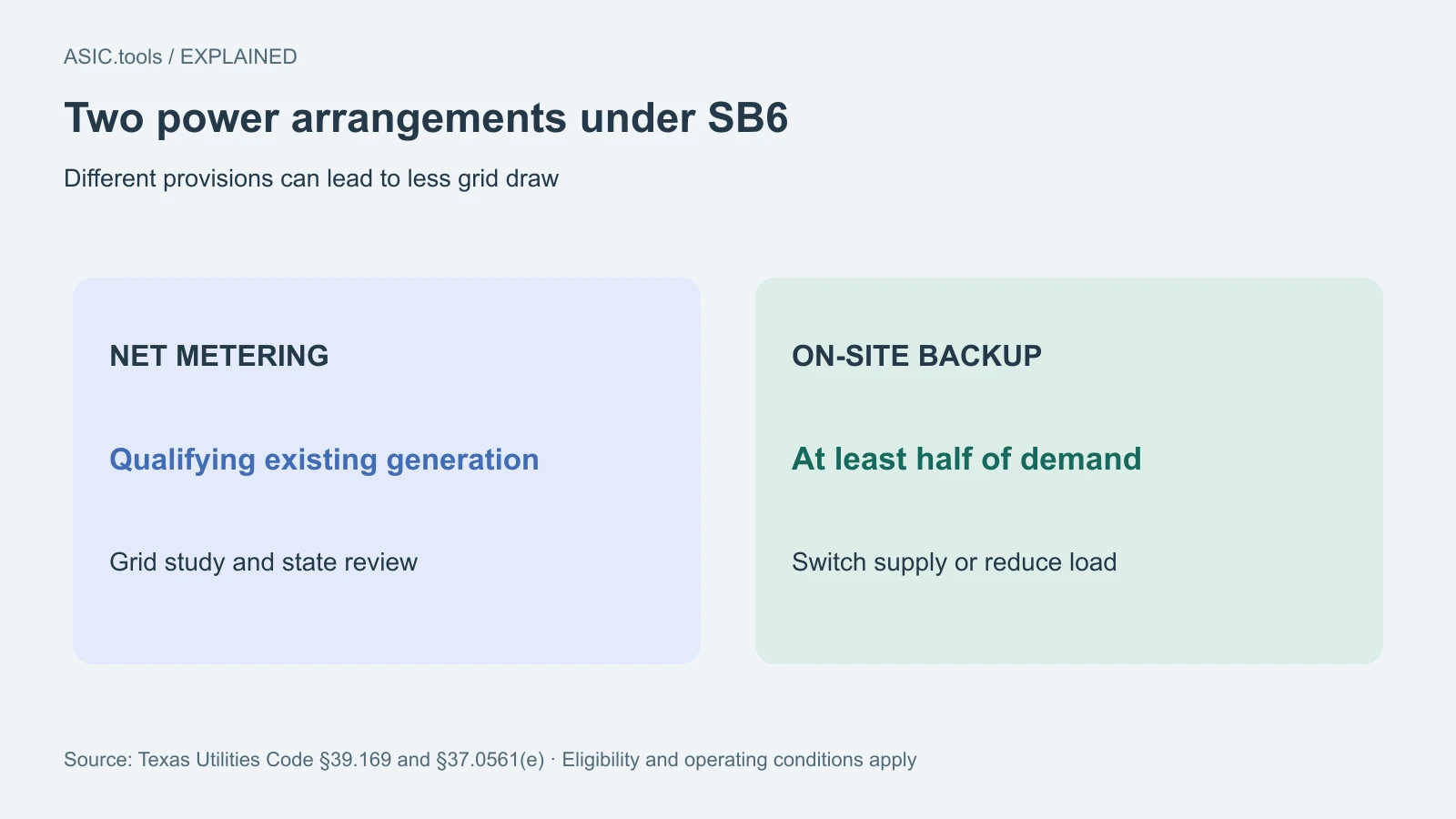
Two site arrangements are in focus
One involves a new large customer operating beside qualifying existing generation with net metering. In this arrangement, some power can go directly to the site behind its grid connection. Texas law calls for a grid-impact study and a decision by the state's utility commission for covered projects. The commission has adopted a rule for that review. An approval can include conditions for the site to cut demand at certain times so the generator can make power available to the grid.
The rule uses the generator’s registration on September 1, 2025, to identify covered existing resources, and there are exemptions. For example, an existing resource may already have had the co-located customer included when it was first energized. For a proposal that goes through review, ERCOT has 120 days from receipt of all required information to finish the study. The commission then has 60 days from receiving the result to make its decision. The November agenda focuses on running the procedures when a reduction is called for.
The other arrangement involves covered customers with on-site backup generation that can supply at least half their demand and cannot export to ERCOT's transmission grid. The statute sets conditions for ordering a response, including prior use of available market services apart from frequency-responsive services. Under those conditions the site can be directed through its utility to deploy the backup or cut load. The law retains existing environmental requirements for operating generators.
The two arrangements can lead to similar readings at the grid meter. At one site the generator may have to make power available to other users, so equipment on the premises may have to slow down or stop. At another site, permitted backup generation may replace part of the electricity usually bought from the grid. Whether the miners stay online depends on the site's wiring, equipment and operating instructions.
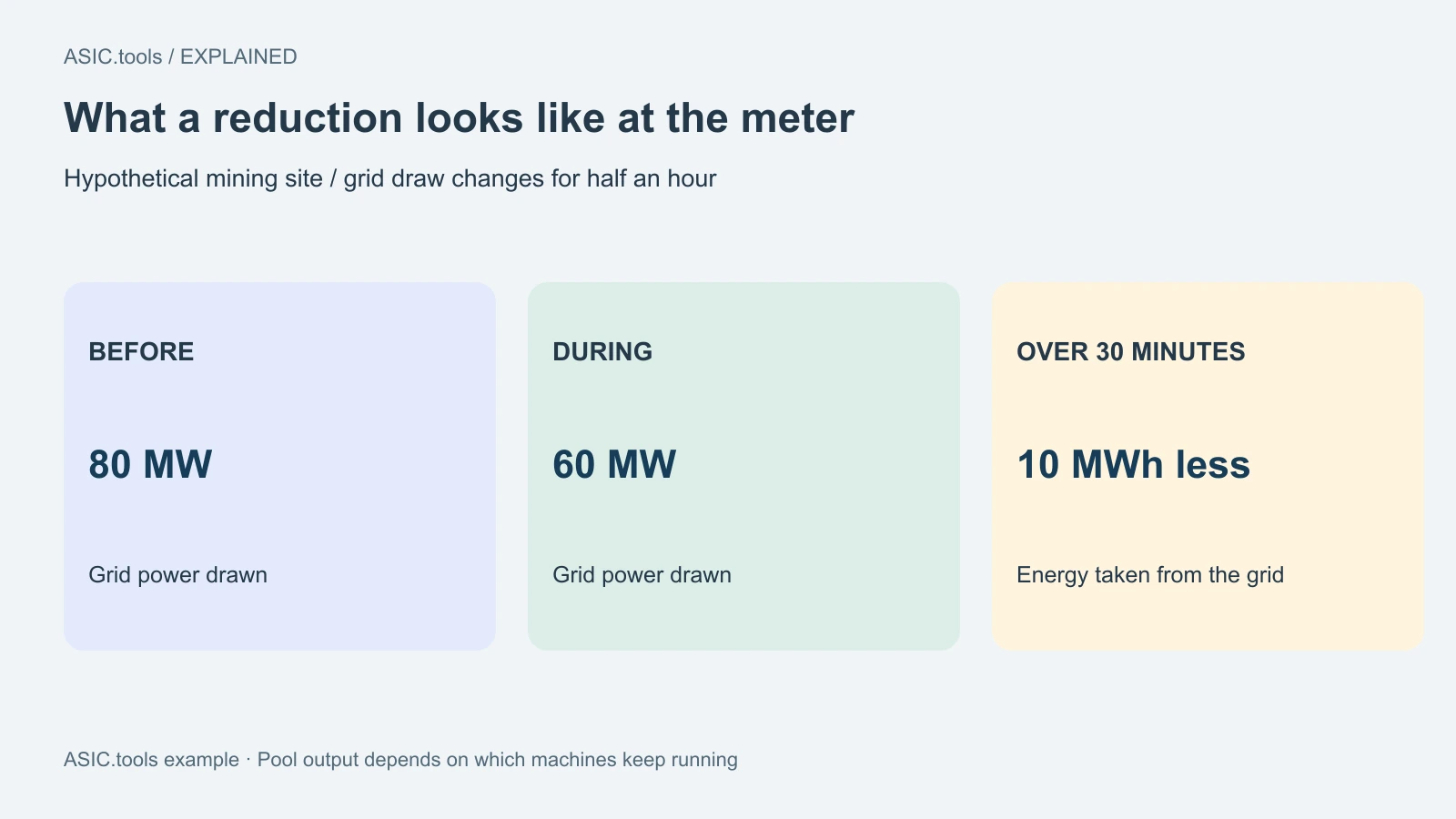
What the meter and the mining pool see
Consider a hypothetical site that reduces grid draw from 80 to 60 megawatts for half an hour. That is 10 megawatt-hours less drawn from the grid over the interval. It is an energy quantity, calculated by multiplying the 20-megawatt change by the half-hour. If the site stops ASICs to achieve it, those machines submit less work to the pool. If permitted backup generation covers part of the draw, some of the same machines could keep running.
Wholesale price effects are on the workshop agenda because the way a reliability action is counted can affect market calculations. The legislation expressly classifies deployments under the backup-generation provision as firm load shed for reliability price adjustments. The event's published program gives no new rate for a particular site. Retail and hosting bills follow their own contracts and metering.
A separate section of Senate Bill 6 calls for a reliability service that competitively buys demand reductions from eligible sites of at least 75 MW. It specifies at least 24 hours' notice for that service. A site owner checking a notice should identify the program and provision first. The different routes into a grid reduction have different triggers and conditions.
What a hosting customer can check
A hosting customer can ask whether the operator expects the site's configuration to be covered, how it would notify customers, and how it records the hours a machine has no work. If a site can switch supplies, the customer may also want to know how it will identify hours served by backup and how those hours appear on the energy bill. Answers depend on the site and the hosting agreement.
The same distinction helps after an event. Compare the meter interval with the miner's running time and the work accepted by the pool. Those records can separate a grid reduction with machines still running from one that reduced mining time. If any contract credits or reliability payments apply, check who receives them and which hours they cover. The operating discussion matters to customers through those everyday records.
Keep notices, changes in the source of power, operating logs and pool data with their timestamps. If a power notice and a change in pool output happen on the same day, match the hours and the affected machines before checking how the contract bills them.
Source: ERCOT / Texas Legislature ↗ · ERCOT workshop calendar ↗ · Texas Senate Bill 6, enrolled text ↗ · ERCOT notice on the proposed operations framework ↗ · Texas Register, adopted §25.205 ↗
Mining calculator ↗