DTEK says a thermal power plant stopped generating after the November 25 attack
Source report: 2026-11-25 · Editorial analysis published: 2026-11-25
DTEK reported serious equipment damage and no casualties. Ukrenergo’s morning report separately described outages in five regions and restrictions through the end of the day.
A power plant goes offline
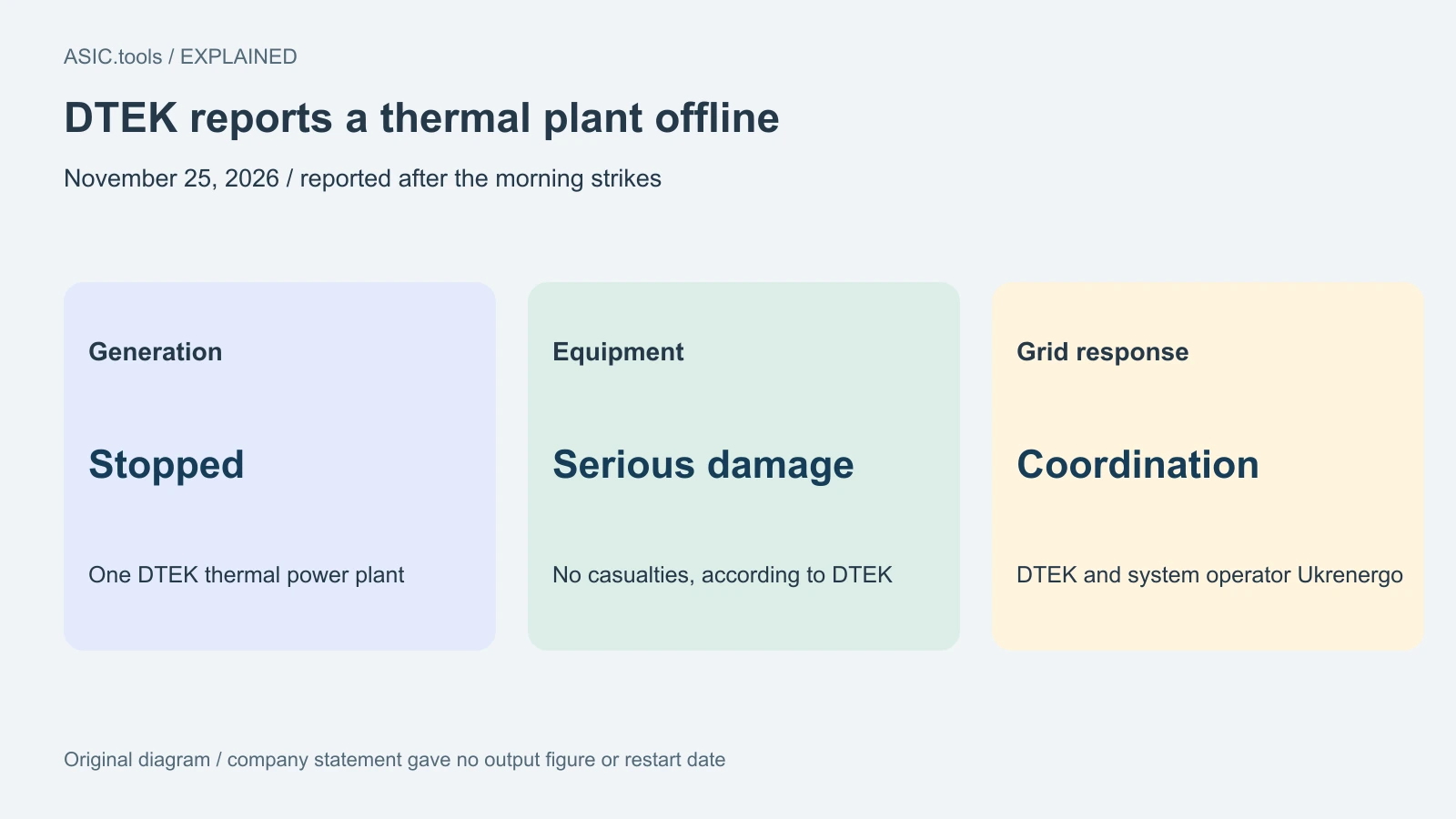
DTEK said a thermal power plant stopped generating electricity on the morning of November 25 after several waves of Russian strikes. The company reported serious damage to its equipment and no casualties. DTEK is coordinating with the national system operator Ukrenergo. The announcement gives no figure for lost output or timetable for restarting the station. The company did not disclose the location.
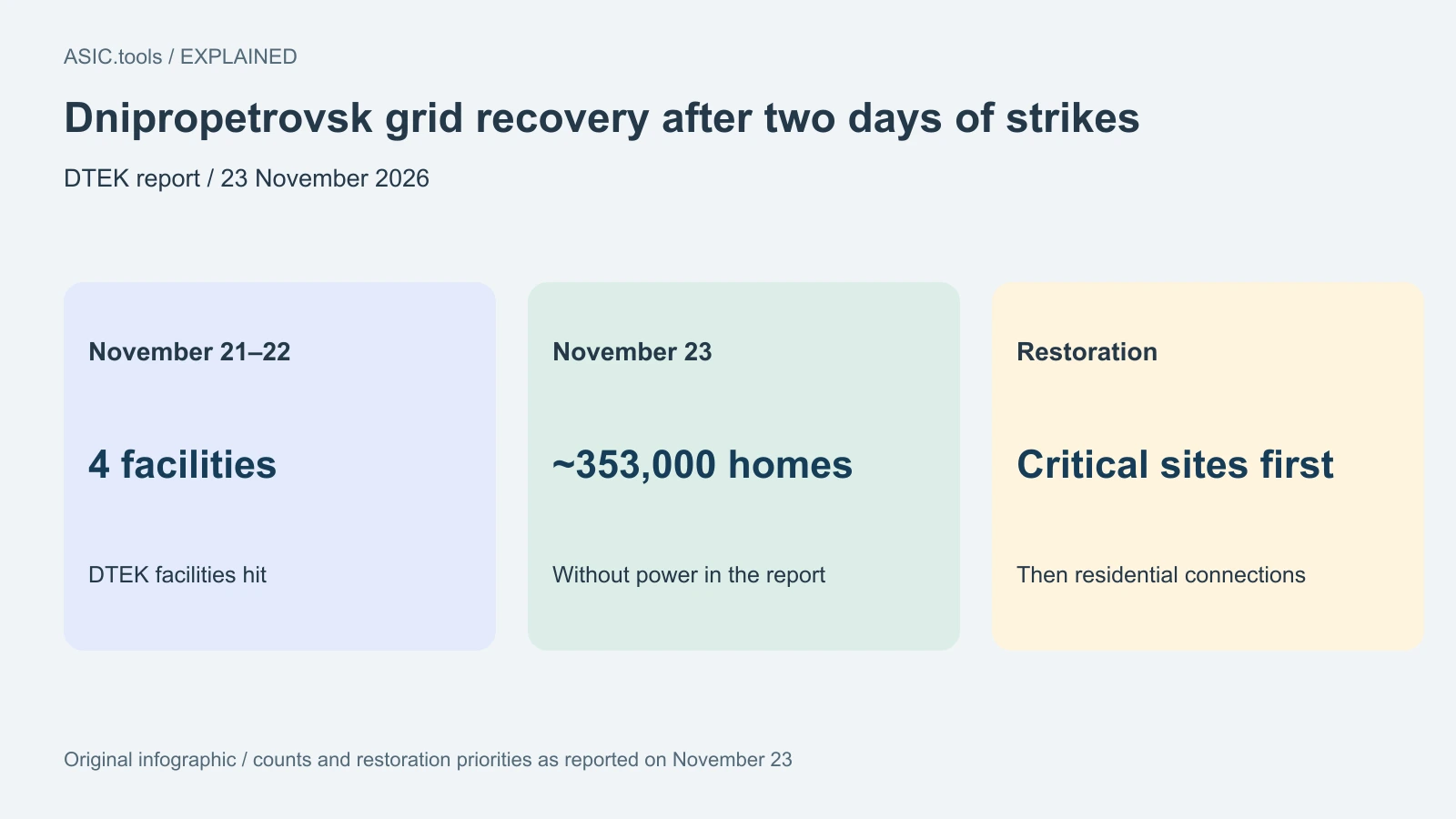
This is the third major November attack on the company’s power plants, according to DTEK. It described a strike on a plant the preceding week and said the November 3 attack halted output at three plants. Those are separate events in the company’s timeline. Its November 23 account of damaged distribution facilities in Dnipropetrovsk Oblast covered an earlier regional event.
The operator’s report says repairs continue and offers separate evidence on local supply. Updates about power returning in part of a city help explain the direction of recovery. A station’s start date remains a separate question. Readers can use the latest notices about their area to plan equipment operation without needing to identify the generating station involved.
Generation is the production of electricity that goes into the grid. Distribution is the delivery network closer to the meter. When generation goes offline, the system has less supply to draw on. Local damage can also interrupt a particular connection while other power is available elsewhere. These two issues matter when reading overlapping notices about a station, the grid and a household or business address.
The morning grid update
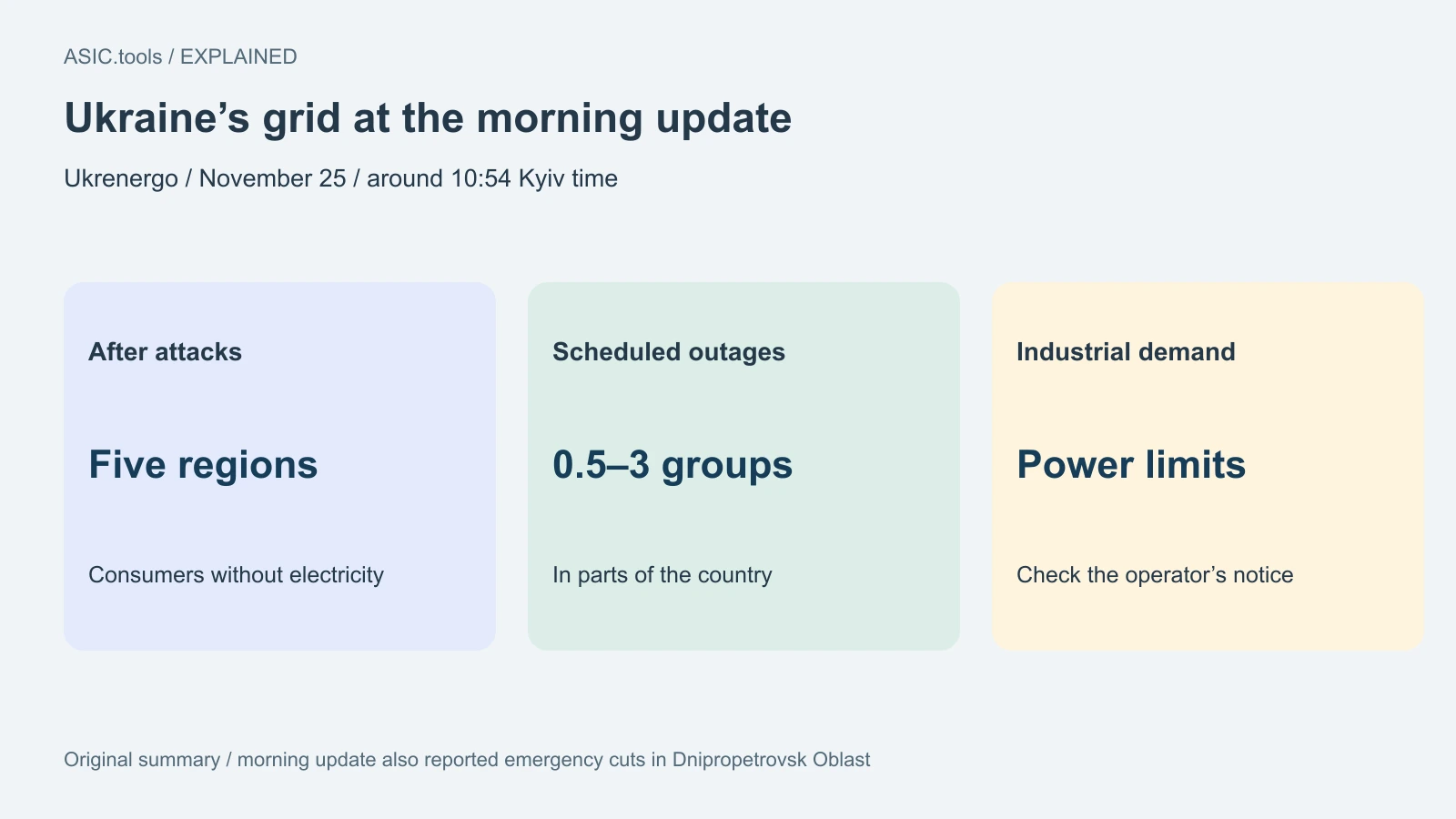
Ukrenergo’s morning update reported consumers without power in Dnipropetrovsk, Donetsk, Zaporizhzhia, Odesa and Kharkiv oblasts after Russian attacks. It reported a particularly difficult situation in Dnipropetrovsk and Zaporizhzhia oblasts, partial recovery in the city of Zaporizhzhia and emergency cuts in Dnipropetrovsk Oblast at the time of the notice. This is a report on the overall grid, alongside DTEK’s account of the power plant.
The system operator said parts of the country would face restrictions through the end of the day. It gave a range of 0.5 to 3 groups for scheduled rolling outages affecting all consumer categories and separate power limits for industry. A group helps the operator identify which consumers to disconnect at a given time. The range describes the scale of the schedule for the system, with the local distribution operator giving the address-level timing.
The previous evening’s Ukrenergo notice had already scheduled the same 0.5–3 group range for November 25. The morning entry, issued at about 10:54 Kyiv time, adds the reported outages across five oblasts and the state of recovery in Zaporizhzhia. This sequence shows how a plan issued the evening before can coexist with new emergency measures at a local level. Read both the date the plan applies to and the time the situation report was issued.
DTEK Dnipro Grids separately reported emergency cuts in Dnipro and several districts, as well as some critical infrastructure without power. If an address is under emergency cuts, a planned timetable for its outage group can become unreliable. Check the local operator’s notice and its timestamp before using a scheduled time to plan around an outage. A general press release about damaged equipment cannot tell whether a particular socket has power at a particular hour.
What a site can plan and measure
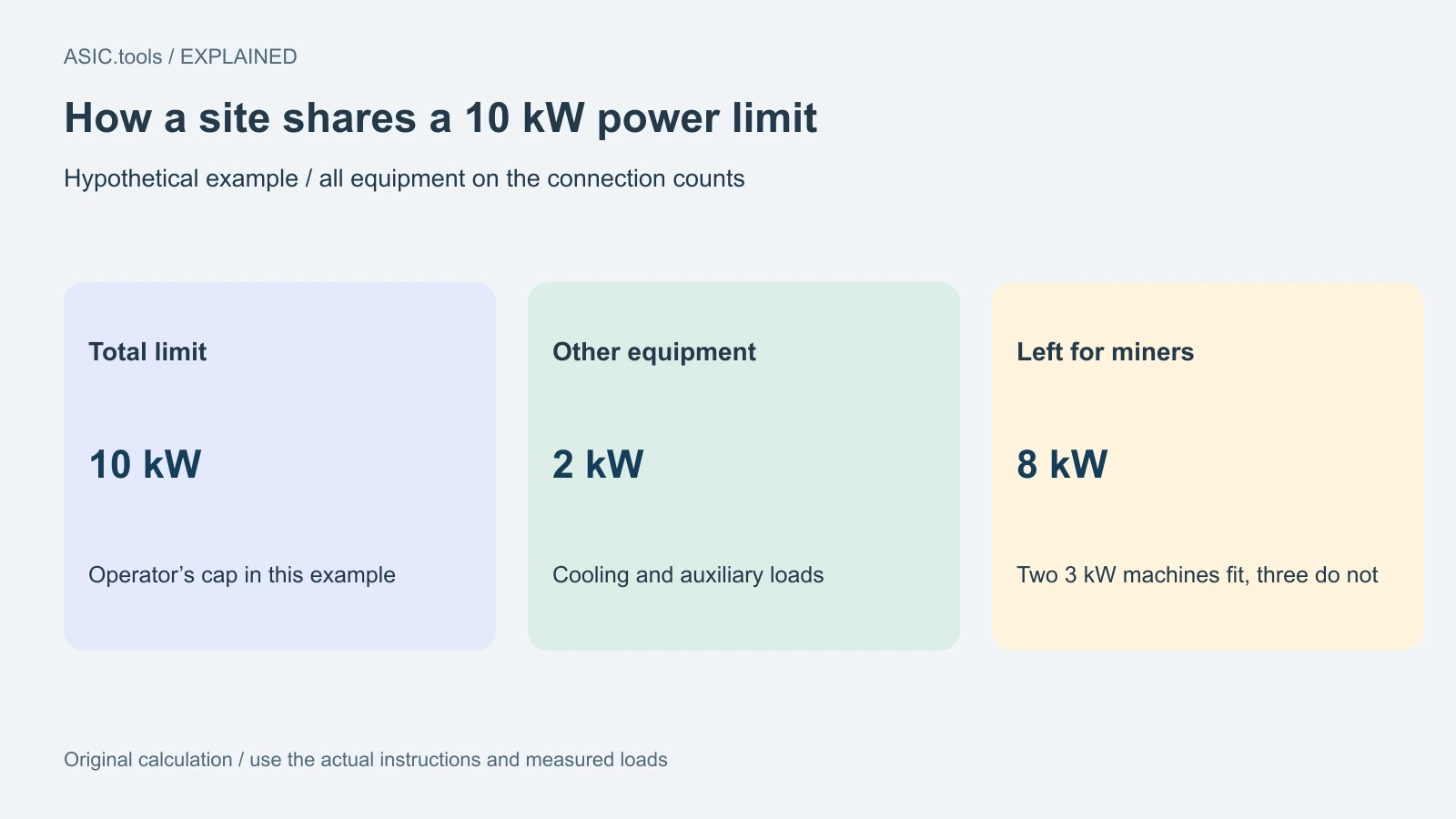
For a site subject to a power cap, the limit covers its total permitted draw. The miners share that allowance with cooling, network equipment and any other load on the same connection. For example, under a hypothetical 10 kW limit, if other equipment takes 2 kW, 8 kW remains. Two machines drawing 3 kW each would use 6 kW. A third at the same load would take the total above the limit. Use the operator’s actual instructions and measured load for a real site.
For a home setup the practical question is when it can resume useful work. The electricity can come back before a router and miner have both connected and the pool has accepted a result. Record the times separately. If outages repeat, the pool’s view of accepted work and the meter over the same period show how much operating time there really was.
In the same hypothetical example, a 3 kW miner running for two hours uses 6 kWh. The first number describes equipment drawing power at a given moment. The second belongs on the electricity record for a particular period. If the power cap changes, update the simultaneous-load calculation. If the available time changes, update the electricity and work totals for the affected hours.
A power ceiling and an outage schedule describe different conditions. One limits how much electricity can be used at once. The other limits when electricity is available at the connection. Planning for the first means checking the total simultaneous load. Planning for the second means checking the current address notice and counting hours actually available, with power restoration and mining recovery recorded separately.
Source: DTEK ↗ · DTEK Energy statement in Ukrainian ↗ · Ukrenergo November 25 system update ↗ · Ukrenergo November 24 notice for November 25 ↗ · DTEK Dnipro Grids emergency restriction notice ↗
Mining calculator ↗