EMCD brings pool earnings and worker status into Tether MDK
Source report: 2026-10-29 · Editorial analysis published: 2026-11-01
EMCD announced an open-source Pool Worker with no additional integration fee. The practical change is a shared view of pool and hardware data, while MDK remains under development.
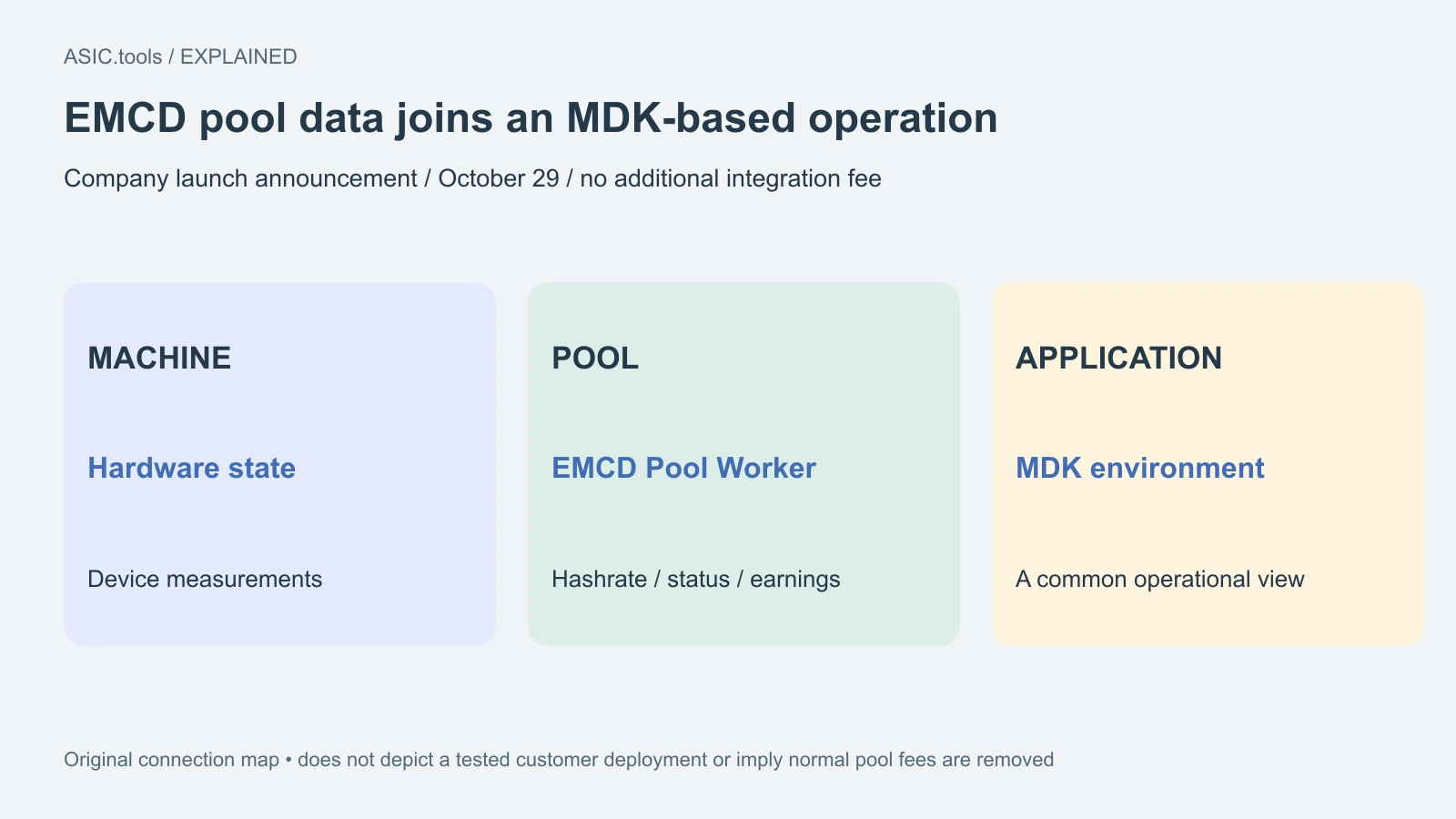
Pool statistics join the hardware view
EMCD announced its Pool Worker for Tether's Mining Development Kit, or MDK, in an October 29 company release distributed through FinanceWire. It connects EMCD pool information to an operator's MDK environment, where hardware and other infrastructure can also be monitored. The useful change is less switching between dashboards when a machine's reported output and its credited pool work need to be compared.
The company says the integration is available worldwide, open source and free beyond the pool's normal terms, using an existing EMCD account. This is a specific connector announcement after Tether's October 24 industry participation announcement, already covered on ASIC.tools. It is not another general partnership story or a change to Bitcoin's mining reward.
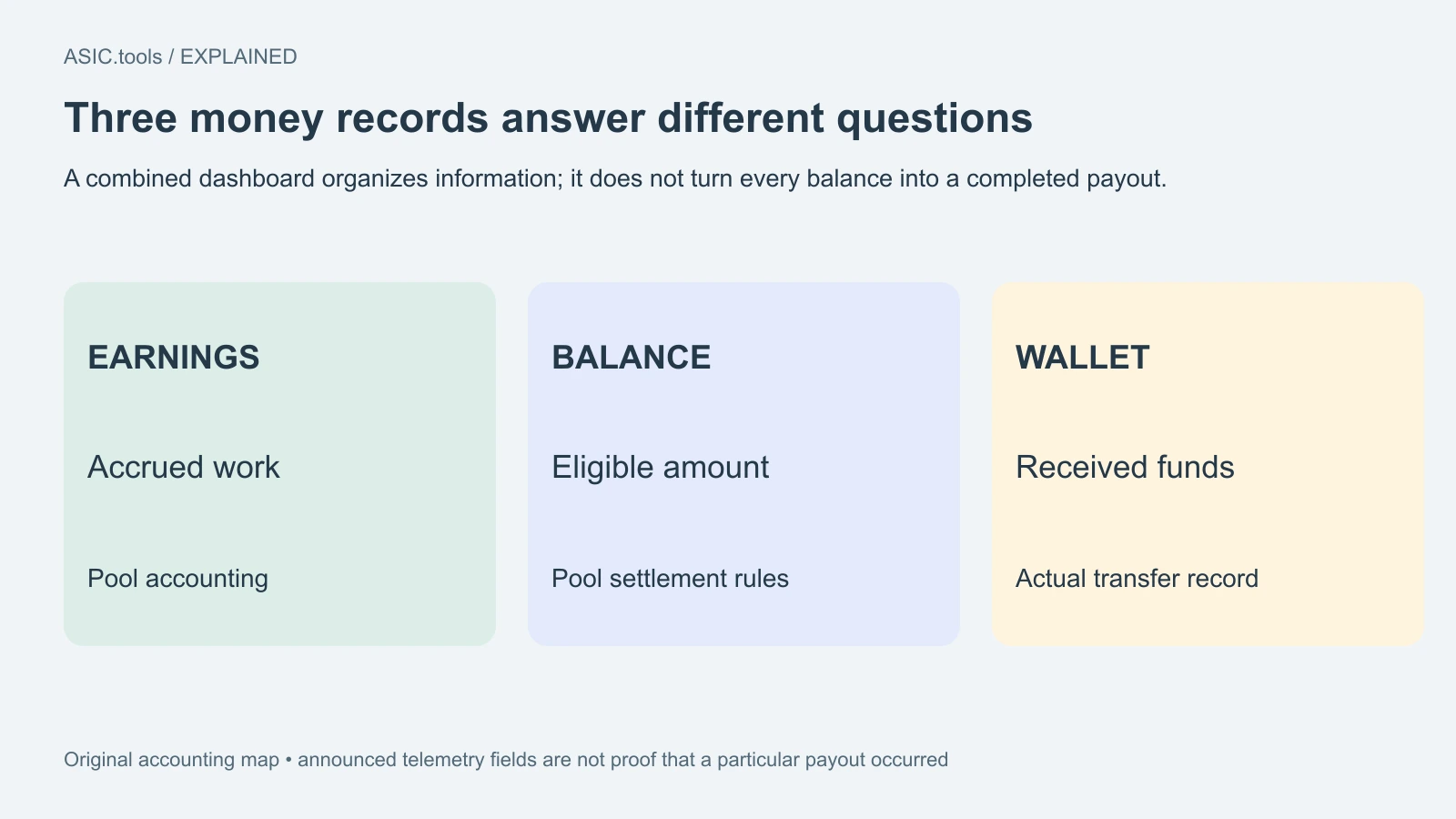
What the connector actually carries
EMCD lists hashrate, worker status, balances and earnings-related metrics among the information brought into MDK. A pool worker is the software identity under which a machine submits work; it should not be confused with an MDK Worker, the software component translating an external service's interface into MDK's common format. One concerns mining-account records, the other connects systems.
A common view can help an operator notice that a miner reports activity while the pool records little accepted work, or that a worker has stopped appearing. It does not make every reading identical. A machine and a pool may measure different things over different windows. The time, source and meaning of the displayed figure still matter before a fault is diagnosed.
Balances and earnings are useful alongside those operational readings, but they describe different stages of the money flow. Earnings accrued, a balance eligible for payout and funds received in a wallet are not interchangeable. A dashboard can make them easier to find; the connector itself does not demonstrate a payout, change the pool's settlement rules or eliminate its ordinary fees.
An integration, not a ready-made universal appliance
MDK is an open software framework for building mining management applications. Its Workers connect equipment or services; applications use the shared data. EMCD describes farms that already mine through its pool and operate an MDK-based environment as the typical users. For them, the connector may reduce custom work needed to bring pool statistics into an existing application.
At our November 1 check, the MDK README names v0.13.0 and explicitly describes the project as work in progress, not yet stable. Tether's target for stable 1.0 remains the end of 2026, a plan rather than a completed release. We verified the company announcement and current documentation, but did not deploy the connector or test a customer's real account. Availability and the promised fields are attributed to EMCD.
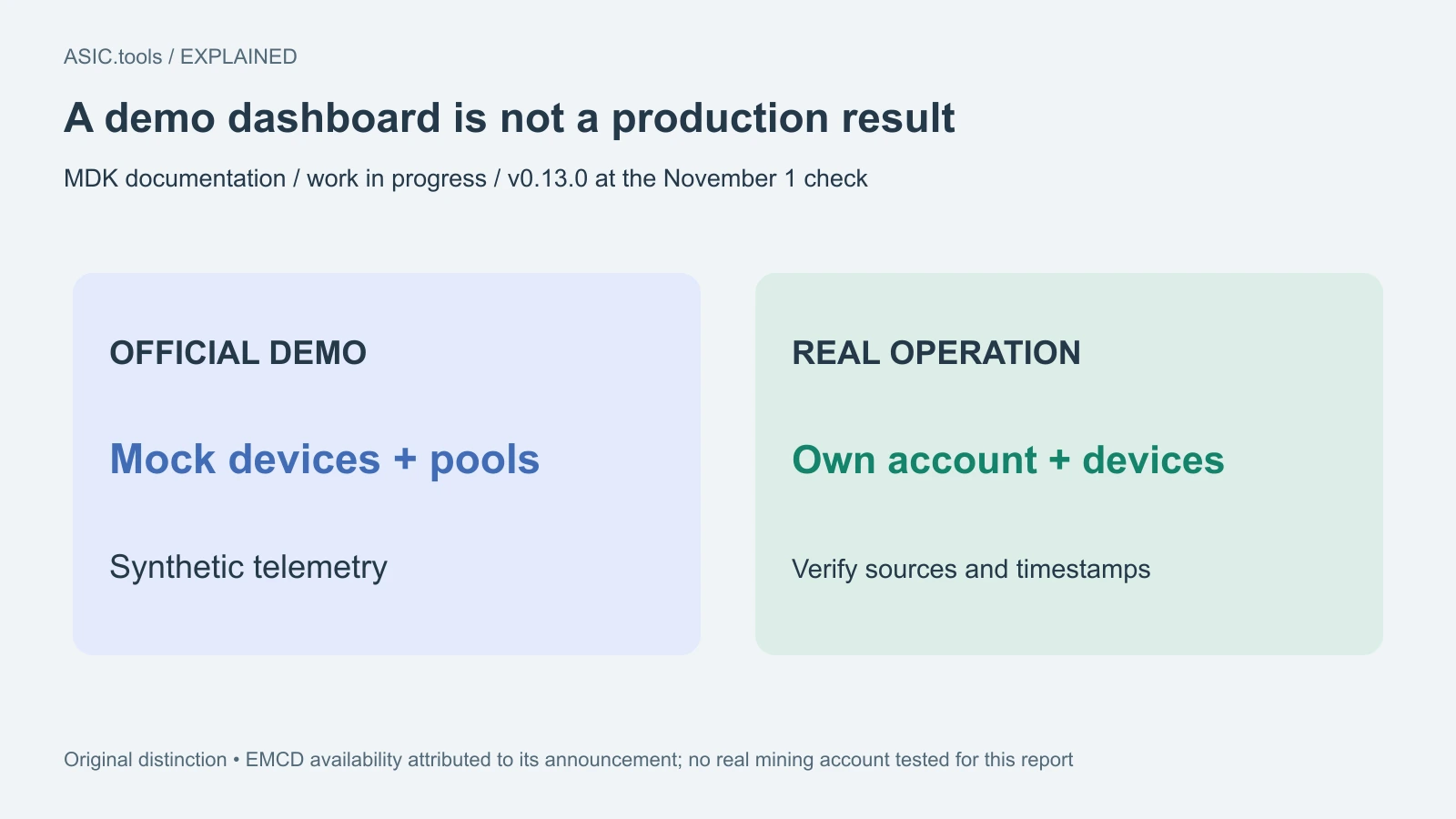
Demo numbers are not farm results
The current official MDK tutorial includes EMCD among the pools in an example site. That example runs against mock services, meaning simulated devices and pool responses. Seeing hashrate or a balance on its dashboard does not establish that a real farm is mining or that a real pool has paid someone. The distinction is especially important when sharing screenshots of a demonstration.
The tutorial describes separate credentials for a real EMCD account and master or subaccount selection. A production operator should establish which account supplies the readings and what access is being granted, rather than assuming sample settings refer to live equipment. Start with observation and verify that records correspond to the intended machines before relying on the combined display for operating decisions.
Where this can help everyday operations
The practical benefit is a shorter route from a symptom to the relevant records: hardware state, pool activity and earnings information in one environment. A sensible evaluation asks whether the connector shows the expected workers, refreshes data reliably and makes unavailable readings distinguishable from a genuine zero. Those checks measure usefulness more directly than a generic claim about AI-powered profitability.
In a combined view, preserve the distinction between a pool worker name and the physical device inventory. Account selection and timestamps make it possible to reconcile the two, while a copied label alone does not. The same applies when comparing a changing earnings total with a hardware snapshot: use records covering the same period. This is an operational reading of the announced data integration, not a claim that the connector supplies an independently audited profit statement or additional account permissions.
Nothing in this launch supplies a universal increase in hashrate or a reduction in the electricity tariff. It adds information to a management system. For an EMCD farm already building on MDK, that can be a useful step toward clearer operations; for everyone else, it is a development to watch through maintained documentation and actual supported functions, rather than a reason to replace working software immediately.
Source: EMCD / FinanceWire ↗ · Official MDK repository ↗ · Official MDK tutorial ↗ · Earlier MDK industry announcement ↗
Mining calculator ↗